


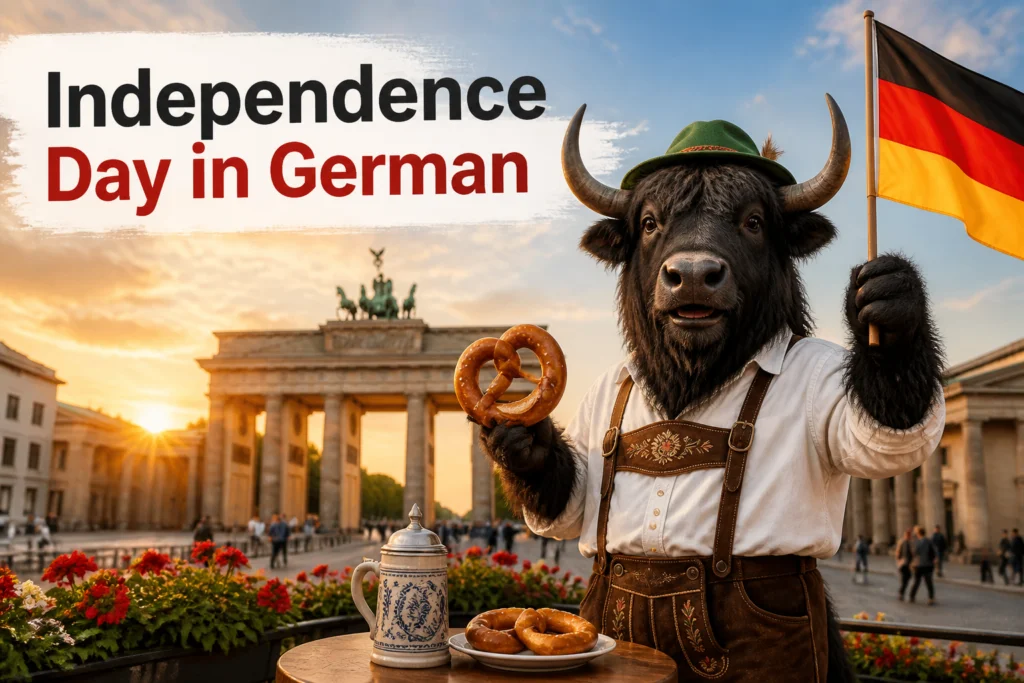
If you want to talk about Independence Day in German, there is one tiny catch: Germany does not have a single, big “Independence Day” like the United States does. So the best German wording depends on which country’s independence day you mean. Fun little language trap, because English makes it sound simple and German politely refuses to cooperate.
This guide will show you how to say “Independence Day” naturally in German, how to ask what day it is, and how to talk about national holidays, celebrations, and dates without sounding like a robot doing calendar homework.
By the end, you’ll know the most useful German words and phrases for public holidays, patriotic events, and simple holiday conversation. You’ll also know when to use a direct translation and when German speakers would choose a more natural phrase instead.
The Main Phrase: Independence Day In German
The most direct translation of “Independence Day” is Unabhängigkeitstag. It is understandable, grammatically correct, and the kind of thing you’ll see in dictionary-style translations. But in real life, German speakers often name the specific holiday instead of using a generic phrase.
For example, Americans usually say der Unabhängigkeitstag or more often der 4. Juli. Mexicans might say der mexikanische Unabhängigkeitstag. Germans themselves usually talk about Feiertage (public holidays) such as der Tag der Deutschen Einheit, not “Independence Day,” because Germany’s major national holiday is about reunification, not independence from another country.
| German | Pronunciation | Meaning | Example Sentence | Translation | Learner Note |
|---|---|---|---|---|---|
| der Unabhängigkeitstag | oona-hen-gikh-kites-tahk | Independence Day | Der Unabhängigkeitstag ist am 4. Juli. | Independence Day is on July 4. | Direct translation; works well when the holiday exists in the country you mean. |
| der Feiertag | FY-er-tahk | public holiday | Am Feiertag haben viele Menschen frei. | On a public holiday, many people have time off. | Very common word. Useful for any holiday discussion. |
| der Nationalfeiertag | natz-ee-o-nahl-fy-er-tahk | national holiday | Der Nationalfeiertag wird jedes Jahr gefeiert. | The national holiday is celebrated every year. | Good general phrase for official national celebration days. |
| der Unabhängigkeitstag der USA | oona-hen-gikh-kites-tahk der oo-ess-ah | U.S. Independence Day | Der Unabhängigkeitstag der USA ist sehr bekannt. | U.S. Independence Day is very well known. | More specific and clearer than the bare phrase. |
Small pronunciation note: Unabhängigkeit is a long word, and yes, German is once again showing off. Break it into chunks: u-na-bhän-gig-keit. The ä sounds a bit like the “e” in bed, not the “a” in cat.
Useful Phrases For Talking About Holidays
These are the phrases you’ll actually want when talking about a national holiday, a celebration, or a day off. They work for Independence Day, but also for pretty much any public holiday conversation in German.
| German | Pronunciation | Meaning | Example Sentence | Translation | Learner Note |
|---|---|---|---|---|---|
| Wann ist der Feiertag? | vann ist der FY-er-tahk | When is the holiday? | Wann ist der Feiertag dieses Jahr? | When is the holiday this year? | Great question for schedules and planning. |
| Es ist am 4. Juli. | es ist ahm fier-ten YOO-lee | It is on July 4. | Der Unabhängigkeitstag ist am 4. Juli. | Independence Day is on July 4. | Use am with dates when talking about a specific day. |
| Es ist ein Feiertag. | es ist ein FY-er-tahk | It is a public holiday. | Heute ist ein Feiertag. | Today is a public holiday. | Feiertag is masculine: der Feiertag. |
| Wir haben frei. | veer HAH-ben fry | We have the day off. | Am Nationalfeiertag haben viele Leute frei. | On the national holiday, many people have the day off. | Very natural in everyday German. |
| Es wird gefeiert. | es veert ge-FY-ert | It is celebrated. | Der Feiertag wird in der Stadt gefeiert. | The holiday is celebrated in the city. | Passive voice is common in news and formal writing. |
| Es gibt eine Parade. | es gipt EYE-ne pah-RAH-deh | There is a parade. | Am Unabhängigkeitstag gibt es oft eine Parade. | On Independence Day, there is often a parade. | es gibt = there is / there are. |
| Feuerwerk | FOY-er-verk | fireworks | Am Abend gibt es Feuerwerk. | In the evening, there are fireworks. | Useful for celebrations and holidays. |
| die Feier | FY-er | celebration, party | Die Feier dauert bis spät in die Nacht. | The celebration lasts until late at night. | Can mean a formal celebration or a party. |
| die Nationalflagge | natz-ee-o-nahl-FLAH-guh | national flag | Die Nationalflagge hängt vor dem Rathaus. | The national flag is hanging in front of the town hall. | Good for civic and official contexts. |
| eine Rede halten | EYE-nuh REH-duh HAHL-ten | to give a speech | Der Präsident hält eine Rede. | The president gives a speech. | halten changes meaning here; the phrase is fixed. |
| glücklich / fröhlich feiern | GLOOK-likh / FRÖH-likh FYE-ern | to celebrate happily / joyfully | Viele Menschen feiern fröhlich zusammen. | Many people celebrate joyfully together. | fröhlich sounds cheerful; glücklich means happy, but is less often used with “celebrate.” |
| ein freier Tag | ine FRY-er tahk | a day off | Morgen ist für mich ein freier Tag. | Tomorrow is a day off for me. | Helpful adjective pattern: frei becomes freier here. |
One tiny grammar thing that matters: dates in German often use am + day or date, like am 4. Juli. That’s just normal German usage, not a secret code. If you want to review dates and weekdays more carefully, the guide What Day Is It In German is a useful next stop.
How Germans Talk About Their Own National Holiday
If the topic is Germany itself, the most important phrase is der Tag der Deutschen Einheit. This is Germany’s national holiday on October 3, marking reunification in 1990. So if someone asks about “Independence Day” in German and they mean Germany’s main national day, the natural answer is not a direct translation at all.
| German | Pronunciation | Meaning | Example Sentence | Translation | Learner Note |
|---|---|---|---|---|---|
| der Tag der Deutschen Einheit | tahk der DOYT-schen EYE-nhyt | German Unity Day | Der Tag der Deutschen Einheit ist am 3. Oktober. | German Unity Day is on October 3. | Germany’s national holiday, not an independence day. |
| die Wiedervereinigung | VEE-der-fer-EYE-ni-gung | reunification | Die Wiedervereinigung war 1990. | Reunification was in 1990. | Important historical word. |
| feiern | FYE-ern | to celebrate | Wir feiern heute den Nationalfeiertag. | We are celebrating the national holiday today. | Common, flexible verb. Works with birthdays, holidays, and parties. |
| der Staatsfeiertag | shtats-FY-er-tahk | state holiday / national holiday | In Österreich ist der Staatsfeiertag am 1. Mai. | In Austria, the national holiday is on May 1. | Useful for Austria. Germany would usually say Nationalfeiertag or a specific holiday name. |
| der Bundesfeiertag | BOON-des-FY-er-tahk | federal holiday | Der Bundesfeiertag ist ein offizieller Feiertag. | The federal holiday is an official holiday. | More common in Switzerland and some formal contexts. |
If you are speaking about holidays in general, the German word Feiertag is your best friend. It is practical, clear, and much more useful than trying to force a literal “independence day” phrase into every sentence. German likes precision. Shocking, really.
Yak wisdom: In German, the smartest word is often not the fanciest one. If there is a specific holiday name, use that. If not, Feiertag usually does the job.
Talking About Celebrations, Speeches, And Traditions
Independence Day conversations often include parades, music, flags, speeches, and family gatherings. Here are the German words that help you describe those scenes without scrambling for vocabulary like a panicked tourist at a snack stand.
| German | Pronunciation | Meaning | Example Sentence | Translation | Learner Note |
|---|---|---|---|---|---|
| das Fest | dahs fest | festival, celebration, feast | Das Fest dauert den ganzen Tag. | The celebration lasts all day. | Very common and broad word. |
| die Parade | pah-RAH-deh | parade | Die Parade beginnt um zehn Uhr. | The parade begins at ten o’clock. | Pronounced like the English-ish loanword, but with German rhythm. |
| die Musik | moo-ZEEK | music | Überall spielt Musik. | Music is playing everywhere. | Useful for describing atmosphere. |
| das Feuerwerk | FOY-er-verk | fireworks | Das Feuerwerk ist um Mitternacht. | The fireworks are at midnight. | Neuter noun: das Feuerwerk. |
| die Rede | REH-duh | speech | Die Rede war kurz und klar. | The speech was short and clear. | Common in formal or official contexts. |
| die Flagge | FLAH-guh | flag | Die Flagge weht im Wind. | The flag is waving in the wind. | Helpful for national holiday descriptions. |
| der Umzug | OOM-tsoog | parade, procession | Der Umzug geht durch die Innenstadt. | The procession goes through the city center. | Can mean a parade or moving house, depending on context. German enjoys multitasking. |
| die Familie trifft sich | dee fah-MEE-lee-uh trift zikh | the family gets together | Am Feiertag trifft sich die Familie. | On the holiday, the family gets together. | Very natural phrase pattern. |
| grillen | GRIL-en | to barbecue | Viele Familien grillen am Feiertag. | Many families barbecue on the holiday. | Extremely common summer activity in German-speaking countries. |
| anstoßen | ahn-SHTOH-sen | to toast, clink glasses | Wir stoßen auf das Fest an. | We toast to the celebration. | Separable verb: stoßen … an. |
If you want to say “Happy Independence Day” in German, you usually adjust the phrase depending on the holiday and the country. A direct version can be Frohen Unabhängigkeitstag! But in everyday German, people more often use the holiday name itself, such as Frohen 4. Juli! or Schönen Feiertag!
For general greetings around holidays, this related guide may help: Useful German Greetings.
How To Ask About Independence Day In German
Here are some real-life question patterns you can use in conversation, class, or travel. These are simple, natural, and much safer than trying to translate word for word while your brain starts buffering.
| German | Pronunciation | Meaning | Example Sentence | Translation | Learner Note |
|---|---|---|---|---|---|
| Wann ist der Unabhängigkeitstag? | vann ist der oona-hen-gikh-kites-tahk | When is Independence Day? | Wann ist der Unabhängigkeitstag in den USA? | When is Independence Day in the USA? | Use this when the holiday exists and you know the country. |
| Wie heißt der Nationalfeiertag auf Deutsch? | vee hysst der natz-ee-o-nahl-fy-er-tahk owf doytsh | What is the national holiday called in German? | Wie heißt der Nationalfeiertag in Deutschland? | What is the national holiday called in Germany? | Great for asking about names of holidays. |
| Feiert ihr das? | FY-er-eer dahs | Do you celebrate that? | Feiert ihr den 4. Juli? | Do you celebrate July 4? | ihr = plural “you” for people you know well. |
| Gibt es einen Feiertag? | gipt es EYE-nen FY-er-tahk | Is there a holiday? | Gibt es heute einen Feiertag? | Is there a holiday today? | Watch the accusative: einen Feiertag. |
| Haben Sie am Feiertag frei? | HAH-ben zee ahm FY-er-tahk fry | Do you have the day off on the holiday? | Haben Sie am 3. Oktober frei? | Do you have the day off on October 3? | Polite Sie form. Good for workplaces, shops, and formal situations. |
| Was passiert am Feiertag? | vahs pah-SEE-ert ahm FY-er-tahk | What happens on the holiday? | Was passiert am Nationalfeiertag? | What happens on the national holiday? | Useful for asking about events and traditions. |
Quick case note, because German likes to hide grammar in plain sight: einen Feiertag uses einen because the noun is masculine and the sentence needs the accusative case. If that sounds annoying, yes, it is. But after a while it becomes predictable.
Germany, Austria, And Switzerland: Small Differences
When talking about national holidays, regional wording can change a bit. The holiday itself may also be different. That is normal in German-speaking countries, which is handy if you enjoy being correct in three countries at once.
| Region | Common Holiday Term | Example | Note |
|---|---|---|---|
| Germany | der Feiertag, der Nationalfeiertag, der Tag der Deutschen Einheit | Der Tag der Deutschen Einheit ist ein Feiertag. | Germany’s national day is about reunification. |
| Austria | der Nationalfeiertag, sometimes der Staatsfeiertag | Der österreichische Nationalfeiertag ist am 26. Oktober. | The official national holiday is October 26 in Austria. |
| Switzerland | der Bundesfeiertag | Der Bundesfeiertag ist am 1. August. | Switzerland’s national holiday is August 1. |
A useful learner tip: if you are unsure, say Feiertag. It is broad, natural, and safe. If you know the official holiday name, use it. German speakers appreciate accuracy, especially with public holidays, dates, and names of events.
For date practice, the phrase am 1. August uses the same pattern as am 4. Juli. If you want more practice with dates and day names, the article learn German is a good place to keep going.
Quick Grammar Notes That Matter
German holiday phrases look simple, but a few grammar bits show up again and again. Here are the main ones you’ll want to notice.
| Pattern | Meaning | German Example | English Translation | Learner Note |
|---|---|---|---|---|
| am + date | on a specific day/date | am 4. Juli | on July 4 | Very common with holidays. |
| der Feiertag | the public holiday | ein Feiertag | a public holiday | Masculine noun. |
| es gibt | there is / there are | Es gibt ein Feuerwerk. | There is fireworks / There is a fireworks show. | Use this for existence, events, and things happening. |
| separable verb | verb split in a sentence | Wir stoßen auf das Fest an. | We toast to the celebration. | Remember the little word often moves to the end. |
| polite Sie | formal “you” | Haben Sie heute frei? | Do you have today off? | Use with strangers, services, and formal situations. |
| plural Feiern | celebrations / parties | viele Feiern | many celebrations / parties | Context matters: it can sound festive or simply social. |
German word order note: in normal statements, the verb usually comes in second position. So Am Feiertag haben wir frei is correct, and Am Feiertag wir haben frei is not. German likes its verb in a very specific seat, like a picky passenger who refuses the middle.
Practice: Make These Sentences Work
Try the mini drills below. They are short on purpose. Language sticks better when it has something to do instead of just staring at you.
| Task | Prompt | Possible Answer | English | Why It Matters |
|---|---|---|---|---|
| Translate | Independence Day is on July 4. | Der Unabhängigkeitstag ist am 4. Juli. | — | Practices the main phrase and am + date. |
| Translate | There is a parade. | Es gibt eine Parade. | There is a parade. | Good es gibt pattern. |
| Fill in the blank | Am Feiertag haben wir ____. | frei | On the holiday, we have time off. | Useful everyday phrase. |
| Choose the correct form | Gibt es einen / ein Feiertag? | einen | Is there a public holiday? | Feiertag is masculine, so use einen. |
| Word order | Heute / feiern / wir / den Nationalfeiertag | Heute feiern wir den Nationalfeiertag. | Today we are celebrating the national holiday. | Verb is second in the main clause. |
| Rewrite politely | Do you have the day off? | Haben Sie frei? | Do you have time off? | Polite and useful in conversation. |
Now try these sentence swaps out loud:
- Heute ist ein Feiertag. → Today is a public holiday.
- Der Tag der Deutschen Einheit ist am 3. Oktober. → German Unity Day is on October 3.
- Am Feiertag gibt es Feuerwerk. → On the holiday there are fireworks.
- Wir feiern mit der Familie. → We celebrate with the family.
- Feiert ihr den 4. Juli? → Do you celebrate July 4?
If you want an official-style word for a national holiday, you can also check how dictionaries and reference sites label it. A boring but reliable place to look is Duden, which gives you the standard spelling and meaning without any drama. Exactly the sort of helpful dullness language learning needs sometimes.
Common Mistakes And Easy Fixes
These are the mistakes English speakers often make when talking about holidays in German. Most are small. German just likes to turn small errors into dramatic little grammar events.
| Common Mistake | Better German | Why |
|---|---|---|
| der Independence Day | der Unabhängigkeitstag | German nouns are not usually left in English. |
| in 4. Juli | am 4. Juli | Use am for specific dates. |
| ein Feiertag but saying die Feiertag | der Feiertag | It is masculine. |
| Wir feiert | Wir feiern | wir takes feiern, not feiert. |
| Gibt es Feiertag? | Gibt es einen Feiertag? | After es gibt, the noun usually needs an article in this pattern. |
| Happy Independence Day translated word-for-word in every case | Frohen Unabhängigkeitstag! or holiday-specific wording | Sometimes a direct phrase works, but the holiday name is often more natural. |
Another common trap: mixing up Feiertag and Fest. They are related, but not identical. Feiertag means a public holiday. Fest means a celebration, feast, or festival. If you mean a legal day off, use Feiertag.
Mini Reference: The Most Useful Words
Here is the shortest possible cheat sheet for talking about Independence Day in German without overthinking it. Which, to be fair, is a very German thing to do with holidays.
- der Unabhängigkeitstag — Independence Day
- der Feiertag — public holiday
- der Nationalfeiertag — national holiday
- der Tag der Deutschen Einheit — German Unity Day
- am 4. Juli — on July 4
- wir haben frei — we have the day off
- es gibt eine Parade — there is a parade
- das Feuerwerk — fireworks
- feiern — to celebrate
- die Rede — speech
- die Flagge — flag
- der Umzug — parade / procession
If you only remember one thing, make it this: in German, the best phrase is often the specific holiday name, not a fancy direct translation. That is especially true when talking about countries other than Germany.
Yak takeaway: Independence Day in German is usually Unabhängigkeitstag, but real-life German often prefers the exact holiday name, like der 4. Juli or der Tag der Deutschen Einheit. Use Feiertag when in doubt, and your German will sound much more natural than a stiff dictionary sentence wearing a tie.