
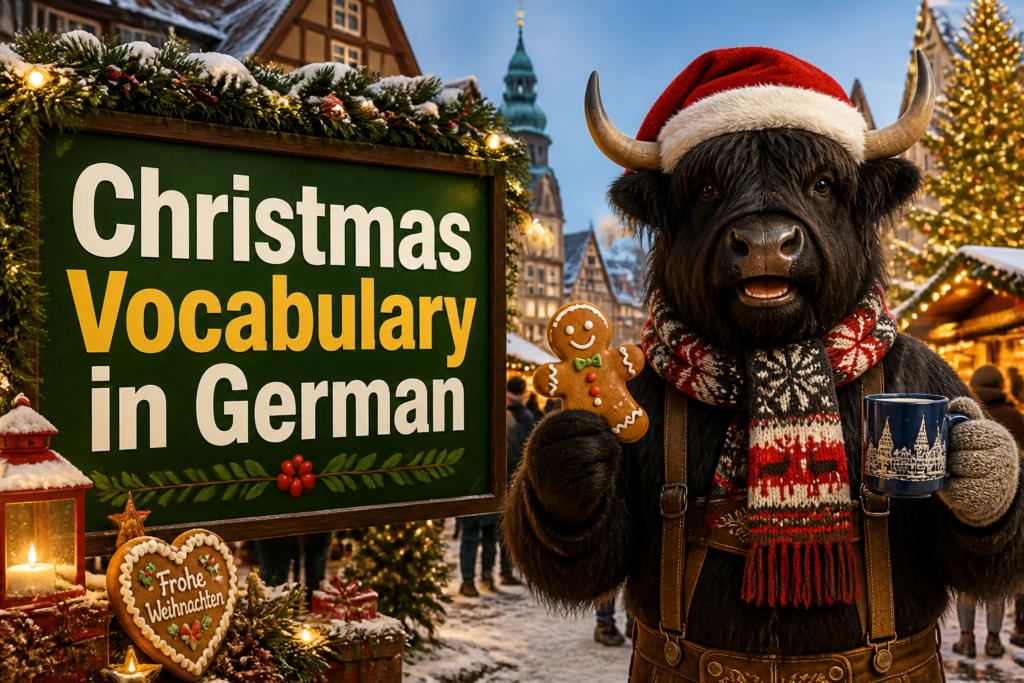
Christmas in German is Weihnachten, and yes, it is one of those words that looks a little serious until you remember Germans use it for cookies, markets, lights, and family chaos like everyone else. If you are learning German, Christmas vocabulary is a very useful bundle because it shows up in greetings, shopping, travel, conversations, and holiday texts everywhere.
And because German likes to capitalize nouns, this topic is also a nice reminder that Weihnachten, der Weihnachtsbaum, and das Geschenk all deserve their little capital letter crowns. Very respectful. Very German.
By the end of this guide, you will know practical Christmas words and phrases, how to pronounce them in a beginner-friendly way, and how to use them naturally in real life. You will also get a few common mistakes to avoid, because German grammar loves to sneak one tiny problem into an otherwise festive sentence.
Yak wisdom: Christmas German is not just about gifts. It is also about greetings, markets, food, weather, and all the little phrases that appear when people are being warm, polite, and slightly over-caffeinated in December.
If you want a solid reference for spelling and usage, Duden is the boring-but-reliable friend you can trust.
Short Intro To Christmas Vocabulary
German Christmas vocabulary is especially handy because many words are used in everyday life during the whole Advent season, not just on 24 or 25 December. You will hear people talk about der Adventskalender, der Weihnachtsmarkt, Plätzchen, Glühwein, and of course Frohe Weihnachten.
Small cultural note: in Germany, Christmas markets are a huge deal. In some places they are basically a seasonal personality trait. Hot drink in one hand, snack in the other, scarf absolutely doing its best.
Useful Christmas Words And Phrases
Here are the most useful Christmas words first, followed by phrases you will actually hear. The pronunciation help is simple on purpose, so your brain does not run away screaming.
| German | Pronunciation | Meaning | Example Sentence | Translation | Learner Note |
|---|---|---|---|---|---|
| Weihnachten | VY-nakh-ten | Christmas | Wir verbringen Weihnachten mit der Familie. | We spend Christmas with the family. | Always capitalized. It is a plural-looking noun used as a holiday name. |
| frohe Weihnachten | FROH-uh VY-nakh-ten | Merry Christmas | Ich wünsche dir frohe Weihnachten! | I wish you a Merry Christmas! | Very common and natural. Use dir with friends, Ihnen in formal situations. |
| der Weihnachtsbaum | VY-nakhts-bowm | Christmas tree | Der Weihnachtsbaum steht im Wohnzimmer. | The Christmas tree is in the living room. | Baum is masculine: der Weihnachtsbaum. |
| der Advent | ahd-VENT | Advent | Im Advent backen viele Familien Plätzchen. | During Advent, many families bake cookies. | Usually refers to the four weeks before Christmas. |
| der Adventskalender | ahd-VENTS-kah-len-der | Advent calendar | Die Kinder öffnen jeden Tag ein Türchen im Adventskalender. | The children open one little door in the Advent calendar every day. | Very common with children, but adults love it too. Obviously. |
| der Weihnachtsmarkt | VY-nakhts-markt | Christmas market | Am Samstag gehen wir auf den Weihnachtsmarkt. | On Saturday we are going to the Christmas market. | Very important winter vocabulary in Germany, Austria, and Switzerland. |
| der Engel | EN-gel | angel | Auf dem Baum hängt ein kleiner Engel. | There is a small angel hanging on the tree. | Masculine noun: der Engel. |
| das Geschenk | geh-SHENK | gift, present | Ich habe ein Geschenk für meine Schwester gekauft. | I bought a present for my sister. | Useful year-round, not only at Christmas. |
| schenken | SHEN-ken | to give as a gift | Wir schenken den Kindern Bücher. | We give the children books as gifts. | Watch the case: often jemandem etwas schenken. |
| beschenken | beh-SHEN-ken | to present, to gift | Die Eltern beschenken ihre Kinder zu Weihnachten. | The parents give gifts to their children at Christmas. | A bit more formal or literary than schenken. |
| die Kerze | KEHR-tsuh | candle | Auf dem Tisch stehen vier Kerzen. | There are four candles on the table. | Plural is Kerzen. Handy for Advent wreath vocabulary too. |
| der Tannenbaum | TAN-nen-bowm | fir tree, Christmas tree | Wir haben einen großen Tannenbaum gekauft. | We bought a big Christmas tree. | Often used like Weihnachtsbaum. Same practical idea, slightly more tree-focused. |
A tiny pronunciation note: Weih- sounds like “vy”, not “way”. And ch in Weihnachten is the softer German sound, a little like a breathy h from the back of the mouth. German does enjoy making easy things sound faintly dramatic.
| German | Pronunciation | Meaning | Example Sentence | Translation | Learner Note |
|---|---|---|---|---|---|
| der Glühwein | GLUE-vine | mulled wine | Ein Glühwein macht auf dem Markt schnell warm. | A mulled wine warms you up quickly at the market. | Very common at Christmas markets. Hot, sweet, and slightly dangerous in the best way. |
| der Punsch | poonsh | punch, hot fruit drink | Ich nehme lieber Kinderpunsch. | I’d rather have non-alcoholic punch. | Kinderpunsch is the alcohol-free version. |
| das Plätzchen | PLEHTS-chen | cookie, biscuit | Meine Oma backt jedes Jahr Plätzchen. | My grandma bakes cookies every year. | Plural is also Plätzchen. The ä sound matters. |
| backen | BAHK-en | to bake | Wir backen heute Zimtsterne. | We are baking cinnamon stars today. | Strong verb: ich backe, du bäckst or backst. |
| der Stollen | SHTOL-len | Christmas loaf cake | Zum Kaffee gibt es Stollen. | There is Christmas stollen with coffee. | A classic German Christmas bake. |
| der Lebkuchen | LAYP-koo-khen | gingerbread | Lebkuchen schmeckt im Winter besonders gut. | Gingerbread tastes especially good in winter. | Very seasonal and very useful. |
| die Zimtsterne | TSIMT-shtair-nuh | cinnamon stars | Wir kaufen Zimtsterne auf dem Markt. | We buy cinnamon stars at the market. | Compound plural form. Treat it like a fixed Christmas treat name. |
| der Schnee | shnay | snow | Vielleicht gibt es an Weihnachten Schnee. | Maybe there will be snow at Christmas. | Masculine noun. In many places, snow on Christmas is more wish than reality. |
| die Glocke | GLOK-uh | bell | Die Glocken läuten am Abend. | The bells ring in the evening. | Plural: Glocken. Useful in carols and church vocabulary. |
| das Licht | likht | light | Die Lichter am Fenster sehen schön aus. | The lights at the window look beautiful. | Plural Lichter is common at Christmas. |
| die Lichterkette | LIKH-ter-ket-tuh | string lights | Wir hängen eine Lichterkette ins Wohnzimmer. | We hang a string of lights in the living room. | Great household Christmas word. |
| der Stern | shtairn | star | Der Stern steht oben auf dem Baum. | The star is at the top of the tree. | Common in decorations, songs, and nativity scenes. |
One very practical note: Glühwein is a noun, but you can also say etwas glüht if something is glowing or glowing hot. That is not the same thing, but the words are connected in the “warm and festive” family. German likes family reunions in its vocabulary too.
| German | Pronunciation | Meaning | Example Sentence | Translation | Learner Note |
|---|---|---|---|---|---|
| der Weihnachtsmann | VY-nakhts-mann | Santa Claus | Der Weihnachtsmann bringt den Kindern Geschenke. | Santa Claus brings gifts to the children. | Standard in Germany. In some regions, other figures are also traditional. |
| der Nikolaus | NEE-koh-lows | Saint Nicholas | Am 6. Dezember kommt der Nikolaus. | On December 6, Saint Nicholas comes. | Important in German-speaking countries. Not the same as Santa. |
| der Heiligabend | HY-lig-ah-bent | Christmas Eve | Am Heiligabend essen wir zusammen. | On Christmas Eve we eat together. | Very important in German Christmas tradition. Gifts are often given then. |
| das Fest | fest | celebration, feast | Wir feiern das Fest mit der ganzen Familie. | We celebrate the holiday with the whole family. | Can mean a general celebration, not only Christmas. |
| feiern | FY-ern | to celebrate | Viele Familien feiern zusammen. | Many families celebrate together. | Very common verb for holidays, birthdays, and parties. |
| die Bescherung | beh-SHAY-rung | gift-giving, opening presents | Die Bescherung ist am Abend. | The opening of presents is in the evening. | Very useful Christmas-specific word. |
| das Festessen | FEST-eh-sen | holiday meal | Zum Festessen gibt es Ente. | There is duck for the holiday meal. | Common in family Christmas contexts. |
| die Familie | fa-MEE-lee-uh | family | Ich bin an Weihnachten bei meiner Familie. | I am with my family at Christmas. | Watch the dative after bei: bei meiner Familie. |
| der Urlaub | OOR-laup | vacation, holiday time off | Zwischen Weihnachten und Neujahr habe ich Urlaub. | Between Christmas and New Year I have time off. | Can mean vacation or paid time off. Context decides. |
For a good winter-season comparison with another holiday topic, you can also look at Easter Vocabulary in German. Different holiday, same useful pattern: greetings, food, family, and a lot of nouns with capital letters marching into your sentence like they own the place.
Useful Christmas Phrases For Real Life
These phrases are the ones you are most likely to use in messages, cards, conversations, shops, and holiday greetings.
| German | Pronunciation | Meaning | Example Sentence | Translation | Learner Note |
|---|---|---|---|---|---|
| Frohe Weihnachten! | FROH-uh VY-nakh-ten | Merry Christmas! | Frohe Weihnachten und einen guten Rutsch ins neue Jahr! | Merry Christmas and a happy new year! | Very common seasonal greeting. |
| Ein frohes Fest! | ine FROH-es fest | Happy holidays! | Wir wünschen Ihnen ein frohes Fest. | We wish you happy holidays. | Nice, warm, slightly more general than Frohe Weihnachten. |
| Schöne Feiertage! | SHUR-nuh FY-er-tah-guh | Happy holidays! | Schöne Feiertage und viel Ruhe! | Happy holidays and lots of rest! | Very useful when you want a broader holiday greeting. |
| Wir feiern Weihnachten. | veer FY-ern VY-nakh-ten | We celebrate Christmas. | Wir feiern Weihnachten mit der ganzen Familie. | We celebrate Christmas with the whole family. | Simple and natural sentence pattern. |
| Hast du schon Geschenke gekauft? | hast doo shon geh-SHEN-kuh geh-kowft | Have you already bought presents? | Hast du schon Geschenke gekauft oder wartest du bis morgen? | Have you already bought presents or are you waiting until tomorrow? | Great everyday conversation question. |
| Ich bin auf dem Weihnachtsmarkt. | ikh bin owf dehm VY-nakhts-markt | I am at the Christmas market. | Ich bin gerade auf dem Weihnachtsmarkt. | I am at the Christmas market right now. | Use auf with this event/location in German. |
| Was möchtest du zu Weihnachten? | vahs MÖHCH-test doo tsoo VY-nakh-ten | What would you like for Christmas? | Was möchtest du zu Weihnachten bekommen? | What would you like to get for Christmas? | möchte is polite and very useful. |
| Ich wünsche dir alles Gute. | ikh VUN-shuh deer AH-les goo-tuh | I wish you all the best. | Ich wünsche dir und deiner Familie alles Gute. | I wish you and your family all the best. | Not only for Christmas, but very useful in cards and messages. |
| Guten Rutsch ins neue Jahr! | GOO-ten rootsh ins NOY-uh yahr | Happy New Year! | Frohe Weihnachten und einen guten Rutsch ins neue Jahr! | Merry Christmas and a happy new year! | Literally “good slide into the new year.” Yes, German is weirdly charming. |
| Wir sehen uns an Weihnachten. | veer ZAY-en oons ahn VY-nakh-ten | We will see each other at Christmas. | Wir sehen uns an Weihnachten bei meinen Eltern. | We will see each other at Christmas at my parents’ place. | an Weihnachten is a standard time expression. |
| Die Geschäfte haben geschlossen. | dee geh-SHESH-teh HAH-ben geh-SHLOSS-sen | The shops are closed. | An Heiligabend haben viele Geschäfte geschlossen. | On Christmas Eve many shops are closed. | Useful for shopping and travel around the holidays. |
| Ich brauche noch ein Geschenk. | ikh BROW-khe nokh ine geh-SHENK | I still need a present. | Ich brauche noch ein Geschenk für meine Mutter. | I still need a present for my mother. | Very practical shopping phrase. |
Notice the little sentence pattern in Ich wünsche dir alles Gute. The verb wünschen usually takes a person in the dative case: dir, Ihnen, meiner Freundin. That is one of those German details that looks tiny and then quietly becomes important everywhere.
Christmas Food And Drink Vocabulary
Food vocabulary is especially useful because holiday talk often starts with “What are you eating?” and ends with “Please stop, I cannot possibly eat another cookie.”
| German | Pronunciation | Meaning | Example Sentence | Translation | Learner Note |
|---|---|---|---|---|---|
| der Lebkuchen | LAYP-koo-khen | gingerbread | Lebkuchen gehört für viele zu Weihnachten. | For many people, gingerbread is part of Christmas. | Seasonal classic in German-speaking countries. |
| das Plätzchen | PLEHTS-chen | cookie | Wir essen Plätzchen zum Tee. | We eat cookies with tea. | Sweet baked treat, especially in winter. |
| der Stollen | SHTOL-len | fruit bread cake | Ein Stück Stollen passt perfekt zum Kaffee. | A slice of stollen goes perfectly with coffee. | Very traditional German Christmas food. |
| der Zimt | tsimt | cinnamon | Ich liebe den Geruch von Zimt. | I love the smell of cinnamon. | Masculine noun. Common in winter recipes. |
| die Mandeln | MAHN-deln | almonds | Die Plätzchen haben Mandeln und Zucker. | The cookies have almonds and sugar. | Plural noun. Very common in holiday baking. |
| die Vanille | vah-NEE-luh | vanilla | Vanillekipferl sind sehr beliebt. | Vanilla crescent cookies are very popular. | Vanillekipferl is especially common in Austria and southern Germany. |
| der Tee | tay | tea | Im Winter trinke ich gern Tee. | In winter I like to drink tea. | Simple but very practical. |
| die heiße Schokolade | HYE-suh sho-KOH-lah-duh | hot chocolate | Für die Kinder gibt es heiße Schokolade. | There is hot chocolate for the children. | Very useful at cafés and markets. |
| der Apfel | AHP-fel | apple | Apfel und Zimt passen gut zusammen. | Apple and cinnamon go well together. | Common flavor combination in winter food. |
| die Ente | EN-tuh | duck | Zu Weihnachten essen manche Familien Ente. | Some families eat duck at Christmas. | Holiday main dish in many homes. |
| der Karpfen | KARP-fen | carp | In einigen Regionen gibt es Karpfen an Weihnachten. | In some regions there is carp at Christmas. | Regional tradition; not everywhere. |
Christmas Market Words You Will Hear Often
Christmas markets are where a lot of practical German suddenly becomes very useful. You need food words, shopping words, price words, and the courage to stand outside in cold weather holding something warm.
| German | Pronunciation | Meaning | Example Sentence | Translation | Learner Note |
|---|---|---|---|---|---|
| der Stand | shtant | stall, stand | Dieser Stand verkauft heiße Getränke. | This stall sells hot drinks. | Useful for markets of all kinds. |
| verkaufen | fer-KOW-fen | to sell | Hier verkaufen sie handgemachte Kerzen. | They sell handmade candles here. | Very common shopping verb. |
| kaufen | KOW-fen | to buy | Ich kaufe noch ein paar Geschenke. | I am buying a few more presents. | Simple and essential. |
| das Souvenir | soo-veh-NEER | souvenir | Ich kaufe ein kleines Souvenir für meine Schwester. | I am buying a small souvenir for my sister. | Borrowed word; pronunciation is more French-style than English-style. |
| der Glühweinbecher | GLUE-vine-beh-kher | mulled wine cup | Der Glühweinbecher ist oft hübsch gestaltet. | The mulled wine cup is often nicely designed. | Many markets use reusable cups with a deposit. |
| das Handwerk | HAHNT-verk | craft, handiwork | Auf dem Markt gibt es viel schönes Handwerk. | There is a lot of beautiful craftwork at the market. | Useful for handmade gift stalls. |
| handgemacht | HAHNT-guh-makht | handmade | Ich suche handgemachte Geschenke. | I am looking for handmade gifts. | Very common on market signs. |
| der Preis | price | price | Der Preis ist heute ein bisschen hoch. | The price is a little high today. | Good shopping vocabulary all year round. |
| billig | BIL-lig | cheap | Die Geschenke sind nicht billig. | The gifts are not cheap. | Careful: can sound negative or low-quality. |
| teuer | TOY-er | expensive | Glühwein ist oft ziemlich teuer. | Mulled wine is often quite expensive. | Very useful adjective. |
| Wollen Sie …? | VOL-len zee | Would you like …? | Wollen Sie noch etwas trinken? | Would you like something else to drink? | Formal and very common in service situations. |
Quick Grammar Notes For Christmas Words
Christmas vocabulary is a nice way to practice noun gender, articles, and a few fixed expressions without turning your brain into a pretzel. Mostly.
| Pattern | Meaning | German Example | English Translation | Learner Note |
|---|---|---|---|---|
| an Weihnachten | at Christmas | An Weihnachten sind viele Menschen bei der Familie. | At Christmas many people are with their family. | an is common with holidays like this. |
| zu Weihnachten | for Christmas | Was wünschst du dir zu Weihnachten? | What do you want for Christmas? | Use this when talking about gifts or plans. |
| am Heiligabend | on Christmas Eve | Am Heiligabend essen wir zusammen. | On Christmas Eve we eat together. | am = an dem, common with dates and days. |
| der Weihnachtsbaum | the Christmas tree | Der Weihnachtsbaum ist sehr groß. | The Christmas tree is very big. | Masculine noun, so der. |
| das Geschenk | the present | Das Geschenk liegt unter dem Baum. | The present is under the tree. | Neutral noun, so das. |
| die Kerze | the candle | Die Kerze brennt schon. | The candle is already burning. | Feminine noun, so die. |
| jemandem etwas schenken | to give someone something as a gift | Ich schenke meiner Mutter ein Buch. | I give my mother a book as a gift. | meiner Mutter is dative because of the person receiving the gift. |
| sich wünschen | to wish for | Ich wünsche mir einen Schal. | I want a scarf / I wish for a scarf. | Very common with presents: sich etwas wünschen. |
Common Mistakes And Easy Fixes
Here are the mistakes English speakers make most often. Luckily, they are all fixable without a holiday miracle.
| Wrong | Better | Why |
|---|---|---|
| frohe Weinachten | Frohe Weihnachten | The spelling is Weihnachten with h. |
| ich wünsche dir alles gut | Ich wünsche dir alles Gute. | The fixed phrase is alles Gute. |
| Ich bin in Weihnachten | Ich bin an Weihnachten … | Use an for the holiday time expression. |
| der Geschenk | das Geschenk | Geschenk is neuter: das. |
| die Weihnachtsmann | der Weihnachtsmann | Weihnachtsmann is masculine. |
| Ich habe ein Geschenk für meine Bruder | Ich habe ein Geschenk für meinen Bruder. | mein Bruder becomes accusative after für: meinen Bruder. |
| Zu Weihnachten ich feiere mit Familie | Zu Weihnachten feiere ich mit der Familie. | German main clauses usually keep the verb in second position. |
| ein Plätzchen | Plätzchen / ein Plätzchen | One cookie is fine, but the word is often used in the plural for festive baking. |
Mini Practice
Try these quick drills. Tiny practice now saves awkward guessing later.
- Translate: “Merry Christmas!” → Frohe Weihnachten!
- Translate: “I need a present.” → Ich brauche ein Geschenk.
- Translate: “We are at the Christmas market.” → Wir sind auf dem Weihnachtsmarkt.
- Fill in the blank: ___ Weihnachten → Frohe
- Fill in the blank: das ___ → Geschenk
- Fill in the blank: der ___ → Weihnachtsbaum
- Correct the sentence: Ich wünsche dir alles gut. → Ich wünsche dir alles Gute.
- Say it naturally: at Christmas → an Weihnachten
Extra challenge: say this out loud three times without smiling like you just saw a badly wrapped present.
Der Weihnachtsmann bringt den Kindern Geschenke.
Pronunciation practice: Weihnachten, Weihnachtsmarkt, Glühwein, Plätzchen, Heiligabend. The ch in Weihnachten and Plätzchen is soft and airy, while Glühwein uses the ü sound, which is basically your mouth pretending to whistle politely.
Germany, Austria, And Switzerland Notes
Most Christmas vocabulary is shared across the German-speaking world, but a few terms have regional flavor. This is where language gets nice and messy in a charming way.
| Region | Useful Difference | Note |
|---|---|---|
| Germany | Weihnachtsmarkt, Weihnachtsmann, Plätzchen | Very standard and widely understood. |
| Austria | Vanillekipferl, Christkind | Christkind is especially important as a gift-bringer in many Austrian and southern German traditions. |
| Switzerland | Samichlaus, Guetzli | Swiss German uses some different Christmas terms, especially in everyday speech. |
So if you hear Christkind instead of Weihnachtsmann, do not panic. German-speaking Christmas traditions are shared, but not copy-pasted. Language, like holiday food, has regional seasoning.
Quick Reference Summary
- Weihnachten = Christmas
- Frohe Weihnachten! = Merry Christmas
- Weihnachtsbaum = Christmas tree
- Weihnachtsmarkt = Christmas market
- Adventskalender = Advent calendar
- Glühwein = mulled wine
- Plätzchen = cookies
- Heiligabend = Christmas Eve
- Geschenk = present, gift
- Guten Rutsch ins neue Jahr! = Happy New Year!
For more broad German learning, the main hub at Learn German is a good place to keep wandering. Efficiently, of course. No one wants to get lost in the language forest without snacks.
Yak takeaway: If you know Weihnachten, Frohe Weihnachten, Weihnachtsmarkt, Plätzchen, and Glühwein, you already have a very useful Christmas starter pack in German. Add the right articles, and you will sound much more natural than the average cheerful tourist with a pocket dictionary.