


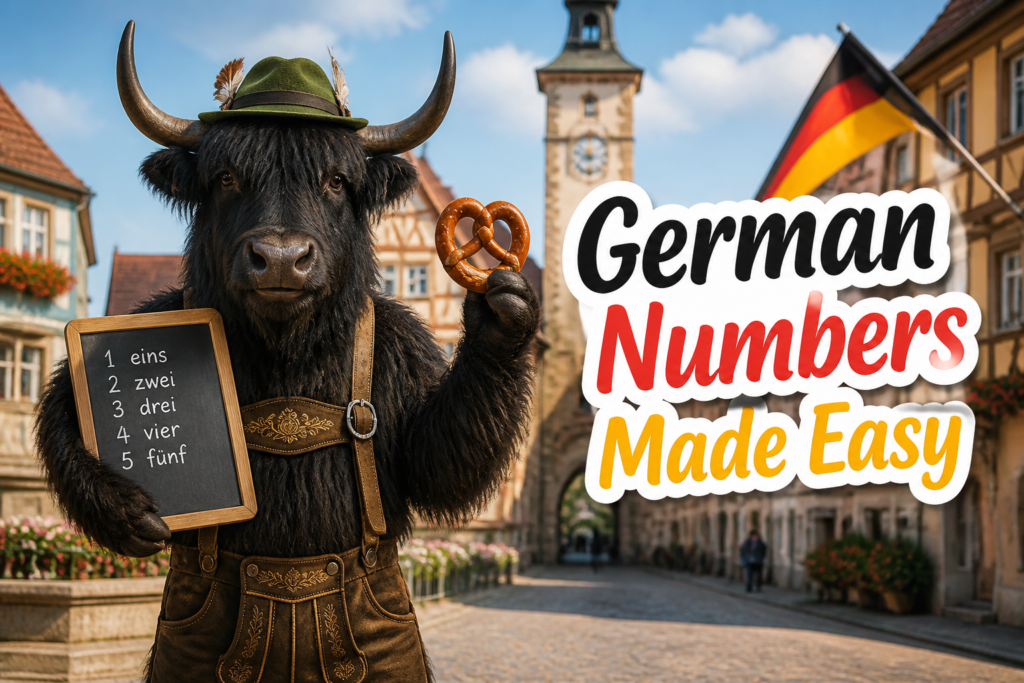
German numbers look friendly at first. Then 21 shows up, and suddenly the language is rearranging itself like it has a personal grudge. Still, once you understand the pattern, German numbers get much easier than they first appear.
This guide will help you read, say, and use German numbers in real life — for time, prices, phone numbers, addresses, dates, and everyday conversation. By the end, you should be able to handle the basics without needing to panic in a bakery queue.
For a quick reference while you learn, you can also check the related guide on German Numbers. If you want the broader learning path, the main Learn German page is there too.
The First Big Rule: German Loves The Ones Place Last
In English, you say “twenty-one.” In German, you say literally “one-and-twenty”: einundzwanzig. That pattern continues for most numbers from 21 to 99.
Yes, it is backward. No, German did not ask permission.
| German | Pronunciation | Meaning | Example Sentence | Translation | Learner Note |
|---|---|---|---|---|---|
| null | nool | zero | Die Temperatur ist null Grad. | The temperature is zero degrees. | Used in dates, scores, temperatures, and phone numbers. |
| eins | ine-s | one | Ich habe eins gekauft. | I bought one. | Often shortens to ein before nouns like ein Buch. |
| zwei | tsvy | two | Wir haben zwei Tickets. | We have two tickets. | Very common and easy to remember. |
| drei | dry | three | Sie hat drei Brüder. | She has three brothers. | The ei sound is like English “eye.” |
| vier | feer | four | Es gibt vier Stühle. | There are four chairs. | Long ie-like sound: ee. |
| fünf | fuunf | five | Fünf Minuten, bitte. | Five minutes, please. | The ü sound is rounded, like saying “ee” with pursed lips. |
| sechs | zeks | six | Sechs Personen warten draußen. | Six people are waiting outside. | The chs sound is a crisp “ks.” |
| sieben | zee-ben | seven | Ich arbeite sieben Tage pro Woche. | I work seven days a week. | Stress is on the first syllable: SEE-ben. |
| acht | ahkt | eight | Der Film beginnt um acht. | The film starts at eight. | The ch here sounds rough, not like English “k.” |
| neun | noyn | nine | Neun Leute sind gekommen. | Nine people came. | The eu sound is like English “oy.” |
| zehn | tsayn | ten | Ich brauche zehn Euro. | I need ten euros. | z sounds like ts. |
Numbers From 11 To 19
These are mostly straightforward, but some of them are a little quirky. Still, they are common enough that learning them early saves time later.
| German | Pronunciation | Meaning | Example Sentence | Translation | Learner Note |
|---|---|---|---|---|---|
| elf | elf | eleven | Der Zug kommt um elf. | The train arrives at eleven. | Simple and common in time-telling. |
| zwölf | tsvurlf | twelve | Es ist zwölf Uhr. | It is twelve o’clock. | Watch the ö sound. |
| dreizehn | dry-tsayn | thirteen | Mein Bruder ist dreizehn. | My brother is thirteen. | Pattern: drei + zehn. |
| vierzehn | feer-tsayn | fourteen | Sie ist vierzehn Jahre alt. | She is fourteen years old. | Pattern: vier + zehn. |
| fünfzehn | fuunf-tsayn | fifteen | Das Kind ist fünfzehn. | The child is fifteen. | Pattern continues cleanly. |
| sechzehn | zek-tsayn | sixteen | Wir haben sechzehn Plätze. | We have sixteen seats. | The s disappears: sech-, not sechs-. |
| siebzehn | zeeb-tsayn | seventeen | Er ist siebzehn. | He is seventeen. | The en drops out in the middle. |
| achtzehn | ahkt-tsayn | eighteen | Das Auto ist achtzehn Jahre alt. | The car is eighteen years old. | Very useful for ages and dates. |
| neunzehn | noyn-tsayn | nineteen | Neunzehn Leute haben zugesagt. | Nineteen people said yes. | Easy once you know the pattern. |
Tens: The Building Blocks For Bigger Numbers
After ten, German numbers become very regular. The main job is to learn the tens words and then glue the ones place in front.
| German | Pronunciation | Meaning | Example Sentence | Translation | Learner Note |
|---|---|---|---|---|---|
| zwanzig | TSVAHN-tsikh | twenty | Der Tisch kostet zwanzig Euro. | The table costs twenty euros. | The z is ts; the ending sounds like a soft German ch. |
| dreißig | DRY-sikh | thirty | Ich arbeite dreißig Stunden. | I work thirty hours. | ß is usually pronounced like s and appears after a long vowel. |
| vierzig | FEER-tsikh | forty | Vierzig Menschen sind da. | Forty people are there. | Notice the -zig ending. |
| fünfzig | FUUNF-tsikh | fifty | Das sind fünfzig Seiten. | That is fifty pages. | Very useful for prices and ages. |
| sechzig | ZEK-tsikh | sixty | Sechzig Minuten sind eine Stunde. | Sixty minutes are one hour. | Again, the spelling drops the s from sechs. |
| siebzig | ZEEB-tsikh | seventy | Die Karte kostet siebzig Euro. | The ticket costs seventy euros. | Spelling becomes shorter than the base number. |
| achtzig | AHKT-tsikh | eighty | Achtzig Prozent sind genug. | Eighty percent is enough. | Common in percentages and statistics. |
| neunzig | NOYN-tsikh | ninety | Neunzig Sekunden sind kurz. | Ninety seconds are short. | The eu vowel is the same as in neu. |
How To Build 21 To 99
The pattern is:
ones + und + tens
So 21 is einundzwanzig, 34 is vierunddreißig, and 99 is neunundneunzig.
| Pattern | Meaning | German Example | English Translation | Learner Note |
|---|---|---|---|---|
| 1 + 20 | twenty-one | einundzwanzig | twenty-one | Literally “one-and-twenty.” |
| 2 + 20 | twenty-two | zweiundzwanzig | twenty-two | The pattern stays the same. |
| 3 + 40 | forty-three | dreiundvierzig | forty-three | The ones digit comes first. |
| 7 + 80 | eighty-seven | siebenundachtzig | eighty-seven | Longer, yes. Still logical. |
| 9 + 90 | ninety-nine | neunundneunzig | ninety-nine | Perfect for prices, ages, and exaggeration. |
Here are a few practical examples:
- einundzwanzig — 21
- zweiunddreißig — 32
- vierundvierzig — 44
- fünfundfünfzig — 55
- sechsundsechzig — 66
- siebenundsiebzig — 77
- achtundachtzig — 88
- neunundneunzig — 99
Notice how the ones number stays in front of und. That is the part English speakers usually trip over. German is very committed to doing things its own way. Respect.
Everyday Number Words You Will Hear All The Time
| German | Pronunciation | Meaning | Example Sentence | Translation | Learner Note |
|---|---|---|---|---|---|
| hundert | HOON-dert | hundred | Das kostet hundert Euro. | That costs one hundred euros. | Often used without ein in everyday speech. |
| tausend | TOW-zent | thousand | Es sind tausend Menschen gekommen. | A thousand people came. | Very common in prices, populations, and large counts. |
| Million | mee-lee-OHN | million | Die Stadt hat eine Million Einwohner. | The city has one million inhabitants. | Noun, so it is capitalized and often takes an article. |
| Milliarde | mil-YAR-duh | billion | Das Projekt kostet eine Milliarde Euro. | The project costs one billion euros. | German uses Milliarde for 1,000,000,000. |
| halbe / halb | HAL-buh / halp | half | Ich möchte eine halbe Portion. | I would like a half portion. | Useful with food, time, and measurements. |
| ein paar | ine pahr | a few, a couple of | Ich brauche ein paar Minuten. | I need a few minutes. | Not exact, but very natural. |
| mehr als | mehr als | more than | Mehr als zehn Leute waren da. | More than ten people were there. | Common in comparisons and estimates. |
| weniger als | vay-nih-ger als | less than | Weniger als fünf Minuten. | Less than five minutes. | Very useful for time and waiting. |
How To Say Prices, Quantities, And Ages
Numbers do not just live by themselves. They usually attach to something: euros, minutes, people, years, or items in a shopping basket.
| German | Pronunciation | Meaning | Example Sentence | Translation | Learner Note |
|---|---|---|---|---|---|
| Es kostet zehn Euro. | es KOS-tet tsayn oy-roh | It costs ten euros. | Es kostet zehn Euro. | It costs ten euros. | Standard shopping phrase. |
| Ich bin zwanzig Jahre alt. | ikh bin TSVAHN-tsikh YAH-ruh alt | I am twenty years old. | Ich bin zwanzig Jahre alt. | I am twenty years old. | In German, you usually say years old explicitly. |
| Wir brauchen drei Karten. | veer BROW-khen dry KAHR-ten | We need three tickets/cards. | Wir brauchen drei Karten. | We need three tickets/cards. | Countable nouns often stay normal plural. |
| Das dauert fünf Minuten. | das DOW-ert fuunf mee-NOO-ten | That takes five minutes. | Das dauert fünf Minuten. | That takes five minutes. | Great for appointments and train delays. |
| Ich habe zwei Geschwister. | ikh HAH-buh tsvy guh-SHVIS-ter | I have two siblings. | Ich habe zwei Geschwister. | I have two siblings. | Handy for personal introductions. |
| Eine halbe Stunde | INE-uh HAL-buh SHTOON-duh | half an hour | Wir warten eine halbe Stunde. | We wait half an hour. | Very common everyday phrase. |
| Drei Viertel | dry FEER-tel | three quarters | Ich habe drei Viertel des Kuchens gegessen. | I ate three quarters of the cake. | Useful in percentages, recipes, and informal time expressions. |
German Time: The Number Trap With A Friendly Face
Time is where numbers get extra interesting. In standard German, you will often hear the 24-hour clock, especially in schedules, trains, and formal contexts.
| German | Pronunciation | Meaning | Example Sentence | Translation | Learner Note |
|---|---|---|---|---|---|
| Es ist acht Uhr. | es ist ahkt oor | It is eight o’clock. | Es ist acht Uhr. | It is eight o’clock. | Basic clock time. |
| Es ist halb neun. | es ist halp noyn | It is half past eight. | Es ist halb neun. | It is half past eight. | Important: German halb neun means 8:30, not 9:30. |
| Viertel nach acht | FEER-tel nakht | quarter past eight | Der Termin ist Viertel nach acht. | The appointment is quarter past eight. | Common in many regions. |
| Viertel vor acht | FEER-tel for akht | quarter to eight | Der Zug kommt Viertel vor acht. | The train comes at quarter to eight. | Regional use varies a bit. |
| um acht Uhr | oom ahkt oor | at eight o’clock | Wir treffen uns um acht Uhr. | We meet at eight o’clock. | Very common with meeting times. |
| gegen neun Uhr | GAY-gen noyn oor | around nine o’clock | Er kommt gegen neun Uhr. | He comes around nine o’clock. | Useful when you are estimating. |
One small warning: if someone says halb neun, they mean 8:30. This is one of those lovely little German logic moments that seems rude until it becomes normal. Then it seems rude in a more experienced way.
Phone Numbers, Addresses, And Digits
When people read phone numbers in German, they often say each digit separately or in grouped chunks. In real life, pronunciation can vary a little, but clarity matters most.
| German | Pronunciation | Meaning | Example Sentence | Translation | Learner Note |
|---|---|---|---|---|---|
| Null eins fünf… | nool ines funf… | 0 1 5… | Meine Nummer ist null eins fünf drei… | My number is 0 1 5 three… | Phone numbers are usually spoken digit by digit. |
| die Nummer | dee NOO-mer | the number | Wie ist Ihre Nummer? | What is your number? | Formal in Ihre, informal with deine. |
| die Hausnummer | hows-NOO-mer | house number | Was ist die Hausnummer? | What is the house number? | Useful for addresses and deliveries. |
| die Postleitzahl | POST-lite-tsahl | postal code | Wie lautet die Postleitzahl? | What is the postal code? | Common abbreviation: PLZ. |
| PLZ | pee-el-tset | postal code abbreviation | Bitte geben Sie die PLZ an. | Please provide the postal code. | Very common on forms and websites. |
Ordinal Numbers: First, Second, Third
Ordinal numbers are the “ranking” numbers: first, second, third, and so on. In German, they are very common in dates, lists, floors, and directions.
| German | Pronunciation | Meaning | Example Sentence | Translation | Learner Note |
|---|---|---|---|---|---|
| erste | EER-stuh | first | Das ist meine erste Reise nach Berlin. | This is my first trip to Berlin. | Often changes ending depending on the noun. |
| zweite | TSVY-tuh | second | Ich wohne im zweiten Stock. | I live on the second floor. | Very common in buildings and lists. |
| dritte | DRIT-tuh | third | Das ist der dritte Versuch. | That is the third attempt. | Useful in everyday speech. |
| vierte | FEER-tuh | fourth | Wir treffen uns am vierten Mai. | We meet on the fourth of May. | Common in dates. |
| fünfte | FUUNF-tuh | fifth | Sie sitzt in der fünften Reihe. | She sits in the fifth row. | Ends in -te for lower numbers. |
| zehnte | TSAYN-tuh | tenth | Das ist der zehnte Geburtstag. | That is the tenth birthday. | Used with dates and counts. |
For many ordinal numbers, you form them by adding -te or -ste to the base number. Example: drei → dritte, elf → elfte, einundzwanzig → einundzwanzigste.
Common Ways Numbers Appear In Real Life
| German | Pronunciation | Meaning | Example Sentence | Translation | Learner Note |
|---|---|---|---|---|---|
| 50% | fünfzig Prozent | 50 percent | Der Rabatt beträgt 50 Prozent. | The discount is 50 percent. | Prozent is neutral and very common. |
| Nr. | Nummer | number abbreviation | Bitte wählen Sie Nr. 3. | Please choose number 3. | Seen on forms, signs, and tickets. |
| ca. | circa | about, approximately | Die Fahrt dauert ca. 20 Minuten. | The trip takes about 20 minutes. | Often written in notes and messages. |
| 1.000 | tausend | one thousand | Das kostet 1.000 Euro. | That costs 1,000 euros. | German often uses a dot for thousands and a comma for decimals. |
| 1,5 | eins Komma fünf | one point five | Die Flasche ist 1,5 Liter groß. | The bottle is 1.5 litres in size. | Decimal comma is standard in German. |
Decimal Commas And Big Numbers
German uses a comma where English uses a decimal point. So 1,5 means one point five, not fifteen. That tiny comma can cause surprisingly large chaos if ignored.
| Pattern | Meaning | German Example | English Translation | Learner Note |
|---|---|---|---|---|
| 1,5 | one point five | eins Komma fünf | one point five | Comma = decimal point. |
| 2,75 | two point seven five | zwei Komma sieben fünf | two point seven five | Read each digit after the comma separately. |
| 1.000 | one thousand | eintausend | one thousand | Dot = thousands separator. |
| 1.000.000 | one million | eine Million | one million | Large numbers use dots in writing. |
If you want a boring but reliable explanation of number words and forms, Duden’s entry for Zahl is a solid reference. It is as glamorous as a filing cabinet, which is exactly why it is useful.
Useful Mini Phrases With Numbers
- Wie viel kostet das? — vee feel KOS-tet das — How much does that cost?
- Wie viele sind es? — vee FEE-luh zint es — How many are there?
- Ich nehme zwei. — ikh NAY-muh tsvy — I’ll take two.
- Noch einmal, bitte. — nokh ine-mal BIT-teh — Once again, please.
- Können Sie das wiederholen? — KUR-nen zee das VEE-der-ho-len — Can you repeat that?
- Es sind ungefähr fünfzig. — es zint OON-guh-fehr FUUNF-tsikh — It’s about fifty.
- Ich bin kurz fünfzehn. — ikh bin kurtst FUUNF-tsayn — I am almost fifteen.
- Das ist Nummer acht. — das ist NOO-mer ahkt — That is number eight.
- Ich habe keine Ahnung. — ikh HAH-buh KY-nuh AH-noong — I have no idea.
- Es ist halb drei. — es ist halp dry — It is 2:30.
Common Mistakes And Easy Fixes
| Mistake | Correct Form | Why It Happens | Quick Fix |
|---|---|---|---|
| zwanzig und eins | einundzwanzig | English word order sneaks in. | Put the ones digit first. |
| halb neun = 9:30 | halb neun = 8:30 | It feels backwards at first. | Think “half to nine.” |
| 1.5 in German writing | 1,5 | English punctuation habits. | Use a comma for decimals. |
| eins Euro | ein Euro | eins changes before nouns. | Use ein before masculine/neuter nouns. |
| sechszehn | sechzehn | Spelling gets shortened. | Drop the extra s. |
| siebzehn said like “seventeen” with hard English sounds | siebzehn with German z = ts | Letter habits from English. | Remember z is ts. |
Practice: Read The Numbers Out Loud
Say these aloud. Yes, really. Numbers are one of those topics that only get friendly after your mouth has had a few tries.
| German | Pronunciation | Meaning | Example Sentence | Translation | Learner Note |
|---|---|---|---|---|---|
| 13 | dreizehn | thirteen | Ich bin dreizehn. | I am thirteen. | Good warm-up number. |
| 24 | vierundzwanzig | twenty-four | Der Laden ist 24 Stunden offen. | The shop is open 24 hours. | Common in signs and schedules. |
| 37 | siebenunddreißig | thirty-seven | Sie ist siebenunddreißig Jahre alt. | She is thirty-seven years old. | Practice the und pattern. |
| 48 | achtundvierzig | forty-eight | Das Paket wiegt achtundvierzig Kilo. | The package weighs forty-eight kilos. | Useful for measurements. |
| 59 | neunundfünfzig | fifty-nine | Der Film dauert neunundfünfzig Minuten. | The film lasts fifty-nine minutes. | Great for time practice. |
| 62 | zweiundsechzig | sixty-two | Wir sind zweiundsechzig Personen. | We are sixty-two people. | Long but regular. |
| 75 | fünfundsiebzig | seventy-five | Das Auto kostet fünfundsiebzig Euro. | The car costs seventy-five euros. | Very useful in shopping contexts. |
| 88 | achtundachtzig | eighty-eight | Der Opa ist achtundachtzig. | Grandpa is eighty-eight. | Excellent for age practice. |
| 91 | einundneunzig | ninety-one | Es kostet einundneunzig Cent. | It costs ninety-one cents. | Currency practice. |
| 100 | hundert | one hundred | Das ist hundertprozentig sicher. | That is one hundred percent certain. | Useful in fixed expressions too. |
Quick Reference Summary
- 0–12 are mostly individual words to memorize.
- 13–19 follow the pattern three/four/five + ten.
- 20–99 use ones + und + tens.
- einundzwanzig means 21, not 12.
- halb neun means 8:30.
- German decimal points use a comma, not a period.
- German numbers are very regular once you stop fighting the word order.
Yak takeaway: German numbers are not hard because they are random. They are hard because they are slightly stubborn. Learn the pattern once, and the rest stops feeling like a puzzle made by a mischievous office printer.