


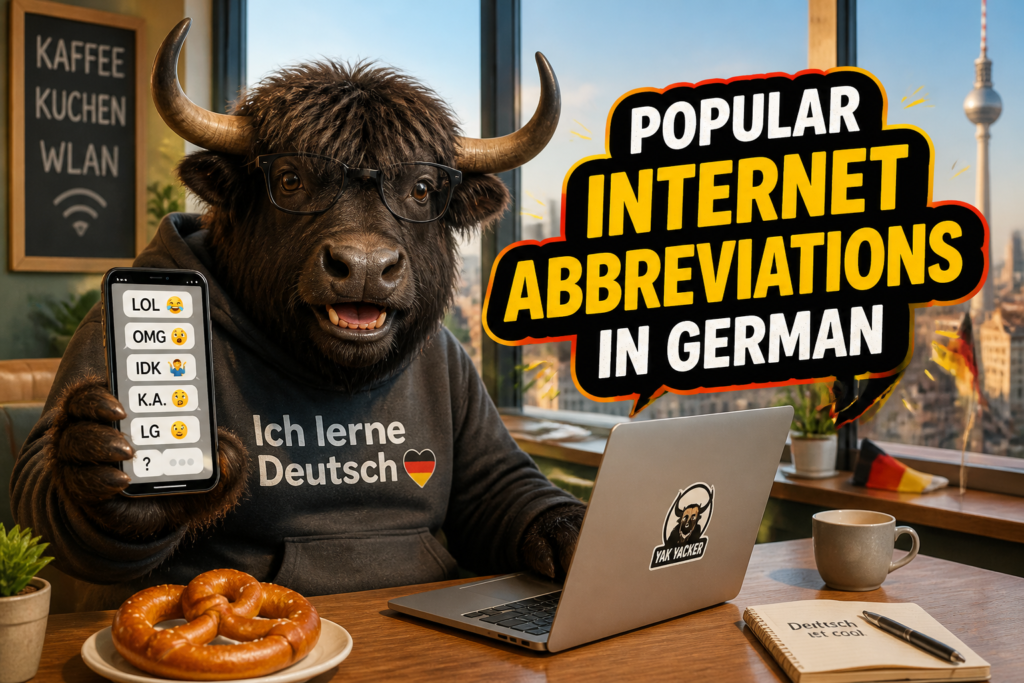
If German online chat sometimes looks like somebody dropped a keyboard down a staircase, you are not imagining it. The good news: most of those little abbreviations are practical, common, and far less scary than they first appear.
In this guide, you’ll learn the most useful German internet abbreviations, what they mean, how people actually use them, and when not to sound like a bored teenager who has seen one meme too many. By the end, you’ll be able to read chats, comments, texts, and quick replies with much less squinting.
And yes, German loves abbreviations. It is basically a hobby.
For a broader tour of informal everyday language, you can also check Popular Slang in German and Popular German Phrases. For a full overview of the learning hub, see Learn German.
Why German Internet Abbreviations Matter
German texts, group chats, gaming chats, forums, and social media comments use a lot of short forms. Some are borrowed from English, some are old German habits, and some are pure “why are we like this?” energy.
Most of them are not grammar traps. They are simply faster ways to write common expressions. That said, a few can be informal, ironic, or slightly rude if used badly. Context matters. Annoying, but true.
Yak wisdom: In German internet culture, short does not always mean simple. Sometimes it just means someone wanted to reply before the bus arrived.
Most Popular Internet Abbreviations
Here are the abbreviations you’ll see again and again in German online conversations. The examples use natural, everyday German, not museum-German.
| German | Pronunciation | Meaning | Example Sentence | Translation | Learner Note |
|---|---|---|---|---|---|
| LG | ell-geh | Liebe Grüße — “kind regards / best wishes” | LG aus Berlin! | Best wishes from Berlin! | Very common in messages and emails. Friendly, neutral, quick. |
| VG | fau-geh | Viele Grüße — “many greetings / best regards” | VG und bis bald. | Best regards and see you soon. | Also very common. Slightly more formal than LG, but still friendly. |
| mfg / MFG | em-eff-geh | mit freundlichen Grüßen — “kind regards” | MFG | Kind regards | Often used in emails. Uppercase is standard. A little old-school, but still alive. |
| z.B. | tsett-beh | zum Beispiel — “for example” | Ich mag deutsche Wörter, z. B. “Handy” und “Feierabend”. | I like German words, for example “Handy” and “Feierabend.” | Very useful in writing. Note the dots and space: z. B. |
| d.h. | deh-ha | das heißt — “that means / in other words” | Der Zug hat Verspätung, d. h. wir warten länger. | The train is delayed, meaning we wait longer. | Common in explanations and writing. Usually followed by a clarification. |
| bzw. | beh-tsett-vau | beziehungsweise — “or rather / respectively / that is to say” | Ich nehme Tee bzw. Kaffee, je nach Uhrzeit. | I’ll have tea or rather coffee, depending on the time. | Tricky one. In English it can be “or rather,” “respectively,” or “that is.” |
| u. a. | oo-ah | unter anderem — “among other things” | Ich lerne u. a. Deutsch und Spanisch. | I’m learning German and Spanish, among other things. | Very common in writing. Great for lists. |
| u. U. | oo-oo | unter Umständen — “possibly / under certain circumstances” | U. U. kommt er später. | He may come later. | More formal and written. Not typical in casual chat. |
| ca. | tsa | circa — “about / approximately” | Ich bin in ca. zehn Minuten da. | I’ll be there in about ten minutes. | Extremely common. Also used outside the internet. |
| Nr. | en-er | Nummer — “number” | Das ist Nr. 4 auf der Liste. | That’s number 4 on the list. | Useful in forms, lists, addresses, and messages. |
| aka | ay-kay-ay | also known as | Max, aka der Kaffee-Experte, ist wieder online. | Max, aka the coffee expert, is online again. | Borrowed from English. Very internet-friendly, very casual. |
| lol | lol | laughing out loud | LOL, das war wirklich peinlich. | LOL, that was really embarrassing. | Used in German too, often as a reaction. Not usually spoken aloud. |
Notice how some abbreviations are pure German, while others are borrowed from English internet culture. German online language is a mix of both, because the internet enjoys borrowing things and then pretending it invented them.
Useful Chat Abbreviations You’ll See All The Time
These are especially common in messaging apps, gaming chats, forums, and fast replies. Some are very informal, so use them with friends or in relaxed online spaces.
| German | Pronunciation | Meaning | Example Sentence | Translation | Learner Note |
|---|---|---|---|---|---|
| HDL | ha-deh-ell | hab dich lieb — “love you / fond of you” | HDL 😘 | Love you 😘 | Warm, affectionate, usually among friends, family, or partners. Not for formal use. |
| HDGDL | ha-deh-geh-deh-ell | hab dich ganz doll lieb — “love you very much” | HDGDL, bis morgen! | Love you very much, see you tomorrow! | Very affectionate and a bit childish/teen-like. Common in personal chats. |
| HDL + Bussi | ha-deh-ell boo-see | affectionate chat style | HDL, bis später. | Love you, see you later. | Short love notes often become abbreviated in German texting. |
| bin da | bin dah | I’m here / I’m available | Ich warte schon, bin da. | I’m already waiting, I’m here. | Not an abbreviation in the strict sense, but common chat shorthand. |
| kA | kah-ah | keine Ahnung — “no idea” | kA, vielleicht später. | No idea, maybe later. | Very common in texting. Casual and fast. |
| mMn | em-em-en | meiner Meinung nach — “in my opinion” | mMn ist der Film okay. | In my opinion, the movie is okay. | Useful in forums and discussions. Can sound a bit internet-nerdy. |
| omg | oh-em-geh | oh my God | OMG, schon wieder Montag? | OMG, Monday again? | Used exactly like English. German internet has zero shame here. |
| wtf | double-u tee eff | what the f*** | WTF ist hier los? | What the hell is going on here? | Strong and vulgar. Best avoided unless you know the tone well. |
| thx | thanks | thanks / thank you | thx für deine Hilfe! | Thanks for your help! | Borrowed from English, often in gaming and casual chat. |
| np | en-peh | no problem | — Danke! — np. | — Thanks! — No problem. | Very casual. Common in online gaming and chat. |
| brb | bee-ar-bee | be right back | brb, ich hole Wasser. | BRB, I’m getting water. | English internet abbreviation used directly in German chats. |
| gn8 | guh-nacht | gute Nacht — “good night” | gn8 und schlaf gut! | Good night and sleep well! | Looks playful and very online. The 8 stands in for “acht.” |
Some of these are not “official” abbreviations at all. They are just the stuff people type because the internet rewards speed, convenience, and a tiny amount of chaos.
Common Written Abbreviations In German
These are not always internet-only, but they show up everywhere online. If you can read them, German emails, articles, and comments get much easier.
| German | Pronunciation | Meaning | Example Sentence | Translation | Learner Note |
|---|---|---|---|---|---|
| usw. | oo-ess-vay | und so weiter — “and so on” | Ich brauche Brot, Milch, Eier usw. | I need bread, milk, eggs, and so on. | Very common in lists. Don’t overuse in polished writing. |
| etc. | et-set-teh-rah | et cetera | Wir sprechen über Musik, Filme etc. | We’re talking about music, films, etc. | Also common, but usw. feels more German. |
| ggf. | geh-geh-eff | gegebenenfalls — “if necessary / if applicable” | ggf. melden wir uns später. | If necessary, we’ll get in touch later. | Formal and useful in work or administrative writing. |
| i. d. R. | ee-deh-er | in der Regel — “usually / as a rule” | i. d. R. antworte ich schnell. | Usually I answer quickly. | Common in writing. Good to know for emails and articles. |
| ca. | tsa | approximately | Der Kurs dauert ca. zwei Stunden. | The course lasts about two hours. | Works for time, money, amounts, and distances. |
| u. a. | oo-ah | among other things | Die Stadt hat u. a. gute Museen. | The city has good museums, among other things. | Handy in formal and neutral writing. |
| zzt. | tsett-t | zurzeit — “currently / at the moment” | Ich bin zzt. beschäftigt. | I’m busy at the moment. | Very short, very written, very German. |
| vgl. | fay-guh-leekh | vergleiche — “compare” | vgl. die beiden Beispiele. | Compare the two examples. | Common in academic or instructional texts. |
| z. T. | tsett-teh | zum Teil — “partly / in part” | Die Regeln sind z. T. kompliziert. | The rules are partly complicated. | Useful in formal comments or explanations. |
| ca. / etwa | tsa / et-vah | about / roughly | Es sind etwa zehn Leute da. | There are about ten people there. | etwa is often a bit more natural than ca. in speech. |
If you see a lot of dots in German abbreviations, that is normal. German writing likes its little dot parade: z. B., d. h., i. d. R. If it feels fussy, it is. German still does it anyway.
Internet Expressions That Are Not Quite Abbreviations But Act Like Them
These words and forms are extremely common online, especially in chat. They are useful because they appear constantly and can be confusing if you expect dictionary-perfect spelling every time.
| German | Pronunciation | Meaning | Example Sentence | Translation | Learner Note |
|---|---|---|---|---|---|
| ok / okay | oh-kay | okay / all right | Okay, ich komme gleich. | Okay, I’m coming in a minute. | Very common in texting. Also used in speech. |
| naja | nah-yah | well / hmm / so-so | Naja, besser als nichts. | Well, better than nothing. | Good for hesitation, mild disagreement, or polite doubt. |
| lol | lol | laughing out loud | lol, das ist ja absurd. | LOL, that’s absurd. | Often ironic in German. Sometimes it means “that is ridiculous,” not real laughter. |
| ^^ | smiley | happy / friendly / cute reaction | Danke dir ^^ | Thanks ^^ | Very chatty and soft. Common in casual online German. |
| 🙂 | smiley | friendly smile | Alles gut 🙂 | All good 🙂 | Simple, universal, and still alive despite what the internet thinks. |
| <3 | heart | love / affection | Bis morgen <3 | See you tomorrow <3 | Used exactly like in English. |
| pls | please | please | pls schick mir den Link. | Please send me the link. | Very casual. Often in gaming or quick chat. |
| kk | kay-kay | okay, okay | kk, bis gleich. | Okay, see you soon. | Short agreement. Very informal. |
How German Abbreviations Work
German abbreviations follow a few patterns. Once you know the pattern, they stop looking like mysterious code and start looking like slightly lazy writing. Which is fair, because that is what they are.
| Pattern | Meaning | German Example | English Translation | Learner Note |
|---|---|---|---|---|
| Initial letters of a phrase | Short form of a longer expression | z. B. = zum Beispiel | for example | Dots are common in formal abbreviations. |
| Single-letter shorthand | Very short written form | ca. = circa | about | Often appears in texts, notes, and online writing. |
| Sound-based texting form | Spelling that sounds like speech | kA = keine Ahnung | no idea | Very informal. Common in chats. |
| English borrowing | Imported from English internet culture | brb | be right back | Used especially in gaming and online chat. |
| Reaction shorthand | Fast emotional response | lol, OMG, <3 | laughing / surprise / love | Meaning depends on tone and context. Internet, unfortunately, remains a mood. |
In German, abbreviations can appear in full uppercase, lowercase, or mixed style. The exact style often depends on how established the abbreviation is. For example, MFG is usually uppercase, while z. B. keeps its dots and spacing.
Pronunciation Tips For Common Abbreviations
Some abbreviations are read letter by letter. Others are read like full words. That difference matters, especially in spoken German or when someone reads an abbreviation aloud in a message.
| German | Pronunciation | How It’s Said | Example | Translation | Learner Note |
|---|---|---|---|---|---|
| z. B. | tsett-beh | Letter by letter | Ich mag Obst, z. B. Äpfel. | I like fruit, for example apples. | Say each letter separately when reading aloud. |
| d. h. | deh-ha | Letter by letter | Er ist müde, d. h. er geht früh schlafen. | He is tired, that is, he goes to bed early. | Good for clarifying meaning. |
| ca. | tsa | Often said as one word | Wir kommen in ca. fünf Minuten. | We’ll come in about five minutes. | Most learners hear this as “tsa.” |
| kA | kah-ah | Letter by letter | kA, frag später nochmal. | No idea, ask again later. | Texting shorthand, not standard spoken German. |
| LOL | lol | Usually said as “lol” | LOL, echt jetzt? | LOL, really? | Can be spoken, but often it just stays written. |
One pronunciation note worth remembering: German generally spells things more consistently than English, but abbreviations are their own little kingdom. The writing may be short, but the usage is not always obvious.
Germany, Austria, And Switzerland Differences
Most internet abbreviations are shared across German-speaking countries, especially the globally common ones like z. B., d. h., ca., and VG. But some chat habits are more regional or simply more common in certain communities.
| Expression | Germany | Austria | Switzerland | Learner Note |
|---|---|---|---|---|
| LG / VG | Very common | Very common | Very common | Safe choice almost everywhere. |
| MFG | Common in email | Common in email | Common in email | Formal but not stiff. |
| ca. | Very common | Very common | Very common | Standard everywhere. |
| kA | Very common in texting | Common in texting | Common in texting | Informal everywhere. |
| HDL / HDGDL | Common in personal chat | Common in personal chat | Common in personal chat | Very affectionate and usually casual. |
A quick cultural note: Swiss German daily life often uses dialect in speech, but written internet shorthand can still look very similar to Germany-based German online language. So if a message looks familiar, that is usually because it is.
Common Mistakes And Easy Fixes
Here are the mistakes that English-speaking learners make most often. Nothing tragic. Just the usual little language tripwires.
- Writing “zb” instead of “z. B.” — In standard German, abbreviations like z. B. and d. h. usually keep dots and spacing.
- Using “MFG” in a very casual chat — It can feel weirdly formal in a text to a friend. Use LG or VG instead.
- Thinking “lol” always means real laughter — In German online speech, lol can also mean irony, surprise, or mild disbelief.
- Using “kA” in formal writing — Fine in chat, not fine in an email to your professor, boss, or doctor. Obviously.
- Mixing up “bzw.” with “oder” — bzw. can mean “or rather,” “respectively,” or “that is to say,” depending on context.
- Forgetting that some abbreviations are not spoken the same way they are written — ca. is often read as “tsa,” not “see-ay.”
If you want a reliable general reference for standard German abbreviations and word usage, Duden is a solid, boring, trustworthy place to start. Boring is good here. Boring means clear.
Practice: Match The Abbreviation
Try these quick matches. No drama, no pressure, just a little brain exercise.
| Abbreviation | Meaning | Your Check |
|---|---|---|
| z. B. | for example | Did you get it? |
| d. h. | that means / in other words | Did you get it? |
| LG | best wishes | Did you get it? |
| ca. | about / approximately | Did you get it? |
| kA | no idea | Did you get it? |
| VG | best regards | Did you get it? |
| mMn | in my opinion | Did you get it? |
| gn8 | good night | Did you get it? |
Now try reading these aloud in the right style:
- LG, bis morgen!
- Ich bin ca. in 10 Minuten da.
- kA, vielleicht später.
- Das heißt, wir gehen nicht heute, sondern morgen.
- VG aus Hamburg!
Mini challenge: Which of these would you send to a friend, and which would you use in an email?
Quick Reference Summary
Keep these in your back pocket, and German online language becomes much easier to decode.
- LG = Liebe Grüße, friendly and common.
- VG = Viele Grüße, slightly more formal.
- MFG = Mit freundlichen Grüßen, standard email ending.
- z. B. = zum Beispiel, for example.
- d. h. = das heißt, that means.
- bzw. = beziehungsweise, or rather / respectively.
- ca. = about / approximately.
- kA = keine Ahnung, no idea.
- mMn = meiner Meinung nach, in my opinion.
- gn8 = gute Nacht, good night.
If you want to keep going, the next smart step is to learn how these abbreviations behave in casual sentences, business emails, and social media comments. German loves context almost as much as it loves shortening things.
Yak takeaway: German internet abbreviations are mostly simple once you see them a few times. Learn the common ones first, watch the tone, and do not send HDGDL to your landlord unless you enjoy strange silences.