


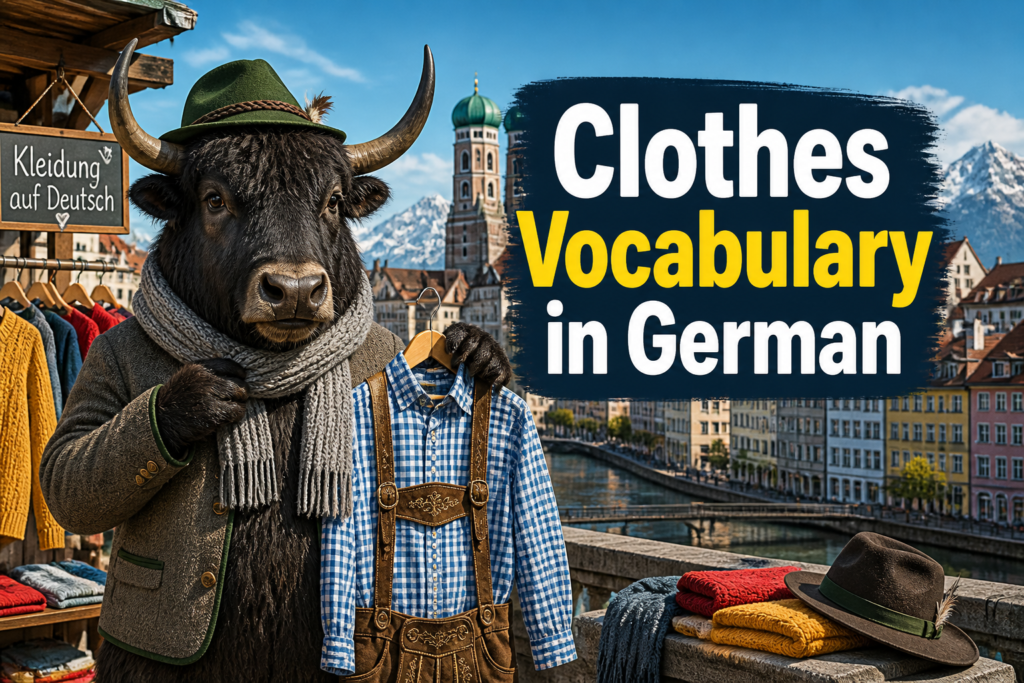
If you can name the clothes, you can do a lot more than shop. You can ask for the right size, understand washing labels, describe what someone is wearing, and avoid the classic “I wanted socks, not stockings” level of chaos. Very important distinction. Tiny, but important.
This guide gives you practical German clothes vocabulary for everyday use in Germany-based standard German. You’ll get common words, useful phrases, pronunciation help, example sentences, and a few grammar notes that actually help instead of making the whole thing feel like a tax form.
For extra practice later, you can also review related German lessons on the main Learn German page and a useful follow-up article at this related Yak Yacker lesson.
Clothes Vocabulary You Will Actually Use
Here are the basics first. These are the clothes words you’ll hear all the time in shops, at home, and in everyday conversations. German nouns are capitalized, which is annoyingly sensible once you get used to it.
| German | Pronunciation | Meaning | Example Sentence | Translation | Learner Note |
|---|---|---|---|---|---|
| die Kleidung | KLY-DOONG | clothes, clothing | Ich brauche neue Kleidung. | I need new clothes. | General word for clothing; usually singular in German. |
| das Kleid | KLYT | dress | Das Kleid ist sehr schön. | The dress is very pretty. | Not for “clothes” in general; just a dress. |
| das Hemd | hemt | shirt, dress shirt | Er trägt ein weißes Hemd. | He is wearing a white shirt. | Often a more formal shirt than das T-Shirt. |
| das T-Shirt | TEE-shurt | T-shirt | Mein T-Shirt ist nass. | My T-shirt is wet. | English loanword; very common. |
| die Bluse | BLOO-zeh | blouse | Sie trägt eine blaue Bluse. | She is wearing a blue blouse. | Usually for women’s tops; noun is feminine. |
| die Hose | HOH-zeh | trousers, pants | Die Hose sitzt gut. | The pants fit well. | In German, Hose is singular. One pair = one noun. |
| der Rock | rok | skirt | Der Rock ist zu kurz. | The skirt is too short. | Watch the article: der. |
| die Jacke | YAH-keh | jacket | Ich nehme meine Jacke mit. | I’m taking my jacket with me. | Common everyday word, very useful in Germany weather. |
| der Mantel | MAHN-tel | coat | Der Mantel hängt an der Tür. | The coat is hanging on the door. | Usually a heavier outer coat. |
| die Schuhe | SHOO-uh | shoes | Neue Schuhe sind teuer. | New shoes are expensive. | Plural only in this sense. |
Clothes Vocabulary For Everyday Situations
These are the words that show up when you get dressed, go shopping, or talk about what someone is wearing. Not glamorous. Extremely useful.
| German | Pronunciation | Meaning | Example Sentence | Translation | Learner Note |
|---|---|---|---|---|---|
| die Socken | ZOK-en | socks | Ich brauche warme Socken. | I need warm socks. | Plural noun. |
| die Strümpfe | SHTRUMP-feh | stockings, socks (formal/older usage) | Sie trägt Strümpfe zum Kleid. | She is wearing stockings with the dress. | Can sound more formal or old-fashioned depending on context. |
| die Unterwäsche | OON-ter-vah-sheh | underwear | Ich packe Unterwäsche ein. | I’m packing underwear. | Useful for packing and laundry. |
| der Pullover | poo-LOH-ver | sweater, jumper | Es ist kalt, also ziehe ich einen Pullover an. | It’s cold, so I’m putting on a sweater. | Very common in Germany. |
| das Sweatshirt | SVET-shurt | sweatshirt | Ich trage heute ein Sweatshirt. | I’m wearing a sweatshirt today. | Loanword; pronunciation is Germanized. |
| der Anzug | AHN-tsook | suit | Er trägt einen dunklen Anzug. | He is wearing a dark suit. | Useful for work and formal events. |
| der Schal | shahl | scarf | Im Winter brauche ich einen Schal. | In winter I need a scarf. | Short a, clear final l. |
| die Mütze | MYUT-zeh | hat, beanie | Ich habe meine Mütze vergessen. | I forgot my hat. | Good for winter hats. |
| der Hut | hoot | hat | Der Hut schützt vor der Sonne. | The hat protects against the sun. | More like a classic hat, not a knitted beanie. |
| der Handschuh | HAHNT-shoo | glove | Ein Handschuh fehlt mir. | One glove is missing. | Compound noun: hand + shoe, but don’t panic; German likes weird furniture for words. |
Shopping Phrases For Clothes
Shopping is where clothes vocabulary becomes real life. Suddenly grammar has a purpose, which is refreshing.
| German | Pronunciation | Meaning | Example Sentence | Translation | Learner Note |
|---|---|---|---|---|---|
| Haben Sie das in Größe M? | HAH-ben zee dahs in GROO-seh em? | Do you have this in size M? | Haben Sie das in Größe M? | Do you have this in size M? | Polite Sie form for shops. |
| Ich suche eine Jacke. | ikh ZOO-kheh EYE-neh YAH-keh | I’m looking for a jacket. | Ich suche eine Jacke für den Winter. | I’m looking for a jacket for winter. | Very common and polite. |
| Wie viel kostet das? | vee feel KOS-tet dahs? | How much does that cost? | Wie viel kostet das T-Shirt? | How much does the T-shirt cost? | Standard shopping question. |
| Kann ich das anprobieren? | kann ikh dahs AHN-pro-bee-ren? | Can I try this on? | Kann ich die Hose anprobieren? | Can I try on the pants? | anprobieren is separable: probiere … an. |
| Es passt nicht. | ess pahst nicht | It doesn’t fit. | Die Jacke passt nicht. | The jacket doesn’t fit. | Useful when the size is wrong. |
| Es ist zu klein. | ess ist tsoo kline | It is too small. | Das Hemd ist zu klein. | The shirt is too small. | Can also say zu groß for too big. |
| Wo ist die Umkleidekabine? | voh ist dee oom-KLY-deh-kah-BEE-neh? | Where is the fitting room? | Wo ist die Umkleidekabine? | Where is the fitting room? | In casual speech, people also just say die Umkleide. |
| Ich nehme das. | ikh NAY-meh dahs | I’ll take this. | Ich nehme das Hemd. | I’ll take the shirt. | Handy phrase at the checkout. |
| Ich brauche noch eine Nummer größer. | ikh BROW-kheh nokh EYE-neh NOO-mer GROO-ser | I need one size bigger. | Ich brauche noch eine Nummer größer. | I need one size bigger. | Very natural in shops. |
| Haben Sie das auch in Schwarz? | HAH-ben zee dahs oukh in shvarts? | Do you also have this in black? | Haben Sie den Mantel auch in Schwarz? | Do you also have the coat in black? | Color words are very useful when shopping. |
Useful Colors For Clothes
Colors matter a lot with clothes, obviously. A shirt exists in theory, but a blue shirt is what you actually buy.
| German | Pronunciation | Meaning | Example Sentence | Translation | Learner Note |
|---|---|---|---|---|---|
| schwarz | shvarts | black | Ich suche eine schwarze Jacke. | I’m looking for a black jacket. | Adjective ending changes after eine. |
| weiß | vys | white | Das Hemd ist weiß. | The shirt is white. | Final ß often sounds like s. |
| blau | blow | blue | Ich habe eine blaue Hose. | I have blue pants. | Common and easy. |
| rot | roht | red | Der Rock ist rot. | The skirt is red. | Short, clean vowel. |
| grau | grow | grey | Der Pullover ist grau. | The sweater is grey. | Very common for coats and sweaters. |
| braun | brown | brown | Sie trägt braune Schuhe. | She is wearing brown shoes. | Ends with n, pronounced clearly. |
| grün | groong | green | Die Mütze ist grün. | The hat is green. | Umlaut ü is important here. |
| gelb | gelp | yellow | Das T-Shirt ist gelb. | The T-shirt is yellow. | Final devoicing: b sounds more like p. |
How To Say You Are Wearing Something
German uses tragen for “to wear,” but in everyday speech people also use anhaben. That one is separable and a little more casual.
| Pattern | Meaning | German Example | English Translation | Learner Note |
|---|---|---|---|---|
| Ich trage … | I am wearing … | Ich trage ein weißes Hemd. | I am wearing a white shirt. | Neutral and widely usable. |
| Er/Sie trägt … | He/She is wearing … | Sie trägt einen roten Rock. | She is wearing a red skirt. | Remember the -t ending for er/sie. |
| Ich habe … an | I am wearing … | Ich habe meine Jacke an. | I have my jacket on. | Very common in conversation. |
| Du hast … an | You are wearing … | Du hast heute eine coole Mütze an. | You are wearing a cool hat today. | Casual and everyday. |
Small but useful warning: anhaben is not the same as the English “to have” in a possession sense. It means something like “to have on.” German enjoys making this just different enough to keep learners humble.
Trying Clothes On And Talking About Fit
Fit vocabulary shows up constantly in real life. If you shop in German-speaking places, this section will save you time, confusion, and one awkward shuffle outside the changing room.
| German | Pronunciation | Meaning | Example Sentence | Translation | Learner Note |
|---|---|---|---|---|---|
| passen | PAHS-sen | to fit | Die Schuhe passen mir. | The shoes fit me. | Often used with dative: mir, dir, ihm. |
| zu eng | tsoo eng | too tight | Die Jeans sind zu eng. | The jeans are too tight. | Plural noun here because Jeans is usually plural in German. |
| zu weit | tsoo vyte | too loose | Die Hose ist zu weit. | The pants are too loose. | Useful when something hangs awkwardly. |
| bequem | beh-KVAME | comfortable | Die Schuhe sind sehr bequem. | The shoes are very comfortable. | Great shopping adjective. |
| eng anliegend | eng AHN-lee-gent | tight-fitting | Das Kleid ist eng anliegend. | The dress is tight-fitting. | More descriptive, a bit more formal. |
| locker | LOK-er | loose, relaxed | Ich mag lockere Kleidung. | I like loose clothing. | Good for style and comfort. |
| die Größe | GROO-seh | size | Welche Größe haben Sie? | What size do you have? | Feminine noun: die Größe. |
| die Kleidergröße | KLY-der-groo-seh | clothing size | Ich trage Größe 38. | I wear size 38. | Very common in shops for women’s clothing. |
| die Schuhgröße | SHOO-groo-seh | shoe size | Meine Schuhgröße ist 42. | My shoe size is 42. | Usually important in shoe shops, unsurprisingly. |
Getting Dressed And Undressed
These verbs are useful for daily routines, travel, and talking about children, weather, or mornings when the bed is clearly winning.
| German | Pronunciation | Meaning | Example Sentence | Translation | Learner Note |
|---|---|---|---|---|---|
| sich anziehen | zikh AHN-tsee-en | to get dressed | Ich ziehe mich an. | I am getting dressed. | Reflexive verb: mich. |
| sich ausziehen | zikh OWS-tsee-en | to get undressed | Bitte zieh dich aus. | Please get undressed. | Also reflexive; context matters a lot here. |
| sich umziehen | zikh OOM-tsee-en | to change clothes | Ich muss mich umziehen. | I have to change clothes. | Very useful for sports or after work. |
| anziehen | AHN-tsee-en | to put on | Zieh bitte die Jacke an. | Please put on the jacket. | Separable verb: zieh … an. |
| ausziehen | OWS-tsee-en | to take off | Zieh deine Schuhe aus. | Take off your shoes. | Also separable. |
| umziehen | OOM-tsee-en | to change | Wir ziehen uns für das Fest um. | We are changing for the party. | Can also mean moving house in another context, so watch the situation. |
Clothes And Weather
German weather loves to make jackets relevant all year. A sunny morning can become a cold afternoon with almost insulting speed. So these words matter.
| German | Pronunciation | Meaning | Example Sentence | Translation | Learner Note |
|---|---|---|---|---|---|
| warm | vahrm | warm | Ich brauche eine warme Jacke. | I need a warm jacket. | Adjective ending changes: warme. |
| kalt | kahlt | cold | Heute ist es kalt. | Today it is cold. | Simple but essential. |
| regenfest | RAY-gen-fest | rainproof | Meine Jacke ist regenfest. | My jacket is rainproof. | Very practical for outdoor gear. |
| wasserdicht | VAH-ser-deekt | waterproof | Die Schuhe sind wasserdicht. | The shoes are waterproof. | Useful for coats, boots, and umbrellas too. |
| leicht | lykht | light, thin | Ich suche einen leichten Pullover. | I’m looking for a light sweater. | Good for spring and layered outfits. |
| dick | dik | thick | Der Mantel ist sehr dick. | The coat is very thick. | Can mean physically thick, not “fat” in this context. |
Pronunciation Tips For Common Clothes Words
A few sounds matter a lot in clothes vocabulary. Get these right and people will understand you much faster. Romance, but for your mouth.
| German Sound | Example Word | Simple Help | Why It Matters |
|---|---|---|---|
| ch | ich, weiche | Like a soft hiss in the throat, not a hard k. | Very common in clothing words with endings like -lich or in everyday phrases. |
| ü | Mütze, grün | Say “ee” with rounded lips. | This sound can change meaning fast, so it is worth practicing. |
| ei | leicht, weiß | Sounds like English “eye.” | Easy to mix up with ie. |
| ie | T-Shirt doesn’t use it, but ziehen does | Sounds like long “ee.” | Common in verbs related to getting dressed. |
| sp at the beginning of a word | Schuhe isn’t it; think sprechen style | Sounds like “shp.” | Good general German pronunciation habit. |
| st at the beginning of a word | Stock style, not here as much | Sounds like “sht.” | Useful when you hear clothing-adjacent words like Stiefel (boots). |
| final devoicing | gelb, Rock | Final b/d/g often sound like p/t/k. | Helps your German sound more natural. |
Regional Differences Worth Knowing
Most clothes vocabulary is the same across German-speaking countries, but a few words differ. Nothing dramatic. German speakers do enjoy naming the same object three slightly different ways, because apparently one word would be too calm.
| English | Germany | Austria | Switzerland | Learner Note |
|---|---|---|---|---|
| sweater | der Pullover | der Pullover | der Pullover | This one is mostly shared. |
| pants | die Hose | die Hose | die Hose | Standard word across all three. |
| cap / beanie | die Mütze | die Haube in some regions | die Mütze or regional variants | Region can matter with winter hats. |
| swimsuit | der Badeanzug / die Badehose | same | same | Use depending on gender and style. |
Common Mistakes And Easy Fixes
These are the mistakes English-speaking learners make all the time. The good news is that they are easy to fix once you spot them.
- “die Hose” is plural in German. Not exactly. It is usually a singular feminine noun that refers to pants/trousers as one item. Example: Die Hose ist neu. = The pants are new.
- Don’t say “Ich habe an Jacke.” Use Ich habe eine Jacke an. or Ich trage eine Jacke.
- Use the correct size word. Größe means size. Groß means big/tall. Related, yes. Same thing, no.
- Watch adjective endings. eine schwarze Jacke, not eine schwarz Jacke.
- Remember separable verbs. anprobieren becomes probiere an in the present tense. The prefix likes to wander off to the end of the sentence.
- Don’t confuse tragen and tragen isn’t “to carry” only. It can mean “to wear” when talking about clothes.
- Jeans is usually plural in German, so you say die Jeans sind or simply treat them as a plural form in many contexts.
Mini Practice
Try these quick drills. Tiny effort, useful payoff. A rare modern miracle.
| Task | Prompt | Answer | Translation |
|---|---|---|---|
| Fill the blank | Ich brauche eine ___ Jacke. | warme | I need a warm jacket. |
| Choose the correct verb | Ich ___ meine Schuhe an. | ziehe | I put on my shoes. |
| Correct the sentence | Er trägt ein schwarzer Mantel. | Er trägt einen schwarzen Mantel. | He is wearing a black coat. |
| Translate | Do you have this in size L? | Haben Sie das in Größe L? | Do you have this in size L? |
| Translate | The shoes are too small. | Die Schuhe sind zu klein. | The shoes are too small. |
Quick Reference Summary
- die Kleidung = clothes, clothing
- das Hemd = shirt
- die Hose = pants/trousers
- die Jacke = jacket
- der Mantel = coat
- die Schuhe = shoes
- ich trage … = I am wearing …
- sich anziehen = to get dressed
- anprobieren = to try on
- passen = to fit
- Größe = size
- zu klein / zu groß = too small / too big
If you can use these words in a shop, you are already doing real German, not just textbook German. And that, frankly, is the good stuff.
Yak takeaway: Learn the clothing nouns, then add passen, anprobieren, and Größe. That combo will carry you through shopping, travel, and most everyday outfit talk without any dramatic linguistic wardrobe malfunction.