


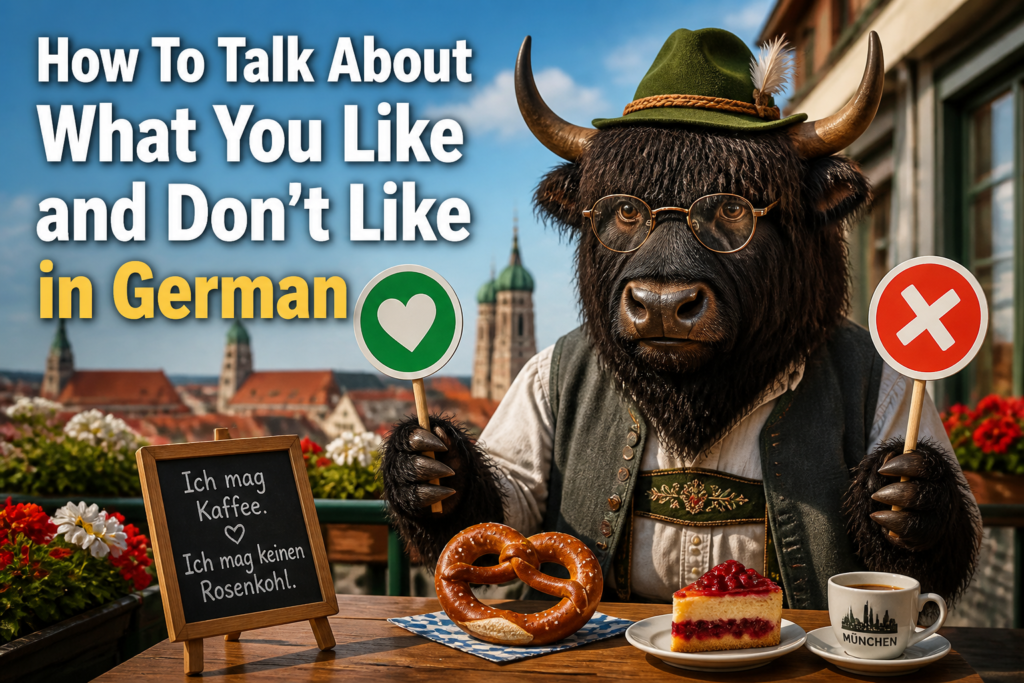
If you can say what you like and don’t like in German, suddenly real conversations get much easier. Coffee, music, films, food, weather, hobbies, people’s opinions about life choices that somehow arrive at 8:15 a.m. in the office — all of it starts with a few simple patterns.
The good news: German has plenty of natural ways to say “I like it” without sounding like a grammar workbook in a trench coat. The slightly annoying news: English and German do not line up perfectly here, so a little structure goes a long way.
By the end of this guide, you’ll be able to talk about likes, dislikes, preferences, and stronger opinions with confidence — and without accidentally sounding like you memorized five lines and froze.
Back to the German learning hub
The Core Idea: German Does Not Use “Like” The Same Way English Does
In English, you often say “I like coffee.” In German, the most common translation is Ich mag Kaffee. That works well for people, things, and general preferences.
But German also uses gefallen in a very different way: Mir gefällt der Film. That literally means something like “The film pleases me.” English speakers often trip over this because the subject and object feel flipped.
Small language trap, big payoff. Once this clicks, your German sounds much more natural.
Useful Ways To Say What You Like
| German | Pronunciation | Meaning | Example Sentence | Translation | Learner Note |
|---|---|---|---|---|---|
| Ich mag das. | ikh mahk dahs | I like that. | Ich mag das. | I like that. | Very common and easy. Good default phrase. |
| Ich mag Kaffee. | ikh mahk kah-feh | I like coffee. | Ich mag Kaffee. | I like coffee. | mag is from mögen. The verb changes: ich mag, du magst, er/sie/es mag. |
| Ich liebe Pizza. | ikh lee-beh pits-tsah | I love pizza. | Ich liebe Pizza. | I love pizza. | Strong, emotional, or exaggerated. Use carefully if you just mean “quite like.” |
| Ich finde das toll. | ikh fin-deh dahs toll | I think that’s great. | Ich finde das toll. | I think that’s great. | Useful for opinions. finden here means “think/find.” |
| Das gefällt mir. | dahs geh-fellt meer | I like that / that appeals to me. | Der Song gefällt mir. | I like the song. | The thing you like is the subject. mir is dative. |
| Das spricht mich an. | dahs shprikhht mikh ahn | That appeals to me. | Das Design spricht mich an. | The design appeals to me. | More natural in style or marketing contexts. |
| Ich stehe auf Rockmusik. | ikh shteh-eh owf rock-moo-zeek | I’m into rock music. | Ich stehe auf alte Filme. | I’m into old films. | Casual; literally “I stand on.” Strange in English, normal in German. Go figure. |
| Ich habe Lust auf Schokolade. | ikh hah-beh loost owf shoh-koh-lah-deh | I feel like / I’m in the mood for chocolate. | Ich habe Lust auf etwas Süßes. | I feel like something sweet. | Very common. Lust auf is about craving or wanting right now. |
| Ich bin ein Fan von Jazz. | ikh bin ayn fahn fon yahss | I’m a fan of jazz. | Ich bin ein Fan von diesem Restaurant. | I’m a fan of this restaurant. | Friendly, casual, and flexible. |
| Mein Lieblingsfilm ist … | myn lee-blings-film ist | My favorite film is … | Mein Lieblingsfilm ist „Good Bye, Lenin!“ | My favorite film is “Good Bye, Lenin!” | Lieblings- is a very useful prefix for favorites. |
Useful Ways To Say What You Don’t Like
| German | Pronunciation | Meaning | Example Sentence | Translation | Learner Note |
|---|---|---|---|---|---|
| Ich mag das nicht. | ikh mahk dahs nisht | I don’t like that. | Ich mag das nicht. | I don’t like that. | Simple and very common. Add nicht after the thing you dislike. |
| Ich mag keinen Kaffee. | ikh mahk ky-nen kah-feh | I don’t like coffee. | Ich mag keinen Kaffee. | I don’t like coffee. | keinen is the accusative form of kein for masculine nouns. |
| Mir gefällt das nicht. | meer geh-fellt dahs nisht | I don’t like that. | Mir gefällt das nicht. | I don’t like that. | Same pattern as gefallen, just negative. |
| Das spricht mich nicht an. | dahs shprikhht mikh nisht ahn | That doesn’t appeal to me. | Die Idee spricht mich nicht an. | The idea doesn’t appeal to me. | Natural in more polished speech. |
| Ich kann X nicht ausstehen. | ikh kahn … nisht owss-shteh-en | I can’t stand X. | Ich kann laute Musik nicht ausstehen. | I can’t stand loud music. | Stronger and more emotional. Use when you really mean it. |
| Ich bin kein Fan von … | ikh bin kyn fahn fon | I’m not a fan of … | Ich bin kein Fan von Horrorfilmen. | I’m not a fan of horror films. | Polite, everyday, and very useful. |
| Ich habe keine Lust auf … | ikh hah-beh ky-neh loost owf | I don’t feel like / I’m not in the mood for … | Ich habe keine Lust auf Streit. | I’m not in the mood for an argument. | Great for moods and plans. |
| Das ist nicht mein Ding. | dahs ist nisht myn ding | That’s not my thing. | Sport am Morgen? Das ist nicht mein Ding. | Sports in the morning? That’s not my thing. | Very natural casual speech. |
| Das ist mir zu langweilig. | dahs ist meer tsoo lang-vy-likh | That’s too boring for me. | Der Film ist mir zu langweilig. | The film is too boring for me. | zu = too. Useful for opinions and limits. |
| Ich finde das schrecklich. | ikh fin-deh dahs shrek-likh | I find that awful. | Ich finde das schrecklich. | I find that awful. | Strong opinion, but common in conversation. |
How To Ask Someone What They Like
| German | Pronunciation | Meaning | Example Sentence | Translation | Learner Note |
|---|---|---|---|---|---|
| Was magst du? | vahs mahkst doo | What do you like? | Was magst du in deiner Freizeit? | What do you like in your free time? | Friendly, informal du form. |
| Was gefällt dir? | vahs geh-fellt deer | What do you like? | Was gefällt dir an Berlin? | What do you like about Berlin? | dir is dative. |
| Was findest du gut? | vahs fin-dest doo ghoot | What do you think is good? | Was findest du an dem Plan gut? | What do you think is good about the plan? | Great for opinions, not just personal tastes. |
| Worauf hast du Lust? | voh-rowf hahst doo loost | What are you in the mood for? | Worauf hast du Lust heute Abend? | What do you feel like tonight? | Very natural in everyday speech. |
| Wofür interessierst du dich? | voh-fyoor in-teh-res-deerst doo dish | What are you interested in? | Wofür interessierst du dich beruflich? | What are you interested in professionally? | sich interessieren für is a reflexive verb. |
| Was ist dein Lieblings-…? | vahs ist dyn lee-blings | What is your favorite …? | Was ist dein Lieblingsessen? | What is your favorite food? | Use with almost any noun: film, song, restaurant, season. |
Real-Life German Like, Dislike, And Preference Patterns
Here are the patterns you will actually hear in conversation. Not the stiff classroom version. The version people use while ordering lunch, chatting about Netflix, or judging the weather with emotional intensity.
| Pattern | Meaning | German Example | English Translation | Learner Note |
|---|---|---|---|---|
| Ich mag + noun | I like + thing/person | Ich mag diese Serie. | I like this series. | Easy, direct, and common. |
| Ich mag + verb in noun form | I like doing something | Ich mag lange Spaziergänge. | I like long walks. | Use nouns or noun-like phrases. |
| Mir gefällt + nominative noun | I like / it appeals to me | Mir gefällt der Stil. | I like the style. | The liked thing stays in nominative. |
| Ich finde + adjective | I think something is … | Ich finde den Ort schön. | I think the place is beautiful. | Very handy for opinions with adjectives. |
| Ich stehe auf + noun | I’m into / I really like | Ich stehe auf Rockmusik. | I’m into rock music. | Casual, a little cool, a little cheeky. |
| Ich habe Lust auf + noun | I feel like / crave | Ich habe Lust auf Eis. | I feel like ice cream. | Great for food, activities, and moods. |
| Ich bin kein Fan von + noun | I’m not a fan of | Ich bin kein Fan von Meetings. | I’m not a fan of meetings. | Polite dislike. Very office-friendly. |
| Das ist nicht mein Ding. | That’s not my thing | Schlager? Das ist nicht mein Ding. | Schlager? That’s not my thing. | Casual and natural. |
Grammar Note: Why “Mir Gefällt Der Film” Works
This is one of those German things that looks backwards until it suddenly doesn’t. In Mir gefällt der Film, the thing you like — der Film — is the subject. The person who likes it is shown with mir, which is dative.
So instead of “I like the film,” the structure is closer to “The film pleases me.” Very German. Very practical. Slightly dramatic.
| Pattern | Meaning | German Example | English Translation | Learner Note |
|---|---|---|---|---|
| Mir gefällt der Film. | I like the film. | Mir gefällt der Film. | I like the film. | der Film = subject; mir = the person who likes it. |
| Dir gefällt die Musik. | You like the music. | Dir gefällt die Musik. | You like the music. | dir = informal “you.” |
| Ihm gefällt das Buch. | He likes the book. | Ihm gefällt das Buch. | He likes the book. | ihm is dative for “him.” |
| Uns gefällt das Hotel. | We like the hotel. | Uns gefällt das Hotel. | We like the hotel. | Works the same for all people. |
When in doubt, remember this rule:
What you like is often the subject in German with “gefallen.” The person who likes it gets the dative pronoun.
Preference Words That Make You Sound More Natural
| German | Pronunciation | Meaning | Example Sentence | Translation | Learner Note |
|---|---|---|---|---|---|
| lieber | LEE-ber | rather / prefer | Ich trinke lieber Tee. | I’d rather drink tea. | Comparative form of gern. Useful for choices. |
| am liebsten | ahm leeb-sten | best / most of all | Am liebsten esse ich Pasta. | I like eating pasta best. | Great for favorite things or habits. |
| gern | gern | gladly / like to | Ich höre gern Podcasts. | I like listening to podcasts. | Very common with activities. |
| gern(e) machen | GER-nuh mah-khen | to like doing something | Ich mache gern Sport. | I like doing sports. | Common everyday pattern. |
| nicht gern | nisht gern | not like to / not enjoy | Ich koche nicht gern. | I don’t like cooking. | More natural than always using nicht mögen. |
| am wenigsten | ahm veh-nih-sten | least of all | Am wenigsten mag ich Kälte. | I like cold weather least. | Useful for ranking preferences. |
Common Ways To Sound Polite, Casual, Or Strong
| German | Register | Meaning | Example Sentence | Translation | Learner Note |
|---|---|---|---|---|---|
| Ich finde das gut. | neutral | I think that’s good. | Ich finde das gut. | I think that’s good. | Safe in most situations. |
| Das gefällt mir sehr. | neutral/polite | I really like that. | Das gefällt mir sehr. | I really like that. | Good for praising a design, idea, or object. |
| Ich finde das richtig gut. | casual | I really like that. | Ich finde das richtig gut. | I really like that. | Emphatic, friendly, everyday speech. |
| Ich bin total begeistert. | strong positive | I’m totally thrilled. | Ich bin total begeistert von dem Konzert. | I’m totally thrilled with the concert. | Useful when you really love something. |
| Ich bin nicht so begeistert. | polite negative | I’m not that excited about it. | Ich bin nicht so begeistert von der Idee. | I’m not that excited about the idea. | A softer dislike than ich mag das nicht. |
| Ganz okay | casual | pretty okay | Der Film war ganz okay. | The film was pretty okay. | Useful if you don’t want to sound dramatic. Which is rare in German, but possible. |
Du, Sie, And Tone: Don’t Accidentally Sound Weird
If you’re talking to friends, classmates, or people your age in casual settings, du is normal. In formal situations, you’ll often use Sie. The actual liking phrases stay mostly the same, but the pronouns change.
For a deeper look at when to use each form, see German du vs Sie explained. Because yes, one tiny pronoun can change the whole vibe of the conversation. German enjoys this kind of suspense.
| Form | German | English | Note |
|---|---|---|---|
| informal | Was magst du? | What do you like? | Use with friends, peers, children, casual chats. |
| formal | Was mögen Sie? | What do you like? | Use with strangers, customers, in formal settings. |
| informal | Gefällt dir das? | Do you like that? | dir = dative “you.” |
| formal | Gefällt Ihnen das? | Do you like that? | Ihnen is the formal dative “you.” |
Pronunciation Tips That Actually Help
- mag sounds like “mahk,” with a soft final k.
- gefällt starts with a soft g, like “guh-FELT,” not “geh-FELT.”
- ich is usually “ikh,” with a soft throat sound at the end.
- sch sounds like “sh,” as in schrecklich.
- sp and st at the start of a word usually sound like “shp” and “sht”: sprechen, stehen.
- lieber has a long ee sound, not “lib-er.”
- gern sounds close to “gairn,” but shorter and tighter.
- ü in words like fühlen or schüchtern is not English “oo.” It’s the “say ee with rounded lips” sound. Yes, German asks a lot.
Common Mistakes And Easy Fixes
| Wrong | Better | Why |
|---|---|---|
| Ich bin mag Kaffee. | Ich mag Kaffee. | mag is a verb. You don’t need bin. |
| Ich gefällt der Film. | Mir gefällt der Film. | The person who likes something takes dative: mir. |
| Ich mag nicht Kaffee. | Ich mag keinen Kaffee. | For a noun object, use kein + noun, not just nicht. |
| Mir gefällt die Film. | Mir gefällt der Film. | Film is masculine: der Film. |
| Ich liebe sehr Kaffee. | Ich liebe Kaffee sehr. | Adverbs like sehr usually go after the object. |
| Ich habe Lust für Pizza. | Ich habe Lust auf Pizza. | Lust takes auf, not für. |
| Ich bin ein Fan mit Jazz. | Ich bin ein Fan von Jazz. | The phrase is Fan von. |
| Ich finde es langweilig when you mean “I’m bored of it” | Ich finde es langweilig can mean “I find it boring” | If you want “I’m bored,” say Mir ist langweilig or Ich langweile mich. |
Quick Practice
Try the swaps below. Say them out loud if possible. Yes, out loud. Quietly staring at the page does less than people pretend it does.
- Change Ich mag Kaffee to “I don’t like coffee.”
- Change Mir gefällt der Film to “I don’t like the film.”
- Change Ich habe Lust auf Pizza to “I don’t feel like pizza.”
- Change Ich stehe auf Popmusik to “I’m into rock music.”
- Change Ich finde das toll to “I think that’s boring.”
- Change Was magst du? to the formal version.
- Change Am liebsten trinke ich Tee to “I like drinking coffee best.”
- Change Ich bin kein Fan von Spinat to a sentence about homework.
Check Your Answers
- Ich mag Kaffee nicht. or Ich mag keinen Kaffee.
- Mir gefällt der Film nicht.
- Ich habe keine Lust auf Pizza.
- Ich stehe auf Rockmusik.
- Ich finde das langweilig.
- Was mögen Sie?
- Am liebsten trinke ich Kaffee.
- Ich bin kein Fan von Hausaufgaben.
Everyday Examples You Can Steal
| Situation | German | English | Learner Note |
|---|---|---|---|
| café | Ich mag den Kaffee hier. | I like the coffee here. | Simple, natural, easy win. |
| music | Mir gefällt dieser Song. | I like this song. | Great for recommendations. |
| food | Ich habe Lust auf etwas Warmes. | I feel like something warm. | Very useful at mealtimes. |
| work | Ich bin kein Fan von Meetings am Montag. | I’m not a fan of meetings on Monday. | Professionally acceptable and mildly tragic. |
| hobbies | Ich mache gern Fotos. | I like taking photos. | gern works beautifully with activities. |
| movies | Ich liebe gute Komödien. | I love good comedies. | Use liebe when you really mean it. |
| weather | Ich mag warmes Wetter lieber. | I prefer warm weather. | lieber = rather / prefer. |
| style | Das Design spricht mich an. | The design appeals to me. | Useful for shops, apps, and branding. |
Mini Nuance: Like A Thing, Like Doing A Thing, Or Like A Person?
German can use the same idea in a few slightly different ways:
- Ich mag den Film. = I like the film.
- Ich schaue gern Filme. = I like watching films.
- Ich habe Lust auf einen Film. = I feel like watching a film.
- Mir gefällt der Film. = The film appeals to me.
- Ich mag dich. = I like you. Romantic, friendly, or personal depending on context.
If you’re talking about a person, Ich mag dich can sound warm and personal. If you’re talking about a thing, Ich mag das is usually the safest all-rounder. If you want to sound a little more natural and less translated-from-English, add gern, lieber, or am liebsten when you can.
For related vocabulary, you may also want common German adjectives and compliments in German. Those two go nicely with opinion phrases, because apparently one German lesson is never enough.
If you want a boring-but-useful dictionary check, Duden is a solid place to confirm meanings and usage. It’s not glamorous. It is correct. Which, in language learning, is often the whole game.
Quick Reference Summary
- Ich mag … = I like …
- Ich mag … nicht / Ich mag keinen … = I don’t like …
- Mir gefällt … = I like … / it appeals to me
- Ich finde … gut / toll / langweilig = I think … is good / great / boring
- Ich habe Lust auf … = I feel like / I want … right now
- Ich stehe auf … = I’m into …
- Ich bin ein Fan von … = I’m a fan of …
- gern = like to / gladly
- lieber = rather / prefer
- am liebsten = most of all / best of all
Yak takeaway: if you can use ich mag, mir gefällt, and ich habe Lust auf comfortably, you can talk about most likes and dislikes in German without sounding stiff. Add a little gern and lieber, and suddenly you sound much more like a person and much less like a worksheet. Magic. Or grammar. Same difference.