


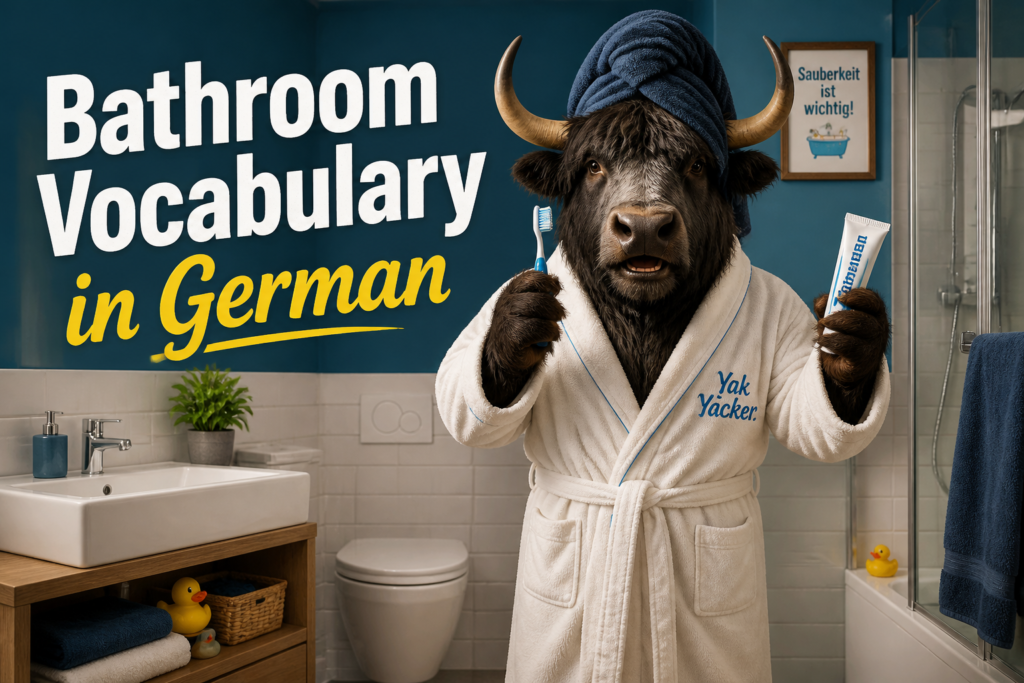
If you ever need the bathroom in Germany, the language suddenly becomes extremely important. Funny how “Where is the bathroom?” can feel more urgent than all the grammar in the world. Good news: German bathroom vocabulary is practical, repeatable, and full of words you will actually use in real life.
This guide teaches the everyday German words and phrases for bathrooms, toilets, sinks, showers, and all the little things that go with them. You will also learn how people ask politely, how to understand signs, and how not to mix up the very common bathroom words that can cause mild public confusion.
One quick note: in German, das Badezimmer usually means the bathroom as a room, while die Toilette and das WC are more direct ways to say toilet. Language, like plumbing, works best when the right pipe goes to the right place.
Essential Bathroom Words
Here are the most useful bathroom words first. These are the ones you will see on signs, hear in homes and hotels, and definitely need if you are trying not to do the awkward door-checking dance in public.
| German | Pronunciation | Meaning | Example Sentence | Translation | Learner Note |
|---|---|---|---|---|---|
| das Badezimmer | DAHS BAH-tsi-mer | bathroom | Das Badezimmer ist im Obergeschoss. | The bathroom is on the upper floor. | Neutral, common for the room in a house or apartment. |
| die Toilette | toy-LET-te | toilet; restroom | Wo ist die Toilette? | Where is the toilet? | Very common and neutral. |
| das WC | veh-tseh | WC, toilet | Das WC ist links im Flur. | The toilet is on the left in the hallway. | Very common on signs and in public places. |
| das Klo | kloh | toilet; loo | Wo ist das Klo? | Where is the loo? | Casual. Fine with friends, less ideal in very formal settings. |
| das Waschbecken | VAHSH-beh-ken | sink, washbasin | Das Waschbecken ist aus Keramik. | The sink is made of ceramic. | Useful for describing the bathroom in a house or hotel. |
| die Dusche | DOO-shuh | shower | Die Dusche ist leider kaputt. | The shower is unfortunately broken. | Common noun; feminine: die. |
| die Badewanne | BAH-duh-vah-nuh | bathtub | Ich nehme heute ein Bad in der Badewanne. | I’m taking a bath in the bathtub today. | Double check the stress: BADE-wanne. |
| das Handtuch | HAHNT-tookh | towel | Ich brauche ein Handtuch. | I need a towel. | Noun with das; plural is die Handtücher. |
| die Seife | ZY-fuh | soap | Haben Sie Seife im Bad? | Do you have soap in the bathroom? | Common household word. |
| die Zahnbürste | TSAHN-bür-stuh | toothbrush | Meine Zahnbürste ist blau. | My toothbrush is blue. | Starts with Zahn- because it is for teeth. |
Need a quick, boring-but-useful reference for basic word meaning and usage? Duden is one of the standard dictionary sources for German spelling and meanings.
Useful Phrases You Will Actually Say
These phrases are the real workhorses. Some are polite, some are casual, and some are exactly what you need when your bladder is doing the talking.
| German | Pronunciation | Meaning | Example Sentence | Translation | Learner Note |
|---|---|---|---|---|---|
| Wo ist die Toilette? | voh ist dee toy-LET-te | Where is the toilet? | Entschuldigung, wo ist die Toilette? | Excuse me, where is the toilet? | The safest all-purpose question. Works almost everywhere. |
| Wo ist das WC? | voh ist dahs veh-tseh | Where is the WC? | Wo ist das WC im Bahnhof? | Where is the WC in the train station? | Very common on signs and in public buildings. |
| Ich muss auf die Toilette. | ikh moos owf dee toy-LET-te | I need to go to the toilet. | Ich muss auf die Toilette. Sofort. | I need to go to the toilet. Immediately. | Natural and polite enough for most situations. |
| Kann ich bitte die Toilette benutzen? | kan ikh BIT-te dee toy-LET-te beh-TSOOT-sen | Can I please use the toilet? | Kann ich bitte die Toilette benutzen? | Can I please use the toilet? | Very polite. Great in restaurants, shops, and hotels. |
| Ich suche das Badezimmer. | ikh ZOO-khe dahs BAH-tsi-mer | I’m looking for the bathroom. | Entschuldigung, ich suche das Badezimmer. | Excuse me, I’m looking for the bathroom. | Useful in homes and hotels when you are looking for the room itself. |
| Gibt es hier eine Toilette? | gipt es heer EYE-nuh toy-LET-te | Is there a toilet here? | Gibt es hier eine Toilette für Gäste? | Is there a toilet here for guests? | Good for asking in cafés, offices, or homes. |
| Ich brauche frische Handtücher. | ikh BROW-khe FRI-shuh HAHNT-too-kher | I need fresh towels. | Wir brauchen frische Handtücher im Hotel. | We need fresh towels in the hotel. | Handtücher is plural of Handtuch. |
| Das Wasser ist kalt. | dahs VAH-ser ist kalt | The water is cold. | Das Wasser in der Dusche ist kalt. | The water in the shower is cold. | Simple and useful if the shower is being rude. |
| Die Dusche funktioniert nicht. | dee DOO-shuh funkt-see-oh-NEERT nicht | The shower is not working. | Die Dusche funktioniert nicht richtig. | The shower is not working properly. | Great for hotel complaints. |
| Ich nehme ein Bad. | ikh NAY-me ine baht | I’m taking a bath. | Heute nehme ich ein Bad. | Today I’m taking a bath. | ein Bad nehmen is a common phrase. |
| Haben Sie Seife? | HAH-ben zee ZY-fuh | Do you have soap? | Haben Sie Seife im Badezimmer? | Do you have soap in the bathroom? | Use Sie for polite/formal situations. |
| Wo kann ich mich waschen? | voh kan ikh mikh VAH-shen | Where can I wash up? | Wo kann ich mich hier waschen? | Where can I wash up here? | Helpful if you need a sink quickly. |
Common Bathroom Objects
Once you know the basics, these extra words help you understand bathroom labels, shopping lists, and the endless little things that make a bathroom function like a bathroom instead of a decorative panic room.
| German | Pronunciation | Meaning | Example Sentence | Translation | Learner Note |
|---|---|---|---|---|---|
| der Spiegel | SHPEE-gel | mirror | Der Spiegel hängt über dem Waschbecken. | The mirror hangs above the sink. | Masculine: der Spiegel. |
| der Wasserhahn | VAH-ser-hahn | faucet, tap | Der Wasserhahn tropft. | The faucet is dripping. | Literal meaning: “water tap.” Very common compound noun. |
| die Seifenschale | ZY-fen-shah-luh | soap dish | Die Seifenschale steht neben dem Waschbecken. | The soap dish is next to the sink. | Compound noun: Seife + Schale. |
| der Mülleimer | MUEL-eye-mer | trash can, bin | Der Mülleimer ist voll. | The trash can is full. | Useful in bathrooms, kitchens, and public restrooms. |
| das Toilettenpapier | toy-LET-ten-pah-peer | toilet paper | Das Toilettenpapier ist leer. | The toilet paper is empty. | Long compound noun. German loves these. A lot. |
| die Bürste | BÜRS-te | brush | Die Bürste liegt neben der Badewanne. | The brush is lying next to the bathtub. | Can also mean hairbrush or cleaning brush depending on context. |
| der Rasierer | ra-zee-EH-rer | razor, shaver | Mein Rasierer ist im Bad. | My razor is in the bathroom. | Common in bathrooms and shaving vocabulary. |
| die Zahnpasta | TSAHN-pas-tah | toothpaste | Wo ist die Zahnpasta? | Where is the toothpaste? | Very common everyday word. |
| die Dusche | DOO-shuh | shower | Die Dusche ist warm. | The shower is warm. | Also used for the shower space or unit. |
| der Duschvorhang | DOO-shfohr-hang | shower curtain | Der Duschvorhang ist nass. | The shower curtain is wet. | Good to know in apartments and older bathrooms. |
Small pronunciation tip: German compound nouns are usually stressed on the first part, like WASserhahn, TOIlettenpapier, and HANdtuch. The main word often arrives at the end, because German enjoys suspense.
Bathroom Signs And Labels
In public places, you may not see Badezimmer at all. Instead, you will see short labels and signs. These are worth learning because they show up everywhere from cafés to train stations.
| German | Pronunciation | Meaning | Example Sentence | Translation | Learner Note |
|---|---|---|---|---|---|
| WC | veh-tseh | toilet, restroom | Das WC ist im Erdgeschoss. | The restroom is on the ground floor. | Very common sign word in Germany, Austria, and Switzerland. |
| Damen | DAH-men | women’s | Die Damentoilette ist rechts. | The women’s toilet is on the right. | From die Dame, polite word for woman/lady. |
| Herren | HEH-ren | men’s | Die Herrentoilette ist links. | The men’s toilet is on the left. | From der Herr, polite word for man/gentleman. |
| Toilette | toy-LET-te | toilet | Toilette bitte hier entlang. | Toilette this way, please. | Short and clear on signs or in directions. |
| Behindertentoilette | beh-HIN-der-ten-toy-LET-te | accessible toilet | Die Behindertentoilette ist im Erdgeschoss. | The accessible toilet is on the ground floor. | Long, but useful in public buildings. |
| Barrierefrei | ba-REE-reh-fry | barrier-free, accessible | Das Gebäude ist barrierefrei. | The building is accessible. | Common official term. |
Quick Yak Rule: If you are unsure, Wo ist die Toilette? is safer than trying to be poetic. Bathrooms are not the time for creative language gymnastics.
Polite Versus Casual Bathroom Language
German has levels of politeness, and bathrooms are one of those places where the wrong level can sound a bit odd. Not dangerous. Just slightly “why are you talking like that?”
| Casual | Polite / Neutral | When To Use |
|---|---|---|
| Wo ist das Klo? | Wo ist die Toilette? | Klo is casual; Toilette is safer in public. |
| Ich muss aufs Klo. | Ich muss auf die Toilette. | Both mean you need to go, but the second is more polite. |
| Hast du Klopapier? | Haben Sie Toilettenpapier? | Use du with friends, Sie with strangers or in formal settings. |
| Kann ich mal aufs Klo? | Kann ich bitte die Toilette benutzen? | Second version is better in restaurants, schools, and offices. |
Important note: aufs Klo is short for auf das Klo. In everyday German, this contraction is very common. No need to panic. German contracts too.
For more everyday health-related words, you can also compare this topic with Health Vocabulary in German. And if you want a break from all this clean-and-wet language, there is a fun detour into food with Condiments Vocabulary in German. Yes, language learning does occasionally involve mustard.
Grammar Notes That Matter Here
You do not need a full grammar lecture to talk about bathrooms, but a few patterns will make your German sound much more natural.
| Pattern | Meaning | German Example | English Translation | Learner Note |
|---|---|---|---|---|
| die Toilette | feminine noun | Die Toilette ist sauber. | The toilet is clean. | Use die, not das. |
| das Badezimmer | neuter noun | Das Badezimmer ist klein. | The bathroom is small. | Common room name. |
| Wo ist …? | Where is …? | Wo ist die Dusche? | Where is the shower? | Simple question word order: verb before subject after Wo. |
| Ich muss … | I must / I need to … | Ich muss auf die Toilette. | I need to go to the toilet. | müssen is very useful for urgent situations. |
| auf die Toilette gehen | to go to the toilet | Ich gehe auf die Toilette. | I’m going to the toilet. | Very common. auf + accusative here. |
| im Badezimmer | in the bathroom | Die Handtücher sind im Badezimmer. | The towels are in the bathroom. | in dem becomes im. |
| am Waschbecken | at the sink | Die Zahnbürste liegt am Waschbecken. | The toothbrush is lying by the sink. | an dem becomes am. |
A tiny pronunciation note: ch in ich sounds soft, a bit like a light hiss. In Toilette, the t is crisp. And yes, z in Zahnbürste sounds like ts, not z in English. German likes to keep things interesting without warning anybody.
Mini Practice
Try these quick exercises. Tiny practice beats staring at vocabulary like it owes you money.
- Translate: “Where is the toilet?” → Wo ist die Toilette?
- Translate: “I need a towel.” → Ich brauche ein Handtuch.
- Translate: “The shower is broken.” → Die Dusche funktioniert nicht.
- Choose the better option in a restaurant: Wo ist das Klo? or Wo ist die Toilette? → Wo ist die Toilette?
- Fill in the blank: Ich muss auf die ____. → Toilette
- Fill in the blank: Das ____ ist im Badezimmer. → Waschbecken
- Say it politely: “Can I use the toilet?” → Kann ich bitte die Toilette benutzen?
- Spot the noun gender: der Spiegel, die Seife, das WC
Challenge: make one sentence with im Badezimmer and one with am Waschbecken. Keep it simple. German adores small, useful wins.
Common Mistakes And Easy Fixes
- Mixing up bathroom and toilet words
English “bathroom” can mean the room, but German often uses Toilette or WC for the toilet itself. If you want the room, say Badezimmer. - Saying das Toilette
Wrong. It is die Toilette. - Using Klo everywhere
Klo is casual. Fine with friends, not the best choice in very formal situations. - Forgetting compound nouns
Toilettenpapier, Waschbecken, and Handtuch are all nouns written as one word. German is very committed to joining things together. - Using English word order
Wo ist die Toilette? not “Wo die Toilette ist?” for a normal question. - Using the wrong pronoun in formal settings
With strangers, staff, or in public places, use Sie: Haben Sie Seife?
Germany, Austria, And Switzerland Notes
Most of this vocabulary is standard across German-speaking countries, but a few labels vary a little.
| Term | Germany | Austria | Switzerland | Note |
|---|---|---|---|---|
| WC | Very common | Very common | Very common | Safe across all three. |
| Toilette | Very common | Very common | Very common | Neutral and widely understood. |
| Klo | Common casual word | Common casual word | Understood, but context matters | Use with care in formal situations. |
| Badezimmer | Common in homes | Common in homes | Common in homes | Room name, not usually the public sign word. |
If you want to see more everyday vocabulary in context, the broader German learning path at Yak Yacker’s Learn German section is a neat place to wander next. Very low risk of getting lost. Probably.
Quick Reference Summary
- Badezimmer = bathroom as a room
- Toilette / WC = toilet, restroom
- Klo = casual toilet word
- Waschbecken = sink
- Dusche = shower
- Badewanne = bathtub
- Handtuch = towel
- Seife = soap
- Zahnbürste = toothbrush
- Toilettenpapier = toilet paper
- Wo ist die Toilette? = Where is the toilet?
- Ich muss auf die Toilette. = I need to go to the toilet.
Yak takeaway: if you learn just a few bathroom words in German, you can handle signs, hotels, homes, and urgent public questions without turning into a silent mime. Start with Toilette, WC, Badezimmer, and Wo ist die Toilette? — then let the rest rinse in naturally.