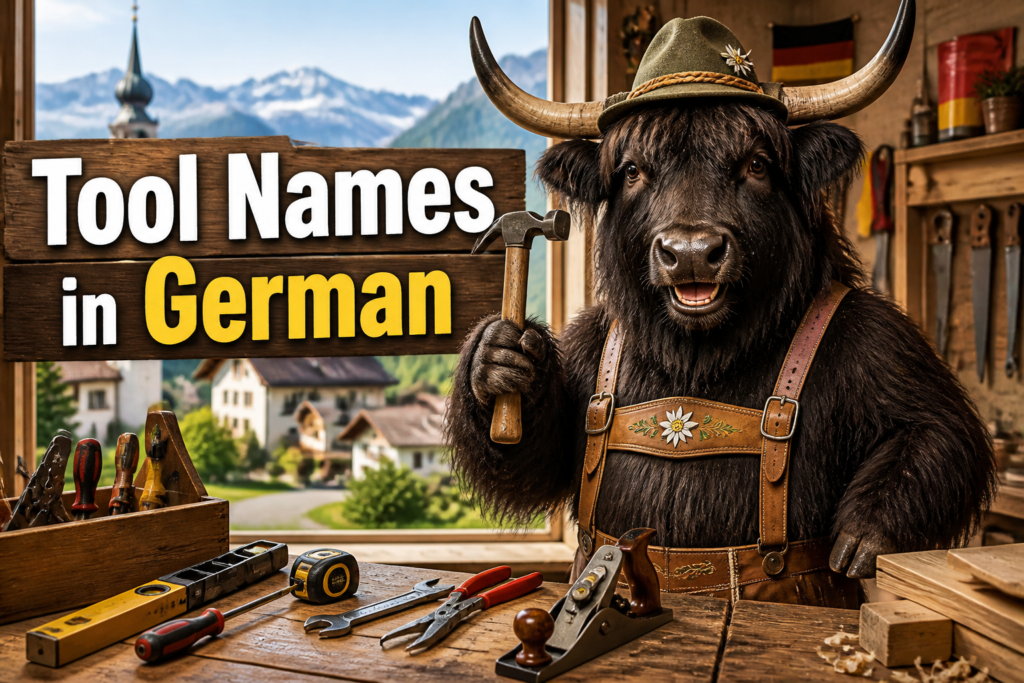
If you ever need to fix something in German-speaking countries, the language gets practical very fast. A tiny toolbox suddenly becomes very useful, and so does knowing whether you need der Hammer, der Schraubenzieher, or the thing you vaguely point at while hoping for mercy.
For the broader learning path, visit our parent guide.
Tool words are great because they show up in real life: at home, in workshops, in DIY shops, and in all those moments when a “simple repair” turns into a three-hour family event. German also loves compound nouns, so tool vocabulary can look a bit like a machine that ate a dictionary. Charming, really.
By the end of this guide, you’ll know the most common tool names in German, how to pronounce them in a beginner-friendly way, and how to use them in everyday sentences.
Core Tool Vocabulary
Here are the most useful tool names first. These are the words you’ll actually hear in shops, homes, and repair conversations. For a few related everyday words, you can also compare with this German basics guide if you want more common vocabulary in the same practical style.
| German | Pronunciation | Meaning | Example Sentence | Translation | Learner Note |
|---|---|---|---|---|---|
| der Hammer | HAH-mer | hammer | Ich brauche einen Hammer. | I need a hammer. | Masculine noun: der. |
| der Schraubenzieher | SHTROW-ben-tsee-her | screwdriver | Hast du einen Schraubenzieher? | Do you have a screwdriver? | Very common in Germany. |
| der Schraubendreher | SHTROW-ben-dray-er | screwdriver | Der Schraubendreher liegt in der Schublade. | The screwdriver is in the drawer. | Also common; Schraubenzieher and Schraubendreher are both used. |
| der Schraubenschlüssel | SHTROW-ben-shloo-sel | wrench / spanner | Wo ist der Schraubenschlüssel? | Where is the wrench? | Common in tool sets. |
| die Zange | TSAHN-ge | pliers | Bitte gib mir die Zange. | Please give me the pliers. | Plural is often the same form: die Zangen. |
| die Säge | ZAY-ge | saw | Die Säge ist sehr scharf. | The saw is very sharp. | Watch the long vowel in Säge. |
| der Bohrer | BOH-rer | drill | Der Bohrer ist kaputt. | The drill is broken. | Also means a drill bit in some contexts, so check the situation. |
| der Akkuschrauber | AH-koo-SHROW-ber | cordless screwdriver / drill driver | Mein Akkuschrauber ist fast leer. | My cordless screwdriver is almost empty. | Very useful in modern everyday German. |
| der Nagel | NAH-gel | nail | Der Nagel steckt in der Wand. | The nail is stuck in the wall. | Not a tool, but essential tool vocabulary. |
| der Dübel | DYOO-bel | wall plug | Ich brauche einen Dübel für die Wand. | I need a wall plug for the wall. | Super useful in home repair language. |
| das Maßband | MAHS-bahnt | measuring tape | Hast du ein Maßband? | Do you have a measuring tape? | Neutral, everyday word. |
| das Lineal | lin-ee-AHL | ruler | Ich brauche ein Lineal für die Linie. | I need a ruler for the line. | Often used at school and office. |
One tiny pronunciation note: German tool words love clusters like schr, sp, and st. In standard German, sch sounds like “sh,” and sp / st often sound like “shp” / “sht” at the beginning of a word. So Schraube starts with a nice crunchy sound, not a lazy English one.
Useful Tool Phrases In Real Life
These phrases are the ones you’ll actually use when you need help, are borrowing tools, or are trying to explain that something is “somewhere in the box, probably.”
| German | Pronunciation | Meaning | Example Sentence | Translation | Learner Note |
|---|---|---|---|---|---|
| die Werkstatt | VAIRK-shtat | workshop / repair shop | Das Auto ist in der Werkstatt. | The car is in the workshop. | Also used for repair shops. |
| das Werkzeug | VAIRK-tsook | tool / tools | Das Werkzeug liegt auf dem Tisch. | The tools are on the table. | Important umbrella word for “tools.” |
| der Werkzeugkasten | VAIRK-tsook-kahs-ten | toolbox | Der Schraubenzieher ist im Werkzeugkasten. | The screwdriver is in the toolbox. | Compound noun: Werkzeug + Kasten. |
| etwas festziehen | FEHST-tsee-hen | to tighten something | Kannst du die Schraube festziehen? | Can you tighten the screw? | Separable verb: festziehen. |
| etwas lösen | LUR-zen | to loosen / unscrew | Ich kann die Schraube nicht lösen. | I can’t loosen the screw. | Very common with screws and bolts. |
| etwas bohren | BOH-ren | to drill | Wir müssen ein Loch bohren. | We need to drill a hole. | Useful for home projects. |
| etwas sägen | ZAY-gen | to saw | Kannst du das Holz sägen? | Can you saw the wood? | Watch the umlaut in sägen. |
| etwas messen | MESS-en | to measure | Wir müssen die Wand messen. | We need to measure the wall. | Very practical around DIY and shopping. |
| etwas reparieren | reh-pah-REE-ren | to repair | Kannst du das reparieren? | Can you repair that? | Easy, useful, and worth memorizing. |
| kaputt sein | kah-POOT zyne | to be broken | Der Bohrer ist kaputt. | The drill is broken. | Very common everyday adjective. |
| funktionieren | funk-tsyo-NEE-ren | to work / function | Der Akkuschrauber funktioniert nicht. | The cordless screwdriver isn’t working. | Safer than just saying “kaputt” if you’re unsure. |
| Ich brauche … | ikh BROW-khe … | I need … | Ich brauche eine Zange. | I need pliers. | One of the most useful repair phrases in German. |
If you want a boring-but-authoritative dictionary check, Duden is always a solid place to confirm spelling, gender, and meaning. Not glamorous, but dependable. Like a good wrench.
Common Tool Names You Will Hear Often
Below are more tool names that show up in everyday German. This is the part where your toolbox vocabulary stops being “I know hammer” and becomes actually useful.
| German | Pronunciation | Meaning | Example Sentence | Translation | Learner Note |
|---|---|---|---|---|---|
| der Hammer | HAH-mer | hammer | Der Hammer ist sehr schwer. | The hammer is very heavy. | Simple and high-frequency. |
| der Nägel | NAH-gel | nails | Die Nägel sind im Karton. | The nails are in the box. | Plural of Nagel is Nägel. |
| der Bolzen | BOHL-tsen | bolt / pin | Der Bolzen sitzt fest. | The bolt is stuck tight. | Useful in technical and repair contexts. |
| die Schraube | SHTROW-be | screw | Die Schraube ist locker. | The screw is loose. | Very common word; feminine noun. |
| der Schraubenschlüssel | SHTROW-ben-shloo-sel | wrench / spanner | Ich suche den Schraubenschlüssel. | I’m looking for the wrench. | Long compound noun, very German. |
| der Inbusschlüssel | IN-boos-shloo-sel | Allen key / hex key | Hast du einen Inbusschlüssel? | Do you have an Allen key? | Common in flat-pack furniture life. |
| die Zange | TSAHN-ge | pliers | Die Zange liegt neben dem Hammer. | The pliers are next to the hammer. | Plural: Zangen. |
| der Seitenschneider | ZYTE-en-shny-der | wire cutter / side cutter | Ich brauche den Seitenschneider. | I need the wire cutter. | Common in workshop and electrical contexts. |
| das Messer | MESS-er | knife | Das Messer ist stumpf. | The knife is dull. | Not exactly a tool in every context, but often used like one. |
| die Schere | SHAY-re | scissors | Wo ist die Schere? | Where are the scissors? | Plural in German is also often used as a singular pair item in practice. |
| der Cutter | KUT-ter | utility knife / box cutter | Der Cutter liegt auf dem Regal. | The utility knife is on the shelf. | Borrowed word, common in modern German. |
| der Pinsel | PIN-sel | paintbrush | Ich brauche einen Pinsel. | I need a paintbrush. | Useful for painting and crafts. |
DIY And Home Repair Phrases
These are the phrases that help when things go from “minor fix” to “where did the instruction manual go?”
| German | Pronunciation | Meaning | Example Sentence | Translation | Learner Note |
|---|---|---|---|---|---|
| die Schraube anziehen | SHTROW-be ahn-tsee-hen | to tighten the screw | Bitte zieh die Schraube an. | Please tighten the screw. | Verb order matters: ziehen + an. |
| die Schraube aufdrehen | OWF-dray-hen | to unscrew | Ich drehe die Schraube auf. | I’m unscrewing the screw. | Also possible: lösen. |
| ein Loch bohren | ine lok BOH-ren | to drill a hole | Wir bohren ein Loch in die Wand. | We are drilling a hole in the wall. | in + accusative when movement goes into something. |
| etwas abschneiden | AP-shnee-den | to cut off | Ich schneide das Kabel ab. | I cut off the cable. | Separable verb: abschneiden. |
| etwas festhalten | FEHST-halt-en | to hold something steady | Kannst du das bitte festhalten? | Can you hold that steady, please? | Very useful while someone is “helping.” |
| etwas messen | MESS-en | to measure something | Wir messen die Länge. | We measure the length. | Length = die Länge. |
| etwas zusammensetzen | tsoo-ZAH-men-zet-sen | to assemble something | Wir setzen den Schrank zusammen. | We are assembling the cupboard. | Very common with furniture. |
| etwas reparieren | reh-pah-REE-ren | to repair something | Kannst du das reparieren? | Can you repair that? | Polite and practical. |
| das geht nicht | das gayt nicht | that doesn’t work / that won’t do | So geht das nicht. | That won’t work like this. | Handy phrase when the tool plan is failing. |
| ich brauche Hilfe | ikh BROW-khe HIL-fe | I need help | Ich brauche Hilfe mit dem Regal. | I need help with the shelf. | Simple, natural, and very useful. |
Small pronunciation clue: eu in German usually sounds like “oy,” so words like Schraube are not the main trap here, but neu or heute often surprise beginners. Tool words themselves are usually friendly, but the compounds look longer than they are. German is dramatic that way.
Germany, Austria, And Switzerland: Small Differences
Most tool words are shared across German-speaking countries, but there are a few regional differences worth knowing so you do not sound puzzled in the hardware aisle for no reason.
| English | Germany | Austria | Switzerland | Learner Note |
|---|---|---|---|---|
| screwdriver | der Schraubenzieher / der Schraubendreher | der Schraubenzieher | der Schraubenzieher | Germany often accepts both forms; Austria and Switzerland commonly prefer Schraubenzieher. |
| wrench / spanner | der Schraubenschlüssel | der Schraubenschlüssel | der Schraubenschlüssel | This one is widely understood, though some technical settings may use other exact terms. |
| cordless screwdriver | der Akkuschrauber | der Akkuschrauber | der Akkuschrauber | Very common modern term in all three regions. |
| pliers | die Zange | die Zange | die Zange | Same word in standard usage. |
If you enjoy comparing everyday vocabulary across topics, the pattern is similar to other practical word groups like kitchen utensil names in German, animal names in German, and bird names in German. Different topic, same German habit of turning one idea into a very determined compound noun.
Grammar Notes That Actually Help
Tool names are a nice way to practice German articles, plurals, and cases without falling into a grammar sinkhole. You can survive a lot of real conversations with just a few patterns.
| Pattern | Meaning | German Example | English Translation | Learner Note |
|---|---|---|---|---|
| Ich brauche einen Hammer. | Accusative after brauchen | Ich brauche einen Hammer. | I need a hammer. | Hammer is masculine, so the article changes to einen. |
| Ich brauche eine Zange. | Accusative feminine | Ich brauche eine Zange. | I need pliers. | Zange is feminine, and the article stays eine. |
| Ich brauche ein Maßband. | Accusative neuter | Ich brauche ein Maßband. | I need a measuring tape. | Maßband is neuter, so ein stays the same. |
| Der Hammer liegt auf dem Tisch. | Location after auf in dative | Der Hammer liegt auf dem Tisch. | The hammer is on the table. | auf here means “on,” not movement. |
| Ich lege den Hammer auf den Tisch. | Movement after auf in accusative | Ich lege den Hammer auf den Tisch. | I put the hammer on the table. | Same preposition, different case. German enjoys this little trick. |
| Wo ist …? | Ask where something is | Wo ist der Schraubenschlüssel? | Where is the wrench? | Very common question pattern. |
| Kannst du …? | Can you …? | Kannst du das festhalten? | Can you hold that? | Friendly and natural in everyday speech. |
Quick article reminder: German nouns are capitalized. So it is der Hammer, die Zange, das Werkzeug. If you forget the capital letter, the grammar police will not appear, but native readers will notice. Quietly. With feelings.
Practice Time
Try these quick exercises out loud or on paper. Little drills like this make the words stick faster than passive reading ever will.
| Task | Prompt | Answer | Learner Note |
|---|---|---|---|
| Choose the right article | ___ Hammer | der Hammer | Masculine noun. |
| Choose the right article | ___ Zange | die Zange | Feminine noun. |
| Choose the right article | ___ Maßband | das Maßband | Neuter noun. |
| Translate | I need a screwdriver. | Ich brauche einen Schraubenzieher. | einen because Schraubenzieher is masculine. |
| Translate | Where is the wrench? | Wo ist der Schraubenschlüssel? | Very practical question. |
| Fill in the blank | Kannst du das bitte ___? (hold) | festhalten | Natural helper phrase for DIY situations. |
| Fill in the blank | Ich will die Schraube ___. (tighten) | anziehen | Separable verb: anziehen. |
| Fix the sentence | Ich brauche ein Zange. | Ich brauche eine Zange. | Zange is feminine, so use eine. |
| Fix the sentence | Der Bohrer funktionieren nicht. | Der Bohrer funktioniert nicht. | Verb form: funktioniert for der Bohrer. |
| Say it in German | The screw is loose. | Die Schraube ist locker. | locker is a handy adjective for screws, lids, and fittings. |
Want to hear the word family in a proper pronunciation reference? DW Learn German is a good, calm place to compare sounds and build your confidence without turning it into a drama series.
Common Mistakes And Easy Fixes
| Common Mistake | Better Version | Why |
|---|---|---|
| Ich brauche ein Hammer. | Ich brauche einen Hammer. | Hammer is masculine, so accusative uses einen. |
| Wo ist der Zange? | Wo ist die Zange? | Zange is feminine. |
| Ich brauche Schraubenzieher. | Ich brauche einen Schraubenzieher. | In this sentence, the tool needs an article. |
| Ich will die Schraube anziehen an. | Ich will die Schraube anziehen. | Separable verbs usually keep the prefix attached in infinitive form. |
| Der Bohrer sind kaputt. | Der Bohrer ist kaputt. | Bohrer is singular here, so use ist. |
| Ich suche ein Werkzeugkasten. | Ich suche einen Werkzeugkasten. | Werkzeugkasten is masculine. |
| Die Schraube ist lose. | Die Schraube ist locker. | locker is the more natural word for a loose screw. |
One more useful note: Schraubenzieher and Schraubendreher are both understood in Germany, but if you only remember one, pick the version you hear most locally. There is no prize for making your life harder than necessary.
Mini Reference: Tool Words At A Glance
- der Hammer = hammer
- der Schraubenzieher / der Schraubendreher = screwdriver
- der Schraubenschlüssel = wrench / spanner
- die Zange = pliers
- die Säge = saw
- der Bohrer = drill
- der Akkuschrauber = cordless screwdriver
- das Maßband = measuring tape
- das Lineal = ruler
- der Inbusschlüssel = Allen key / hex key
- die Schraube = screw
- der Dübel = wall plug
- der Werkzeugkasten = toolbox
You can also remember the basic action verbs: bohren (drill), sägen (saw), messen (measure), reparieren (repair), festziehen (tighten), and lösen (loosen). That’s already enough to survive a decent DIY conversation, which is more than many flat-pack instructions can say for themselves.
Yak takeaway: In German tool vocabulary, learn the noun with its article, not just the English meaning. der Hammer, die Zange, das Werkzeug — because in German, the little article often does the heavy lifting.