


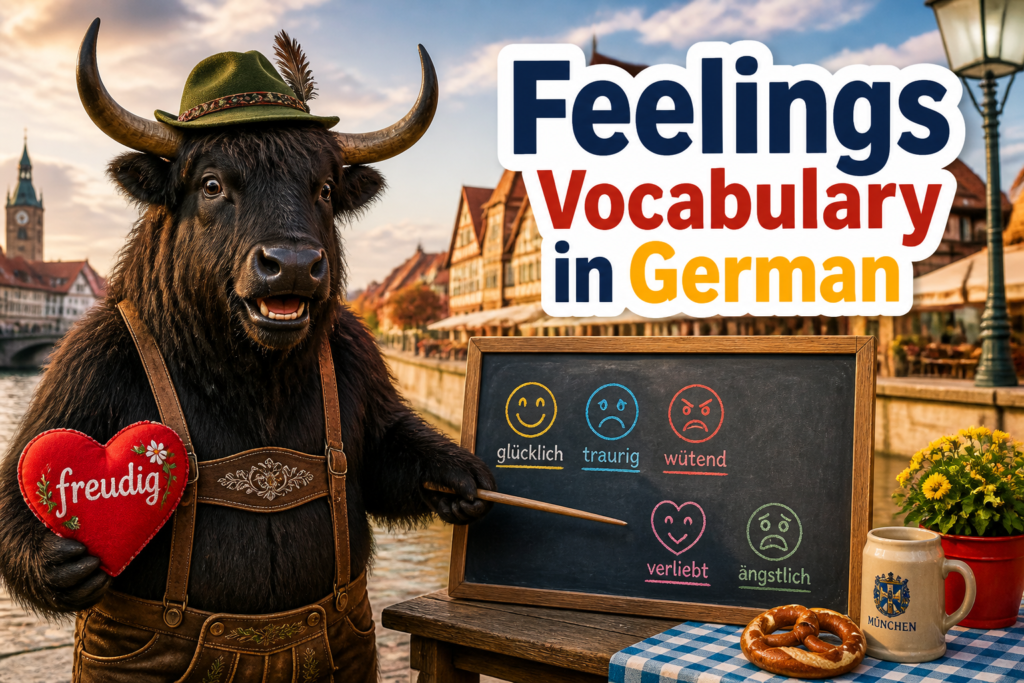
Feelings Vocabulary in German is one of those topics that looks simple until you actually want to say something beyond “gut” or “schlecht.” Humans, annoyingly, have more than two emotions. German does too. Convenient, right?
In this guide, you’ll learn useful German words and phrases for emotions, moods, and reactions. You’ll also get pronunciation help, example sentences, and small notes on tone and usage, so you can sound natural instead of like a very polite dictionary.
By the end, you should be able to talk about how you feel, ask others how they feel, and understand common emotion words in everyday German conversations, texts, and health-related situations. If you want a broader topic map, the main German hub is here: Learn German.
How To Say “How Do You Feel?”
The most useful starting point is the everyday question:
| German | Pronunciation | Meaning | Example Sentence | Translation | Learner Note |
|---|---|---|---|---|---|
| Wie fühlst du dich? | vee fuelst doo dikkh | How do you feel? | Wie fühlst du dich heute? | How do you feel today? | Casual “du” form. |
| Wie geht es dir? | vee gate es deer | How are you? | Wie geht es dir nach der Prüfung? | How are you after the exam? | Very common and natural. |
| Wie geht’s? | vee gates | How’s it going? | Hey, wie geht’s? | Hey, how’s it going? | Short, friendly, very common. |
| Wie fühlen Sie sich? | vee fuelen zee zikh | How do you feel? | Wie fühlen Sie sich heute? | How do you feel today? | Formal “Sie” form. |
Small but important detail: German often uses dich/dir here because the verb fühlen and the phrase es geht jemandem need the right case. You do not need to memorize the grammar monster all at once. Just copy the whole phrase at first.
Core Feelings Words
These are the basic emotion words you’ll use all the time. Many are adjectives, so they often appear after sein: Ich bin müde = I am tired.
| German | Pronunciation | Meaning | Example Sentence | Translation | Learner Note |
|---|---|---|---|---|---|
| glücklich | GLOOK-likh | happy | Ich bin heute glücklich. | I’m happy today. | Very general, neutral. |
| zufrieden | tsoo-FREE-den | satisfied, content | Ich bin mit dem Ergebnis zufrieden. | I’m satisfied with the result. | Common in everyday and work situations. |
| fröhlich | FROY-likh | cheerful, cheerful-looking | Sie ist immer fröhlich. | She is always cheerful. | Often describes a mood or personality. |
| traurig | TROW-rikh | sad | Er war über die Nachricht traurig. | He was sad about the news. | Very common. |
| wütend | VUE-tent | angry, furious | Sie ist auf den Lärm wütend. | She is angry about the noise. | Stronger than ärgerlich. |
| ärgerlich | AIR-guh-likh | annoyed, irritated | Das ist wirklich ärgerlich. | That is really annoying. | Very useful in daily life. |
| ängstlich | ENGST-likh | anxious, fearful | Das Kind ist ängstlich. | The child is anxious/scared. | Often used for fear or nervousness. |
| besorgt | beh-ZORGT | worried | Ich bin wegen der Prüfung besorgt. | I’m worried about the exam. | Very common with wegen. |
| müde | MYU-duh | tired | Nach der Arbeit bin ich müde. | After work, I’m tired. | One of the first words learners need. |
| gestresst | geh-STRESST | stressed | Ich bin heute total gestresst. | I’m totally stressed today. | Very common in modern German. |
| nervös | ner-VOES | nervous | Vor dem Interview bin ich nervös. | I’m nervous before the interview. | Watch the ö sound. |
| aufgeregt | OWF-guh-raykt | excited, nervous | Ich bin auf den Urlaub aufgeregt. | I’m excited about the holiday. | Can mean excited or nervous depending on context. |
| entspannt | ent-SHPANT | relaxed | Am Wochenende bin ich entspannt. | On the weekend, I’m relaxed. | Very natural and useful. |
| langweilig | LANG-vy-likh | boring | Der Film war langweilig. | The film was boring. | Not a feeling exactly, but often used emotionally. |
| verwirrt | fer-VEERT | confused | Ich bin etwas verwirrt. | I’m a bit confused. | Useful when something is unclear. |
Notice the pattern: a lot of feeling words are adjectives. That means they often sit neatly after sein. German likes structure. German also likes reminding you that structure exists.
Quick memory trick: “Ich bin …” is your best friend for feelings. “Ich habe …” is less common for emotions, but it does appear in fixed expressions like Ich habe Angst.
Feelings And Reactions You’ll Hear In Real Life
German speakers often describe not only the feeling itself, but also the reaction to a situation. These words show up in chats, at work, in class, and during the classic “I need a coffee and five minutes” moment.
| German | Pronunciation | Meaning | Example Sentence | Translation | Learner Note |
|---|---|---|---|---|---|
| überrascht | UE-ber-rasht | surprised | Ich bin von der Nachricht überrascht. | I’m surprised by the news. | Common with von. |
| beeindruckt | BEH-een-drookt | impressed | Ich bin von der Arbeit beeindruckt. | I’m impressed by the work. | Often used in polite praise. |
| enttäuscht | ent-TOW-sht | disappointed | Die Fans sind enttäuscht. | The fans are disappointed. | Common and very expressive. |
| erleichtert | er-LY-khtert | relieved | Ich bin erleichtert, dass alles gut ist. | I’m relieved that everything is fine. | Long word, very useful. |
| peinlich | PINE-likh | embarrassing, awkward | Das war mir peinlich. | That was embarrassing for me. | Very common in everyday German. |
| schüchtern | SHUEKH-tern | shy | Er ist ein bisschen schüchtern. | He is a little shy. | The ü sound matters. |
| eifersüchtig | EYE-fer-zookh-tikh | jealous | Sie ist auf ihre Schwester eifersüchtig. | She is jealous of her sister. | Usually followed by auf. |
| neidisch | NYE-dish | envious | Er ist neidisch auf dein Auto. | He is envious of your car. | Similar to jealous, but not identical. |
A tiny nuance: eifersüchtig and neidisch are not perfect twins. Eifersüchtig is often jealousy in relationships or rivalry. Neidisch is more like envy when you want what someone else has. German keeps the emotional filing cabinet tidy. Very rude of it.
Useful Phrases For Talking About Feelings
These phrases are the practical ones. They help you describe your mood, explain a reaction, or answer a friend without sounding like you swallowed a textbook.
| German | Pronunciation | Meaning | Example Sentence | Translation | Learner Note |
|---|---|---|---|---|---|
| Ich fühle mich gut. | ikh FUE-luh mikh goot | I feel good. | Heute fühle ich mich gut. | Today I feel good. | Very common, neutral. |
| Ich fühle mich nicht so gut. | ikh FUE-luh mikh nisht zo goot | I don’t feel so good. | Ich fühle mich heute nicht so gut. | I don’t feel so good today. | Useful for mild illness or low energy. |
| Mir geht es gut. | meer gate es goot | I’m fine / I’m doing well. | Danke, mir geht es gut. | Thanks, I’m fine. | Very standard answer. |
| Es geht mir nicht gut. | es gate meer nisht goot | I’m not doing well. | Heute geht es mir nicht gut. | I’m not doing well today. | Common and polite. |
| Ich bin in guter Stimmung. | ikh bin in goo-ter SHTIM-oong | I’m in a good mood. | Am Freitag bin ich in guter Stimmung. | On Friday I’m in a good mood. | More descriptive than casual. |
| Ich bin schlecht gelaunt. | ikh bin shlekht guh-LOWNT | I’m in a bad mood. | Am Morgen bin ich oft schlecht gelaunt. | In the morning I’m often in a bad mood. | Very natural phrase. |
| Ich habe schlechte Laune. | ikh HAH-buh shlekht-uh LOW-nuh | I’m in a bad mood. | Heute habe ich schlechte Laune. | Today I’m in a bad mood. | Very common alternative. |
| Ich habe gute Laune. | ikh HAH-buh goo-tuh LOW-nuh | I’m in a good mood. | Nach dem Kaffee habe ich gute Laune. | After coffee I’m in a good mood. | Excellent everyday phrase. |
| Ich bin total erledigt. | ikh bin to-tahl ehr-LAY-dikt | I’m completely exhausted. | Nach dem Umzug bin ich total erledigt. | After the move, I’m completely exhausted. | Very useful after work or travel. |
| Das macht mich nervös. | das makht mikh ner-VOES | That makes me nervous. | Die Prüfung macht mich nervös. | The exam makes me nervous. | Good cause-and-effect phrase. |
| Ich freue mich. | ikh FROY-uh mikh | I’m happy / I’m looking forward to it. | Ich freue mich auf das Wochenende. | I’m looking forward to the weekend. | Can mean happiness or anticipation depending on context. |
| Ich habe Angst. | ikh HAH-buh ahngst | I’m afraid / I’m scared. | Ich habe Angst vor Spinnen. | I’m afraid of spiders. | Important fixed phrase. |
Ich freue mich deserves special attention. It is often about anticipation, not just current happiness. So if someone says Ich freue mich auf den Urlaub, they mean they are looking forward to the holiday. Very different from “I am cheerful right now,” and yes, German makes you keep both in your head at once.
Pronunciation Tips For Feeling Words
Some feeling words are easy. Some sneak in tricky sounds. Here are the most common pronunciation points worth knowing early.
- ü in müde, früh, schüchtern: round your lips like “oo,” but say “ee.”
- ö in nervös: similar to a rounded “eh.”
- ch in mich, nicht, schlecht: a soft sound, not the English “k.”
- sp and st at the beginning of a word sound like shp and sht: stressed in German is gestresst, not “gess-tressed.”
- v often sounds like f: verwirrt starts with a “fer” sound.
- Final consonants are often devoiced: glücklich ends with a light, quiet sound.
If you want to double-check standard spellings and meanings, the boring-but-useful Duden dictionary is a solid reference.
Simple Grammar Patterns For Feelings
You do not need a full grammar monologue here. Just a few patterns cover most emotion sentences.
| Pattern | Meaning | German Example | English Translation | Learner Note |
|---|---|---|---|---|
| Ich bin + adjective | I am + feeling/state | Ich bin müde. | I am tired. | Most common pattern. |
| Ich habe + noun | I have + emotion noun | Ich habe Angst. | I’m afraid. | Fixed expression. |
| Mir geht es + adjective | I am doing + state | Mir geht es gut. | I’m doing well. | Very standard. |
| Das macht mich + adjective | That makes me + feeling | Das macht mich traurig. | That makes me sad. | Useful for causes and reactions. |
| Ich fühle mich + adjective | I feel + adjective | Ich fühle mich krank. | I feel sick. | Great for physical and emotional states. |
| Ich freue mich auf + accusative | I’m looking forward to + thing | Ich freue mich auf das Essen. | I’m looking forward to the food. | auf takes accusative here. |
| Ich bin traurig über + accusative | I’m sad about + thing | Ich bin traurig über die Absage. | I’m sad about the cancellation. | Common with reasons. |
| Ich bin froh, dass … | I’m glad that … | Ich bin froh, dass du da bist. | I’m glad that you are here. | Very natural in conversation. |
One more helpful note: adjectives after sein usually stay in their base form. You say Ich bin müde, not something awkward like “müder” unless you are comparing people. German is picky, but at least it tells you what it wants.
Emotion Nouns You’ll See In Texts And Conversations
Sometimes German uses a noun instead of an adjective. These are especially common in set phrases.
| German | Pronunciation | Meaning | Example Sentence | Translation | Learner Note |
|---|---|---|---|---|---|
| die Freude | DEE FROY-duh | joy, delight | Die Freude war groß. | The joy was great. | Noun; capitalized. |
| die Angst | dee ahngst | fear | Ich habe Angst vor Hunden. | I’m afraid of dogs. | Used in a very common fixed phrase. |
| die Wut | dee voot | rage, anger | Er konnte seine Wut nicht zeigen. | He could not show his anger. | Stronger than everyday annoyance. |
| die Trauer | dee TROW-er | grief, sorrow | Sie war in tiefer Trauer. | She was in deep grief. | Serious and formal. |
| die Sorge | dee ZOR-guh | worry, concern | Ich habe Sorgen wegen des Geldes. | I have worries about the money. | Often plural: Sorgen. |
| die Verwirrung | dee fer-VUE-roong | confusion | Die Verwirrung war groß. | The confusion was huge. | Formal-ish but common. |
| die Erleichterung | dee er-LY-kh-teh-roong | relief | Man hörte seine Erleichterung. | You could hear his relief. | Great for emotional reactions. |
| die Überraschung | dee UE-ber-RAH-shoong | surprise | Die Überraschung war gelungen. | The surprise was successful. | Often used for events and gifts. |
German nouns are capitalized, of course, because why let your feelings stay lowercase? If you see a capitalized emotion word, it may be a noun rather than an adjective.
Everyday Mini Dialogues
Here are a few realistic exchanges. These are the kinds of things people actually say, not museum pieces locked behind glass.
| German | Pronunciation | Meaning | Example Sentence | Translation | Learner Note |
|---|---|---|---|---|---|
| Wie geht’s dir? | vee gates deer | How are you? | — Wie geht’s dir heute? | — How are you today? | Friendly and common. |
| Ganz gut, danke. | gahnts goot, DAHN-kuh | Pretty good, thanks. | — Ganz gut, danke. Und dir? | — Pretty good, thanks. And you? | Natural response. |
| Ich bin etwas müde. | ikh bin ET-vahs MYU-duh | I’m a bit tired. | — Warum bist du so still? — Ich bin etwas müde. | — Why are you so quiet? — I’m a bit tired. | Soft, everyday phrasing. |
| Das freut mich. | das FROYT mikh | That makes me happy / I’m glad to hear that. | — Ich habe die Prüfung bestanden. — Das freut mich. | — I passed the exam. — That makes me happy. | Very useful reaction phrase. |
| Das tut mir leid. | das toot meer lyte | I’m sorry / That’s too bad. | — Ich habe schlechte Nachrichten. — Das tut mir leid. | — I have bad news. — I’m sorry. | Not a feeling word exactly, but emotionally essential. |
Das tut mir leid is one of those must-know phrases. It does not mean “it does pain to me.” It means “I’m sorry” or “that’s unfortunate.” German expression logic is sometimes elegant, sometimes a raccoon with a briefcase.
Common Mistakes And Easy Fixes
- Wrong: Ich bin Angst.
Right: Ich habe Angst.
Why: Angst is used in a fixed phrase with haben. - Wrong: Ich fühle gut.
Right: Ich fühle mich gut.
Why: In German, sich fühlen is reflexive: “feel oneself.” - Wrong: Mir geht gut.
Right: Mir geht es gut.
Why: The little es belongs there. - Wrong: Ich bin excited.
Right: Ich bin aufgeregt. or Ich freue mich.
Why: Use German emotion words, not English ones in disguise. - Wrong: Ich bin peinlich.
Right: Das ist mir peinlich.
Why: Something is embarrassing to me; the person is not “embarrassing” in the same way. - Wrong: Ich bin langweilig.
Right: Ich langweile mich. or Es ist langweilig.
Why: langweilig means boring, not bored. - Wrong: Ich bin für den Urlaub aufgeregt.
Right: Ich freue mich auf den Urlaub.
Why: aufgeregt can sound nervous or overexcited. freuen sich auf is safer for looking forward to something.
If you like checking word meaning and usage in more than one place, DW Learn German has plenty of beginner-friendly material that pairs nicely with vocabulary study.
Quick Reference Summary
- Ich bin … is the easiest way to describe a feeling or state.
- Ich habe Angst is a fixed and very important phrase.
- Mir geht es gut works well for “I’m doing well.”
- Ich fühle mich … is useful for “I feel …” in a broader sense.
- Ich freue mich auf … means you are looking forward to something.
- Das macht mich … helps you explain what caused the feeling.
- peinlich, besorgt, verwirrt, and erleichtert are especially useful in real conversations.
- German feeling words often appear after sein, but some fixed expressions use haben or reflexive forms.
Yak takeaway: If you can say Ich bin müde, Mir geht es gut, and Ich habe Angst, you already have a very usable feelings toolkit in German. Not bad for a language that likes making nouns out of emotions.
If you want the next practical topic, a good follow-up is Health Vocabulary in German, because feelings and health tend to show up together when life decides to be inconvenient.