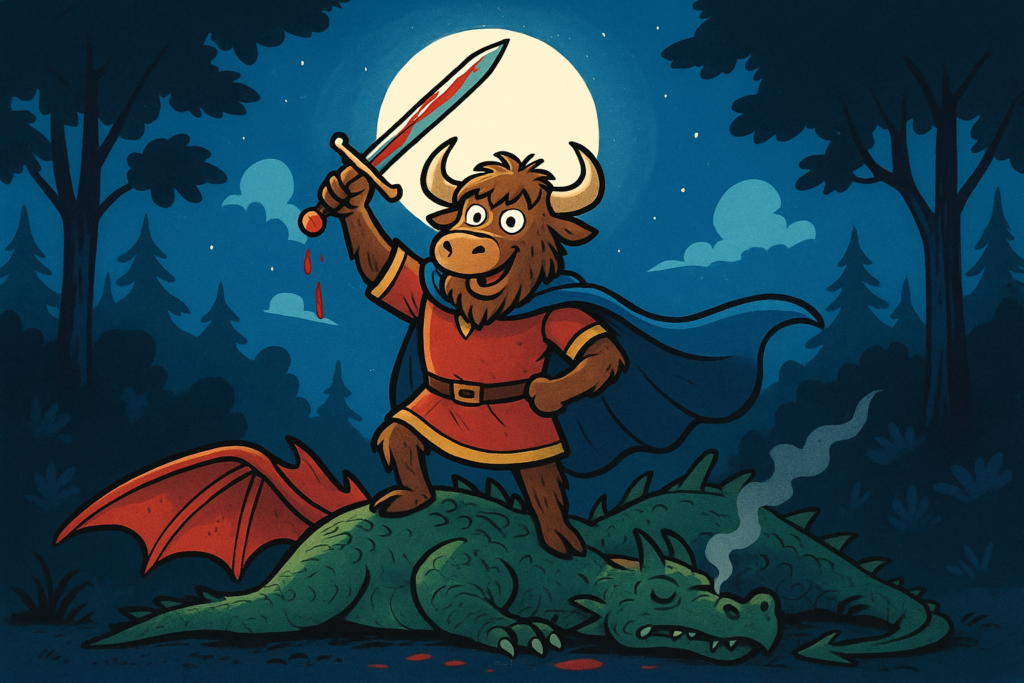
Join Siegfried, the fearless hero of the Nibelungen legend, as he sets out to slay a fearsome dragon and claim its treasure. In this retelling, you'll follow his journey into the dark forest, his clever battle with the beast, and the magical powers he gains from its blood. The story is presented in B1 German, perfect for intermediate learners ready to tackle longer narratives.
Every word is clickable, so you can translate unfamiliar terms instantly and keep reading without frustration. There's also full story audio to help you improve your listening skills, plus lesson notes that break down tricky grammar and vocabulary. It's a completely free, self-contained reading experience designed to bring German legends to life while you learn.
Es war einmal ein namens Siegfried. Er war und , aber auch etwas . Er lebte bei dem Schmied Mime im Wald.
Mime war kein guter . Er war und . Eines Tages er Siegfried von einem großen Drachen. "Dieser Drache bewacht einen riesigen Schatz", sagte Mime. "Er heißt Fafnir und ist sehr gefährlich."
Siegfrieds Augen . "Ich will den Drachen und den Schatz !" rief er. Mime nickte. "Dann brauchst du ein starkes Schwert. Ich werde eins für dich schmieden."
Mime ein Schwert. Aber als Siegfried es auf den schlug, es in viele Stücke. "Das ist kein Schwert für einen Helden!" lachte Siegfried. "Mach ein besseres!"
Da holte Siegfried die vom Schwert seines Vaters hervor. "Schmiede daraus mein Schwert", er. Mime arbeitete lange und das Schwert Notung. Es war scharf und glänzend. Siegfried hob das Schwert und den Amboss in zwei Teile. "Das ist ein Schwert für einen Helden!" rief er.
Am nächsten Morgen ging Siegfried . Er den Drachen im Wald. Plötzlich stand ein alter Mann mit einem breiten Hut vor ihm. "Willst du den Drachen töten?", fragte der Mann. "Ja", antwortete Siegfried. "Dann eine Grube auf seinem Weg. Verstecke dich darin und stoße dein Schwert in sein Herz, wenn er über dich kriecht", riet der Mann und .
Siegfried folgte dem Rat. Er grub eine tiefe Grube und legte sich hinein. Dann wartete er. Der Boden bebte, als der Drache näher kam.
Der Drache war . Feuer aus seinem Maul. Sein Atem war heiß und nach Gift. Siegfried blieb ruhig. Als der Drache über die Grube kroch, stieß er Notung mit aller Kraft nach oben.
Das Schwert in den Bauch des Drachen. Fafnir vor Schmerz. Blut auf Siegfried herab. Der Drache fiel zu Boden und sprach mit schwacher Stimme: "Du hast mich getötet, junger Held. Aber der Schatz ist . Er bringt jedem Unglück." Dann starb Fafnir.
Siegfried zog das Schwert heraus. Ein paar Tropfen Drachenblut auf seine Zunge. Plötzlich er die Sprache der Vögel. Die Vögel in den Bäumen : "Mime will dich töten! Er will den Schatz für sich allein!"
Voller kehrte Siegfried zurück. "Mime, du willst mich ?", rief er. Mime . "Nein, nein! Ich bin dein Freund!" Aber Siegfried sah die in seinen Augen und tötete ihn mit Notung.
Dann nahm Siegfried den des Drachen. Unter den Schätzen war ein aus Gold und ein . Er setzte den Helm auf und neue Kraft. "Jetzt bin ich bereit für neue Abenteuer", dachte er.
So tötete Siegfried den Drachen Fafnir und gewann den Schatz. Seine wurden bald im ganzen Land bekannt. Man nannte ihn den .
The tale of Siegfried is packed with vivid vocabulary that brings the medieval world to life. Let's focus on the most useful words for telling your own stories in German.
Many of these terms appear in fairy tales and legends, so they're great to have at your fingertips. Pay attention to how they're used in context.
- der Held (hero) – Siegfried is a junger Held; the word appears for brave figures.
- das Schwert (sword) – a classic weapon; notice the plural die Schwerter.
- der Drache (dragon) – often a dangerous creature in myths; here it's Fafnir.
- der Schatz (treasure) – always masculine, often guarded by a dragon.
- verflucht (cursed) – a strong adjective; the treasure is verflucht and brings Unglück.
- das Abenteuer (adventure) – neuter; Siegfried is ready for neue Abenteuer.
Written German stories almost always use the Präteritum (simple past). This is the tense you see throughout Siegfried's adventure. While you might use the Perfekt in everyday speech, the Präteritum is the natural choice for narration.
You'll notice many strong (irregular) verbs change their stem vowels. For example, 'gehen' becomes 'ging', 'schlagen' becomes 'schlug'. Regular verbs like 'erzählen' simply add -te.
- erzählte (erzählen) – Mime erzählte Siegfried von einem Drachen.
- ging (gehen) – Am nächsten Morgen ging Siegfried los.
- schlug (schlagen) – Siegfried schlug das Schwert auf den Amboss.
- zerbrach (zerbrechen) – Das Schwert zerbrach in viele Stücke.
- war (sein) – Er war stark und mutig.
- hatte (haben) – Siegfried hatte Notung in der Hand.
Great storytelling depends on more than just a sequence of events. Notice the connecting words and dramatic phrases that move the narrative forward and build suspense.
The story also includes typical legend elements: a prophecy (the curse), magical transformation (bird language), and a twist of fate. These devices make the tale memorable and emotionally engaging.
- Eines Tages (one day) – introduces a change or a new event.
- Plötzlich (suddenly) – signals a surprise; here, an old man appears.
- Dann (then) – moves the action step by step.
- So (thus/in this way) – wraps up the story neatly: So tötete Siegfried den Drachen…
Now it's your turn to wield the sword of storytelling! Try retelling a part of the legend in your own words, or invent a new adventure for Siegfried using the vocabulary and past tense you've just explored.
Don't worry about perfection—the goal is to play with the language and make the story your own. You could write a short paragraph beginning with 'Eines Tages…' and see where your imagination takes you.
- Write 4–5 sentences in Präteritum about a hero of your choice.
- Retell a key moment from Siegfried's quest—like forging the sword or the dragon's death.
Siegfried und der Drache comes from an older public-domain story tradition and is best known as a public_domain_legend_retelling. This Yak Yacker article is an original learner retelling based on public-domain source material, so the wording here is simplified for modern learners rather than copied from one old edition.
Older printings, translations, and retellings of this story can vary quite a bit. This version is adapted for B1 Intermediate learners studying German.
If you want to keep going, browse more in our German section and review the Goethe B1 German Vocabulary. After that, try German Comparative and Superlative Forms for another useful next step.