Welcome to a playful retelling of one of China's most beloved legends: the Monkey King's famous rebellion in the Heavenly Palace. In this A2 Elementary story, you'll follow the mischievous Sun Wukong as he leaps from cloud to cloud, outsmarts celestial guards, and stirs up glorious chaos among the gods. It's a delightfully fun way to strengthen your basic Chinese vocabulary and sentence patterns.
This interactive graded reader is designed especially for learners at the A2 level (upper beginner). As you read, you can tap difficult words for instant translations, listen to the full story audio to improve your listening skills, and review the key teaching points in our free lesson notes. The entire experience is free and self-contained-perfect for a relaxed study session or a quick, engaging review.
With its lively characters and humorous twists, 'Havoc in Heaven' introduces high-frequency verbs, descriptive adjectives, and authentic story structures. You'll laugh along with Sun Wukong's antics while building confidence in reading and understanding Chinese. So grab a peach (or cup of tea), press play, and enjoy the story!
从前,在花果山上,有一块神奇的大石头。有一天,石头裂开了,里面跳出来一只猴子。这只猴子会说话,会跑会跳,还会笑呢。猴子们非常喜欢他,就让他当了猴王。
孙悟空想学更加厉害的本事。他走了很远的路,找到了一位老神仙学习法术。他学会了七十二般变化,还能翻一个,一下就飞出。老神仙给他取了个名字,叫孙悟空。
孙悟空飞到东海龙宫,找老龙王要一件宝贝。龙王拿出了,那根神针能。孙悟空高兴极了,他有了自己的武器–金箍棒。
玉皇大帝听说了孙悟空的厉害,就让他上天做了官。孙悟空很开心,他到了天上,以为能得到。
但是,玉皇大帝只让孙悟空当了一个小小的养马官。孙悟空知道后,气得跳了起来。他大喊:"你们敢小看我!我是猴王,我要当齐天大圣!"说完,他就动起手来。
孙悟空闯进了,偷吃了很多仙桃。他又跑到,喝光了神仙们的仙酒。他还吃了太上老君的仙丹。天上被他搞得。
天兵天将都来孙悟空。可是孙悟空太厉害了,他用金箍棒把他们都。他哈哈大笑,大声说:"我是齐天大圣,谁也我!"
如来佛祖来了,他对孙悟空说:"你本事虽大,但能吗?"孙悟空大笑:"这还不简单!"他跳到佛祖手上,一个筋斗翻了出去。可他回来时,发现还在佛祖手裡。佛祖一翻手掌,,把他压在了。
Once upon a time, on the Mountain of Flowers and Fruit, there was a magical large rock. One day, the rock split open and a monkey jumped out. This monkey could talk, run, jump, and even laugh. The monkeys liked him very much and made him their king.
Sun Wukong wanted to learn even more powerful skills. He traveled a long way and found an old immortal to learn magic arts. He learned seventy-two transformations and could somersault on a cloud, covering 108,000 li in one leap. The old immortal gave him the name Sun Wukong.
Sun Wukong flew to the Dragon Palace of the Eastern Sea and asked the old Dragon King for a treasure. The Dragon King brought out the magical pillar that could shrink or expand. Sun Wukong was overjoyed-he now had his weapon, the Ruyi Jingu Bang.
The Jade Emperor heard of Sun Wukong's prowess and invited him to Heaven to be an official. Sun Wukong was very happy and went to Heaven, thinking he would get a good position.
But the Jade Emperor only made Sun Wukong a minor keeper of horses. When Sun Wukong found out, he was furious and jumped up. He shouted, 'You dare look down on me! I am the Monkey King, I want to be the Great Sage Equal to Heaven!' With that, he started fighting.
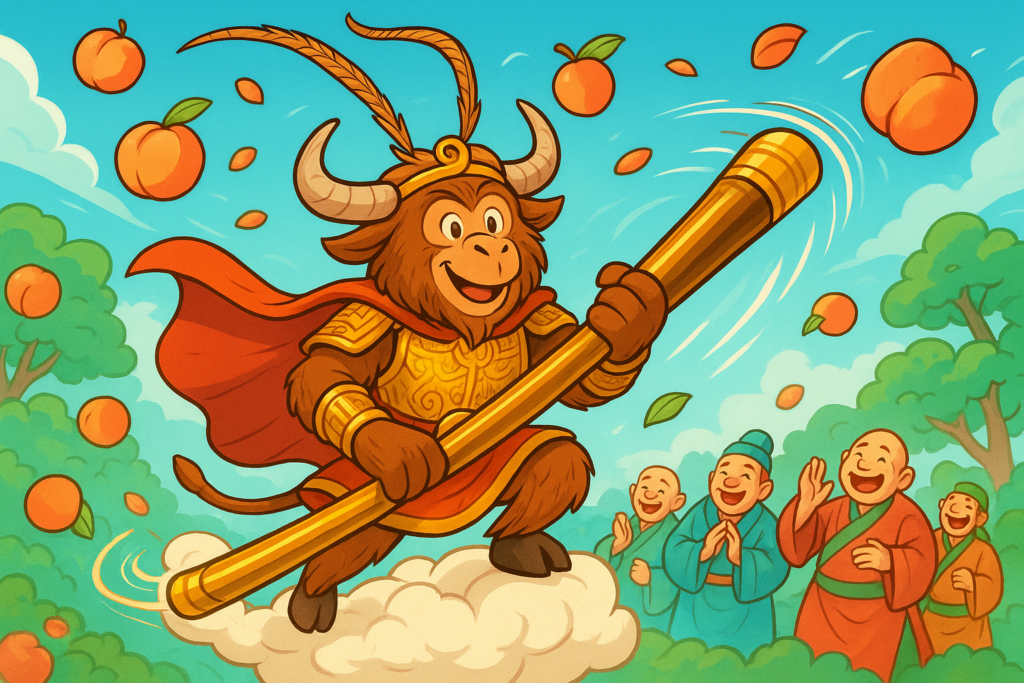
Sun Wukong broke into the Peach Garden and secretly ate many immortal peaches. Then he went to the Jade Pool and drank all the celestial wine. He also ate the Laojun's pills of immortality. Heaven was thrown into chaos.
Heavenly troops and generals came to capture Sun Wukong. But he was too powerful; with his Jingu Bang, he fought them all off. He laughed loudly and declared, 'I am the Great Sage Equal to Heaven, no one can defeat me!'
The Buddha came and said to Sun Wukong, 'You may have great abilities, but can you leap out of my palm?' Sun Wukong laughed, 'That's easy!' He jumped onto the Buddha's hand and somersaulted away. But when he returned, he was still in the Buddha's hand. The Buddha flipped his palm, and his five fingers turned into a mountain, pinning him under the Five Elements Mountain.
The Monkey King's story introduces words that paint a vivid picture of his world. Here are some key ones to help you retell his adventures with confidence.
These words combine basic characters you may know with new ones that capture the playful, larger-than-life spirit of the tale.
- 石头 (shítou) - stone; appears in 大石头 (big stone), the origin of the Monkey King.
- 裂开 (lièkāi) - split open; the stone 裂开了 and out jumped a monkey.
- 筋斗云 (jīndǒuyún) - somersault cloud; lets him travel 十万八千里 in one leap.
- 金箍棒 (jīngūbàng) - golden cudgel; his treasured weapon that can 变大变小 (grow big or small).
- 齐天大圣 (qítiān dà shèng) - 'Great Sage, Equal of Heaven'; the title he demands after feeling insulted.
Chinese doesn't change verbs for past tense, but it uses 了 (le) after a verb to show completion. Time words like 有一天 (yǒu yì tiān - one day) set the scene.
Notice how the story flows: 有一天,石头裂开了 (One day, the stone split open). The 了 tells you the action is done. Then the sequence continues naturally.
- Verb + 了 = completed action: 他学会了七十二般变化 (He learned 72 transformations).
- Time word + … + 了 = past context: 孙悟空飞到东海龙宫… (Sun Wukong flew to the Eastern Sea Dragon Palace…).
- Adding 了 after a verb-object phrase: 他偷吃了很多仙桃 (He stole and ate many immortal peaches).
- Tip: Don't overuse 了; the context often makes the timing clear.
The story pops with expressions like 哈哈大笑 (laugh heartily) and 气得跳了起来 (so angry he jumped up). These make the Monkey King's feelings burst off the page.
Chinese loves using reduplication and descriptive compounds to intensify. 乱糟糟 (luànzāozāo - messy/chaotic) is one example: repeating the sound paints a picture of things completely out of order.
- Verb + 得 + complement: 气得 (so angry that…) + 跳了起来 (jumped up).
- Adjective reduplication: 乱糟糟 → adds a sense of 'totally messed up'.
- Onomatopoeic laughter: 哈哈 (hāhā) mimics the sound, common in storytelling.
Try retelling a short episode-maybe his fight with the heavenly troops-using the words and patterns we explored. Don't worry about perfection; just play with the language.
You could also write a mini diary entry from the Monkey King's point of view: '今天我很生气,因为玉皇大帝只让我当养马官!' (Today I was furious because the Jade Emperor only made me a horse keeper!).
- Pick three new words from the list and use them in a sentence.
- Record yourself telling the story aloud-let your voice show the monkey's mischief.
- Swap out characters: What if the Monkey King visited your hometown?
Havoc in Heaven comes from the Chinese / Journey to the West tradition and is best known as a classic novel episode. This Yak Yacker article is an original learner retelling based on Journey to the West, 16th century; public domain, so the wording here is simplified for modern learners rather than copied from one old edition.
Older printings, translations, and retellings of this story can vary quite a bit. The original audience was usually kids/general, but this version is adapted for A2 Elementary learners studying Simplified Chinese. Very famous; simplify character names.
If you want to look into the source tradition, start with Project Gutenberg.
If you want to keep going, browse more in our Simplified Chinese section and review the HSK Level 1 Chinese Vocabulary. After that, try Essential Chinese Grammar Words for another useful next step.