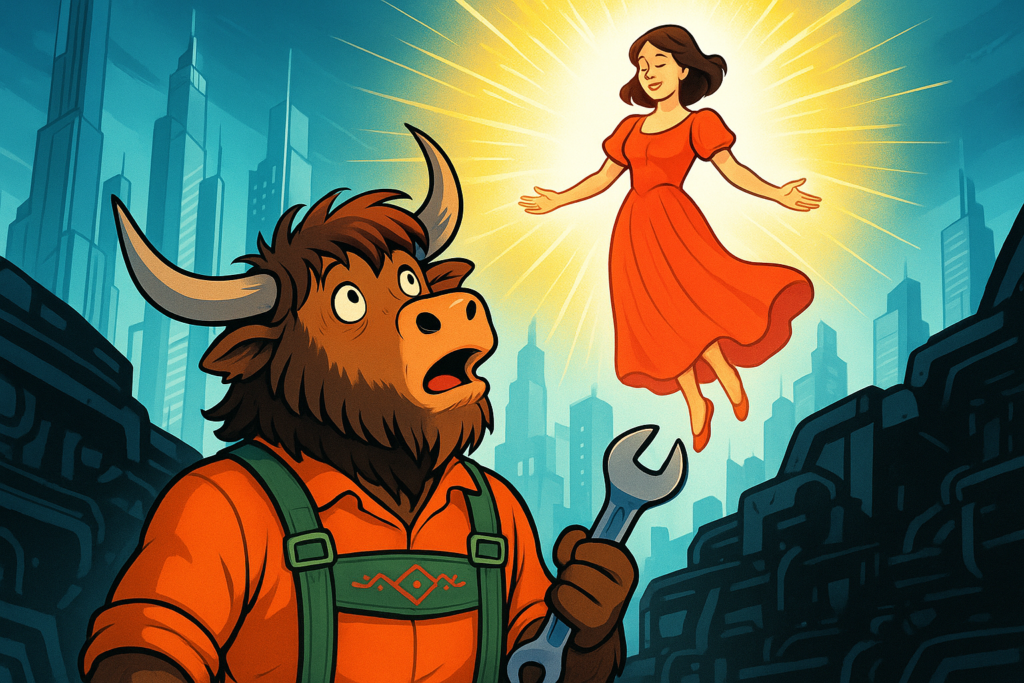
Metropolis is a timeless science fiction story set in a vast city of the future. The wealthy elite live in luxurious towers above ground, while the workers toil endlessly on machines deep below. When Freder, the privileged son of the city's ruler, falls in love with Maria, a woman from the worker class, he uncovers the harsh inequality and begins to dream of a world where the 'head and hands' are united by a heart.
This B1 German graded reader retells the classic tale with carefully simplified language, making it ideal for intermediate learners. As you read, every word is clickable for an instant English translation, so you never need to leave the story to check meaning. The narrated audio brings the futuristic atmosphere to life, helping you train your listening and pronunciation at the same time.
Best of all, it's a completely free interactive reading experience. Alongside the story, you'll find practical lesson notes that highlight key grammar and vocabulary, from describing technology and emotions to talking about social change. Immerse yourself in the world of Metropolis and take your German skills to the next level.
Metropolis ist eine voller und .
Über der Erde leben die Reichen in . Sie im 'Ewigen Garten' und kennen keine .
Tief unter ihren Füßen, im Dunkeln, die Arbeiter an . Sie sehen nie die .
Freder, der Sohn des Herrschers Joh Fredersen, im Garten mit seinen Freunden. Er , aber etwas .
Da eine Tür, und eine junge Frau in tritt ein. Eine folgt ihr.
'Seht her! Das sind eure Brüder und Schwestern!', mit klarer Stimme. Freder . Er hat so etwas noch nie .
Die Frau heißt Maria. Sie spricht von einer Zeit, in der alle Menschen sind. 'Mittler zwischen Hirn und Händen muss das sein', sagt sie leise.
Freder kann sie nicht . Er hinab in die Arbeiterstadt. Dort hört er das der Maschinen und sieht erschöpfte Gesichter.
Plötzlich eine der großen Maschinen! Schreie die Luft. Freder hilft, Verletzte zu , und fragt sich: 'Warum müssen sie so leiden?'
'Wenn mein Vater wüsste, wie es hier ist, würde er helfen', denkt Freder. Er seine Kleidung mit einem Arbeiter und stellt sich an eine Maschine.
Zehn Stunden er schwere . Seine Arme . Jetzt versteht er die Arbeiter wirklich.
Am Abend trifft er Maria wieder. Sie : 'Ich glaube an einen , der kommt. Eines Tages wird er die Welt verändern.'
Doch Freders Vater hat Angst. Er lässt einen Roboter , der genauso aussieht wie Maria – nur und ohne Herz.
Der falsche Maria-Roboter die Arbeiter zur Gewalt an. 'Zerstört die Maschinen!', er. Freder versucht, sie aufzuhalten: 'Nein! Gewalt ist keine Lösung!'
Die echte Maria wird , doch Freder sie. Gemeinsam retten sie die Kinder der Arbeiter aus den .
In dieser Gefahr erkennen die Arbeiter: Freder und Maria sind auf ihrer Seite. 'Vielleicht kann es doch ', flüstert ein alter Mann.
Am Ende treffen sich Joh Fredersen, Freder, Maria und die Arbeiter. Freder seines Vaters und sagt: 'Ohne Herz gibt es keine Zukunft. Hirn und Hände müssen .'
Langsam beginnen die Reichen und die Arbeiter, . Und Freder und Maria gehen – mit einem Lächeln in eine .
The story Metropolis paints a vivid contrast between two worlds. The shiny towers and technology of the upper city introduce words like der Turm (tower), die Technologie (technology), and hell (bright). Below, the workers' reality is heavy with die Maschine (machine), die Arbeiterin/der Arbeiter (worker), and dunkel (dark). These nouns and adjectives not only build the setting but also carry the emotional weight of inequality.
Beyond concrete objects, the story uses symbolic language. Maria’s call – 'Mittler zwischen Hirn und Händen muss das Herz sein' (the mediator between brain and hands must be the heart) – introduces abstract yet crucial B1 terms: das Hirn (brain), die Hand (hand), das Herz (heart), and der Mittler (mediator). These are key for discussing society and relationships.
- der Arbeiter / die Arbeiterin – worker
- die Maschine – machine
- der Turm – tower
- hell / dunkel – bright / dark
- das Herz – heart
- der Mittler – mediator
Freder imagines a different reality: 'Wenn mein Vater wüsste, wie schlimm es hier ist, würde er helfen.' (If my father knew how bad it is here, he would help.) This is a classic B1 structure: the subjunctive II (Konjunktiv II) for unreal or hypothetical situations. It’s formed with würde + infinitive for most verbs, or special forms like wüsste (from wissen), hätte, and wäre.
Use this mood to express wishes, dreams, or unreal conditions. Notice the word order in the wenn-clause: the verb comes last. You can also flip the sentence: 'Mein Vater würde helfen, wenn er wüsste, wie schlimm es ist.' Both patterns are common and useful for deeper conversations.
- würde + infinitive: würde helfen, würde sehen
- Irregular forms: wüsste (wissen), hätte (haben), wäre (sein)
- Wenn-Satz: verb at the end of the subordinate clause
- Example: Wenn ich mehr Zeit hätte, würde ich mit dir kommen.
Strong emotions drive the story forward: Maria cries out 'Seht her! Das sind eure Brüder und Schwestern!' (Look! These are your brothers and sisters!). Freder shouts 'Gewalt ist keine Lösung!' (Violence is no solution!). These short, impactful phrases use simple grammar but deliver powerful messages. The imperative (Seht!) and negation (keine Lösung) are tools you already have; now use them with conviction.
At B1, you can also soften or intensify statements to match the moment. For hope, a worker murmurs 'Vielleicht kann es doch anders werden' (Maybe things can change after all). The word doch adds a sense of 'despite everything' – a tiny word with big emotional weight. Experiment with such particles to sound more natural and empathetic.
- Imperative: Seht her! – Look! / Hört zu! – Listen!
- Negation for emphasis: keine Lösung – no solution
- Softening with vielleicht – maybe
- Emotional particle doch – expressing contrary hope or insistence
Freder’s journey from sheltered son to active ally is a story about listening and change. Now, take this language into your own discussions. Try retelling the story in your own words, or imagine a dialogue between Freder and his father using the subjunctive. Could you describe a social issue you care about using the vocabulary of ‘Hirn, Hände, Herz’?
Watch for these structures in German news, podcasts, or conversations. When you hear a sentence like 'Wenn es mehr Gerechtigkeit gäbe, würde die Welt anders aussehen', you’ll recognize the grammar and the spirit. Keep reading, keep speaking, and remember: every new word is a step toward a more human connection.
- Retell the Metropolis story in 5 sentences, using at least three new words.
- Write a short dialogue: 'Wenn ich der Herrscher wäre, …'
- Discuss: Was bedeutet 'Mittler zwischen Hirn und Händen' heute?
- Listen for Konjunktiv II in a German song or video this week.
Metropolis comes from an older public-domain story tradition and is best known as a public_domain_story_retelling. This Yak Yacker article is an original learner retelling based on public-domain source material, so the wording here is simplified for modern learners rather than copied from one old edition.
Older printings, translations, and retellings of this story can vary quite a bit. This version is adapted for B1 Intermediate learners studying German.
If you want to keep going, browse more in our German section and review the A1 German Vocabulary List. After that, try Essential German Grammar Words for another useful next step.