
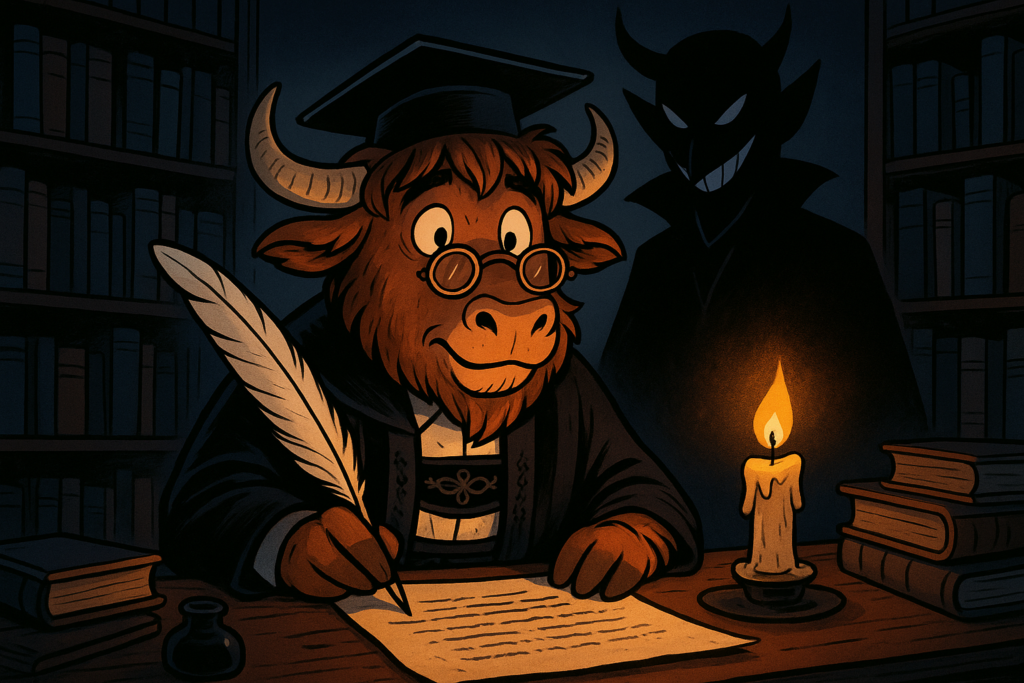
Dr. Faust sits alone in his study, surrounded by dusty books and flickering candlelight. He has mastered every science, yet feels empty and yearns for something more. A mysterious figure named Mephistopheles appears, offering unlimited knowledge and pleasure in exchange for Faust's soul. Desperate and ambitious, Faust agrees, setting off a chain of supernatural events that lead through passion, power, and ultimate regret. You can also listen to the full story audio on Yak Yacker.
This interactive graded reader brings the classic German legend to life for B1-level learners. Tap any word for an instant translation, listen to the full story narrated by a native speaker, and explore concise lesson notes that highlight key grammar and vocabulary. It's a free, self-contained reading experience designed to build your confidence with real German storytelling.
Es war einmal ein alter . Er hieß .
Faust saß in seinem Studierzimmer. Überall lagen . Aber er war .
Er hatte so viel – . Doch er fühlte sich .
„Ich weiß alles – und doch nichts!", rief er. „Das Leben hat keinen Sinn mehr."
In seiner beschwor er die Geister. Plötzlich ein Teufel. Sein Name war .
Mephistopheles trug . Er . „Du riefst, Herr Doktor? Was Ihr?", fragte er.
Faust nicht. „Ich will die Welt wirklich – nicht nur aus Büchern! Ich will , Macht und tiefes Wissen."
„Das kann ich Euch geben", sagte der Teufel. „Aber der ist Eure . Ich Euch auf der Erde, und danach dient Ihr mir in der Hölle."
Faust dachte nur kurz nach. Dann nahm er eine und den mit seinem Blut.
Sofort begann ein . Mephistopheles Faust die Welt. Sie durch Städte und Länder.
Faust Wein, Frauen und Gesang. Er wurde wieder . Aber wahre fand er nicht.
Eines Tages sah er ein Mädchen. Sie hieß Gretchen. Faust sofort.
„Hilf mir, Mephisto!", bat er. „Ich muss sie !" Der Teufel half mit und .
Doch die Liebe brachte großes . Gretchen verlor ihre und ihren . Am Ende wurde sie verhaftet.
Faust wollte sie . Aber Gretchen . „Ich auf Gott", flüsterte sie und starb in seiner Hand.
Faust fühlte tiefe . Er hatte so viel verursacht. „Was habe ich getan?", weinte er.
Am Ende seines Lebens Faust aufrichtig. Er half anderen Menschen und suchte die .
Als er starb, Engel und Teufel um seine Seele. Aber weil er wirklich , trugen die Engel ihn zum .
Mephistopheles laut. Aber er konnte nichts mehr tun. Die Liebe und die hatten Faust gerettet.
Once upon a time, there was an old scholar named Doctor Faust.
Faust sat in his gloomy study. Thick books lay everywhere, but he was unhappy.
He had learned so much-philosophy, medicine, law, and even theology-yet he felt empty.
"I know everything-and yet nothing!" he cried. "Life has no meaning anymore."
In despair, he summoned spirits. Suddenly, a devil named Mephistopheles appeared.
Mephistopheles wore fine black clothes and smiled mockingly. "You called, Doctor? What do you wish?" he asked.
Faust didn't hesitate. "I want to truly know the world-not just from books! I want pleasure, power, and deep knowledge."
"I can give you that," said the devil. "But the price is your soul. I'll serve you on Earth, and afterward you'll serve me in hell."
Faust thought only briefly. Then he took a quill and signed the pact with his blood.
A wild adventure began at once. Mephistopheles showed Faust the world, traveling through cities and countries.
Faust enjoyed wine, women, and song. He became young again, but found no true joy.
One day he saw an innocent girl named Gretchen and fell in love instantly.
"Help me, Mephisto!" he begged. "I must have her!" The devil helped with magic and trickery.
But the love brought great misfortune. Gretchen lost her family and reputation, and in the end was arrested.
Faust wanted to save her, but Gretchen refused. "I trust in God," she whispered and died in his arms.
Faust felt deep remorse. He had caused so much suffering. "What have I done?" he wept.
At the end of his life, Faust sincerely repented. He helped others and sought forgiveness.
When he died, angels and devils fought over his soul. But because he truly repented, the angels carried him to heaven.
Mephistopheles cursed loudly, but could do nothing more. Love and repentance had saved Faust.
Faust’s story is driven by powerful desires. The German language has a rich palette to express wanting, craving, and being tempted. Key words from the tale include 'der Wunsch' (wish), 'sich wünschen' (to wish), 'die Lust' (desire/pleasure), 'die Begierde' (stronger, often selfish desire), and 'die Versuchung' (temptation). 'Lust' often describes a robust enjoyment or drive, while 'Begierde' implies a deep, sometimes dangerous craving—like Faust’s thirst for experience.
To tempt or seduce someone is 'verführen', and the devil himself is a Verführer. You might also hear 'in Versuchung geraten' (to fall into temptation). In the story, Mephistopheles offers Faust everything he craves, making him face his deepest wishes.
- „Ich will die Welt wirklich kennen!- - Faust uses 'wollen' to express a strong desire.
- 'die Begierde' is more intense than 'der Wunsch'. A 'Wunsch' can be a simple wish, while 'Begierde' suggests an obsession.
- 'Lust auf etwas haben' means to feel like doing something, e.g., 'Ich habe Lust auf ein Abenteuer.'
When Faust signs the pact, he makes a monumental decision. German offers several ways to talk about decisions and their outcomes. The go-to verb is 'sich entscheiden' (to decide), often with 'für' (+accusative) or 'gegen' (+accusative): 'Er entschied sich für den Pakt.' Another common expression is 'eine Entscheidung treffen' (to make a decision). When things go wrong, you might need 'die Konsequenzen tragen' (to bear the consequences) or 'die Folgen spüren' (to feel the effects).
To connect cause and effect, use conjunctions like 'weil' (because), 'deshalb' or 'darum' (therefore), and 'so dass' (so that). For example: 'Faust bereute seine Entscheidung, weil sie Gretchen ins Unglück stürzte.' Or: 'Er traf eine schnelle Entscheidung. Deshalb musste er später die Konsequenzen tragen.'
- sich entscheiden für/gegen: Ich habe mich für den neuen Job entschieden.
- eine Entscheidung treffen: Faust traf eine fatale Entscheidung.
- zu etwas bereit sein: Er war bereit, seine Seele zu verkaufen.
- Konsequenzen tragen: Am Ende musste er die schweren Konsequenzen tragen.
Faust’s journey ends in deep remorse, and the story uses emotionally charged words like 'Reue' (remorse) and 'bereuen' (to regret). 'Bereuen' is stronger than a simple 'Entschuldigung'. When you say 'Ich bereue es', you are expressing heartfelt regret about a past action. 'Leidtun' ('Es tut mir leid') is more common for everyday apologies, while 'bedauern' is a formal way to express regret, similar to 'Ich bedauere diesen Fehler.'
Notice how Gretchen’s quiet trust contrasts with Faust’s earlier arrogance. Her words, 'Ich vertraue auf Gott,' show a shift from hopelessness to faith. For your own conversations, you might use 'Ich hätte das nicht tun sollen' (I shouldn’t have done that) to express regret without the weight of 'bereuen'. Both are useful, but the emotional intensity differs.
- bereuen: Faust bereute seine Entscheidung zutiefst.
- Reue empfinden/zeigen: Er zeigte echte Reue und half anderen.
- leidtun: Es tut mir leid, dass ich dich verletzt habe.
- Ich hätte … nicht tun sollen: Ich hätte den Pakt nicht unterschreiben sollen.
You’ve seen how desire, decisions, and regret shape Faust’s story. Try turning these abstract ideas into your own German sentences. What have you wished for lately? Can you recall a difficult choice and describe how it turned out? Use the vocabulary and structures from this lesson to talk about moments big or small.
A gentle challenge: write three sentences about Faust’s experience, one with 'sich entscheiden', one with 'bereuen', and one with 'deshalb'. Then, if you’re feeling brave, swap in your own story. Language comes alive when it’s personal, and these expressive words will help you share your own tales of longing, decisions, and perhaps a little regret.
Faust - Eine deutsche Legende comes from an older public-domain story tradition and is best known as a public_domain_story_retelling. This Yak Yacker article is an original learner retelling based on public-domain source material, so the wording here is simplified for modern learners rather than copied from one old edition.
Older printings, translations, and retellings of this story can vary quite a bit. This version is adapted for B1 Intermediate learners studying German.
If you want to keep going, browse more in our German section and review the B1 German Vocabulary List. After that, try German Comparative and Superlative Forms for another useful next step.