Read this story on Yak Yacker with clickable word help, full story audio, and lesson notes below the text.
This version is written for English-speaking learners who want a friendly reading experience in English.
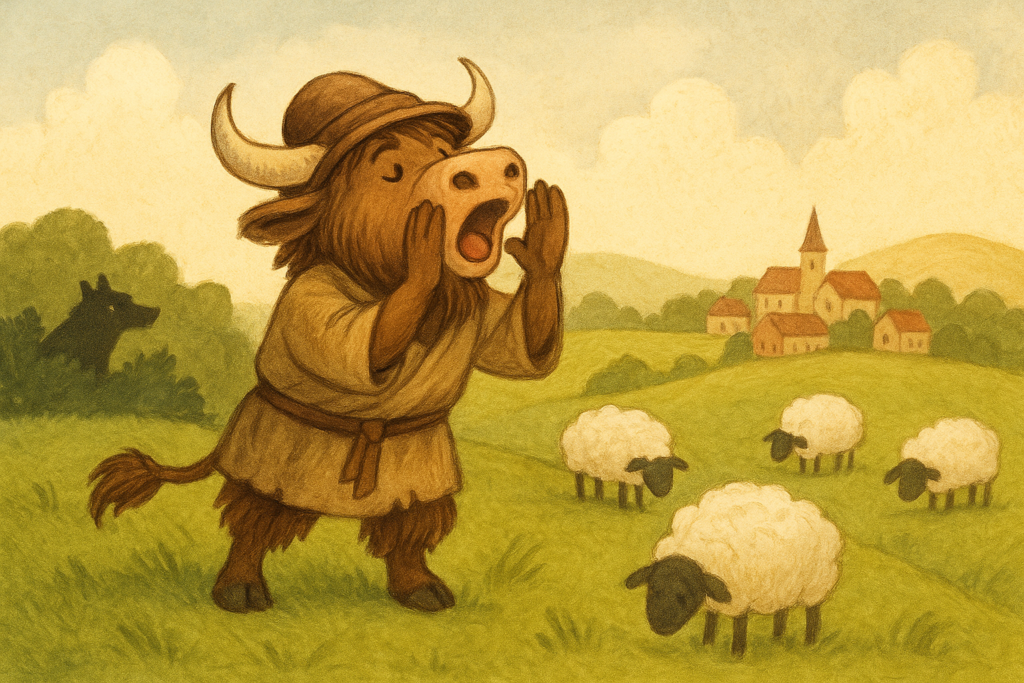
Once there was a . He the sheep on a .
He was very . He some fun. So he , 'Wolf! Wolf! A wolf is attacking the sheep!'
The villagers him. They up the hill. But there was no wolf.
The boy . 'It was just a !' he said. The villagers were . 'Do not when there is no wolf!' they said.
The next week, the boy was bored again. He , 'Wolf! Wolf! A wolf is the sheep!' Again the villagers . Again, there was no wolf.
The villagers were very . 'You to us!' they said. 'We will not .'
Then, a came. The boy shouted, 'Wolf! Wolf! A big wolf! Please !' But no one came. The wolf the sheep away. The boy cried. He learned that no one believes a .
A young shepherd boy watched sheep on a green hill.
He was bored and wanted fun. He shouted that a wolf was attacking the sheep.
The villagers ran up the hill but saw no wolf.
The boy laughed and said it was a joke. The angry villagers told him not to cry wolf when there is no wolf.
The next week, he again shouted about a wolf. The villagers ran to help but found no wolf again.
The villagers were angry because he lied. They said they would not come again.
Later, a real wolf came. The boy shouted for help, but no one came. The wolf chased the sheep away. The boy learned that liars are not believed.
Here are some words from the story. Can you remember them?
- shepherd: a person who takes care of sheep
- sheep: animals with wool
- bored: feeling unhappy because you have nothing to do
- shout: speak very loudly
- wolf: a wild animal like a big dog
- villagers: people who live in a village
The story uses the past tense because it happened before. For many verbs, add -ed to make the past: shout → shouted, watch → watched. Some verbs change: run → ran, come → came.
The story teaches us: if you tell lies, people will not believe you later, even when you say the truth. The villagers learned not to trust the boy.
- Always tell the truth.
- A liar is not believed, even when he tells the truth.
Try to tell the story to a friend or family member. Use the new words! You can also write three sentences about the story.
- What did the boy do wrong?
- Why didn't the villagers come?
- What do you think the boy learned?
The Boy Who Cried Wolf comes from an older public-domain story tradition and is best known as a public_domain_fable_retelling. This Yak Yacker article is an original learner retelling based on public-domain source material, so the wording here is simplified for modern learners rather than copied from one old edition.
Older printings, translations, and retellings of this story can vary quite a bit. This version is adapted for A1 Beginner learners studying English.
If you want to keep going, browse more in our English section and review the A1 English Vocabulary List. After that, try English Question Words for another useful next step.