This A2 Elementary retelling of The Gold Rush keeps the plot clear for learners while still giving the story some atmosphere and momentum. Tom lived in a small town. One day, a man came with exciting news.
This version is written for English-speaking learners and includes clickable word help inside the story, full story audio, and lesson notes after the reading. It is free to use on Yak Yacker and is designed to feel natural, readable, and manageable in English.
Tom lived in a small town. One day, a man came with . 'Gold! They found gold in California!' he shouted.
Tom's . 'Gold? ?' he asked. 'Yes!' said the man. 'People are !'
Tom talked to his family. 'I want to ,' he said. 'I will for us.' His mother looked but smiled.
Tom packed his bag and started his . He walked for many days. He rivers and mountains. 'I will not stop,' he said to himself.
Finally, he in California. Many people were there. Some in the river. Some looked tired but . Tom found a spot by the water.
He worked hard every day. Dig, wash, look. Nothing. Dig, wash, look. Still nothing. Then one afternoon, something appeared in his pan. 'Could it be?' he .
It was a small gold nugget! Tom danced with joy. 'I found gold!' he yelled. Other people came to see. They for him.
Tom did not become the richest man, but he found enough gold to help his family. He went home with a . He always remembered his .
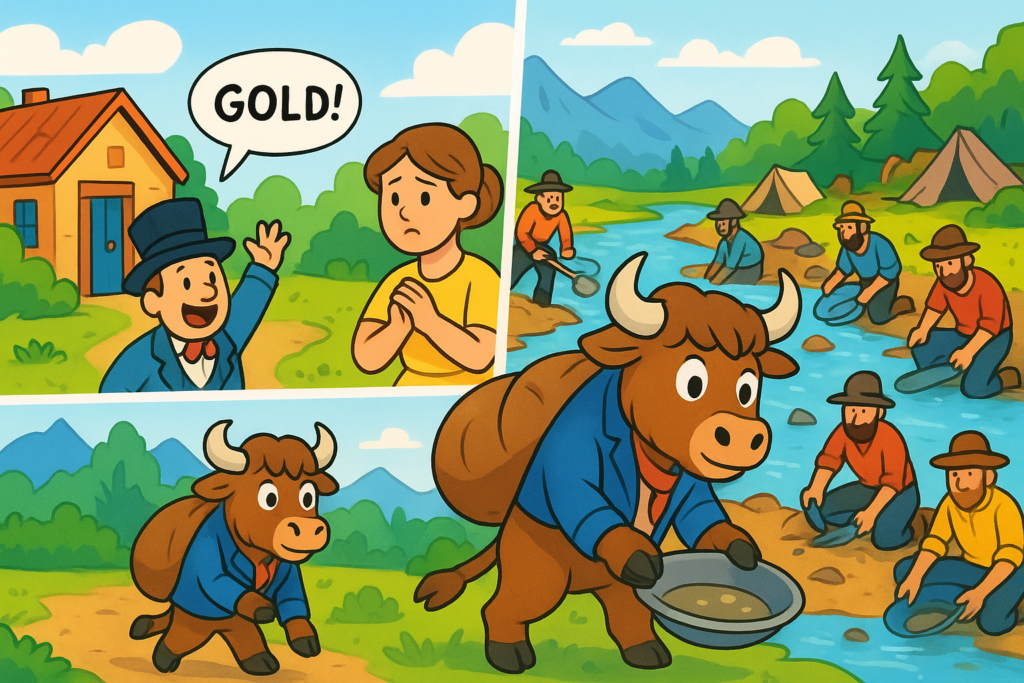
Tom lived in a small town. A man came with exciting news. He shouted, "Gold! They found gold in California!"
Tom was surprised. He asked, "Gold? Real gold?" The man said, "Yes! People are becoming rich!"
Tom told his family, "I want to go to California. I will find gold for us." His mother was worried but smiled.
Tom packed and started his long trip. He walked many days, crossing rivers and mountains. He told himself, "I will not stop."
He arrived in California. Many people were there, digging in the river. Some were tired but hopeful. Tom found a place by the water.
He worked hard every day: dig, wash, look. He found nothing. One afternoon, he saw something shiny in his pan. He whispered, "Could it be?"
It was a small gold piece! Tom danced happily. He yelled, "I found gold!" Others came and cheered.
Tom didn't become very rich, but he found enough gold to help his family. He went home happy, always remembering his big adventure.
Let's look at some key words from Tom's adventure. These will help you talk about discoveries, journeys, and big emotions.
Notice how the story uses simple but vivid words like <em>shiny</em> and <em>nugget</em> to paint a picture. Try to picture them as you read.
- gold rush - a time when many people hurry to a place to find gold
- nugget - a small, rough piece of gold or another metal
- pan (for gold) - a shallow metal dish used to wash sand and find gold
- shiny - giving a bright light when light hits it; something that sparkles
Tom's story happens in the past, so it uses the past simple tense a lot. For regular verbs, we add <em>-ed</em>: <em>walked</em>, <em>packed</em>, <em>shouted</em>.
But many common verbs are irregular. Look at these from the text: <em>came</em> (come), <em>found</em> (find), <em>said</em> (say), <em>went</em> (go). You just have to learn them by heart!
- Regular: work → worked, cross → crossed, arrive → arrived
- Irregular: dig → dug, see → saw, find → found, go → went
- Question form: 'Did Tom find gold?' (not 'Did Tom found')
- Negative: 'He did not stop.' (didn't stop)
The story shows how Tom expresses excitement and hope. Notice the short, powerful sentences: <em>Gold! Real gold?</em> and <em>I will find gold for us.</em>
Using exclamation marks and phrases like <em>Could it be?</em> makes the moment feel alive. Try these when you want to share your own excitement or wonder.
- Use <em>Could it be?</em> to show surprise and hope
- Say <em>I will …</em> to make a promise or show strong intention
- Simple shouts: <em>I found it!</em> or <em>Look!</em> are natural for happy discoveries
Now it's your turn! Think about a time you wanted something very much. Did you work hard for it? What happened in the end?
Write a few sentences using the past simple, and include at least one feeling word. Even a short paragraph can be a little adventure like Tom's.
The Gold Rush comes from the American / public-domain screen or print culture tradition and is best known as a silent feature film. This Yak Yacker article is an original learner retelling based on 1925 film; public domain in U.S., so the wording here is simplified for modern learners rather than copied from one old edition.
Older printings, translations, and retellings of this story can vary quite a bit. The original audience was usually general/family, but this version is adapted for A2 Elementary learners studying English. Use original silent film version; later soundtrack edits may differ.
If you want to look into the source tradition, start with Project Gutenberg.
If you want to keep going, browse more in our English section and review the A2 English Vocabulary List. After that, try English Question Words for another useful next step.