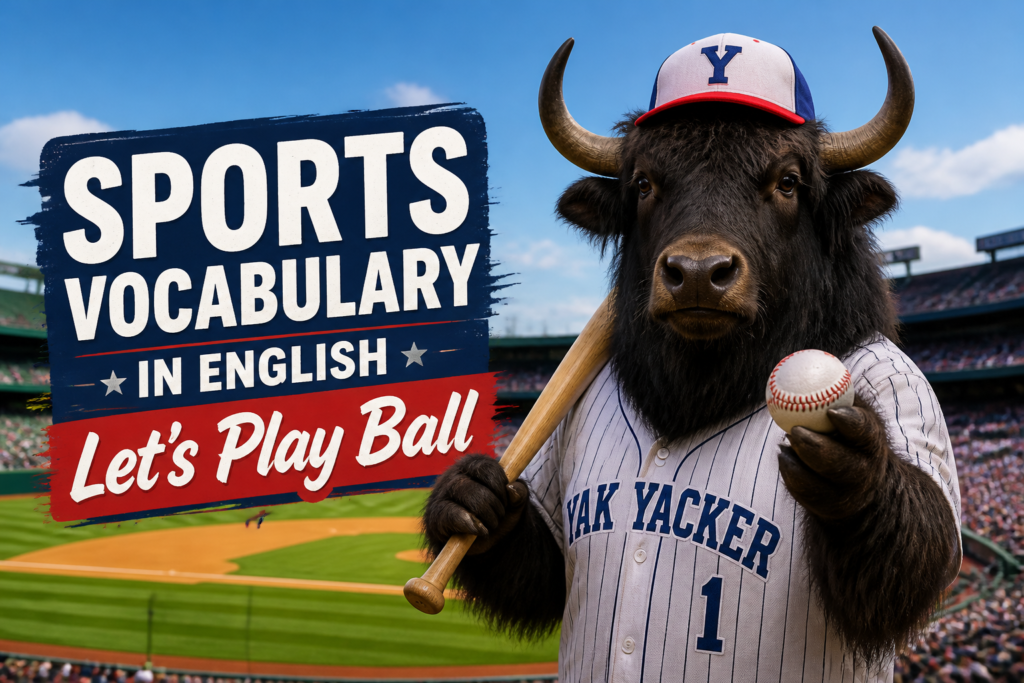
Sports English is everywhere: on TV, in school, at work, in text messages, and yes, in those very serious conversations where someone says, “I’m a little competitive,” and then behaves like a champion with homework. If you like sports, this vocabulary can help you talk about games, teams, scores, equipment, and the little phrases people shout when things get exciting.
By the end of this article, you will know useful sports words and phrases in practical English, with simple pronunciation help, clear meanings, and real example sentences. No confusing locker-room poetry. Just the language people actually use.
If you want more English practice after this, try the English Vocabulary Test or the English Placement Test CEFR. If you want the bigger learning picture, the main hub is Learn English.
Useful Sports Words And Phrases
Here are the most useful sports words first, followed by phrases you will hear in real life. These are great for talking about games, watching sports, joining a team, or just sounding less lost when someone says, “We were down by two points at halftime.”
| English | Pronunciation | Meaning | Example Sentence | Learner Note |
|---|---|---|---|---|
| sport | spawrt | a physical game or activity | Soccer is my favorite sport. | Singular and general. “Sports” is the plural form. |
| team | teem | a group of players who play together | Our team won the match. | Used for both small and large groups in sports. |
| player | PLAY-er | a person who plays a sport | She is a great player. | Common in almost every sport. |
| coach | kohch | a person who trains and guides players | The coach gave us advice after practice. | Can also be a person who trains athletes outside a school. |
| game | gaym | a sports event; also a match | We watched the game last night. | In American English, “game” is very common for sports events. |
| match | match | a sports competition | The match starts at 7 p.m. | More common in British English; still understood in American English. |
| score | skor | the number of points or goals in a game | The final score was 3–1. | Also a verb: “They scored twice.” |
| goal | gohl | a point in soccer/hockey; also the place you score into | He scored a goal in the second half. | Important in soccer and hockey. |
| point | poynt | a unit used to count in many sports | They won by two points. | Common in basketball, tennis, and many other sports. |
| win | win | to be the best in a game or competition | Our school team won the tournament. | Opposite: lose. |
| lose | looz | to not win | They lost the final game. | Pronounced with a long “oo” sound: looz. |
| tie / draw | tye / draw | a game with the same score for both sides | The game ended in a tie. | “Tie” is common in American English; “draw” is common in British English. |
| practice | PRAK-tiss | training for a sport | I have soccer practice after school. | Also a verb: “We practice every day.” |
| training | TRAY-ning | preparation and exercise for a sport | His training is very intense. | Often sounds a little more serious than “practice.” |
| exercise | EK-ser-size | physical activity to stay fit | Exercise helps athletes stay strong. | Common in fitness and health, not only sports. |
More Sports Phrases You Will Hear
These phrases show up in interviews, commentary, and everyday conversation. Some are literal. Some are a little dramatic, because sports people apparently never met a calm sentence they liked.
| English | Pronunciation | Meaning | Example Sentence | Learner Note |
|---|---|---|---|---|
| kick off | kick off | to start a game; to begin something | The tournament kicks off on Friday. | Common in soccer and also for events. |
| play ball | play bawl | to cooperate; also to start playing baseball | If you want the deal, you need to play ball. | Idiomatic meaning is common in business and casual speech. |
| step up to the plate | step up too the پلیٹ | to take responsibility or act bravely | She stepped up to the plate and led the team. | From baseball; now used more broadly. |
| go the distance | goh thuh DIS-tuhns | to continue all the way to the end | The boxer went the distance. | Can also mean to keep trying until the end. |
| be on the ball | bee on the bawl | to be quick, alert, and smart | You need to be on the ball in this fast game. | Good for sports and work situations. |
| score a point | skor uh poynt | to get one point | She scored a point on the last play. | Very common in tennis, basketball, and volleyball. |
| score a goal | skor uh gohl | to put the ball into the goal | He scored a goal in the first minute. | Mostly used in soccer, hockey, and similar sports. |
| make a comeback | mayk uh KUM-bak | to return strongly after losing | The team made a comeback in the second half. | Very common in sports news. |
| lose by one point | looz by wuhn poynt | to lose with a very small difference | They lost by one point. | A useful pattern for scores. |
| beat a team | beet uh teem | to win against another team | They beat the champions. | “Beat” is irregular: beat, beat, beaten. |
| draw with | draw with | to tie with another team | Our team drew with the rivals. | More common in British English. |
| in the lead | in thuh leed | ahead in the score | She is in the lead now. | Useful in races and competitions. |
| catch up | kach up | to reach the same level or score | The team caught up in the final minutes. | Very common in sports and daily English. |
| overtime | OH-ver-tym | extra time after the normal game ends | The game went into overtime. | Common in American sports. |
| half-time | haf tym | the break between halves | At half-time, the coach changed the plan. | British spelling uses a hyphen; American English often writes “halftime.” |
Sports Equipment And Places
If you want to talk about gear, fields, and places, these words are very handy. They also stop you from saying “that thing” too many times. Which, let’s be honest, happens.
| English | Pronunciation | Meaning | Example Sentence | Learner Note |
|---|---|---|---|---|
| ball | bawl | a round object used in many sports | We need a new ball for practice. | Simple and very common. |
| bat | bat | a long object used to hit a ball | He bought a new bat for baseball. | Used in baseball and cricket. |
| racket | RAK-it | a sports tool used in tennis, badminton, and squash | My racket is in my bag. | American spelling: racket. “Rocket” is a different word, sadly. |
| helmet | HEL-met | protective headgear | Always wear a helmet when cycling. | Common in cycling, hockey, and motor sports. |
| uniform | YOO-nih-form | the special clothes a team wears | The team wore blue uniforms. | Can also be called a kit in British English. |
| field | feeld | a place where many outdoor sports are played | The players ran onto the field. | Common in American English. |
| court | kort | a place for tennis, basketball, volleyball, and similar sports | The tennis court was busy. | Important word for racket sports and basketball. |
| stadium | STAY-dee-um | a large place for sports events | The stadium was full of fans. | Can also be used for concerts. |
| track | trak | a running lane or course | The race started on the track. | Used in athletics and running. |
| goal post | gohl pohst | the post that marks the goal area | The ball hit the goal post. | More common in soccer and American football. |
| net | net | the mesh barrier in some sports | The ball landed in the net. | Used in tennis, volleyball, and soccer goals. |
| whistle | WIS-uhl | a small sound tool used by referees and coaches | The referee blew the whistle. | Very common in sports instruction. |
People In Sports
Not everyone on the field is trying to score. Some people are helping, judging, cheering, or keeping everyone from turning the game into chaos.
| English | Pronunciation | Meaning | Example Sentence | Learner Note |
|---|---|---|---|---|
| referee | ref-uh-REE | the official who makes the rules work during a game | The referee made a difficult call. | Often shortened to “ref.” |
| umpire | UM-pyre | an official in baseball, tennis, and some other sports | The umpire called the player out. | Very common in baseball and cricket. |
| spectator | SPEK-tay-ter | a person who watches a game | The spectators cheered loudly. | More formal than “fan.” |
| fan | fan | someone who likes a team or player | She is a big fan of basketball. | Very common in everyday English. |
| captain | KAP-tin | the leader of a team | The captain spoke to the referee. | Can also mean a ship leader, so context matters. |
| opponent | uh-POH-nuhnt | the person or team you play against | Our opponent was very strong. | Useful in sports and arguments, because English enjoys recycling words. |
| teammate | TEEM-mayt | a person on the same team | My teammate passed me the ball. | Very common and friendly word. |
| rookie | ROOK-ee | a new player | The rookie played surprisingly well. | Casual and very common in American sports. |
Sports Verbs You Should Know
Verbs are the action words. In sports English, they do a lot of heavy lifting. Here are the ones you will hear all the time.
- play — to take part in a sport
- score — to get points or goals
- pass — to give the ball to another player
- shoot — to try to score by throwing or kicking the ball
- kick — to hit the ball with your foot
- hit — to strike a ball with a bat, racket, hand, or other part
- throw — to send the ball through the air with your hand
- catch — to grab a ball in the air or after it is thrown
- run — to move quickly on your feet
- train — to prepare for a sport through practice and exercise
- compete — to try to win against others
- defend — to stop the other team from scoring
- attack — to try to score or put pressure on the other team
- celebrate — to show happiness after a win or goal
- cheer — to shout support for a player or team
Example: She passed the ball, ran forward, and scored. Nice and simple. Sports English loves short action chains like that.
Sports Result Words
When people talk about games, they often use the same score words again and again. That is helpful, because sports commentary likes to move fast and assume everyone is emotionally invested.
| English | Pronunciation | Meaning | Example Sentence | Learner Note |
|---|---|---|---|---|
| halftime | HALF-tym | the break between the two halves of a game | We talked during halftime. | American spelling usually has no hyphen. |
| final | FYE-nuhl | the last game in a tournament or competition | The final was exciting. | “Final” can also mean last in general. |
| tournament | TOOR-nuh-ment | a series of games to find a winner | The tournament lasts all week. | Common in school sports and professional sports. |
| league | leeg | a group of teams that compete together | He plays in a local league. | Common in American football, basketball, and baseball. |
| champion | CHAM-pee-uhn | the winner | They became the champions. | Can also describe a very strong person or thing. |
| record | REK-erd / ree-KORD | a best result; also to write down information | She broke the school record. | Stress changes meaning: REK-erd = noun, ree-KORD = verb. |
| tie game | tye gaym | a game with equal scores | It was a tie game after regulation time. | Very common in American English. |
| season | SEE-zuhn | the part of the year when a sport is played | The season starts in September. | Also used for weather and TV shows, so context matters. |
Common Sports Phrases In Real Life
Some sports phrases are also used outside sports. That is one reason they are so useful. English loves to borrow from games and pretend it was always a business meeting.
- That was a close game. — The score was very near.
- They are ahead by three points. — They have a higher score.
- We are behind. — We have a lower score.
- The team is under pressure. — The team is in a difficult situation.
- The coach made a smart decision. — The coach chose well.
- He missed the shot. — He tried to score but failed.
- She made the shot. — She successfully scored.
- The player was injured. — The player got hurt.
- The referee stopped the game. — The referee ended or paused the game.
- The crowd went wild. — The fans became very excited.
- It was a tough loss. — Losing was hard emotionally.
- They played well as a team. — They worked together effectively.
American And British Differences
Sports English changes a little depending on where you are. Not wildly, but enough to trip up learners if nobody warns them.
| American English | British English | Use |
|---|---|---|
| soccer | football | The sport played with a round ball and goals |
| game | match | A sports competition |
| tie | draw | When both sides have the same score |
| halftime | half-time | The break in the middle of a game |
| team gear | kit | The uniform and equipment a team uses |
Learner note: if you are talking with international English speakers, football can mean different sports. If needed, be specific and say soccer for American English or association football for formal writing.
Quick Pronunciation Help
A few sports words cause trouble because they look simple but still manage to be annoying. English is elegant like that.
- coach — one syllable, rhymes with “roach”
- racket — stress on the first syllable: RAK-it
- referee — stress on the last syllable: ref-uh-REE
- opponent — uh-POH-nuhnt, with stress on the second syllable
- tournament — TOOR-nuh-ment, not “tour-na-MENT”
- record — noun: REK-erd; verb: ree-KORD
- score — rhymes with “more”
- goal — rhymes with “soul”
Yak wisdom: In sports English, short words do a lot of work. A few simple verbs and phrases can carry an entire conversation. Convenient, almost suspiciously so.
Practice Time
Try these quick exercises. If they feel easy, great. If not, that just means your brain is doing warm-up stretches.
1) Fill In The Blank
- The team won by two _____.
- She scored a _____ in the last minute.
- The game went into _____.
- We have soccer _____ after school.
- The _____ blew the whistle.
Answers: points, goal, overtime, practice, referee.
2) Choose The Best Word
- A person who leads the team: coach or captain?
- A place to play tennis: court or field?
- A sports event with many games: tournament or helmet?
- A person who watches the game: fan or umpire?
- To get the ball to another player: pass or kick?
Answers: captain, court, tournament, fan, pass.
3) Sentence Upgrade
Make these sentences more natural:
- I like sports. → I like playing sports / I’m a sports fan.
- They won the game. → They won the match / They beat the other team.
- He got one point. → He scored a point.
- The game is starting. → The game is kicking off.
Common Mistakes And Fixes
Here are a few mistakes learners make with sports vocabulary. They are normal, but we can clean them up before they sneak into your English forever.
| Wrong | Better | Why |
|---|---|---|
| He made a goal. | He scored a goal. | In English, we usually score a goal, not make it. |
| The team has won by two points. | The team won by two points. | Use the simple past for completed games. |
| We are in the first half-time. | We are in the first half. | Half-time is the break, not the period of play. |
| He is a good sportsman. | He is a good athlete. | Athlete is more natural for someone who competes in sports. |
| The team was defeated with 3-1. | The team lost 3–1. | Lost 3–1 is simpler and more natural in everyday English. |
Small note: athlete means a person who plays sports seriously or professionally. Sportsman exists, but it sounds old-fashioned or formal in many places.
Mini Glossary Of Useful Sports Collocations
Collocations are words that naturally go together. Learning them helps your English sound more smooth and less like a robot trying to pass a spelling test.
- score a goal
- score a point
- win a match
- lose a game
- play a game
- make a pass
- take a shot
- train hard
- watch a game
- cheer for a team
- join a team
- break a record
Example: She trains hard and often breaks school records. That is a very nice sports sentence. Short, clear, and a little heroic.
Quick Reference Summary
- People: player, coach, referee, umpire, fan, teammate, captain
- Actions: play, score, pass, shoot, kick, hit, catch, train
- Results: win, lose, tie, draw, beat, record, champion
- Places and gear: field, court, stadium, track, ball, bat, racket, helmet
- Useful phrases: kick off, be on the ball, make a comeback, go the distance, play ball
One simple rule: if you can talk about who is playing, what they use, what they do, and who won, you already have a strong sports vocabulary foundation.
Yak takeaway: sports English is full of short, powerful words. Learn the basics first, use them in real sentences, and suddenly the scoreboard is not the only thing that looks better.