Welcome to our free A2 elementary English retelling of Little Red Riding Hood. This classic fairy tale has been rewritten in simple English, perfect for learners.
Click on any word you don't know to see its meaning instantly. After the story, check out our helpful lesson notes to review key vocabulary and grammar.
Enjoy reading and improving your English!
Little Red Riding Hood lived in a . She always wore a with a hood. Everyone called her Little Red Riding Hood. One morning, her mother said, "Take this to Grandma. She is not well. and ."
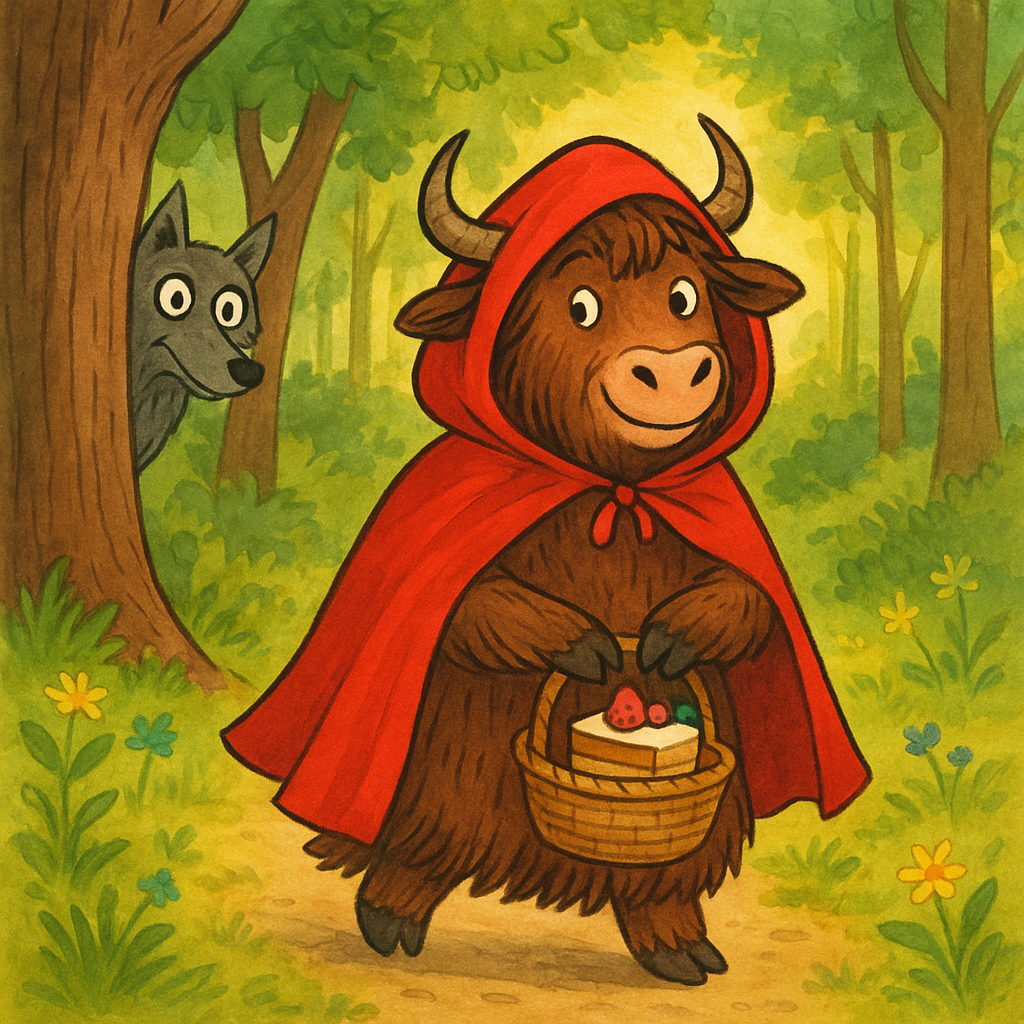
Little Red Riding Hood took the basket. It had cake and fruit. She walked into the . She picked . Then a big wolf . "Hello, little girl," the wolf said. "Where are you going?"
"I am going to my grandmother's house," she said. "She lives in the forest." The wolf and said, "Goodbye." Then he .
The wolf ran to Grandma's house. He went and Grandma. Then he put on her and glasses. He waited in the bed.
Later, Little Red Riding Hood arrived. She saw the and went inside. "Grandma, what big eyes you have!" she said. "All the better to see you with," the wolf said. "Grandma, what big you have!" "All the better to hear you with." "Grandma, what big you have!" "All the better to eat you with!"
The wolf . A woodcutter heard the and ran inside. He Little Red Riding Hood and Grandma. They all lived .
A girl named Little Red Riding Hood lived in a village. She always wore a red hood. One day, her mother sent her with a basket to her sick grandma, telling her to stay on the path.
She took the basket of cake and fruit into the forest. While picking flowers, a wolf asked her where she was going.
She told the wolf she was going to her grandmother's house in the forest. The wolf said goodbye and ran off.
The wolf ran to Grandma's house, ate her, and disguised himself in her nightgown and glasses, waiting in bed.
When Little Red Riding Hood arrived, she went in and noticed Grandma's big eyes, ears, and teeth. The wolf said that the teeth were for eating her.
The wolf jumped out, but a woodcutter heard the noise, saved the girl and Grandma, and they lived happily ever after.
The story is full of useful words. Let's look at some key ones you can use in everyday English.
- Cloak: a loose coat, often with a hood. Red Riding Hood wore a red cloak.
- Basket: a container to carry things. She took a basket with cake and fruit.
- Path: a small road or track. Her mother told her to stay on the path.
- Woodcutter: a person who cuts wood. The woodcutter saved them.
This story uses the simple past tense to tell what happened. Most verbs add -ed, but many common verbs are irregular.
- Regular verbs: lived, called, walked, picked, appeared, waited, arrived, saved → add -ed.
- Irregular verbs: said, took, saw, ran, ate, put, heard → they change their form. She took the basket. He ran away.
- In questions, use did + base verb: 'Where did you go?' not 'Where you went?'
The dialogue in the story has a special rhythm. It also shows how we report speech in past narratives.
- The wolf says, 'All the better to see you with.' This is an old-fashioned but fun phrase. You can use 'All the better to...' to say something makes an action easier or better: 'I bought a map - all the better to find the museum!'
- When reporting speech, we often shift tenses: 'She said, "I am going"' becomes 'She said she was going.' In the story: 'She said, "I am going to my grandmother's house."'
- Imperatives (commands) like 'Take this basket' or 'Walk carefully' are common in instructions. They stay the same when reported: 'Her mother told her to take the basket.'
You've learned new words and past tense forms. Now try retelling the story yourself! It's a great way to practice English storytelling.
- Start with a sentence in the past tense: 'Once upon a time, there was a little girl...'
- Use the vocabulary: cloak, basket, path, wolf, woodcutter.
- Add dialogue: What did the wolf say? What did Little Red Riding Hood say?
- Next, try telling a different fairy tale, like 'Goldilocks' or 'The Three Little Pigs,' in your own words.
If you want to keep going, browse more in our English section and review the A2 English Vocabulary List. After that, try English Question Words for another useful next step.