


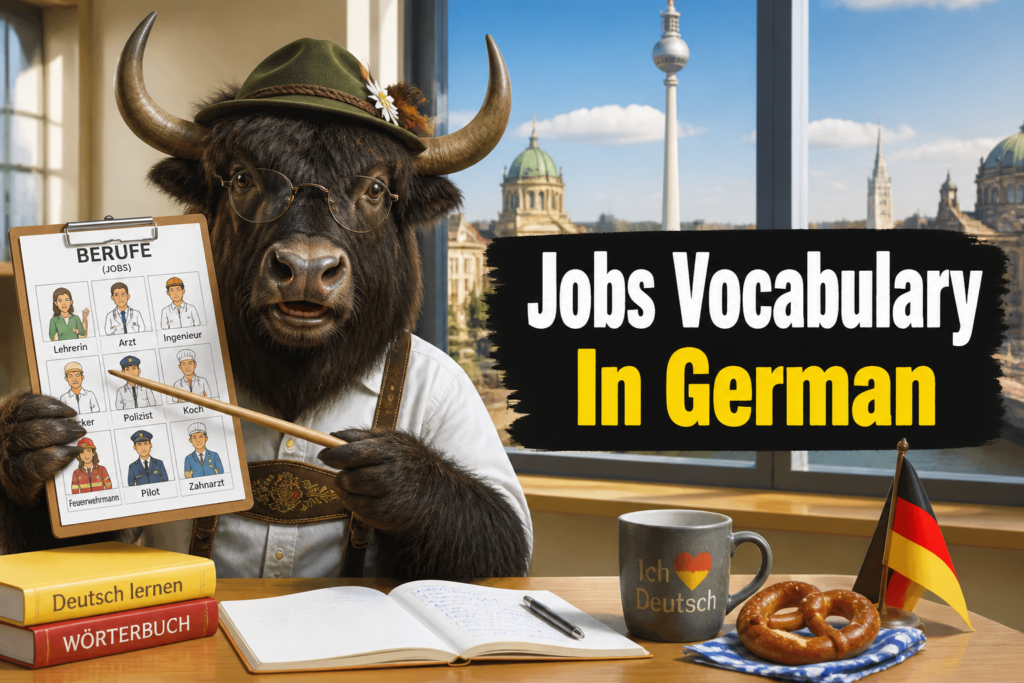
If you want to talk about work in German, you do not need a giant dictionary and a cup of despair. You need the right everyday words, a few useful phrases, and enough grammar to avoid accidentally sounding like you are applying for a potato-related position.
For the broader learning path, visit our parent guide.
This guide covers practical jobs vocabulary in German for interviews, workplace chat, emails, job ads, and the classic “So, what do you do?” conversation. You will also see how German job titles work, how to say “I work as…,” and how to describe duties without sounding like a broken office printer.
German job words often pack a lot of meaning into one neat little noun. That is the fun part. The slightly annoying part is that nouns are capitalized, articles matter, and some job titles change depending on gender or context. Deep breath. We will keep it practical.
For a useful broader word base, it helps to know common everyday German too. If you want to build out your vocabulary beyond work, check the related guides on essential German words and phrases, conversational German, and business vocabulary in German.
Core Jobs Vocabulary
Here are the most useful job words first: common job titles, workplace people, and a few general terms you will see in job ads and conversations.
| German | Pronunciation | Meaning | Example Sentence | Translation | Learner Note |
|---|---|---|---|---|---|
| der Job | job | job, work position | Ich suche einen neuen Job. | I’m looking for a new job. | Common in everyday German; very normal, even though it is borrowed from English. |
| die Arbeit | AHR-bite | work, job, labor | Ich habe heute viel Arbeit. | I have a lot of work today. | More general than der Job; also used for “work” as a concept. |
| der Beruf | buh-ROOF | occupation, profession | Was ist Ihr Beruf? | What is your profession? | Very common in formal and neutral contexts. Also means “career/profession” more than a single job. |
| die Stelle | SHTEH-luh | position, vacancy | Die Stelle ist noch frei. | The position is still open. | Very useful in job ads. |
| die Firma | FEER-mah | company | Ich arbeite bei einer kleinen Firma. | I work at a small company. | Very common. In business German, das Unternehmen is also common. |
| das Unternehmen | oon-ter-NAY-men | company, enterprise | Das Unternehmen wächst schnell. | The company is growing quickly. | Slightly more formal than die Firma. |
| der Arbeitgeber | AHRB-gee-buhr | employer | Mein Arbeitgeber bietet flexible Arbeitszeiten. | My employer offers flexible working hours. | Literally “work-giver.” German loves these compound nouns, naturally. |
| der Arbeitnehmer | AHRB-neem-er | employee | Arbeitnehmer haben auch Rechte. | Employees also have rights. | Literally “work-taker.” A standard legal/workplace term. |
| die Kollegin / der Kollege | koh-LEE-ghin / koh-LEE-guh | female colleague / male colleague | Meine Kollegin hilft mir oft. | My colleague helps me often. | Use for coworkers in a neutral, friendly way. |
| der Chef / die Chefin | shef / SHEF-in | boss | Der Chef ist heute nicht im Büro. | The boss is not in the office today. | Very common. Can sound casual; in formal contexts, Vorgesetzter may appear. |
| das Büro | boo-ROO | office | Ich bin im Büro. | I’m in the office. | Watch the umlaut: ü is not “oo.” Try smiling while saying it. German is like that. |
| der Betrieb | buh-TREEB | business, operation, workplace | Im Betrieb gibt es viele Regeln. | There are many rules in the workplace/company. | Common in workplace and technical contexts. |
| die Branche | BRAHN-shuh | industry, sector | Ich arbeite in der IT-Branche. | I work in the IT sector. | Useful for saying what field you are in. |
| die Karriere | kah-ree-AIR-uh | career | Sie macht schnell Karriere. | She is making a fast career progression. | Used for professional growth; common in job and business contexts. |
| die Erfahrung | eh-FAHR-oong | experience | Ich habe viel Erfahrung im Verkauf. | I have a lot of experience in sales. | Often appears in job ads: Berufserfahrung = work experience. |
Useful Ways To Say What You Do
When people ask about your job, German often uses sein or arbeiten. The most useful patterns are simple, and thankfully they do not require a dramatic performance.
| Pattern | Meaning | German Example | English Translation | Learner Note |
|---|---|---|---|---|
| Ich bin + Beruf. | I am a/an + profession | Ich bin Lehrerin. | I am a teacher. | Very common and natural. |
| Ich arbeite als + Beruf. | I work as a/an + profession | Ich arbeite als Krankenschwester. | I work as a nurse. | Great for talking about work roles without over-explaining. |
| Ich arbeite bei + company. | I work at + company | Ich arbeite bei Siemens. | I work at Siemens. | Use bei with companies, organizations, and employers. |
| Ich arbeite in + field/industry. | I work in + field | Ich arbeite in der Medienbranche. | I work in the media sector. | Good for broad industry talk. |
| Ich bin in + field tätig. | I work in + field | Ich bin im Marketing tätig. | I work in marketing. | More formal and common in CVs, profiles, and business language. |
| Ich suche einen Job. | I’m looking for a job. | Ich suche einen Teilzeitjob. | I’m looking for a part-time job. | suchen takes the accusative: einen Job. |
| Ich bewerbe mich auf + position. | I apply for + position | Ich bewerbe mich auf die Stelle als Assistent. | I’m applying for the position of assistant. | Very important job-application verb. Reflexive: mich. |
| Ich habe ein Vorstellungsgespräch. | I have a job interview. | Ich habe morgen ein Vorstellungsgespräch. | I have a job interview tomorrow. | Long word, very useful. German compounds do not ask permission. |
A tiny but important note: in German, job titles are often written with the article or without it depending on context. Ich bin Lehrer is normal. Ich bin der Lehrer means “I am the teacher” in a specific situation, like the teacher you already know about.
Common Job Titles You Will Actually Use
This is where things get useful fast. The table below gives a solid starter set for everyday jobs and professions. If you know these, you can survive introductions, job ads, and awkward small talk with dignity intact.
| German | Pronunciation | Meaning | Example Sentence | Translation | Learner Note |
|---|---|---|---|---|---|
| der Lehrer / die Lehrerin | LAY-rer / LAY-re-rin | teacher | Meine Schwester ist Lehrerin. | My sister is a teacher. | Professional titles often have gendered forms. |
| der Arzt / die Ärztin | artst / AIRT-stin | doctor | Der Arzt kommt gleich. | The doctor is coming soon. | The umlaut changes the sound: ä is not just fancy a. |
| die Krankenschwester | KRAHN-ken-shves-ter | nurse | Sie arbeitet als Krankenschwester. | She works as a nurse. | Traditional form; modern German also uses more neutral terms in some contexts. |
| der Ingenieur / die Ingenieurin | in-jeh-NYUR / in-jeh-NYU-rin | engineer | Er ist Ingenieur. | He is an engineer. | Borrowed from French, so the pronunciation is a little dramatic. |
| der Verkäufer / die Verkäuferin | fer-KFOY-fer / fer-KFOY-fe-rin | salesperson | Die Verkäuferin ist sehr freundlich. | The saleswoman is very friendly. | äu sounds like “oy” in most standard pronunciations. |
| der Programmierer / die Programmiererin | proh-grah-MEE-rer / …-rin | programmer | Mein Bruder ist Programmierer. | My brother is a programmer. | Common in tech; sometimes Softwareentwickler is also used. |
| der Manager / die Managerin | MEN-eh-jer / MEN-eh-je-rin | manager | Sie ist Managerin in einer Firma. | She is a manager in a company. | English loanword, very common in business German. |
| der Kellner / die Kellnerin | KELL-ner / KELL-ne-rin | waiter / waitress | Der Kellner bringt die Rechnung. | The waiter brings the bill. | In some places, more neutral alternatives are used, but this is still widely understood. |
| der Koch / die Köchin | kokh / KUR-shin | cook / chef | Der Koch arbeitet im Restaurant. | The cook works in the restaurant. | ö is rounded; not “oh.” |
| der Journalist / die Journalistin | zhoor-nah-LEEST / …-tin | journalist | Sie ist Journalistin beim Radio. | She is a journalist at the radio station. | Pronunciation is not exactly English-friendly. German kindly does not care. |
| der Student / die Studentin | shtooh-DENT / shtoo-DEN-tin | student | Ich bin Student. | I am a student. | Very common. For university students specifically, this is the default word. |
| der Azubi | ah-TSOO-bee | apprentice, trainee | Mein Cousin ist Azubi. | My cousin is an apprentice. | Short for Auszubildende/r; very common in Germany. |
| der Handwerker | HAHND-verk-er | skilled tradesperson | Ein Handwerker kommt morgen. | A tradesperson is coming tomorrow. | Useful for repairs, construction, and practical work. |
| der Schichtarbeiter | SHTIKHT-ar-bite-er | shift worker | Er ist Schichtarbeiter im Krankenhaus. | He is a shift worker in the hospital. | Helpful for schedules and factory/workplace talk. |
| die Reinigungskraft | ry-NOOGS-kraft | cleaning staff, cleaner | Die Reinigungskraft kommt am Abend. | The cleaner comes in the evening. | More neutral than some older everyday words. |

Verbs For Talking About Work
German job vocabulary is not just nouns. These verbs show up constantly in conversations, CVs, interviews, and office life. If you can use them confidently, your German suddenly sounds much more alive.
| German | Pronunciation | Meaning | Example Sentence | Translation | Learner Note |
|---|---|---|---|---|---|
| arbeiten | AHR-bite-en | to work | Ich arbeite von Montag bis Freitag. | I work from Monday to Friday. | One of the most important work verbs. |
| anfangen | AHN-fahng-en | to start | Wann fängt dein neuer Job an? | When does your new job start? | Separable verb: anfangen / fängt … an. |
| aufhören | OWF-huh-ren | to stop, quit | Ich höre um 18 Uhr auf. | I stop at 6 p.m. | Also separable. Very common in daily schedules. |
| verdienen | fer-DEE-nen | to earn | Er verdient gut. | He earns well. | Useful for salary talk. |
| bekommen | buh-KOM-en | to get, receive | Ich bekomme jeden Monat mein Gehalt. | I get my salary every month. | Common with pay, email replies, and job offers. |
| verdienen | fer-DEE-nen | to earn, deserve | Sie verdient genug für die Miete. | She earns enough for the rent. | Can mean “deserve” too, depending on context. |
| sich bewerben | zikh buh-VER-ben | to apply | Ich bewerbe mich auf die Stelle. | I’m applying for the position. | Reflexive verb, very important in job applications. |
| einstellen | EIN-shtel-en | to hire | Die Firma stellt neue Leute ein. | The company is hiring new people. | Separable verb; used a lot in job ads. |
| kündigen | KUHN-dee-gen | to resign, to give notice, to fire | Er hat letzte Woche gekündigt. | He quit last week. | Context matters: it can mean resign or dismiss someone. |
| leiten | LIE-ten | to lead, manage | Sie leitet das Team. | She leads the team. | Useful for leadership roles. |
| planen | PLAH-nen | to plan | Wir planen ein Meeting für morgen. | We are planning a meeting for tomorrow. | Very common in office language. |
| organisieren | or-gah-nee-ZEE-ren | to organize | Ich organisiere den Termin. | I’m organizing the appointment. | Useful in workplace and event planning. |
| helfen | HEL-fen | to help | Meine Kollegin hilft mir oft. | My colleague often helps me. | Often used with the dative: mir, dir, ihm, ihr. |
| schaffen | SHAF-en | to manage, to accomplish | Ich schaffe das heute noch. | I can still manage that today. | Very useful in everyday work talk. |
| wechseln | VEK-sheln | to change, switch | Ich will den Job wechseln. | I want to change jobs. | Common for career change talk. |
Job Ad Vocabulary You Will See A Lot
German job ads love compact words and tidy lists. Very efficient. Slightly intimidating. Here are the words that matter most.
| German | Pronunciation | Meaning | Example Sentence | Translation | Learner Note |
|---|---|---|---|---|---|
| Vollzeit | FOLT-tsite | full-time | Die Stelle ist in Vollzeit. | The position is full-time. | Often written as one word in ads. |
| Teilzeit | TILE-tsite | part-time | Ich suche eine Teilzeitstelle. | I’m looking for a part-time position. | Very common and useful. |
| befristet | buh-FRIS-tet | temporary, fixed-term | Der Vertrag ist beMore German to explore How to Type German Characters on Any Device Best graded readers for German The Golden Goose: A2 Elementary German Story with Audio Learn German with Struwwelpeter: Shock-Headed Peter Story & Audio (A1 Beginner) |