


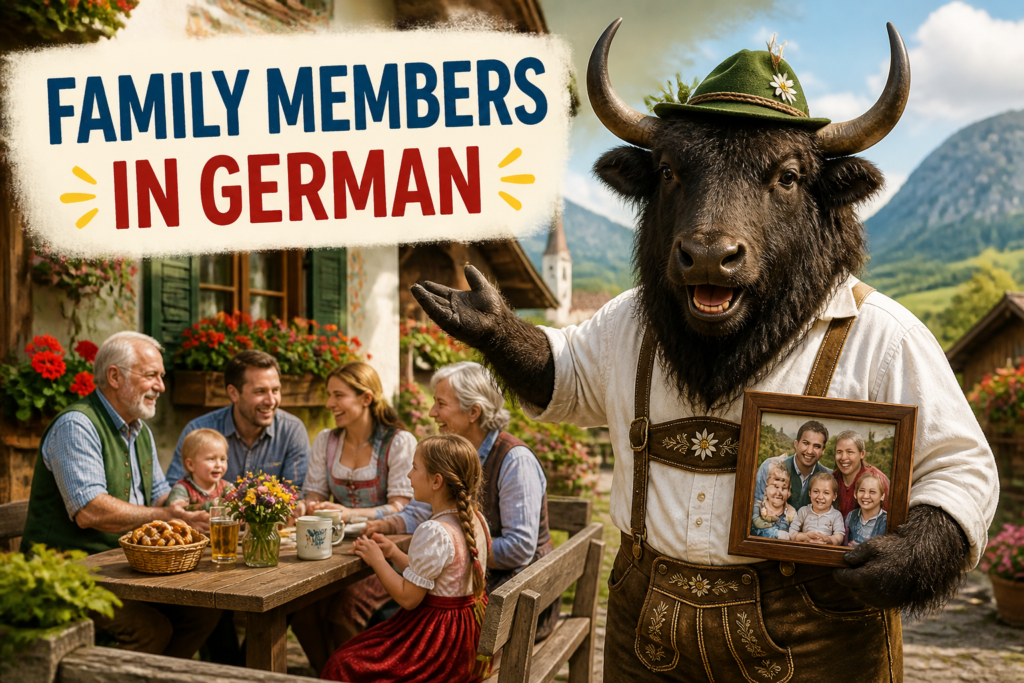
German family words are wonderfully practical. You will hear them in introductions, small talk, birthday messages, and the occasional “Yes, my mother also thinks I should eat more vegetables.” Very relatable. Learn these words once, and suddenly a lot more real-life German becomes readable.
This guide gives you the most useful family vocabulary in natural German, with pronunciation help, example sentences, and a few notes on formality, grammar, and common mistakes. If you want more everyday basics after this, the related guides on essential German words and phrases, popular German phrases, and common German adjectives are a solid next stop. For a broader learning path, the main hub is Learn German.
One useful thing to know: German family words are usually very direct. No drama, no fluff, no unnecessary extra syllables trying to impress anyone.
Core Family Members
Here are the most common family members you will actually need in daily German.
| German | Pronunciation | Meaning | Example Sentence | Translation | Learner Note |
|---|---|---|---|---|---|
| die Familie | dee fah-MEE-lee-uh | family | Meine Familie wohnt in Köln. | My family lives in Cologne. | die because the noun is feminine. |
| die Mutter | MOO-ter | mother | Meine Mutter arbeitet als Ärztin. | My mother works as a doctor. | Very common and neutral. Capitalized because all nouns are capitalized in German. |
| der Vater | FAH-ter | father | Mein Vater fährt gern Rad. | My father likes cycling. | der is the masculine article. |
| die Eltern | EL-tern | parents | Meine Eltern kommen morgen zu Besuch. | My parents are coming to visit tomorrow. | Plural word, so no singular article here. |
| die Elternteile | EL-tern-tie-luh | parent(s) / parent figures | Die Elternteile teilen sich die Betreuung. | The parents share the care. | Less common in everyday speech; useful in formal or explanatory contexts. |
| der Sohn | zohn | son | Ihr Sohn geht schon zur Schule. | Their son already goes to school. | oh sounds long, like “zone” without the z. |
| die Tochter | TOHKH-ter | daughter | Unsere Tochter spielt Klavier. | Our daughter plays piano. | The ch sound is soft, like a light throat sound. |
| der Bruder | BROO-der | brother | Mein Bruder wohnt in Berlin. | My brother lives in Berlin. | Common in both casual and neutral speech. |
| die Schwester | SHVES-ter | sister | Meine Schwester studiert Medizin. | My sister studies medicine. | schw starts with the “sh” sound. |
| das Kind | kint | child | Das Kind schläft endlich. | The child is finally sleeping. | das is neuter. |
| die Kinder | KIN-der | children | Die Kinder sind heute müde. | The children are tired today. | Plural of das Kind. |
| der Mann | mahn | man / husband | Mein Mann kocht heute Abend. | My husband is cooking this evening. | Can mean “man” or “husband” depending on context. |
| die Frau | frow | woman / wife | Meine Frau liest gern. | My wife likes reading. | Can mean “woman” or “wife” depending on context. |
Quick note: In German, family relationships often use the same word for the person and the relationship. Context does the heavy lifting. Convenient, right? Almost suspiciously so.
More Family Members You’ll Hear Often
These are especially useful for talking about extended family, blended families, or people you meet at family events where nobody remembers who is related to whom until dessert.
| German | Pronunciation | Meaning | Example Sentence | Translation | Learner Note |
|---|---|---|---|---|---|
| die Großmutter | GROS-moo-ter | grandmother | Meine Großmutter backt den besten Apfelkuchen. | My grandmother bakes the best apple cake. | More formal or traditional than Oma. |
| der Großvater | GROS-fah-ter | grandfather | Mein Großvater erzählt gern Geschichten. | My grandfather likes telling stories. | More formal or traditional than Opa. |
| die Oma | OH-mah | grandma | Meine Oma wohnt auf dem Land. | My grandma lives in the countryside. | Very common, warm, and natural in everyday speech. |
| der Opa | OH-pah | grandpa | Mein Opa liest die Zeitung jeden Morgen. | My grandpa reads the newspaper every morning. | Very common and friendly. |
| die Enkelin | EN-kel-in | granddaughter | Ihre Enkelin besucht sie oft. | Her granddaughter visits her often. | Feminine noun. |
| der Enkel | EN-kel | grandson | Ihr Enkel spielt Fußball. | Her grandson plays football. | Same word can sometimes mean “grandchild” in broader context, but usually grandson when gender is clear. |
| die Enkelkinder | EN-kel-kin-der | grandchildren | Die Enkelkinder kommen am Sonntag. | The grandchildren are coming on Sunday. | Compound plural, very common and easy to understand. |
| die Tante | TAHN-teh | aunt | Meine Tante wohnt in Hamburg. | My aunt lives in Hamburg. | Neutral and everyday. |
| der Onkel | ON-kel | uncle | Mein Onkel arbeitet im Krankenhaus. | My uncle works in the hospital. | Common and standard. |
| die Cousine | koo-ZEE-nuh | female cousin | Meine Cousine wohnt in Wien. | My female cousin lives in Vienna. | Borrowed from French; used in standard German. |
| der Cousin | koo-ZAHN | male cousin | Mein Cousin ist Ingenieur. | My male cousin is an engineer. | Pronounced more like the French-style ending than English “cousin.” |
| die Nichte | NIKH-tuh | niece | Meine Nichte ist fünf Jahre alt. | My niece is five years old. | ch is soft, not like English “k.” |
| der Neffe | NEF-fuh | nephew | Mein Neffe spielt gern Schach. | My nephew likes playing chess. | Useful in family conversations and birthday cards. |
| der Schwiegervater | SHVEE-ger-fah-ter | father-in-law | Mein Schwiegervater kommt zu Weihnachten. | My father-in-law is coming for Christmas. | Schwieger- means “in-law.” |
| die Schwiegermutter | SHVEE-ger-moo-ter | mother-in-law | Meine Schwiegermutter kocht fantastisch. | My mother-in-law cooks fantastically. | Yes, sometimes the sentence really is that diplomatic. |
Useful Family Words For Real Life
When people talk about family, they often use more than just the basic nouns. These extra words help you describe the whole picture without sounding like a robot with a family tree obsession.
| German | Pronunciation | Meaning | Example Sentence | Translation | Learner Note |
|---|---|---|---|---|---|
| verheiratet | fer-HYE-rah-tet | married | Sie ist verheiratet. | She is married. | Used as an adjective. Very common in introductions. |
| ledig | LAY-dikh | single / unmarried | Er ist ledig. | He is single. | More formal than single, which also exists in German. |
| geschieden | ge-SHEE-den | divorced | Meine Eltern sind geschieden. | My parents are divorced. | Common in family descriptions. |
| verwitwet | fer-VIT-vet | widowed | Sie ist verwitwet. | She is widowed. | More formal, but useful. |
| das Paar | pahr | couple | Das Paar hat zwei Kinder. | The couple has two children. | Neuter noun, plural: die Paare. |
| das Ehepaar | AY-uh-pahr | married couple | Das Ehepaar wohnt nebenan. | The married couple lives next door. | More specific than Paar. |
| die Verwandten | fer-VAHN-ten | relatives | Die Verwandten kommen aus Bayern. | The relatives come from Bavaria. | Plural only in this meaning. |
| die Verwandtschaft | fer-VAHNT-shaft | relatives / family circle | Die Verwandtschaft ist sehr groß. | The family circle is very large. | Can also mean the relationship itself. |
| das Familienleben | fah-MEE-lee-en-lay-ben | family life | Familienleben ist oft chaotisch. | Family life is often chaotic. | Compound noun: die Familie + das Leben. |
| alleinerziehend | ahl-I-ner-tseeh-ent | single parent / raising a child alone | Sie ist alleinerziehend. | She is a single parent. | Often used as an adjective or adjective-like description. |
Family Roles And Household Words
German has lots of useful words for family roles and everyday family setup. Some are simple, some are a little more formal, and some are just the sort of thing that pops up on forms and in polite conversations.
| German | Pronunciation | Meaning | Example Sentence | Translation | Learner Note |
|---|---|---|---|---|---|
| das Geschwister | ge-SHVIS-ter | sibling | Sie hat ein Geschwister. | She has one sibling. | Less common in everyday speech; often people say Bruder or Schwester directly. The plural die Geschwister is very common. |
| die Geschwister | ge-SHVIS-ter | siblings | Meine Geschwister leben in drei Städten. | My siblings live in three cities. | Plural only in normal usage. |
| der Stiefvater | SHTEEF-fah-ter | stepfather | Mein Stiefvater ist Lehrer. | My stepfather is a teacher. | Stief- means step-. |
| die Stiefmutter | SHTEEF-moo-ter | stepmother | Meine Stiefmutter lebt in München. | My stepmother lives in Munich. | Common in blended-family contexts. |
| der Stiefsohn | SHTEEF-zohn | stepson | Ihr Stiefsohn ist zwölf. | Her stepson is twelve. | Useful family vocabulary in legal or practical contexts. |
| die Stieftochter | SHTEEF-tohk-ter | stepdaughter | Seine Stieftochter besucht dieselbe Schule. | His stepdaughter attends the same school. | Long compound, but predictable once you know Stief-. |
| der Pflegevater | PLAY-guh-fah-ter | foster father | Der Pflegevater bringt sie zur Schule. | The foster father takes her to school. | Pflege relates to care or fostering. |
| die Pflegemutter | PLAY-guh-moo-ter | foster mother | Die Pflegemutter arbeitet Teilzeit. | The foster mother works part-time. | More formal and context-dependent. |
| der Adoptivvater | ah-dop-TEEF-fah-ter | adoptive father | Sein Adoptivvater lebt in Österreich. | His adoptive father lives in Austria. | Formal and clear. |
| die Adoptivmutter | ah-dop-TEEF-moo-ter | adoptive mother | Ihre Adoptivmutter spricht drei Sprachen. | Her adoptive mother speaks three languages. | Useful for official or sensitive contexts. |
How To Say “My Family” And “Your Family”
German possessives are a small thing that causes big confusion. The family word itself stays the same, but the possessive changes depending on the person and the noun’s gender.
| Pattern | Meaning | German Example | English Translation | Learner Note |
|---|---|---|---|---|
| meine Mutter | my mother | Meine Mutter ist nett. | My mother is nice. | Mutter is feminine, so use meine. |
| mein Vater | my father | Mein Vater kocht gut. | My father cooks well. | Vater is masculine, so use mein. |
| mein Kind | my child | Mein Kind ist noch klein. | My child is still small. | Kind is neuter, so also mein. |
| meine Eltern | my parents | Meine Eltern kommen später. | My parents are coming later. | Plural uses meine. |
| deine Schwester | your sister | Deine Schwester ist freundlich. | Your sister is friendly. | dein changes for gender, just like mein. |
| sein Bruder | his brother | Sein Bruder wohnt in Bonn. | His brother lives in Bonn. | Also used for “its” with people? No. For things, German uses different logic. Don’t let the pronouns bully you. |
| ihr Sohn | her son / their son | Ihr Sohn ist acht. | Her son is eight. | Capital Ihr can also mean formal “your.” Context matters. |
Easy rule: the possessive adjective changes to match the noun, not the person. So you say mein Vater, but meine Mutter, and meine Eltern. German likes agreement. It is loyal to the concept.
Pronunciation Tips That Actually Help
Some family words are easy for English speakers. Others are mildly annoying, which is very on-brand for German spelling.
| Sound | Example | How It Works | Example Word | Learner Note |
|---|---|---|---|---|
| ch | soft throat sound | Not English “k” or “sh.” | Tochter, Nichte | Say it lightly, not dramatically. No throat wrestling required. |
| r | German r | Often a soft guttural sound or a light vocalic ending. | Bruder, Großvater | Don’t over-roll it like a cartoon villain unless that is your goal. |
| eu / äu | oy sound | Like “boy.” | Freund, euer | Useful if you talk about my friend’s family or relatives. |
| ie | long “ee” | Not “i-e.” | Familie, Geschwister does not use it, but Liebe does | German spelling is often more regular than English. Small mercy. |
| sch | sh sound | Like English “sh.” | Schwester, Schwiegermutter | Very common in family words with Schwieger-. |
| sp and st | shp / sht at the beginning of a word | At the start of a word, German often says “sh.” | Stiefvater, Schwester is different | Start of words is the tricky part. |
If you want a more detailed dictionary-style pronunciation check, Duden’s entry for Familie is a boring little goldmine. Exactly what you want from a reliable source, frankly.
How To Talk About Family In Sentences
German family sentences usually follow the normal verb-second rule. That means the verb comes in second position in a main clause, even when the sentence starts with a family word or a time phrase.
| Pattern | Meaning | German Example | English Translation | Learner Note |
|---|---|---|---|---|
| Ich habe … | I have … | Ich habe zwei Brüder. | I have two brothers. | Bruder becomes Brüder in the plural. |
| Ich habe eine Schwester. | I have a sister. | Ich habe eine Schwester. | I have a sister. | eine is used with feminine nouns in the accusative here, but for beginners it is enough to notice the pattern. |
| Wir besuchen … | We visit … | Wir besuchen meine Großeltern. | We are visiting my grandparents. | Großeltern is plural. |
| Er lebt bei … | He lives with / at … | Er lebt bei seinen Eltern. | He lives with his parents. | bei takes the dative case, so seinen changes. |
| Sie spricht mit … | She speaks with … | Sie spricht mit ihrer Schwester. | She is speaking with her sister. | mit also takes dative. |
| Das ist … | This is … | Das ist mein Onkel. | This is my uncle. | Very common for introductions. |
One tiny but important thing: German often uses the plural for “parents” and “grandparents,” but singular for individual family members. So meine Eltern means “my parents,” while mein Vater means “my father.” Simple enough, once your brain stops trying to make it weird.
Real-Life Family Phrases
These phrases come up in introductions, conversations, forms, emails, and casual chat. They are the kind of useful expressions that make you sound like a person instead of a vocabulary workbook.
| German | Pronunciation | Meaning | Example Sentence | Translation | Learner Note |
|---|---|---|---|---|---|
| Hast du Geschwister? | hahst doo ge-SHVIS-ter | Do you have siblings? | Hast du Geschwister? | Do you have siblings? | Very natural, casual question. |
| Wie viele Kinder hast du? | vee FEE-luh KIN-der hahst doo | How many children do you have? | Wie viele Kinder hast du? | How many children do you have? | Use this only when the topic is appropriate. |
| Ich bin verheiratet. | ikh bin fer-HYE-rah-tet | I am married. | Ich bin verheiratet. | I am married. | Common in introductions and forms. |
| Ich bin ledig. | ikh bin LAY-dikh | I am single. | Ich bin ledig. | I am single. | Neutral and standard. |
| Meine Eltern leben in … | MY-neh EL-tern LAY-ben in … | My parents live in … | Meine Eltern leben in Hamburg. | My parents live in Hamburg. | Very useful for talking about family background. |
| Ich komme aus einer großen Familie. | ikh KOM-muh ows EYE-ner GRO-sen fah-MEE-lee-uh | I come from a big family. | Ich komme aus einer großen Familie. | I come from a big family. | groß becomes großen because of the case and adjective ending. A little grammar seasoning. |
| Das ist meine Schwester. | dahs ist MY-neh SHVES-ter | This is my sister. | Das ist meine Schwester. | This is my sister. | Perfect for introductions. |
| Er hat zwei Söhne. | ehr haht tsvy ZÖH-nuh | He has two sons. | Er hat zwei Söhne. | He has two sons. | sohn → Söhne, with an umlaut in the plural. |
| Sie hat eine Tochter. | zee haht EYE-nuh TOHKH-ter | She has a daughter. | Sie hat eine Tochter. | She has a daughter. | Very standard and useful. |
| Wir feiern den Geburtstag meiner Mutter. | veer FYE-ern dayn geh-BURTS-tahk MY-ner MOO-ter | We are celebrating my mother’s birthday. | Wir feiern den Geburtstag meiner Mutter. | We are celebrating my mother’s birthday. | Genitive is common in possessive expressions, but not scary if you see the whole phrase. |
| Meine Familie ist sehr wichtig für mich. | MY-neh fah-MEE-lee-uh ist zair VIKH-tikh fewr mikh | My family is very important to me. | Meine Familie ist sehr wichtig für mich. | My family is very important to me. | A useful sentence for real conversations. |
Yak wisdom: Family words are one of the fastest ways to make German feel real. The grammar is useful, but the meaning is personal. That is why these words stick.
Germany, Austria, And Switzerland: Small Differences
Standard German is the safest default, but family words can vary a little by region. Not wildly. German-speaking countries do love their variations, but they are not out here trying to sabotage you.
| Concept | Germany | Austria | Switzerland | Learner Note |
|---|---|---|---|---|
| grandma | Oma | Oma | Grossmutter in formal writing, Oma in speech | Oma is common everywhere in everyday speech. |
| grandpa | Opa | Opa | Grossvater in formal writing, Opa in speech | Same general pattern as grandma. |
| father | Vater | Vater, also dialect forms | Vater | Standard word is the same. |
| mother | Mutter | Mutter, also dialect forms | Mutter | Standard word is the same. |
| children | Kinder | Kinder | Kinder | Same across standard German. |
In Switzerland, you will also hear Swiss German dialect forms in everyday conversation, but standard German family vocabulary is still understood and used in writing. For a simple external reference, the Wikipedia article on Familie gives a broad overview of the term and its usage. Not glamorous. Very useful.
Common Mistakes And Easy Fixes
Here are the mistakes English-speaking learners make most often. Good news: most of them are very fixable.
| Mistake | Wrong | Better | Why |
|---|---|---|---|
| Using the wrong article | der Mutter | die Mutter | Mutter is feminine, so it takes die. |
| Forgetting plural forms | zwei Bruder | zwei Brüder | Plural changes in German can be irregular. |
| Using English word order | Ich meine Mutter liebe. | Ich liebe meine Mutter. | Normal main-clause word order is subject + verb + object. |
| Confusing “family” and “relatives” | meine Verwandte for all family | meine Familie for family, meine Verwandten for relatives | Familie is the whole family unit; Verwandte means relatives. |
| Forgetting dative after mit | mit meine Schwester | mit meiner Schwester | mit requires dative. |
| Using the wrong possessive form | mein Schwester | meine Schwester | Schwester is feminine, so use meine. |
| Mispronouncing ch | “To-kter” | Tochter with a soft throat ch | German ch is its own sound. |
Quick Practice
Try these before you move on. Tiny practice, less panic.
| Task | Prompt | Answer | Translation / Note |
|---|---|---|---|
| Translate | My mother | meine Mutter | Feminine noun, so meine. |
| Translate | My father | mein Vater | Masculine noun, so mein. |
| Translate | My parents | meine Eltern | Plural takes meine. |
| Fill in the blank | Ich habe zwei ___. | Brüder | Plural of Bruder. |
| Fill in the blank | Sie spricht mit ihrer ___. | Schwester | Dative after mit. |
| Correct the sentence | Das ist mein Tante. | Das ist meine Tante. | Tante is feminine. |
| Correct the sentence | Meine Eltern ist nett. | Meine Eltern sind nett. | Plural subject needs sind. |
| Choose the right word | grandmother | Großmutter or Oma | Oma is more casual. |
Mini Reference: Family Words At A Glance
- die Mutter = mother
- der Vater = father
- die Eltern = parents
- der Sohn = son
- die Tochter = daughter
- der Bruder = brother
- die Schwester = sister
- das Kind = child
- die Kinder = children
- die Oma / der Opa = grandma / grandpa
- die Tante / der Onkel = aunt / uncle
- die Cousine / der Cousin = female cousin / male cousin
- die Nichte / der Neffe = niece / nephew
- die Schwiegermutter / der Schwiegervater = mother-in-law / father-in-law
Family vocabulary is one of those topics that pays off again and again. First you use it for basic introductions. Then you use it for stories, forms, birthdays, and the occasional “No, that is not my brother, that is my cousin.” Language learning: forever organizing human chaos into nouns.
Yak takeaway: Learn the core family words first, then add the common extras like Oma, Opa, Schwieger-, and Geschwister. Once those stick, German family talk gets a lot friendlier.