False Friends English–Spanish
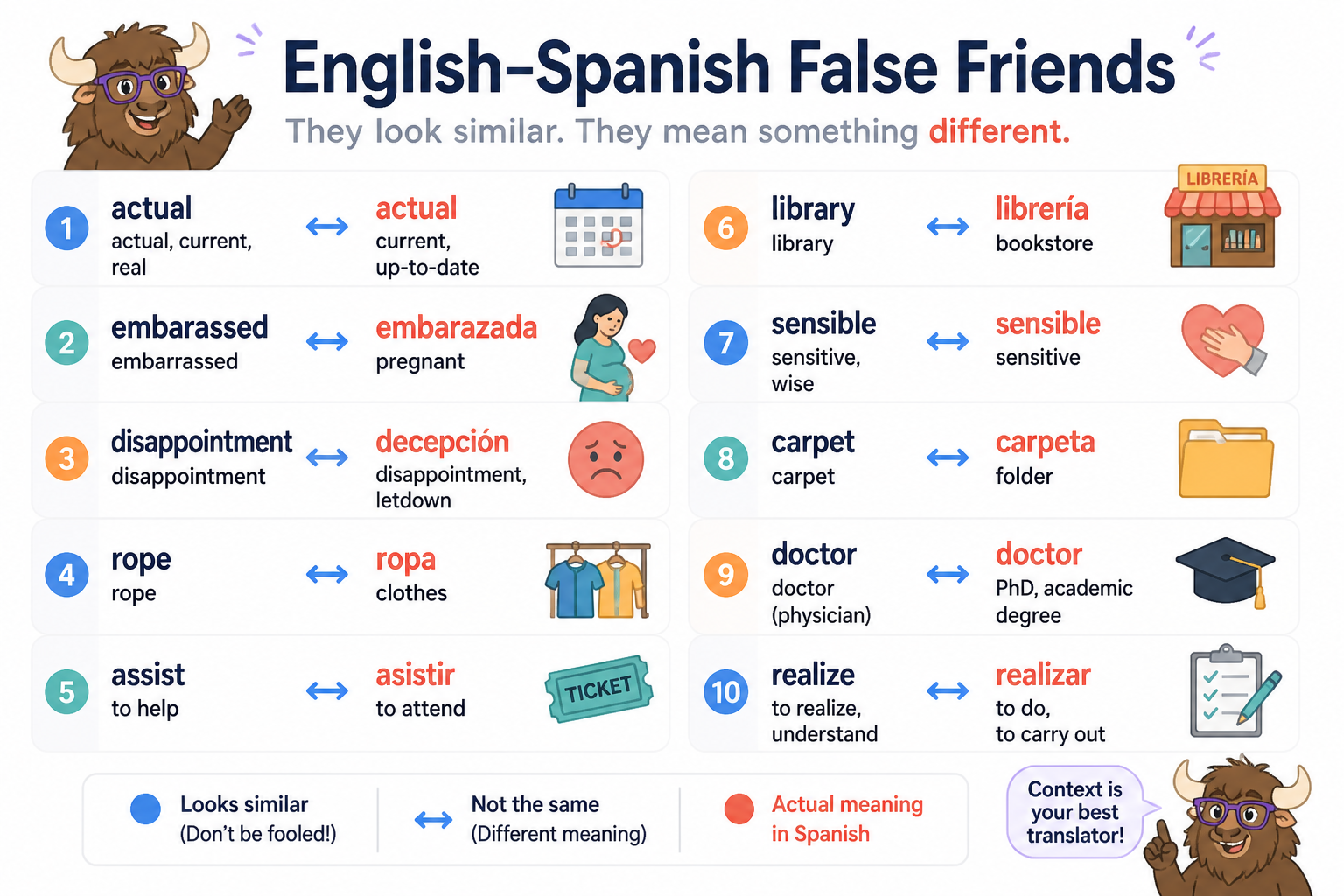
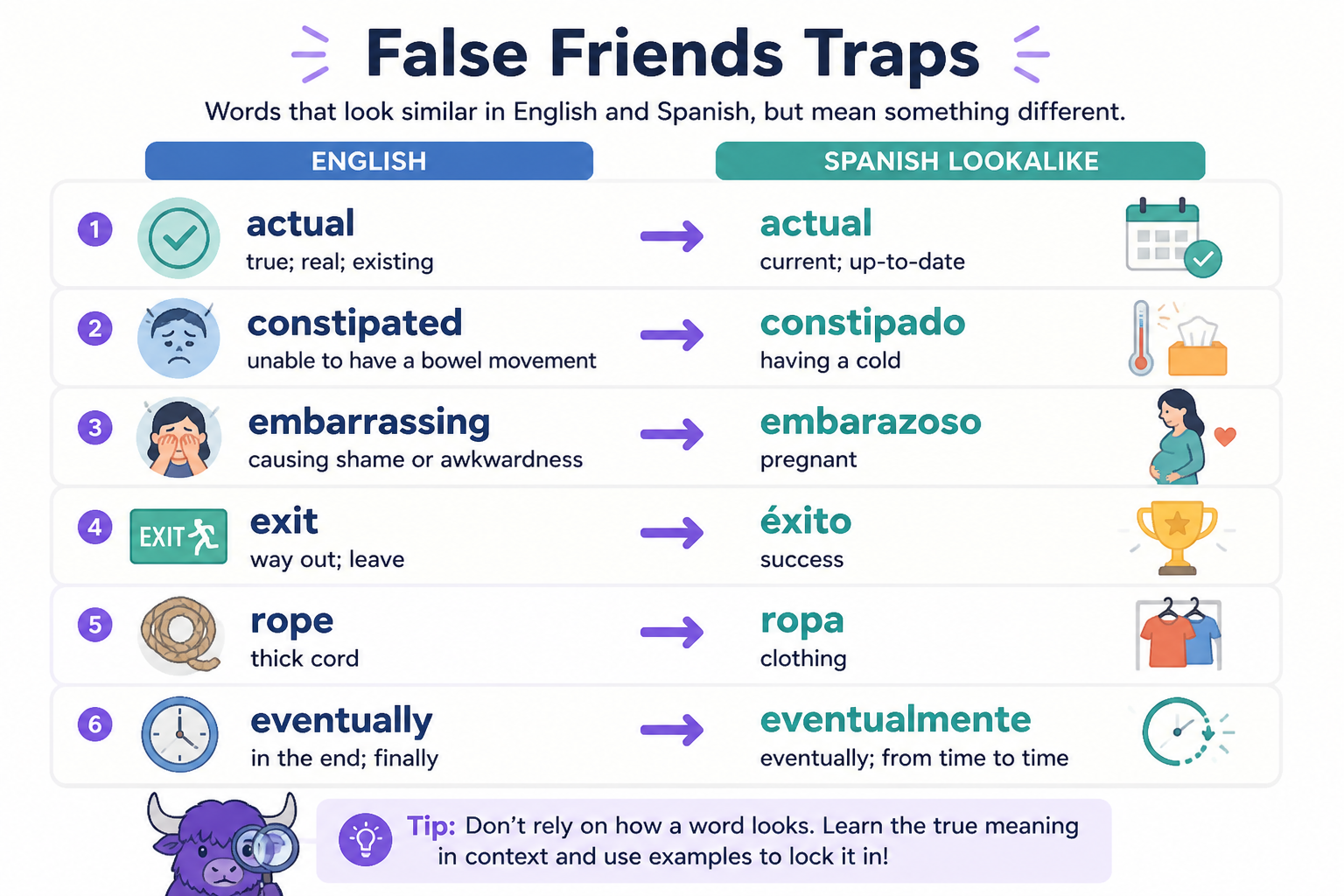
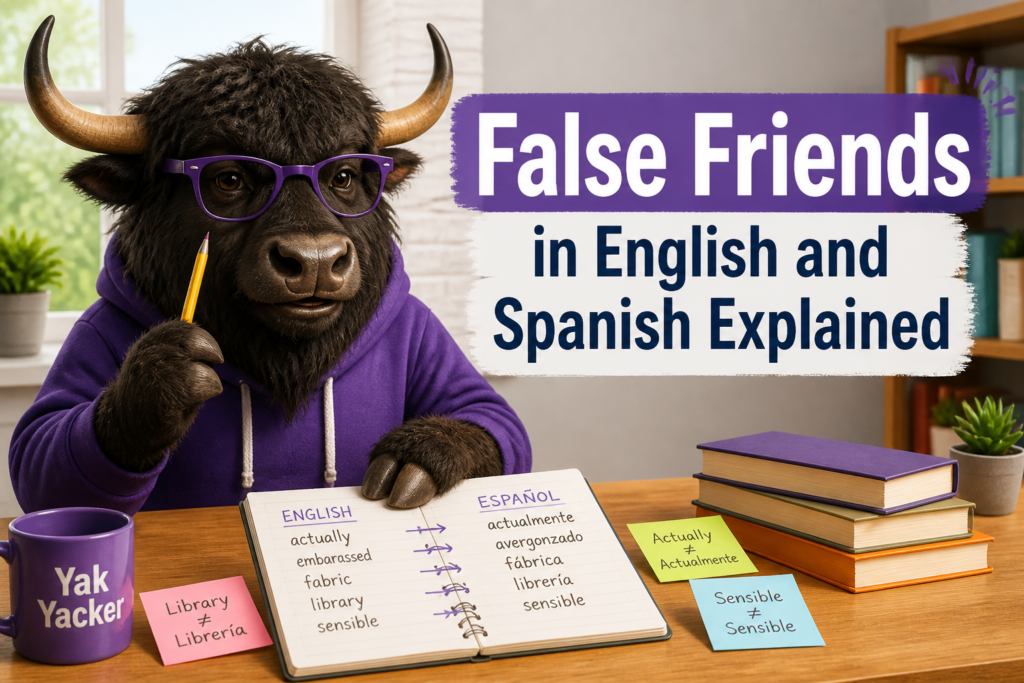
False friends (falsos cognados) look like English… but mean something else in Spanish. Below you’ll get a clean, Mexican-Spanish-friendly list with pronunciation (IPA), audio buttons, and real-life examples—plus a worksheet, an exercise quiz, and game ideas (Wordwall + Bamboozle-style).
Tip: click 🔊 to hear Mexican Spanish pronunciation (your device voice may vary).
What you’ll learn: 75 common English–Spanish false friends, each with IPA pronunciation, meaning (and the “NOT this” warning), plus a natural Spanish example and an English translation.
What you’ll stop doing: saying things like “Estoy embarazada” when you meant “I’m embarrassed.” (That one is a career-limiting moment.)
8 essential false friends (learn these first)
These show up constantly in real life. Master them and you’ll instantly sound more confident.
embarazada
IPA: /em.ba.ɾaˈsa.ða/
Means: pregnant (NOT “embarrassed”)
asistir
IPA: /a.sisˈtiɾ/
Means: to attend (NOT “assist”)
actualmente
IPA: /ak.twalˈmen.te/
Means: currently (NOT “actually”)
éxito
IPA: /ˈek.si.to/
Means: success (NOT “exit”)
carpeta
IPA: /kaɾˈpe.ta/
Means: folder (NOT “carpet”)
constipado
IPA: /kons.tiˈpa.ðo/
Means: congested / with a cold (NOT “constipated”)
discutir
IPA: /dis.kuˈtiɾ/
Means: to argue (NOT a calm “discussion”)
colegio
IPA: /koˈle.xjo/
Means: school (NOT “college”)
14 real-life phrases to handle false friends (without panic)
These are your “save the conversation” phrases. Use them when you’re not sure what a word means, or when someone uses a false friend and you want to confirm.
¿Qué significa “___” en español?
IPA: /ke sigˈni.fi.ka en es.paˈɲol/
What does “___” mean in Spanish?
¿Quieres decir ___ o ___?
IPA: /ˈkje.ɾes deˈsiɾ o/
Do you mean ___ or ___?
Perdón, ¿me explicas esa palabra?
IPA: /peɾˈðon me eksˈpli.kas ˈe.sa paˈla.βɾa/
Sorry—can you explain that word?
Ah, o sea… ¿te refieres a ___?
IPA: /a oˈse.a te reˈfje.ɾes a/
Oh, so you mean… ___?
En inglés suena parecido, pero en español es diferente.
IPA: /en iŋˈgles ˈswe.na paˈɾe.si.ðo ˈpe.ɾo en es.paˈɲol es ði.feˈɾen.te/
In English it sounds similar, but in Spanish it’s different.
Entonces, ¿“actualmente” es “currently”, verdad?
IPA: /enˈton.ses ak.twalˈmen.te es ˈkʌ.ɹənt.li βeɾˈðað/
So “actualmente” is “currently,” right?
¿Cómo se dice “actually” entonces?
IPA: /ˈko.mo se ˈði.se enˈton.ses/
How do you say “actually,” then?
De verdad / En realidad.
IPA: /de βeɾˈðað / en rea.liˈðað/
“Actually”: really / in reality.
¿Me das un ejemplo con esa palabra?
IPA: /me das un eˈxem.plo kon ˈe.sa paˈla.βɾa/
Can you give me an example with that word?
No quise decir eso; quise decir ___.
IPA: /no ˈki.se deˈsiɾ ˈe.so ˈki.se deˈsiɾ/
I didn’t mean that; I meant ___.
Disculpe, ¿podría repetirlo?
IPA: /disˈkul.pe poˈðɾi.a re.peˈtiɾ.lo/
Excuse me, could you repeat that? (formal)
¿Eso es “carpeta” (folder) o “alfombra” (carpet)?
IPA: /ˈe.so es kaɾˈpe.ta o alˈfom.bɾa/
Is that “carpeta” (folder) or “alfombra” (carpet)?
¿“Asistir” es “attend”, no “assist”, ¿cierto?
IPA: /a.sisˈtiɾ es aˈtend no aˈsist ˈsjɛɾ.to/
“Asistir” is “attend,” not “assist,” right?
Gracias, ya entendí.
IPA: /ˈgɾa.sjas ʝa en.tenˈði/
Thanks, I got it now.
False friends English Spanish examples (mini-dialogs)
These are the exact moments false friends show up: quick conversations, texts, and work messages.
1) actualmente vs actually
ES: Actualmente trabajo desde casa.
EN: Currently I work from home.
“Actually” is usually en realidad / de verdad.
2) asistir vs assist
ES: ¿Vas a asistir a la junta?
EN: Are you going to attend the meeting?
“Assist” (help) is usually ayudar.
3) carpeta vs carpet
ES: Te mando el archivo en una carpeta.
EN: I’ll send you the file in a folder.
“Carpet” is alfombra.
4) constipado vs constipated
ES: Estoy constipado, creo que me dio gripa.
EN: I’m congested; I think I caught the flu/cold.
“Constipated” is estreñido.
Pick 3 false friends per day. Say each Spanish example out loud once (🔊), then use one in a text to a friend. Consistency beats cramming.
False friends English Spanish list (75)
Search the list by typing any English or Spanish word. You’ll see the row count update as you filter.
| Quick “don’t get bamboozled” map | |
|---|---|
| actually → en realidad / de verdad | |
| library → biblioteca (NOT librería) | |
| exit → salida (NOT éxito) | |
| embarrassed → avergonzado (NOT embarazada) | |
Quick dictionary checks: RAE (Diccionario) • SpanishDict
“ll” and “y” often sound like a soft “y” in Mexico. Focus on stress: the bold syllable in IPA shows where your voice naturally lands.
A) Everyday & travel traps
| Spanish | Pronunciation (IPA) | Meaning (EN) | Example (ES) | Translation (EN) | Audio |
|---|---|---|---|---|---|
| actualmente | /ak.twalˈmen.te/ | currently (NOT “actually”) | Actualmente vivo en Guadalajara. | I currently live in Guadalajara. | |
| carpeta | /kaɾˈpe.ta/ | folder (NOT “carpet”) | Guarda el contrato en esa carpeta. | Save the contract in that folder. | |
| librería | /li.βɾeˈɾi.a/ | bookstore (NOT “library”) | Compré el libro en la librería de la esquina. | I bought the book at the corner bookstore. | |
| éxito | /ˈek.si.to/ | success (NOT “exit”) | Tu proyecto fue un éxito. | Your project was a success. | |
| salida | /saˈli.ða/ | exit / way out (NOT “success”) | La salida está a la derecha. | The exit is on the right. | |
| ropa | /ˈro.pa/ | clothes (NOT “rope”) | Lavo la ropa los sábados. | I wash clothes on Saturdays. | |
| sopa | /ˈso.pa/ | soup (NOT “soap”) | Hoy quiero sopa de tortilla. | Today I want tortilla soup. | |
| jabón | /xaˈβon/ | soap (NOT “soup”) | ¿Tienes jabón para lavarte las manos? | Do you have soap to wash your hands? | |
| constipado | /kons.tiˈpa.ðo/ | congested / with a cold (NOT “constipated”) | Estoy constipado y me duele la garganta. | I’m congested and my throat hurts. | |
| embarcar | /em.baɾˈkaɾ/ | to board (transport) (NOT “to start” in a general sense) | Vamos a embarcar en diez minutos. | We’re going to board in ten minutes. | |
| sensible | /senˈsi.βle/ | sensitive (NOT “sensible”) | Soy sensible al ruido. | I’m sensitive to noise. | |
| sensato | /senˈsa.to/ | sensible / reasonable (NOT “sensitive”) | Es sensato ahorrar un poco cada mes. | It’s sensible to save a little each month. | |
| cita | /ˈsi.ta/ | appointment / date / quote (NOT “cite” as a verb) | Tengo una cita con el doctor. | I have an appointment with the doctor. | |
| molde | /ˈmol.de/ | mold (shape/form) (NOT “mold” = fungus) | Usé un molde para hacer gelatina. | I used a mold to make gelatin. | |
| moho | /ˈmo.o/ | mold (fungus) (NOT “shape”) | Hay moho en la pared del baño. | There’s mold on the bathroom wall. | |
| pan | /pan/ | bread (NOT “pan” the cooking tool) | ¿Quieres pan con tu café? | Do you want bread with your coffee? | |
| sartén | /saɾˈten/ | frying pan (NOT “bread”) | Calienta la sartén antes de cocinar. | Heat the pan before cooking. | |
| vaso | /ˈba.so/ | drinking glass (NOT “vase”) | Dame un vaso de agua, por favor. | Give me a glass of water, please. | |
| jarrón | /xaˈron/ | vase (NOT “glass”) | El jarrón está lleno de flores. | The vase is full of flowers. |
B) School & work traps
| Spanish | Pronunciation (IPA) | Meaning (EN) | Example (ES) | Translation (EN) | Audio |
|---|---|---|---|---|---|
| asistir | /a.sisˈtiɾ/ | to attend (NOT “to assist”) | Voy a asistir a la clase de mañana. | I’m going to attend tomorrow’s class. | |
| ayudar | /a.ʝuˈðaɾ/ | to help (use this for “assist”) | ¿Me puedes ayudar con esto? | Can you help me with this? | |
| colegio | /koˈle.xjo/ | school (NOT “college”) | Mis hijos van al colegio cerca de aquí. | My kids go to the school near here. | |
| universidad | /u.ni.βeɾ.siˈðað/ | university (often what English means by “college”) | Estudié en la universidad en Monterrey. | I studied at the university in Monterrey. | |
| lectura | /lekˈtu.ɾa/ | reading (NOT “lecture”) | La lectura de hoy es corta. | Today’s reading is short. | |
| conferencia | /kon.feˈɾen.sja/ | lecture / talk (often) (not always a big “conference”) | El profesor dio una conferencia sobre historia. | The teacher gave a lecture about history. | |
| profesor | /pɾo.feˈsoɾ/ | teacher (often) (NOT always “university professor”) | Mi profesor de español es muy paciente. | My Spanish teacher is very patient. | |
| tarea | /taˈɾe.a/ | homework / task (NOT “tariff”) | Tengo mucha tarea hoy. | I have a lot of homework today. | |
| realizar | /re.a.liˈsaɾ/ | to carry out / to do (NOT “realize”) | Vamos a realizar una prueba mañana. | We’re going to do a test tomorrow. | |
| darse cuenta | /ˈdaɾ.se ˈkwen.ta/ | to realize (NOT “realizar”) | Me di cuenta de mi error. | I realized my mistake. | |
| contestar | /kon.tesˈtaɾ/ | to answer (NOT “contest”) | ¿Me puedes contestar el correo hoy? | Can you answer the email today? | |
| concurso | /konˈkuɾ.so/ | contest / competition (NOT “answer”) | Participé en un concurso de fotografía. | I entered a photography contest. | |
| firma | /ˈfiɾ.ma/ | signature (NOT “firm” = company) | Falta tu firma en el documento. | Your signature is missing on the document. | |
| empresa | /emˈpɾe.sa/ | company / firm (NOT “signature”) | Trabajo en una empresa de tecnología. | I work at a tech company. | |
| grado | /ˈgɾa.ðo/ | grade / degree (depends on context) | Terminé mi grado en ingeniería. | I finished my degree in engineering. | |
| currículum | /kuˈri.ku.lum/ | résumé (CV) (NOT “curriculum” in school sense) | Mándame tu currículum, por favor. | Send me your résumé, please. | |
| plan de estudios | /plan de esˈtu.ðjos/ | curriculum / syllabus (school program) | El plan de estudios cambió este año. | The curriculum changed this year. | |
| balance | /baˈlan.se/ | balance sheet / accounting report (often, in business) | Revisemos el balance del mes. | Let’s review the month’s balance sheet. | |
| bibliografía | /bi.βljo.gɾaˈfi.a/ | bibliography (NOT “library”) | Incluye la bibliografía al final del trabajo. | Include the bibliography at the end of the paper. | |
| biblioteca | /bi.βljoˈte.ka/ | library (NOT “bookstore”) | Voy a la biblioteca a estudiar. | I’m going to the library to study. |
C) People, feelings & social life traps
| Spanish | Pronunciation (IPA) | Meaning (EN) | Example (ES) | Translation (EN) | Audio |
|---|---|---|---|---|---|
| embarazada | /em.ba.ɾaˈsa.ða/ | pregnant (NOT “embarrassed”) | Mi hermana está embarazada. | My sister is pregnant. | |
| avergonzado | /a.βeɾ.ɣonˈsa.ðo/ | embarrassed (NOT “pregnant”) | Me dio pena; estaba avergonzado. | I felt ashamed; I was embarrassed. | |
| familiar | /fa.miˈljaɾ/ | relative / family member (NOT “familiar”) | Un familiar me recomendó ese lugar. | A relative recommended that place to me. | |
| conocido | /ko.noˈsi.ðo/ | known / acquaintance (often what English “familiar” implies) | Es un tema conocido para mí. | It’s a familiar/known topic for me. | |
| parientes | /paˈɾjen.tes/ | relatives (NOT “parents”) | Mis parientes viven en Puebla. | My relatives live in Puebla. | |
| padres | /ˈpa.ðɾes/ | parents (NOT “relatives” in general) | Mis padres vienen el domingo. | My parents are coming on Sunday. | |
| pretender | /pɾe.tenˈdeɾ/ | to intend / to claim (NOT “to pretend”) | No pretendo ser perfecto. | I don’t intend to be perfect. | |
| fingir | /finˈxiɾ/ | to pretend (act) (NOT “intend”) | No finjas que no me viste. | Don’t pretend you didn’t see me. | |
| molestar | /mo.lesˈtaɾ/ | to bother / annoy (English “molest” is much stronger) | Perdón si te molesto. | Sorry if I’m bothering you. | |
| asistir (a alguien) | /a.sisˈtiɾ/ | to assist/help (formal, less common) (context matters) | El personal puede asistirle en recepción. | Staff can assist you at reception. | |
| eventual | /e.βenˈtwal/ | temporary / occasional (NOT “eventual” = “in the end”) | Fue un trabajo eventual, solo por una semana. | It was a temporary job, only for a week. | |
| emocionado | /e.mo.sjoˈna.ðo/ | excited (NOT “emotional”) | Estoy emocionado por el viaje. | I’m excited about the trip. | |
| emocional | /e.mo.sjoˈnal/ | emotional (NOT automatically “excited”) | Fue un momento muy emocional. | It was a very emotional moment. | |
| gracioso | /gɾaˈsjo.so/ | funny / amusing (NOT “gracious”) | Tu comentario estuvo muy gracioso. | Your comment was really funny. | |
| amable | /aˈma.βle/ | kind / nice (closer to “gracious”) | Gracias por ser tan amable. | Thanks for being so kind. | |
| rudo | /ˈru.ðo/ | rough / tough (NOT “rude”) | El camino está muy rudo. | The road is really rough. | |
| grosero | /gɾoˈse.ɾo/ | rude (NOT “rough”) | No seas grosero con ella. | Don’t be rude to her. | |
| lástima | /ˈlas.ti.ma/ | pity / what a shame (NOT “last”) | ¡Qué lástima! Ya cerraron. | What a shame! They already closed. | |
| mayor | /maˈʝoɾ/ | older / bigger (NOT “mayor” = city official) | Mi hermana mayor vive fuera. | My older sister lives out of town. | |
| alcalde | /alˈkal.de/ | mayor (city) (NOT “older”) | El alcalde anunció nuevas obras. | The mayor announced new public works. |
D) Numbers, time & “sneaky” everyday verbs
| Spanish | Pronunciation (IPA) | Meaning (EN) | Example (ES) | Translation (EN) | Audio |
|---|---|---|---|---|---|
| una vez | /ˈu.na βes/ | one time (NOT “once” = eleven) | Fui a Oaxaca una vez. | I went to Oaxaca one time. | |
| once | /ˈon.se/ | eleven (NOT “once”) | Son las once en punto. | It’s eleven o’clock. | |
| billón | /biˈʝon/ | often “trillion” (1,000,000,000,000) (NOT English “billion”) | Un billón es un número enorme. | A billón is a huge number. | |
| mil millones | /mil miˈʝo.nes/ | billion (1,000,000,000) (English “billion”) | La empresa vale mil millones de dólares. | The company is worth a billion dollars. | |
| aviso | /aˈβi.so/ | notice / warning (NOT “advice”) | Pusieron un aviso en la puerta. | They put a notice on the door. | |
| consejo | /konˈse.xo/ | advice / tip (NOT “notice”) | Dame un consejo, por fa. | Give me some advice, please. | |
| jornada | /xoɾˈna.ða/ | workday / work shift (NOT “journey”) | Mi jornada empieza a las ocho. | My workday starts at eight. | |
| viaje | /ˈbja.xe/ | journey / trip (NOT “work shift”) | El viaje fue largo, pero bonito. | The trip was long, but nice. | |
| soportar | /so.poɾˈtaɾ/ | to tolerate / endure (NOT “support” emotionally) | No soporto el calor. | I can’t stand the heat. | |
| apoyar | /a.poˈʝaɾ/ | to support (a person/idea) (NOT “endure”) | Te apoyo en lo que decidas. | I support you in whatever you decide. | |
| esperar | /es.peˈɾaɾ/ | to wait / to hope (NOT “expect”) | Espérame cinco minutos. | Wait for me five minutes. | |
| expectativa | /eks.pek.taˈti.βa/ | expectation (for “expect”) | Tengo altas expectativas para este año. | I have high expectations for this year. | |
| receta | /reˈse.ta/ | recipe (and sometimes prescription) (NOT “receipt”) | ¿Me pasas la receta de tus chilaquiles? | Can you share your chilaquiles recipe? | |
| recibo | /reˈsi.βo/ | receipt (NOT “recipe”) | Guarda el recibo por si acaso. | Keep the receipt just in case. | |
| delito | /deˈli.to/ | crime / offense (NOT “delete”) | Eso es un delito grave. | That’s a serious crime. | |
| borrar | /boˈraɾ/ | to delete / erase (NOT “crime”) | Voy a borrar ese mensaje. | I’m going to delete that message. | |
| suceder | /su.seˈðeɾ/ | to happen (NOT “succeed”) | ¿Qué sucedió aquí? | What happened here? | |
| tener éxito | /teˈneɾ ˈek.si.to/ | to succeed (NOT “happen”) | Si practicas, vas a tener éxito. | If you practice, you’ll succeed. | |
| argumento | /aɾ.guˈmen.to/ | plot / storyline (often) (NOT only “argument”) | El argumento de la película es buenísimo. | The movie’s plot is really good. | |
| discusión | /dis.kuˈsjon/ | argument / dispute (NOT a friendly “discussion”) | No quiero otra discusión por eso. | I don’t want another argument about that. | |
| conversación | /kon.βeɾ.saˈsjon/ | conversation (a calm “discussion”) | Tengamos una conversación tranquila. | Let’s have a calm conversation. |
E) Bonus traps (fast hits)
| Spanish | Pronunciation (IPA) | Meaning (EN) | Example (ES) | Translation (EN) | Audio |
|---|---|---|---|---|---|
| fábrica | /ˈfa.βɾi.ka/ | factory (NOT “fabric”) | La fábrica queda lejos del centro. | The factory is far from downtown. | |
| tela | /ˈte.la/ | fabric / cloth (NOT “factory”) | Esta tela es muy suave. | This fabric is very soft. | |
| largo | /ˈlaɾ.go/ | long (NOT “large”) | Fue un día largo. | It was a long day. | |
| grande | /ˈgɾan.de/ | big / large (NOT “long”) | Quiero un café grande. | I want a large coffee. | |
| decepción | /de.sepˈsjon/ | disappointment (NOT “deception”) | Fue una decepción total. | It was a total disappointment. | |
| engaño | /enˈga.ɲo/ | deception / trick (NOT “disappointment”) | Eso fue un engaño. | That was a deception/trick. | |
| educación | /e.ðu.kaˈsjon/ | education / manners (also “upbringing”) | Tiene buena educación; siempre saluda. | He has good manners; he always greets people. | |
| introducir | /in.tɾo.ðuˈsiɾ/ | to insert / introduce (NOT “intrude”) | Introduce la tarjeta aquí. | Insert the card here. | |
| interrumpir | /in.te.rumˈpiɾ/ | to interrupt (closer to “intrude”) | Perdón por interrumpir. | Sorry to interrupt. | |
| remover | /re.moˈβeɾ/ | to stir (Mexico/common) (NOT always “remove”) | Remueve el café para que se disuelva. | Stir the coffee so it dissolves. | |
| quitar | /kiˈtaɾ/ | to remove / take off (NOT “quit” = stop doing) | Quítate la chamarra si tienes calor. | Take off your jacket if you’re hot. | |
| dejar | /deˈxaɾ/ | to stop / to quit (a habit) (NOT “remove”) | Quiero dejar el azúcar un tiempo. | I want to quit sugar for a while. | |
| inconveniente | /in.kon.βeˈnjen.te/ | drawback / issue (NOT “inconvenient” only) | El único inconveniente es el tráfico. | The only drawback is the traffic. | |
| historia | /isˈto.ɾja/ | story / history (depends on context) | Te voy a contar una historia. | I’m going to tell you a story. | |
| idioma | /iˈðjo.ma/ | language (NOT “idiom”) | El español es un idioma hermoso. | Spanish is a beautiful language. | |
| modismo | /moˈðis.mo/ | idiom (NOT “language”) | “Echar la mano” es un modismo común. | “Echar la mano” is a common idiom. | |
| exquisito | /eks.kiˈsi.to/ | delicious / exquisite (often food-focused) | ¡Qué exquisito está este mole! | This mole is delicious! | |
| localizar | /lo.ka.liˈsaɾ/ | to locate (NOT “localize” as “translate/adapt”) | No logro localizar mis llaves. | I can’t manage to locate my keys. | |
| adaptar | /a.ðapˈtaɾ/ | to adapt / localize (content) (what English “localize” often means) | Hay que adaptar el texto para México. | We need to localize/adapt the text for Mexico. |
If a word looks too perfect, it’s probably plotting something. Verify once. Flex forever.
False friends English Spanish worksheet (fillable + answer reveal)
Do this in 5 minutes. Fill the English meaning. Then reveal answers to self-check. If you teach, this is printable.
False friends English Spanish exercise (auto-score quiz)
Pick the correct English meaning. Then check your score. This is the “don’t get bamboozled” drill.
Want a quick “hard mode”? Say each Spanish word out loud after you answer (🔊). Your brain learns faster when your mouth is involved.
False friends English Spanish PDF / exercises PDF (print + save)
Need a “PDF” version? Use your browser’s print feature to save this page (or specific sections) as a PDF. This also works great for an “exercises PDF” or “worksheet PDF.”
Print / Save as PDF
On desktop: Ctrl/Cmd + P → Destination: Save as PDF. On mobile, look for Share/Print.
Make your own mini “exercises PDF”
- Print the worksheet + quiz sections.
- Hide answers (don’t reveal), then print.
- Add a title page: “False Friends Practice” and you’ve got a neat handout.
False friends English Spanish Wordwall ideas (useful, not just “clicky”)
If you’re building a Wordwall activity (or anything similar), here are formats that actually improve recall—especially for false friends.
Best Wordwall-style activity types
- Match-up: Spanish word → correct English meaning (with “NOT…” distractors).
- Quiz: show the Spanish word, pick the meaning.
- True/False: “carpeta means carpet.” (Spoiler: false.)
- Random wheel: students must use the word in a sentence.
Teacher tip (Mexico-friendly)
Use the examples from the tables above as your sentence prompts. Students learn faster when the sentence feels like something a real person would say.
If you’re not a teacher: you can still do this solo by turning the list into flashcards.
False friends English Spanish Bamboozle-style game ideas (teams, points, laughter)
“Bamboozle” is basically the emotion false friends want you to feel. Let’s flip it: use a team game to make the correct meanings stick.
12 ready-to-use prompts
- Define embarazada (and say what it does NOT mean).
- Use actualmente in a sentence.
- Translate “I’m embarrassed” (no false friends allowed).
- What’s the difference between librería and biblioteca?
- Translate “The exit is to the left.”
- Use pretender correctly.
- Translate “I want to quit sugar.”
- Correct this: “Estoy constipado” (if you mean constipation).
- What does asistir usually mean?
- Translate “Can you answer the email?”
- Give one synonym for “actually” in Spanish.
- Make a sentence with soportar.
How to run it
- Teams choose a number → get a prompt.
- Correct meaning + sentence = points. <цин
- If they use the false friend incorrectly, the other team “steals” by fixing it.
- Keep it fast: 30–45 seconds per turn.
Goal: speed + accuracy. That’s real-life speaking.
False friends English Spanish game: False Friend Roulette
Hit “Spin.” Guess the meaning. Reveal. Repeat. This is surprisingly effective when you do it for 3 minutes a day.
Set a timer for 3 minutes. Every spin, say the Spanish word out loud (🔊), then say the English meaning. Your brain will start predicting the correct meaning.
Make it harder
- Answer in a full sentence.
- Use a rescue phrase from the phrase section.
- Explain the “NOT” meaning.
Make it easier
- Only do the 8 essentials.
- Repeat the example sentence once.
- Do 5 spins
- Turn on “Reveal” immediately (no pressure).
If you want to say “actually” (as in “in fact”), your safest choices are en realidad or de verdad. If you say actualmente, you’re saying currently.
Bonus: 25 more false friends (because Spanish likes to keep you humble)
You already have the core list + games. This bonus set is for anyone who wants extra practice, or teachers who need more material for a second lesson.
| Spanish | Pronunciation (IPA) | Meaning (EN) | Example (ES) | Translation (EN) | Audio |
|---|---|---|---|---|---|
| asistente | /a.sisˈten.te/ | assistant / attendee (NOT “attendant” only) | El asistente del gerente me ayudó. | The manager’s assistant helped me. | |
| atender | /a.tenˈdeɾ/ | to attend to / help / serve (NOT “attend an event”) | Enseguida lo atiendo. | I’ll take care of you / help you right away. | |
| asunto | /aˈsun.to/ | matter / issue / subject line (NOT “assumption”) | ¿Cuál es el asunto del correo? | What’s the email subject line? | |
| asumir | /a.suˈmiɾ/ | to assume (NOT “asunto”) | No asumas nada sin preguntar. | Don’t assume anything without asking. | |
| compromiso | /kom.pɾoˈmi.so/ | commitment / appointment (NOT “compromise”) | Tengo un compromiso en la tarde. | I have an engagement/appointment in the afternoon. | |
| conveniente | /kon.βeˈnjen.te/ | convenient / suitable (NOT “inconvenient”) | Te queda conveniente ese horario. | That schedule works for you / is convenient for you. | |
| disciplina | /dis.siˈpli.na/ | discipline (also “field/subject”) (NOT “punishment” only) | La psicología es una disciplina interesante. | Psychology is an interesting field. | |
| éxito (tener) | /ˈek.si.to/ | success (NOT “exit”) | Te deseo mucho éxito. | I wish you lots of success. | |
| exponer | /eks.poˈneɾ/ | to present / to expose (context matters) | Mañana voy a exponer mi proyecto. | Tomorrow I’m going to present my project. | |
| éxitos | /ˈek.si.tos/ | hits (songs) / successes (NOT “exits”) | Ese grupo tiene muchos éxitos. | That band has a lot of hits. | |
| eventualmente | /e.βen.twalˈmen.te/ | eventually (in the end) (NOT “eventual”) | Eventualmente lo resolvimos. | We eventually solved it. | |
| recordar | /re.koɾˈðaɾ/ | to remember (NOT “to record”) | No recuerdo su nombre. | I don’t remember his name. | |
| grabar | /gɾaˈβaɾ/ | to record (audio/video) (NOT “remember”) | Voy a grabar un video. | I’m going to record a video. | |
| soportar | /so.poɾˈtaɾ/ | to endure / tolerate (NOT “support” emotionally) | No soporto el ruido. | I can’t stand the noise. | |
| asistir a | /a.sisˈtiɾ a/ | to attend (NOT “assist”) | Voy a asistir a la conferencia. | I’m going to attend the talk. | |
| lugar | /luˈgaɾ/ | place (NOT “lug”) | Es un buen lugar para comer. | It’s a good place to eat. | |
| ropa interior | /ˈro.pa in.teˈɾjoɾ/ | underwear (NOT “interior” = inside only) | Necesito comprar ropa interior. | I need to buy underwear. | |
| pretensión | /pɾe.tenˈsjon/ | claim / aspiration (NOT “pretension” as attitude only) | Su pretensión es crecer este año. | Their goal/claim is to grow this year. | |
| asistencia | /a.sisˈten.sja/ | attendance / help desk (NOT “assistance” only) | La asistencia fue alta en el evento. | Attendance was high at the event. | |
| suerte | /ˈsweɾ.te/ | luck (NOT “sort”) | ¡Buena suerte! | Good luck! | |
| ordenar | /oɾ.ðeˈnaɾ/ | to order (food) / to organize (NOT “ordain”) | Voy a ordenar unos tacos. | I’m going to order some tacos. | |
| éxito (¡Éxito!) | /ˈek.si.to/ | “Good luck / success!” (wish) (NOT “exit”) | ¡Éxito en tu entrevista! | Good luck on your interview! | |
| ropa de cama | /ˈro.pa ðe ˈka.ma/ | bedding (NOT “rope”) | Lavé la ropa de cama hoy. | I washed the bedding today. |
The good news: once you learn the top 20 false friends, you start catching the rest automatically. Your brain becomes a tiny bilingual scam-detector.
Resources (optional, if you like clicking buttons)
If you want to double-check meanings or build activities fast, these are solid places to start.
Reference (accurate definitions)
- RAE Dictionary (DLE) — authoritative Spanish definitions.
- SpanishDict — quick lookup + examples.
- WordReference — great for usage notes and forums.