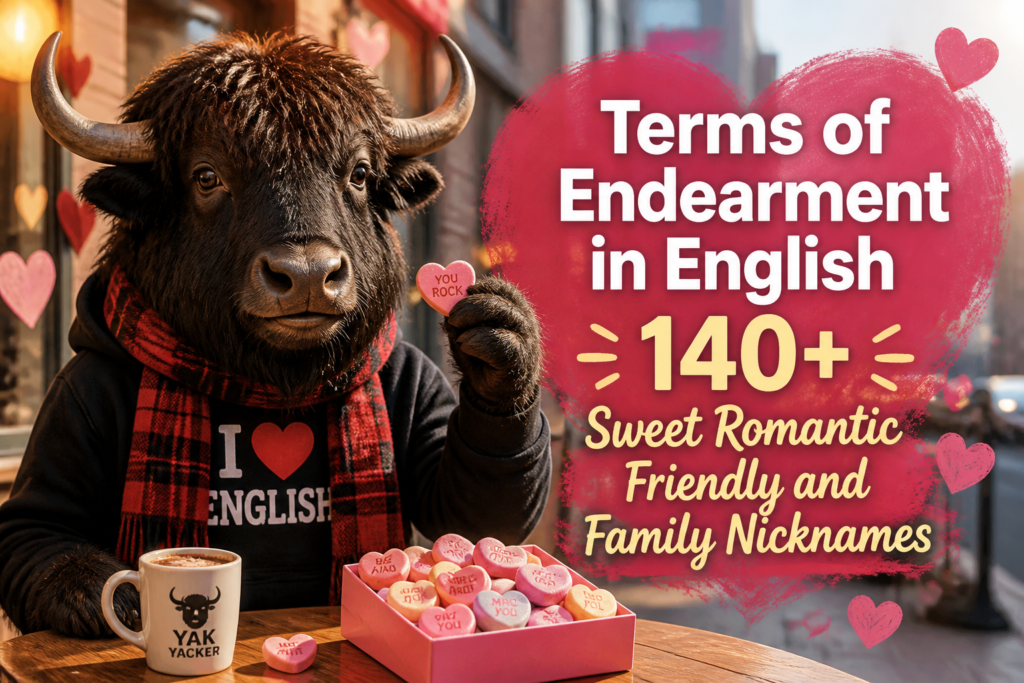
English is full of little affectionate nicknames. Some are sweet, some are romantic, some are warm and family-friendly, and some are the kind people use so casually that they barely notice they’re being nice. Yes, English speakers really do call each other things like honey, love, and sweetie—because apparently a normal name is not enough drama.
In this guide, you’ll learn more than 140 common terms of endearment in English, with pronunciation help, meanings, examples, and learner notes. You’ll also see which ones are romantic, friendly, family-style, regional, formal, or a little risky if you use them with the wrong person. Tiny word, big social consequences.
If you want to check your level after reading, try the English vocabulary test or the English placement test CEFR.
What Are Terms Of Endearment?
Terms of endearment are affectionate words or phrases people use to show love, care, warmth, or closeness. They are often used with a partner, child, family member, close friend, or sometimes even a stranger in a friendly way. The exact meaning depends on the country, relationship, tone, and situation.
For a general dictionary definition, see Cambridge Dictionary.
Big rule: a sweet nickname can sound caring in one relationship and weird in another. English loves context. Annoying, but useful.
Quick Tips Before You Use One
- Use affectionate nicknames with people who already know you well.
- Listen for local style. Some words are common in the U.S., while others are more common in the U.K. or other English-speaking places.
- Be careful with age, power, and politeness. Sweetheart can sound kind, old-fashioned, or condescending depending on tone.
- Romantic nicknames usually stay private. Using them in public can be cute, awkward, or both.
- Family nicknames are often softer and more playful than romantic ones.
Sweet And Romantic Terms Of Endearment
These are common in dating, marriage, and close romantic relationships. Some are classic. Some are cheesy. English speakers survive both.
| English | Pronunciation | Meaning | Example Sentence | Learner Note |
|---|---|---|---|---|
| honey | HUH-nee | A sweet, loving word for a partner or loved one | “Good night, honey.” | Very common and friendly; can also be used casually in some places. |
| sweetheart | SWEET-hart | A person you love or care about deeply | “Come here, sweetheart.” | Warm, but can sound old-fashioned or gentle depending on tone. |
| darling | DAHR-ling | A beloved person; very affectionate | “Darling, I’m home.” | Romantic or very warm. More common in some varieties of English. |
| baby | BAY-bee | A romantic nickname for a partner | “Baby, are you okay?” | Very common in American English; can sound childish outside romance. |
| babe | bayb | Short, casual romantic nickname | “Thanks, babe.” | Very informal. Often used between partners. |
| love | luhv | A loving nickname for a partner | “Do you want tea, love?” | Common in British English; also used elsewhere. Can be friendly too. |
| my love | my LUV | A very affectionate way to address someone | “My love, I missed you.” | Romantic and warm; also used with family in some cultures. |
| dear | DEER | Kind, affectionate address | “Are you feeling better, dear?” | Can sound sweet, polite, or slightly old-fashioned. |
| cutie | KYOO-tee | A cute person; affectionate and playful | “You’re such a cutie.” | Light, playful, and casual. |
| handsome | HAN-sum | An attractive man; sometimes affectionate | “Good morning, handsome.” | Often used for men in romantic relationships. |
| beautiful | BYOO-tuh-fuhl | An affectionate way to praise someone | “You look beautiful tonight.” | Common with partners; also a real compliment. |
| gorgeous | GOR-jus | Very attractive; affectionate praise | “You’re gorgeous, you know that?” | Romantic or friendly compliment; not always used as a nickname. |
| princess | PRIN-ses | Affectionate nickname, often for a woman or girl | “Sleep well, princess.” | Can be loving or teasing; tone matters a lot. |
| king | king | Affectionate nickname for a man | “You’ve got this, king.” | Modern, supportive, and often used in casual praise. |
| queen | kween | Affectionate nickname for a woman | “That outfit is amazing, queen.” | Very common in modern casual English, especially online. |
Friendly And Casual Nicknames
These are often used with close friends, teammates, or people in relaxed social settings. Some can also be used in families. A few are regional, so don’t throw them around like confetti without checking the vibe.
| English | Pronunciation | Meaning | Example Sentence | Learner Note |
|---|---|---|---|---|
| buddy | BUH-dee | Friend; informal friendly address | “Hey, buddy, how’s it going?” | Very common in American English; can be warm or slightly sharp. |
| pal | pal | Friend; informal address | “Thanks, pal.” | Friendly, but can sound a little old-fashioned in some contexts. |
| mate | mayt | Friend; casual address | “How’s it going, mate?” | Very common in British, Australian, and New Zealand English. |
| matey | MAY-tee | Very casual, friendly address | “All right, matey?” | Can sound playful or regional; not always natural everywhere. |
| bro | bro | Brother; casual friend nickname | “Come on, bro.” | Very informal, often used with men or close friends. |
| sis | sis | Sister; casual friendly nickname | “You got this, sis.” | Popular online and in casual speech, often supportive. |
| fam | fam | Family; close friend group | “What’s up, fam?” | Modern slang. Very casual. |
| friend | frend | Friendly address, sometimes gentle or polite | “Listen, friend, I think you’re wrong.” | Can sound warm or slightly serious depending on tone. |
| chief | cheef | Casual address, often to a man | “Thanks, chief.” | Friendly in some places; can sound sarcastic in others. |
| champ | champ | Short for champion; friendly praise | “Nice work, champ.” | Can be encouraging or sarcastic. Tone matters a lot. |
| sport | sport | Old-fashioned friendly nickname for a man or boy | “Good job, sport.” | Old-fashioned; sometimes sounds patronizing now. |
| kiddo | KID-oh | Friendly nickname for a younger person | “Morning, kiddo.” | Warm and casual, often used by adults. |
| sunshine | SUN-shine | Bright, cheerful person | “Well, hello there, sunshine.” | Can be sweet or sarcastic, depending on tone. |
| sweetie | SWEET-ee | Sweet person; affectionate and casual | “Can you pass the salt, sweetie?” | Common in warm, casual speech; can feel familiar. |
| pumpkin | PUMP-kin | A cute nickname for someone dear | “Good morning, pumpkin.” | Playful and affectionate; more common with children or partners. |
| peach | peech | Nice, sweet person | “You’re a peach.” | Kind but a little old-fashioned. |
| champion | CHAM-pee-un | Supportive nickname; winner, star | “You did great, champion.” | Encouraging, especially in family or coaching contexts. |
Family Nicknames For Children And Loved Ones
Family nicknames are often tender, playful, and a little silly. That is part of the charm. English-speaking families love using affection to sound extra warm, especially with children.
| English | Pronunciation | Meaning | Example Sentence | Learner Note |
|---|---|---|---|---|
| sweetie pie | SWEET-ee py | Very sweet, beloved person | “Come eat your lunch, sweetie pie.” | Very affectionate; often used with children. |
| honey bun | HUH-nee bun | Cute, sweet nickname | “Good night, honey bun.” | Playful and loving. |
| snuggle bug | SNUG-uhl bug | A person who likes cuddling | “You’re my little snuggle bug.” | Very cute and childlike. |
| little one | LIH-tuhl wuhn | Young child; affectionate address | “Come here, little one.” | Warm and gentle; common with children. |
| kid | kid | Child; casual family address | “Good job, kid.” | Can sound affectionate or casual, depending on tone. |
| baby girl | BAY-bee gurl | Affectionate nickname for a girl or daughter | “Good morning, baby girl.” | Very common in family speech in some regions. |
| baby boy | BAY-bee boy | Affectionate nickname for a boy or son | “How was school, baby boy?” | Warm and common with children. |
| munchkin | MUN-chkin | Small, adorable child | “That’s my little munchkin.” | Very playful; often used with kids. |
| little star | LIH-tuhl star | Beloved child or special person | “You did so well, little star.” | Encouraging and affectionate. |
| angel | AYN-juhl | Very sweet, good, dear person | “Thanks for helping, angel.” | Very common with children and loved ones. |
| kiddo | KID-oh | Friendly nickname for a child or younger person | “Ready for bed, kiddo?” | Gentle and casual. |
| tiger | TYE-gur | Strong, brave child or person | “You’re a tough tiger.” | Encouraging nickname, often for kids. |
| champ | champ | Winner; praised child or person | “Nice try, champ.” | Very common from parents, coaches, and teachers. |
| buttercup | BUH-ter-kup | Cute affectionate nickname | “Sleep tight, buttercup.” | Sweet and a little old-fashioned. |
| poppet | POP-it | Dear child or loved one | “Are you all right, poppet?” | More common in British English. |
Regional And Cultural Differences
Some affectionate words are very regional. If you learn that part, you avoid sounding like a chatbot in a cowboy hat.
| Word Or Phrase | Where It’s Common | Style | Note |
|---|---|---|---|
| love | U.K., Ireland, parts of Australia | Friendly, warm | Often used casually with strangers in shops or restaurants in some places. |
| mate | U.K., Australia, New Zealand | Friendly, casual | Very common between friends and acquaintances. |
| darling | U.K., older speakers, formal or affectionate contexts | Warm, sometimes old-fashioned | Can sound elegant or a bit dated. |
| honey | U.S., parts of the South, everyday speech | Warm, casual | Can be romantic, family-style, or friendly. |
| sweetheart | U.S., U.K., family contexts | Affectionate, gentle | May sound caring or patronizing depending on tone and situation. |
| pet | U.K., especially some regional speech | Friendly, affectionate | Not the same as “pet” meaning an animal. English loves confusion, naturally. |
| poppet | U.K. | Cute, warm | Often used with children. |
Common Expressions With Endearment Words
These phrases are useful because English speakers often use the nickname inside a full expression, not alone.
| Phrase | Pronunciation | Meaning | Example Sentence | Learner Note |
|---|---|---|---|---|
| my dear | my DEER | Very warm or polite address | “My dear, you look tired.” | Can sound formal, kind, or old-fashioned. |
| my darling | my DAHR-ling | Very affectionate address | “My darling, I missed you.” | Romantic and strong. |
| my sweetie | my SWEET-ee | A sweet, affectionate way to speak to someone | “My sweetie, come here.” | Often used in families or romantic relationships. |
| my love | my LUV | Deeply affectionate address | “My love, thank you for everything.” | Common and flexible. |
| dear one | DEER wuhn | Beloved person | “Rest well, dear one.” | Soft, tender, and literary. |
| little darling | LIH-tuhl DAHR-ling | Small beloved person | “Come sit here, little darling.” | Very sweet; often used with children. |
| my angel | my AYN-juhl | Very dear and good person | “My angel, thank you so much.” | Warm and common. |
| my sunshine | my SUN-shine | Someone who brightens your day | “Good morning, my sunshine.” | Playful and affectionate. |
Words That Can Be Sweet Or Awkward
Some terms of endearment are tricky. They can sound loving, but they can also sound patronizing, too familiar, or sarcastic. Tone is everything.
- Honey — sweet in many situations, but can sound overfriendly in the wrong workplace setting.
- Sweetheart — lovely with family or partners, but sometimes sounds condescending from a stranger.
- Dear — polite in some places, but can sound old-fashioned or sharp if said coldly.
- Champ — encouraging with kids, but sarcastic if said after a mistake.
- Buddy — friendly with friends, but can sound irritated if someone says, “Listen, buddy…”
When in doubt, listen first. English affection is often less about the word itself and more about the relationship around it.
Fast Pronunciation Notes
| Word | Pronunciation Help | Common Mistake | Tip |
|---|---|---|---|
| honey | HUH-nee | Too much emphasis on the second syllable | Keep it soft and smooth. |
| darling | DAHR-ling | Pronouncing the “r” too strongly in some accents | Say it gently and naturally. |
| sweetheart | SWEET-hart | Separating the word too much | It usually sounds like one flowing phrase. |
| babe | bayb | Adding an extra vowel sound | It is short and clean. |
| mate | mayt | Using a long “i” sound by mistake | It rhymes with “late.” |
Common Mistakes And Easy Fixes
| Mistake | Better Choice | Why |
|---|---|---|
| Using baby with someone you barely know | Use a neutral greeting like hi or hello | Baby is usually intimate or romantic. |
| Calling a stranger sweetheart | Use sir, ma’am, or the person’s name | It may sound too familiar or patronizing. |
| Using mate in a very formal email | Use Dear or the person’s name | Mate is casual, not business-style. |
| Assuming every English speaker uses honey the same way | Check the country and relationship | Usage changes a lot by region and context. |
| Thinking all nicknames are romantic | Notice family and friendly uses too | Many endearments are not romantic at all. |
Practice
Choose the best term of endearment for each situation.
- 1. You are speaking gently to your child: ________
- 2. You want to thank your boyfriend or girlfriend: ________
- 3. You are talking casually to a close friend in the U.K.: ________
- 4. You want a warm nickname for a cheerful friend: ________
- 5. You are speaking to your son in a loving way: ________
Possible answers: sweetie, love, mate, sunshine, baby boy.
Now try changing the sentence to make it more affectionate:
- “Can you help me?” → “Can you help me, ________?”
- “Thanks for dinner.” → “Thanks for dinner, ________.”
- “Are you okay?” → “Are you okay, ________?”
Good options: honey, dear, babe, sweetheart, love.
Quick Reference Summary
- Romantic: honey, babe, baby, darling, my love, sweetheart
- Friendly: buddy, mate, pal, bro, sis, fam
- Family: kiddo, angel, little one, munchkin, sweetie pie, baby boy, baby girl
- Playful: pumpkin, sunshine, champ, cutie, buttercup
- Regional: mate, love, pet, poppet, darling
- Watch the tone: some words can sound sweet, sarcastic, or too familiar
If you want to keep building your English vocabulary, visit the main Learn English page for more practical guides. Yak takeaway: a good term of endearment makes English warmer, but the wrong one can make a conversation go from sweet to weird in one tiny syllable. Choose wisely.