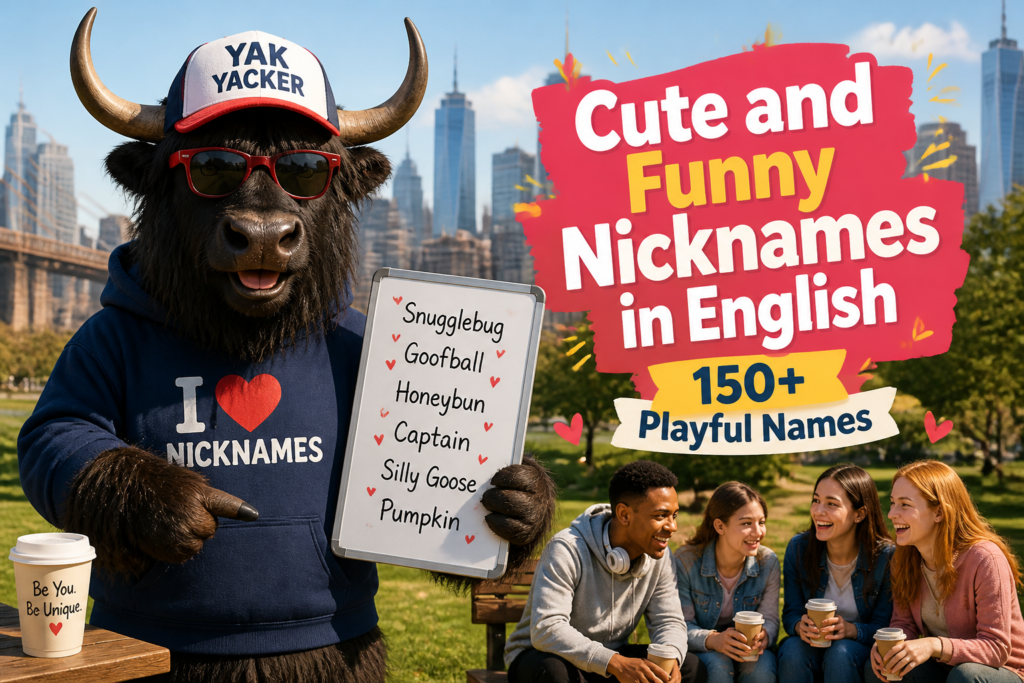
Nicknames are the tiny language snacks of English. They are short, playful, warm, and sometimes a little ridiculous in the best way. A good nickname can make a friend laugh, make a couple sound adorable, or turn a family gathering into a comedy show with snacks.
English nicknames are often about tone, not just meaning. “Babe” can sound sweet. “Buddy” can sound friendly. “Goofball” can sound teasing. And yes, calling someone “Boss” does not always mean they are the actual boss. English loves pretending.
In this guide, you’ll learn cute, funny, and useful nicknames for friends, couples, and family members, plus pronunciation help, meaning, example sentences, and quick learner notes. For extra practice later, try the English vocabulary test or check your level with the English placement test CEFR.
If you want to explore more English learning topics, the Learn English page is a nice place to wander around without getting lost in grammar fog.
What Makes A Nickname Cute Or Funny?
A nickname is an informal name used instead of someone’s real name. It can show affection, humor, closeness, or group identity. Some nicknames are sweet. Some are silly. Some are both, which is usually where the best ones live.
Important note: nicknames are very personal. A nickname that sounds cute to one person may sound rude to another. Use them with people who know you well, or at least with people who enjoy a little playful English chaos.
| Word / Phrase | Pronunciation | Meaning | Example Sentence | Learner Note |
|---|---|---|---|---|
| nickname | nik-naym | A short or special name used for a person | Her nickname is “Maggie,” but her real name is Margaret. | Can be cute, funny, or personal. |
| term of endearment | turn uhv en-DEER-ment | A loving word used for someone close | “Honey” is a term of endearment. | More formal than everyday speech. |
| pet name | pet naym | A sweet nickname for a loved one | They call each other pet names like “sweetie” and “babe.” | Common in romantic relationships. |
| inside joke | IN-side johk | A joke understood by a specific group | The nickname came from an inside joke at school. | Many funny nicknames start this way. |
Cute Nicknames For Friends
These nicknames are friendly, warm, and usually safe for casual use. They work best with people you know well.
| English | Pronunciation | Meaning | Example Sentence | Learner Note |
|---|---|---|---|---|
| buddy | BUD-ee | Friend; informal and friendly | Hey, buddy, want to grab lunch? | Very common in American English. |
| pal | pal | Friend; casual | Thanks, pal. You saved me a lot of time. | Can sound warm or slightly old-school. |
| mate | mayt | Friend; very common in British English and also in Australia | He’s my mate from college. | American English uses it less often for friends. |
| bestie | BESS-tee | Best friend; very casual and affectionate | My bestie always sends me memes. | Popular in texting and social media. |
| chief | cheef | Friendly, playful way to address someone | What’s up, chief? | Can sound joking, not literal. |
| champ | champ | Short for “champion”; friendly or teasing | Nice job, champ. | Often used with kids or close friends. |
| bro | broh | Brother; casual for male friend | Bro, are you coming with us? | Very informal. |
| sis | sis | Sister; casual for a female friend | Thanks, sis, that was really kind. | Friendly, modern, and common online. |
| buddy-buddy | BUD-ee BUD-ee | Very friendly or overly close | They’re all buddy-buddy with the new guy. | Can sound teasing. |
| sidekick | SYD-kik | Close friend who always joins you | My sidekick came with me to the store. | Funny and a little playful. |
| partner in crime | PART-ner in krym | A friend who shares your fun or mischief | She’s my partner in crime for late-night snacks. | Very common and humorous. |
| muppet | MUP-it | Silly person; often affectionate in British English | You forgot your keys again, you muppet. | Usually funny, but can sound rude if said badly. |
| goofball | GOOF-ball | Silly person | He’s a lovable goofball. | Good for a friend with big chaotic energy. |
| weirdo | WEER-doh | Unusual person; can be teasing or affectionate | You are such a weirdo, but I mean that lovingly. | Context matters a lot. |
| sunshine | SUN-shyne | A cheerful, positive person | Good morning, sunshine. | Sweet and popular in both friendships and families. |
One tiny warning: “buddy” is friendly, but “buddy” can also sound like you are talking to a child or gently correcting someone. English is fun like that. Slightly confusing, deeply committed to being casual.
Cute And Funny Nicknames For Couples
Couples often use nicknames that sound soft, playful, or a little extra. That is part of the charm. Romance in English likes short words with lots of feeling packed inside them.
| English | Pronunciation | Meaning | Example Sentence | Learner Note |
|---|---|---|---|---|
| babe | bayb | Romantic nickname for a partner | “Babe, are you ready to go?” she asked. | Very common, casual, and affectionate. |
| baby | BAY-bee | Very affectionate nickname for a partner | He sent a text saying, “Good night, baby.” | Can feel very sweet or very cheesy. |
| honey | HUN-ee | Sweet nickname for a loved one | “Honey, I made coffee,” he said. | Also used for children or in friendly service speech in some places. |
| sweetie | SWEET-ee | Sweet, affectionate nickname | Come here, sweetie. | Warm and common in family or romance. |
| dear | deer | Affectionate term; slightly old-fashioned in some contexts | Thank you, dear. | Can sound very gentle or a bit formal. |
| love | luv | Affectionate term, especially in British English | Are you okay, love? | In the U.S., it sounds more romantic or personal. |
| snuggle bug | SNUG-uhl bug | A cuddly, affectionate person | My snuggle bug fell asleep on the couch. | Very cute and playful. |
| cutie | KYOO-tee | A cute person; affectionate and playful | Hey, cutie, want to watch a movie? | Common in texting and casual speech. |
| pumpkin | PUMP-kin | Sweet nickname, often playful | Good morning, pumpkin. | Often sounds warm and a little old-fashioned. |
| cupcake | KUP-kayk | Sweet, cute nickname | Come on, cupcake, let’s go. | Playful and a bit sugary. |
| lovebug | LUV-bug | A loving, affectionate person | You’re my little lovebug. | Common for couples and kids. |
| snookums | SNOO-kumz | Very cute, silly nickname | Okay, snookums, I’m leaving now. | Very cheesy on purpose. |
| boo | boo | Romantic nickname for a partner | My boo is making dinner tonight. | Popular in casual American English. |
| sweet pea | SWEET pee | Small, sweet, lovable person | Sweet pea, come here for a minute. | Gentle and affectionate. |
| snack | snak | Very attractive person; slang and playful | He walked in looking like a snack. | Slang; use carefully and only in casual settings. |
“Boo” and “babe” are common in American English. “Love” is especially common in British English as a casual term of affection. If that sounds like a tiny romance map, congratulations: it is.
Funny Nicknames For Friends And Family
Funny nicknames often come from personality, habits, accidents, food, or one unforgettable moment that everybody still laughs about. The more specific the nickname, the stronger the memory.
| English | Pronunciation | Meaning | Example Sentence | Learner Note |
|---|---|---|---|---|
| goofball | GOOF-ball | Silly person | My brother is a total goofball. | Friendly and playful. |
| nerd | nurd | Smart, awkward, or overly interested person | He’s a proud science nerd. | Can be insulting or affectionate. |
| geek | geek | Very enthusiastic, often about a hobby or topic | I’m a coffee geek, so don’t judge my mugs. | Now often positive. |
| pickle | PIK-uhl | Silly or tricky person; also a funny nickname | Stop being a pickle and finish your homework. | Very playful. |
| munchkin | MUNCH-kin | Small, cute person or child | Come here, munchkin. | Common with children or short loved ones. |
| tiny tornado | TY-nee tor-NAY-doh | Very energetic, chaotic person | That toddler is a tiny tornado. | Great for lively kids. |
| troublemaker | TRUB-uhl-may-ker | Person who causes mischief | You little troublemaker, what did you do now? | Can be teasing and affectionate. |
| snickerdoodle | SNIK-er-doo-dul | Funny, sweet-sounding nickname inspired by the cookie | My aunt calls the dog Snickerdoodle. | Silly, cute, and very American-sounding. |
| wiggle worm | WIG-uhl wurm | Someone who moves a lot, especially a child | The wiggle worm would not sit still. | Very common for kids. |
| smarty pants | SMART-ee pants | Person who acts clever or knows everything | Okay, smarty pants, what’s the answer? | Often teasing. |
| boss | bos | Playful way to call someone confident or in charge | You’re the boss today. | Can be supportive or joking. |
| chief | cheef | Friendly title for someone acting important | Slow down, chief, you’re not in charge here. | Often funny in casual speech. |
| pickle juice | PIK-uhl joos | Silly made-up nickname | My dad calls my cousin Pickle Juice. | Great for family jokes. |
| bean | been | Small, cute person | That little bean is already asleep. | Cute and modern. |
| goose | goos | Silly person; affectionate in some families | You silly goose, you left your bag again. | Classic and very common in family speech. |
| mess | mes | Chaos; used for a very disorganized person in a joking way | You are such a mess today. | Can be affectionate or critical. |
“You silly goose” is one of those English phrases that sounds almost too soft to be an insult, which is good, because it usually is not one.
Sweet Nicknames For Kids And Younger Family Members
Family nicknames are often simple, cute, and repeated a thousand times a week. They may be based on size, personality, habits, or just pure love with no logic at all. That’s family style.
| English | Pronunciation | Meaning | Example Sentence | Learner Note |
|---|---|---|---|---|
| kiddo | KID-oh | Child; affectionate and informal | Come on, kiddo, it’s bedtime. | Warm and common in American English. |
| little one | LIT-uhl wun | Small child; affectionate | The little one is asleep now. | Gentle and natural. |
| champ | champ | Child or person being praised | Nice work, champ. | Encouraging and casual. |
| tiger | TY-ger | Energetic or brave child | Good job, tiger. | Common with kids. |
| honey bun | HUN-ee bun | Sweet, cute person | How was school, honey bun? | Very affectionate, a little sugary. |
| peanut | PEE-nut | Small child or short person | My grandma calls me peanut. | Common and playful. |
| buttons | BUT-enz | Very cute nickname for a child | Good night, buttons. | Old-fashioned but sweet. |
| tiny | TY-nee | Small person | Hey, tiny, are you ready? | Can be affectionate or teasing. |
| sprout | sprowt | Young child; a little plant, used metaphorically | My little sprout loves stories. | Very cute and gentle. |
| bean sprout | BEEN sprowt | Very small child | Look at that bean sprout in the raincoat. | Funny and affectionate. |
| sunshine | SUN-shyne | Bright, happy person | Morning, sunshine. Did you sleep well? | Works for adults and children. |
| pumpkin pie | PUMP-kin py | Extra sweet nickname | My aunt calls her grandson pumpkin pie. | Very warm and playful. |
| button nose | BUT-uhn nohz | Sweet nickname based on appearance | Come here, button nose. | Use only if the person likes it. |
| little monster | LIT-uhl MON-ster | Playful nickname for a mischievous child | That little monster ate the cookies. | Funny, not mean, if said lovingly. |
| angel | AYN-juhl | Very good, sweet person | You’re my little angel. | Very common in family speech. |
Nicknames Based On Food, Animals, And Tiny Chaos
English speakers love naming people after snacks, animals, and random cute things. It sounds strange until it sounds completely normal. Language is like that: one day “cupcake” is dessert, the next day it is your best friend’s pet name.
| English | Pronunciation | Meaning | Example Sentence | Learner Note |
|---|---|---|---|---|
| cupcake | KUP-kayk | Sweet person | She’s a cupcake and everybody loves her. | Cute and common. |
| cookie | KOO-kee | Sweet, nice person | Thanks, cookie. That was thoughtful. | Often affectionate for children. |
| muffin | MUF-in | Soft, sweet person | Come on, muffin, let’s go home. | Warm and slightly old-fashioned. |
| pudding | PUD-ing | Sweet nickname; especially British English | Are you okay, pudding? | More common in the UK. |
| honey bun | HUN-ee bun | Very sweet nickname | Good morning, honey bun. | Very affectionate and sugary. |
| peach | peech | Nice, pleasant person | You’re a peach for helping me. | Can mean kind and lovely. |
| buttercup | BUT-er-kup | Bright, cute flower name used as a nickname | Hey, buttercup, what’s new? | Sweet and playful. |
| honeybee | HUN-ee bee | Busy, sweet person | My honeybee never stops moving. | Less common, but cute. |
| snail | snayl | Very slow person; teasing nickname | Hurry up, snail. | Teasing, not ideal for sensitive people. |
| chicken | CHIK-in | Scared person or cute child nickname | You little chicken, it’s only a spider. | Can be funny or rude depending on tone. |
| birdie | BUR-dee | Small, cute person; common in some families | Come here, birdie. | Gentle and sweet. |
| bunny | BUN-ee | Cute, soft, or sweet person | My dad calls my little sister bunny. | Popular in romantic and family speech. |
| fox | foks | Smart or sly person; sometimes attractive in slang | She’s a clever fox. | Can mean smart or attractive. |
| turtle | TUR-tuhl | Slow person; playful nickname | You’re such a turtle in the morning. | Teasing and cute. |
| panda | PAN-duh | Soft, cute person | He’s a sleepy panda before coffee. | Modern and friendly. |
Useful Nickname Patterns You Can Copy
Some nicknames follow easy patterns. Learn the pattern, and you can make your own without sounding completely random.
| Pattern | Meaning | Example | Learner Note |
|---|---|---|---|
| Sweet noun | A cute object or food used as a nickname | cupcake, honey, pumpkin | Often affectionate and warm. |
| Small animal | A tiny, cute animal image | bunny, birdie, turtle | Can sound gentle and playful. |
| Friendly role | A casual title for someone in your group | buddy, pal, chief | Very useful for friends. |
| Funny personality label | A teasing name based on behavior | goofball, smarty pants, troublemaker | Use only if the person enjoys teasing. |
| “Little + noun” | Makes the nickname sound cute or smaller | little one, little monster, little bean | Very common with kids. |
American Vs British Nickname Differences
Some nicknames work in both varieties of English, but a few feel more American or more British. Knowing this helps you avoid sounding oddly formal, strangely flirtatious, or like you learned English from a sitcom marathon.
| Expression | American English | British English | Note |
|---|---|---|---|
| love | Can sound romantic or very close | Very common as a casual affectionate term | In the UK, it can be used much more broadly. |
| mate | Less common for friends | Very common for friends | One of the classic British-friendly words. |
| pet | Not common as a nickname | Used in some regions as an affectionate term | Very regional in British English. |
| cheeky | Used, but less often in nickname style | Very common for playful behavior | Examples: cheeky monkey, cheeky little thing. |
When in doubt, use safer choices like buddy, bestie, sweetie, goofball, or kiddo. They are widely understood and less likely to cause nickname drama, which is already enough of a hobby in real life.
How To Use Nicknames Naturally
Nicknames usually appear in direct address, texts, and casual conversation. That means they often come at the beginning or end of a sentence.
| Pattern | Meaning | Example | Learner Note |
|---|---|---|---|
| Nickname + comma + sentence | Direct address | Buddy, can you help me? | Use a comma when writing. |
| Sentence + nickname | Casual affection at the end | Thanks, honey. | Very common in spoken English. |
| Hey/Hi + nickname | Friendly greeting | Hey, cutie. | Sounds warm and casual. |
| My + nickname | Shows closeness or possession in a cute way | My bestie is late again. | Common in texting and speech. |
Common Mistakes And Fixes
Nicknames are fun, but they are also social. That means tone matters. A lot. English is delightfully dramatic that way.
| Wrong Or Risky | Better | Why |
|---|---|---|
| Using babe with a stranger | Use sir, ma’am, or the person’s name | Babe is romantic or very casual. |
| Calling someone goofball when they are upset | Use friend or their name | Teasing nicknames can feel insulting in the wrong moment. |
| Using mate like an American friend term everywhere | Check the situation and region | Mate is more natural in British English. |
| Using a nickname the person does not like | Ask first or listen carefully | Nicknames should feel welcome, not forced. |
| Thinking all cute words are appropriate for adults | Match the relationship and context | Some nicknames sound childish, too sweet, or too personal. |
Quick Practice
Choose the best nickname for each situation. No cheating. English is already trying its best.
- You want to greet your close friend in a very casual way. Choose: buddy, professor, or strawberry.
- You want a sweet nickname for your partner. Choose: babe, chief, or pickle.
- You want a playful name for a silly person. Choose: goofball, dear, or mate.
- You want a cute nickname for a child. Choose: kiddo, lawyer, or boss.
- You want a very sweet nickname for someone small and lovable. Choose: munchkin, engineer, or captain.
Try making three nicknames for imaginary people: one sweet, one funny, and one silly-but-kind. Example: pumpkin, smarty pants, little bean.
Mini Reference: 30 More Playful Nicknames
| English | Pronunciation | Meaning | Example Sentence | Learner Note |
|---|---|---|---|---|
| sweetheart | SWEET-hahrt | Very affectionate person | Good night, sweetheart. | Classic and warm. |
| darling | DAR-ling | Beloved person | Darling, where are my keys? | Common in British English; also used in American English. |
| angel face | AYN-juhl fays | Very sweet-looking person | Look at that angel face. | Usually affectionate. |
| pretty thing | PRIT-ee thing | Attractive or cute person | Hey, pretty thing, you look nice today. | Very casual; use carefully. |
| little bean | LIT-uhl been | Small and adorable person | My little bean is finally awake. | Popular online and in families. |
| bug | bug | Cute term for a loved one or child | Come here, bug. | Small and affectionate. |
| snug bug | SNUG bug | Cuddly person | You’re my snug bug on rainy days. | Very cute and playful. |
| little star | LIT-uhl star | Excellent, lovable person | Great job, little star. | Good for praise. |
| sunbeam | SUN-beem | Happy, bright person | You’re a little sunbeam this morning. | Sweet and positive. |
| sparkles | SPAR-kuhlz | Shiny, lively, charming person | My niece loves the nickname Sparkles. | Often used for children. |
| crumbs | krumz | Funny little nickname; often just playful sound | Hey, crumbs, you left the door open. | Very informal and quirky. |
| wiggles | WIG-uhlz | Someone who moves a lot | My toddler is all wiggles today. | Good for kids. |
| peanut butter | PEE-nut BUT-er | Silly food nickname | My uncle calls everyone peanut butter when he is joking. | Best as a family joke. |
| cookie monster | KOO-kee MON-ster | Someone who loves cookies or snacks | You ate all the snacks, cookie monster. | Funny and widely understood. |
| grumpy bear | GRUM-pee bair | Person who is moody in a cute way | Don’t wake the grumpy bear before coffee. | Playful and descriptive. |
| sleepyhead | SLEE-pee-hed | Someone who is sleepy | Wake up, sleepyhead. | Very common and friendly. |
| smarty | SMAR-tee | Clever person | Nice one, smarty. | Can be teasing or praising. |
| chatty one | CHAT-ee wuhn | Talkative person | The chatty one never stops talking. | Neutral to playful. |
| tiny dancer | TY-nee DAN-ser | Lively, energetic person | That toddler is a tiny dancer. | Cute and fun. |
| mischief | MIS-chif | Playful troublemaker | What mischief are you planning now? | Can be affectionate. |
| bossy boots | BOS-ee boots | Person who likes to be in charge | My sister is a bossy boots in group projects. | Teasing nickname; common in British English. |
| cheeky monkey | CHEE-kee MUN-kee | Playfully naughty person | You cheeky monkey, you stole my fries. | Very British and very playful. |
| rascal | RAS-kuhl | Playful troublemaker | That rascal hid my phone. | Old-school but still used. |
| sweet pea | SWEET pee | Sweet, small, lovable person | Night, sweet pea. | Gentle and kind. |
| peaches | PEE-chiz | Kind or lovely person | You’re a real peaches, thank you. | Less common, but charming. |
| butterscotch | BUT-er-skotch | Sweet, funny-sounding nickname | Grandpa called the dog Butterscotch. | Very cute and old-fashioned. |
| honey child | HUN-ee chyld | Affectionate, often southern-sounding term | Honey child, slow down and breathe. | Regional and warm. |
| little rascal | LIT-uhl RAS-kuhl | Mischievous child or person | You little rascal, stop hiding the remote. | Funny and affectionate. |
| cutie pie | KYOO-tee py | Very cute person | You’re my cutie pie. | Sweet and common in romance or family speech. |
| snuggle muffin | SNUG-uhl MUF-in | Very cuddly, sweet person | My snuggle muffin is already asleep. | Very playful and affectionate. |
And there you go: cute nicknames, funny nicknames, sweet nicknames, and a few gloriously silly ones. The secret is simple: the best nickname is the one that fits the relationship, the mood, and the person. If it makes everyone smile, it usually works. If it makes everyone stare in silence, maybe try buddy instead.
Yak Takeaway: Nicknames in English are about closeness, tone, and timing. Sweet, silly, or slightly ridiculous, the right nickname can make English feel warmer and more natural fast.