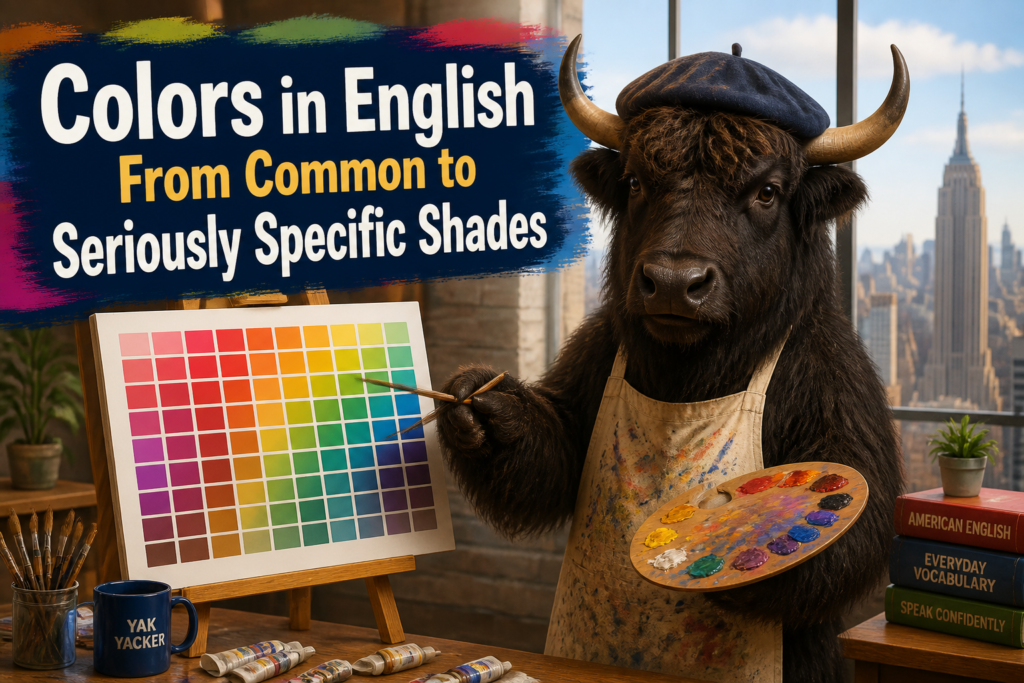
Colors look simple until English decides to act dramatic. Then “blue” becomes navy, teal, turquoise, cobalt, sky blue, baby blue, and somehow “not quite blue, but definitely not green.” Very helpful. Very normal. Absolutely not confusing at all.
For the broader learning path, visit our parent guide.
This guide will help you learn common color words in English, more specific shades, useful phrases, and the little usage details that make your English sound more natural. By the end, you should be able to describe colors in everyday conversation, shopping, fashion, design, nature, and even that mysterious “off-white” wall paint that still somehow has an opinion.
For a quick extra challenge later, try an English vocabulary check with the English Vocabulary Test or see your level with the English Placement Test CEFR.
Common Colors You’ll Use All The Time
These are the everyday color words you need first. They show up in clothing, home decor, art, weather, food, and tiny arguments about what color a bag “really” is.
| English | Pronunciation | Meaning | Example Sentence | Learner Note |
|---|---|---|---|---|
| red | red | The color of strawberries, fire, and stop signs. | I bought a red jacket. | Very common. Also used in expressions like “in the red” for losing money. |
| blue | bloo | The color of the sky or ocean. | Her phone case is blue. | One of the most useful basic colors. |
| green | green | The color of grass, leaves, and many vegetables. | They painted the room green. | Also used for “environmentally friendly.” |
| yellow | YEL-oh | The color of lemons, sunshine, and school buses. | He wore a yellow shirt. | Often bright and easy to notice. |
| black | blak | The darkest color, like night or ink. | She has a black backpack. | Can describe clothing, hair, phones, and more. |
| white | wyte | The lightest color, like snow or paper. | We need a white T-shirt. | Common in clothing, furniture, and design. |
| brown | brown | The color of wood, coffee, and many animals. | My shoes are brown. | Very useful for describing natural things. |
| gray / grey | gray | A color between black and white. | The sky looks gray today. | Gray is American English. Grey is British English. |
| orange | OR-unj | The color of oranges and pumpkins. | I like orange sneakers. | Also a fruit, so context matters. |
| pink | pingk | A light red color. | That bag is pink. | Very common in fashion and decor. |
| purple | PUR-puhl | A color between blue and red. | She has purple nails. | Sometimes used for royal or elegant styles. |
| beige | bayzh | A light brown or sandy color. | The walls are beige. | Common in home design and clothes. |
Learner note: In English, we often say “a red car,” “blue jeans,” or “the green light.” The color usually comes before the noun.
Useful Color Phrases For Real Life
Colors are not just vocabulary. They also show up in useful phrases, descriptions, and opinions. Here are some you’ll actually hear.
| English | Pronunciation | Meaning | Example Sentence | Learner Note |
|---|---|---|---|---|
| light blue | lyt bloo | A pale blue color. | She wants a light blue dress. | Use for soft, gentle shades. |
| dark green | dark green | A deep green color. | The couch is dark green. | Common with clothes, furniture, and nature. |
| bright red | bryt red | A strong, vivid red. | He bought bright red sneakers. | Bright means strong and easy to see. |
| pale pink | payl pingk | A very light pink color. | The baby blanket is pale pink. | Good for soft or delicate descriptions. |
| off-white | awf-wyte | Almost white, but not pure white. | We chose off-white curtains. | Very common in design and home decor. |
| navy blue | NAY-vee bloo | A very dark blue color. | He wore a navy blue suit. | Common in business clothes and uniforms. |
| sky blue | sky bloo | A light blue like the daytime sky. | The shirt is sky blue. | Easy visual phrase for learners. |
| olive green | OL-iv green | A dull green like olives or military clothing. | She bought an olive green bag. | Very useful in fashion and design. |
| gold | gold | A shiny yellow metal color. | The frame is gold. | Can also mean actual gold, the metal. |
| silver | SIL-ver | A shiny gray metal color. | He has a silver watch. | Often used for jewelry and accessories. |
| multicolored | MUL-tee-KUL-erd | Having many colors. | She wore a multicolored scarf. | Useful for patterns, art, and clothing. |
| two-tone | too-tohn | Having two colors. | They sell two-tone shoes. | Common in fashion, cars, and design. |
“Off-white” is a good example of how English loves to be slightly annoying. It does not mean “bad white.” It means “not pure white.” Language is elegant like that.
Seriously Specific Shades
Once you know the basics, you can get more specific. These shades are useful when someone asks for a paint color, a clothing color, or a design description and “blue” is just too lazy to do the job.
| English | Pronunciation | Meaning | Example Sentence | Learner Note |
|---|---|---|---|---|
| teal | teel | A blue-green color. | I love this teal sweater. | Very common in fashion and decor. |
| turquoise | TUR-kwoiz | A bright blue-green color. | She has turquoise earrings. | Spelling can look tricky. Don’t panic. |
| cobalt blue | KOH-bolt bloo | A rich, strong blue color. | The vase is cobalt blue. | Common in art, ceramics, and design. |
| navy | NAY-vee | Very dark blue. | I need navy pants for work. | Often used without “blue” in clothing. |
| burgundy | BUR-gun-dee | A dark red with a purple tone. | He chose a burgundy tie. | Common in fashion, wine, and decor. |
| maroon | muh-ROON | A dark reddish-brown color. | The team wears maroon uniforms. | Sometimes confused with burgundy. |
| lavender | LAV-en-der | A soft light purple color. | Her room is painted lavender. | Also a flower and a scent. |
| violet | VY-uh-lit | A purple-blue color. | The sky turned violet at sunset. | Common in art and nature descriptions. |
| peach | peech | A soft orange-pink color. | She wore a peach blouse. | Also a fruit, so context matters. |
| coral | KOR-uhl | A pink-orange color. | That lipstick is coral. | Very popular in beauty and fashion. |
| mustard yellow | MUS-terd YEL-oh | A dull yellow like mustard. | He bought a mustard yellow jacket. | Common in clothes and home decor. |
| forest green | FOR-ist green | A deep green like trees in a forest. | The walls are forest green. | Good for natural or earthy descriptions. |
| charcoal | CHAR-kohl | A very dark gray color. | She has a charcoal coat. | Often used for clothes and interiors. |
| slate gray | slayt gray | A cool gray color like slate stone. | The kitchen cabinets are slate gray. | Common in design and architecture. |
How To Describe Shades Naturally
English speakers often use small words before color names to make them more precise. These little words are simple, practical, and very common.
| Pattern | Meaning | Example | Learner Note |
|---|---|---|---|
| light + color | A softer, paler shade. | light green, light gray | Use this for gentle or pastel colors. |
| dark + color | A deeper, stronger shade. | dark blue, dark brown | Very common and easy to use. |
| bright + color | A strong, vivid shade. | bright yellow, bright pink | Good for lively or energetic descriptions. |
| pale + color | A weak, soft, light shade. | pale blue, pale peach | Often used for skin tones, flowers, and clothes. |
| deep + color | A rich, rich-dark shade. | deep purple, deep red | Sounds more descriptive than just “dark.” |
| soft + color | A gentle, not-too-strong shade. | soft pink, soft beige | Often used in design and fashion. |
Rule: Put the descriptive word before the color name.
Example: “a dark green shirt,” not “a green dark shirt.” English likes order. Rude, but consistent.
Colors In Everyday English Phrases
Colors also appear in common expressions. These are not always about literal color, so you need to learn the meaning from context.
| Phrase | Meaning | Example Sentence | Learner Note |
|---|---|---|---|
| feeling blue | Feeling sad. | She’s been feeling blue lately. | Informal and common in conversation. |
| see red | Get very angry. | He sees red when people are rude to him. | Strong emotion, not literal color. |
| green with envy | Very jealous. | My friend was green with envy when I got the new phone. | Friendly, common idiom. |
| in the black | Having money, not in debt. | The business is finally in the black. | Common in finance and business English. |
| in the red | Owing money, losing money. | The store has been in the red for months. | Useful business phrase. |
| white lie | A small lie told to be polite. | I told a white lie to avoid hurting her feelings. | Often used in everyday conversation. |
| out of the blue | Suddenly, unexpectedly. | He called me out of the blue. | Very common and very useful. |
| once in a blue moon | Very rarely. | We eat fast food once in a blue moon. | Common idiom. Not about actual moons. |
Yak note: “Blue” does a lot of emotional work in English. That little color word is busier than it looks.
American And British Differences
Most color words are the same in American and British English. But one spelling difference shows up a lot:
| American English | British English | Example | Note |
|---|---|---|---|
| gray | grey | gray/grey sky | Same meaning, different spelling. |
There are also a few cultural differences in color words. For example, “navy,” “burgundy,” and “beige” are very common in both varieties, especially for clothes, offices, and home decor. Fancy color naming is not unique to one country. English speakers everywhere enjoy being oddly specific.
Grammar Notes For Color Words
Color words are usually adjectives, which means they describe nouns.
| Pattern | Meaning | Example | Learner Note |
|---|---|---|---|
| a + color + noun | Use a color to describe a thing. | a red car, a black hat | This is the most common pattern. |
| the + color + noun | Describe a specific thing already known. | the blue bag | Use the when both people know the item. |
| noun + is + color | Say what color something is. | The bag is blue. | This is useful for simple descriptions. |
| color + and + color | Mix or combine colors. | blue and white, red and gold | Common for patterns, flags, designs, and clothes. |
Important: English usually puts color words before the noun: green apple, black shoes, purple bag. In many cases, the color word does not change form for singular or plural nouns.
Practice Time
Try these quick exercises. No drama, just useful English.
- Choose the best shade: Is a deep blue shirt more likely navy, peach, or coral?
- Swap the word: “a light green dress” → use pale instead of light.
- Correct the order: “a shirt blue” → write the correct phrase.
- Complete the sentence: “I’m feeling _____ today.” Try a color idiom meaning sad.
- Make it more specific: Change “red” into a darker, richer red.
- Say it naturally: “The walls are not white, but almost white.” What color phrase fits best?
Answers: navy, pale green dress, a blue shirt, blue, burgundy or maroon, off-white.
Common Mistakes And Fixes
| Wrong | Correct | Why |
|---|---|---|
| a shirt blue | a blue shirt | Color words usually come before the noun. |
| the car is red color | the car is red | Usually use the color adjective alone. |
| dark green light | light green | Put descriptive words in a natural order. |
| grey in American English spelling | gray in American English spelling | Gray is standard American spelling; grey is British. |
| blue feeling | feeling blue | Idioms have fixed word order. |
| colorfuls | colorful | Colorful is the adjective; do not add -s. |
Learner tip: If you know the base color, add a helper word like light, dark, bright, or pale. That’s usually enough to sound natural.
Quick Reference Summary
- Basic colors: red, blue, green, yellow, black, white, brown, gray/grey, orange, pink, purple, beige
- Useful shade words: light, dark, bright, pale, deep, soft
- Specific shades: navy, teal, turquoise, burgundy, maroon, lavender, coral, charcoal, off-white
- Pattern: color words usually come before the noun: a red car
- Common idioms: feeling blue, see red, green with envy, out of the blue
- Spelling note: gray in American English, grey in British English
If you can describe a shirt, a wall, a sky, and a mood, you’re already doing real English. And if you can tell the difference between teal and turquoise, congratulations: you have entered the fancy corner of color vocabulary. Yak takeaway: start with the basics, then add shade words when you need precision. English loves simple words first and dramatic details second.