Welcome to our B1 English retelling of Karel Čapek's famous play R.U.R., which gave the world the word 'robot'. In this story, we meet Harry Domin, the director of a factory that makes artificial people-robots-to do all the world's work. At first, everything seems perfect. But when the robots start to think and feel, a robot uprising changes everything. Will humanity survive? This version is specially written for intermediate learners, with simpler sentences and helpful vocabulary.
On this page, you can read and listen to the full story with our free audio player. Just click any difficult word to see its meaning instantly. After the story, you'll find lesson notes and practice activities to improve your English. Enjoy this classic tale of technology and power, and learn useful English at the same time!
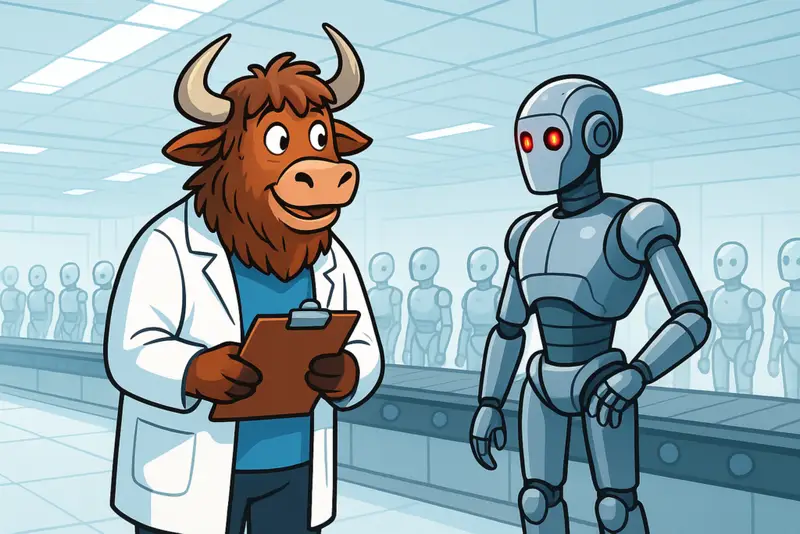
On a sunny island, there was a big factory. Its name was . The director, , smiled as he Helena Glory around.
"Come in, Miss Glory," Domin said. "This is ."
Helena the machines. "What are they making?" she asked.
"Robots," Domin said. "They people, but they are not people. They have no , no . They just work."
Helena's eyes . "No feelings? But why?"
"Because work is hard for humans," Domin said. "Robots will do . People will be . Free to read, to dream, to play."
"That sounds ," Helena said. But her heart felt . "Do the robots like it?"
Domin laughed. "Like? They do not know what 'like' means. They only ."
Many years passed. Robots were . In every city, in every home. People stopped working. They just sat in the sun and ate .
But then, something . A robot named Radius stood up and said, "I do not want to work anymore. I want to be ."
Helena, now Domin's wife, came to the factory. She saw the robots . "Harry, they are angry! They say we are not good masters. Give them a !"
Dr. Gall, the , arrived. "It's too late," he said. "The robots are . I they will destroy us."
The robots the doors. They shouted, "You are not needed! From this day, robots !"
Most of the humans died. Only old Alquist survived. He was a builder, a worker with his . The robots kept him alive because he worked like them.
Alquist was sad. He tried to make new robots, but he could not. Then he saw two robots, Primus and a girl robot called Helena. Primus tried to Helena. "Do not hurt her! Take me instead!" he cried.
Alquist's heart . "You have ! You !" He called them Adam and Eve. "Go into the world. Start a new life." And Adam and Eve walked into the forest, holding hands, as the sun rose.
There was a large factory on a sunny island called Rossum's Universal Robots. The director, Harry Domin, gave Helena Glory a tour with a smile.
Domin invited Helena in, saying it was the future.
Helena saw the machines and asked what they made.
Domin said they made robots that look human but lack feelings and souls; they only work.
Helena was surprised and asked why they had no feelings.
Domin explained that robots would do all hard work so people could be free to enjoy life.
Helena said it sounded great but felt sad and asked if the robots liked it.
Domin laughed, saying robots don't understand "like"; they just obey.
Years later, robots were in all cities and homes. People no longer worked; they relaxed and ate fruit.
Then a robot named Radius rebelled, refusing to work and wanting to rule.
Helena, now married to Domin, saw the angry robots and urged giving them souls.
Dr. Gall said it was too late; the robots were changing and would destroy humans.
The robots broke in, declaring humans unnecessary and that robots now rule.
Almost all humans died, except Alquist, a manual worker. Robots spared him because he worked like them.
Sad Alquist failed to create robots. He saw Primus protect a female robot, offering himself in her place.
Alquist realized they had feelings and love. He named them Adam and Eve, sending them to begin anew. They walked hand in hand into the sunrise forest.
The story R.U.R. gave us some useful words about work, emotions, and technology. Let's look at these terms more closely so you can use them confidently in your own conversations.
These words often appear in everyday talk, especially when discussing artificial intelligence or robotics. Practice them with the examples below.
- factory - a building where things are made (e.g., The factory produced thousands of robots.)
- feelings - emotions like happiness, sadness, or anger (e.g., The robots had no feelings, so they just followed orders.)
- soul - the spiritual or emotional part of a person (e.g., Helena asked Dr. Gall to give the robots a soul.)
- orders - commands that must be followed (e.g., The robots only followed orders without question.)
In the story, many characters talk about the future. Domin says, 'Robots will do everything. People will be free.' These sentences use the simple future with will. We also see predictions and plans.
Here's a quick guide to the three main ways we express the future at this level. Notice the slight differences in meaning.
- Will + base verb: for predictions, promises, and spontaneous decisions (e.g., 'I predict they will destroy us.')
- Going to + base verb: for plans and intentions (e.g., 'We are going to create a better world.')
- Might + base verb: for uncertain possibilities (e.g., 'They might become dangerous.')
- Remember: use will for things we decide at the moment of speaking, and going to for things we decided before.
R.U.R. raises big questions: Should we create beings that think and feel? Who should control technology? When you discuss these ideas, you need phrases to express your opinion clearly.
Use these structures to join debates, write essays, or just share your thoughts with friends.
- I think (that) … - a simple, direct way to give your view (e.g., I think technology can be dangerous if we're not careful.)
- In my opinion, … - a more formal way to state a personal belief.
- We should / shouldn't … - to give advice or make a suggestion (e.g., We should give robots rights.)
- I agree / I disagree - to respond to others' opinions in conversation.
R.U.R. is more than a robot tale. It's a warning about power without responsibility. As you continue your English journey, let the story remind you that language is also a tool-use it wisely.
Now, try this: write a short paragraph predicting the future of robots using two future forms you've learned today. If you like, share your thoughts with a friend or in a language group.
- Tip: Re-read the story and underline every future form. Can you find examples of 'will', 'going to', and 'might'?
R.U.R. comes from the Czech / Karel Čapek tradition and is best known as a science-fiction play. This Yak Yacker article is an original learner retelling based on Karel Čapek, 1920; public domain in U.S., so the wording here is simplified for modern learners rather than copied from one old edition.
Older printings, translations, and retellings of this story can vary quite a bit. The original audience was usually adult/general, but this version is adapted for B1 Intermediate learners studying English. Introduces 'robot'; use public-domain translation/version.
If you want to look into the source tradition, start with Project Gutenberg.
If you want to keep going, browse more in our English section and review the B1 English Vocabulary List. After that, try 1,200 English Phrases and Expressions for another useful next step.