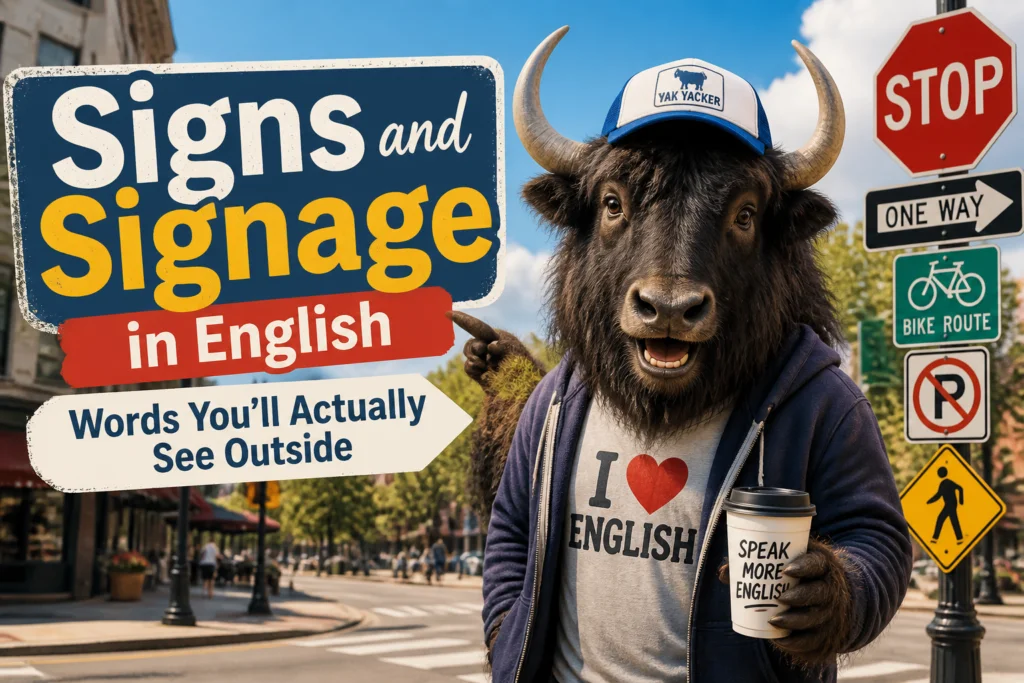
If you can read signs quickly, daily life gets a lot easier. Suddenly the street is less of a mystery and more of a very loud public message. English signs are everywhere: on doors, roads, buses, stores, parks, and buildings, and many of them use short, practical phrases that repeat all the time.
For the broader learning path, visit our parent guide.
This guide will help you understand the most common signs and signage words in English, especially the ones you’ll actually see outside. You’ll learn what they mean, how to say them, and how to use them in real life. Because yes, “No Entry” is useful, and so is knowing the difference between “Exit” and “Emergency Exit” before you wander into the wrong hallway like a confused raccoon.
For a quick dictionary check, see Cambridge Dictionary. You can also test your vocabulary with this English vocabulary test or check your level with this CEFR placement test.
Common Signs And Signage Words
Here are the most useful words and phrases first. These are the ones you will actually see on streets, doors, buildings, and public places.
| English | Pronunciation | Meaning | Example Sentence | Learner Note |
|---|---|---|---|---|
| sign | sine | A piece of writing or symbol that gives information or instructions. | I saw a sign that said “Open.” | Very common and very general. |
| signage | SIH-nij | Signs used in a place, or the whole system of signs. | The airport signage was easy to follow. | More formal than signs. |
| notice | NOH-tis | A written message that gives information or a warning. | There was a notice about the schedule change. | Common in schools, offices, and public places. |
| warning | WOR-ning | A sign that tells people about danger or a problem. | The warning sign said “Wet Floor.” | Often used for safety. |
| direction | duh-REK-shun | Information that tells you where to go. | We followed the directions to the train station. | Plural directions is very common. |
| exit | EG-zit | The way out of a building or place. | Use the exit on the left. | Stress is on the first syllable: EG-zit. |
| entrance | EN-truns | The way into a building or place. | The entrance is around the corner. | Common opposite of exit. |
| entrance only | EN-truns OHN-lee | A place where people may go in, but not out. | This door is entrance only. | Very common on public buildings. |
| no entry | noh EN-tree | You are not allowed to go in. | The sign said “No Entry,” so we stopped. | Very common in British English and on official signs. |
| private property | PRY-vut PROH-per-tee | Land or a place owned by a person or company. | The sign said “Private Property.” | Do not enter without permission. |
| open | OH-pun | Allowed to enter; a store or place is operating. | The café is open until 9 p.m. | Can mean “not closed” or “available.” |
| closed | KLOHZD | Not open; not operating. | The shop was closed on Sunday. | Very common on doors and business signs. |
Useful Public Signs You’ll See Everywhere
These signs are short, practical, and easy to notice once you know them. English signs often use simple words, not full sentences. That is normal. Signs are busy. They do not have time for drama.
| English | Pronunciation | Meaning | Example Sentence | Learner Note |
|---|---|---|---|---|
| push | push | Use your hand to move the door away from you. | The sign said “Push,” so I pushed the door. | Often paired with pull. |
| pull | pool | Use your hand to move the door toward you. | Don’t push it. Pull the handle. | Very common on doors. |
| pull to open | pool tuh OH-pun | You must pull the door to open it. | We pulled to open the glass door. | Sometimes the sign is smaller than the confusion it causes. |
| push to open | push tuh OH-pun | You must push the door to open it. | He pushed to open the heavy door. | Common in shops and offices. |
| keep out | keep out | Do not enter. | The old building had a sign that said “Keep Out.” | Strong and direct. |
| do not enter | doo not EN-ter | You are not allowed to go in. | The road was blocked with a “Do Not Enter” sign. | Very direct and official. |
| restricted area | rih-STRIK-tid AIR-ee-uh | A place only certain people may enter. | This is a restricted area. | Common in airports, offices, and factories. |
| authorized personnel only | AW-thuh-ryzd per-suh-NEL OHN-lee | Only approved workers or people may enter. | The sign said “Authorized Personnel Only.” | Formal and common in workplaces. |
| no smoking | noh SMOH-king | You are not allowed to smoke here. | There was a “No Smoking” sign near the entrance. | Very common in public places. |
| no parking | noh PAR-king | You are not allowed to park a car here. | The street had a no parking sign. | Used on roads and outside stores. |
| one way | wun way | Traffic or movement goes in only one direction. | This is a one-way street. | Very important for drivers. |
| dead end | DED end | A road with no exit. | We drove into a dead end. | Common in neighborhoods and map directions. |
Store And Business Signs
These are the signs you see at shops, restaurants, banks, and service places. They are useful because they tell you when a place is open, what it offers, and how it wants you to behave. Very polite. Very bossy. Very English.
| English | Pronunciation | Meaning | Example Sentence | Learner Note |
|---|---|---|---|---|
| hours | OW-ers | The times when a store or business is open. | The hours are 9 a.m. to 6 p.m. | Often written as store hours or business hours. |
| business hours | BIZ-niss OW-ers | The official open times for a business. | Please call during business hours. | More formal than just hours. |
| open 24 hours | OH-pun twen-tee-FOUR OW-ers | Open all day and all night. | This pharmacy is open 24 hours. | Very common for gas stations and some stores. |
| sale | sayl | A lower price or a special offer. | Everything is on sale today. | In the U.S., this usually means discounted items. |
| clearance | KLEER-ans | Items sold at a lower price to remove old stock. | The clearance sign was on the back wall. | Common in retail stores. |
| cash only | kash OHN-lee | You must pay with cash. | The small café is cash only. | Watch for this before you order. |
| card only | kard OHN-lee | You must pay by card. | The kiosk is card only. | Common in modern shops and machines. |
| customer service | KUS-tuh-mer SUR-viss | The place or staff that help customers. | Ask customer service for help. | Useful in malls, airports, and stores. |
| check out | chek out | The cashier or payment area in a store. | Please pay at the checkout. | In the U.S., checkout is one word as a noun. |
| self-checkout | self CHEK-out | A machine where you pay yourself. | I used self-checkout at the supermarket. | Very common in grocery stores. |
| restrooms | REST-roomz | Public toilets. | The restrooms are downstairs. | Common American English sign. In British English, you may see toilets or WCs. |
| bathroom | BATH-room | Toilet; often used in the U.S. for homes and public places too. | Where is the bathroom? | Very common in American English. |
Road And Traffic Signs
Road signs are a world of their own. They are short because drivers do not have time to read a paragraph while turning left and trying not to meet a mailbox at speed.
| English | Pronunciation | Meaning | Example Sentence | Learner Note |
|---|---|---|---|---|
| stop | stop | Come to a full stop. | The sign said “Stop,” so the driver stopped. | One of the most important signs in traffic. |
| yield | yeeld | Let other cars or people go first. | You must yield at this sign. | Common in the U.S.; British English often uses give way. |
| give way | giv way | Let other traffic go first. | In the U.K., drivers often see “Give Way.” | Common British English; same idea as yield. |
| speed limit | speed LIM-it | The maximum legal driving speed. | The speed limit is 35 miles per hour. | Very common on roads. |
| detour | DEE-toor | A temporary different route. | We took a detour because of road work. | Often seen with construction signs. |
| road work | rohd wurk | Construction or repair on a road. | Road work caused a long delay. | Very common warning sign. |
| parking | PAR-king | The place where cars can be left. | Parking is on the second floor. | Often appears with arrows. |
| no U-turn | noh yoo-turn | You are not allowed to turn the car around. | The sign said no U-turn. | Very common on roads with traffic rules. |
| bus stop | bus stop | A place where buses pick up and drop off passengers. | The bus stop is across the street. | Useful for travel and city life. |
| crosswalk | CROSS-wawk | A marked place for people to cross a street. | Use the crosswalk, not the middle of the road. | American English. British English often says pedestrian crossing. |
| pedestrian crossing | puh-DES-tree-uhn KROSS-ing | A place for people to cross the road. | The pedestrian crossing was busy. | Common in British English and many other countries. |
| school zone | skool zohn | An area near a school where extra caution is needed. | Slow down in the school zone. | Often means lower speed limits. |
Safety And Warning Signs
These signs are designed to keep people safe. They are often simple, direct, and a little rude in tone. That is normal. Safety signs do not usually worry about being charming.
| English | Pronunciation | Meaning | Example Sentence | Learner Note |
|---|---|---|---|---|
| caution | KAW-shun | Be careful. | The sign said “Caution: Wet Floor.” | Very common in warning signs. |
| wet floor | wet floor | The floor is slippery because it is wet. | We saw a wet floor sign at the entrance. | Extremely common in stores and malls. |
| slippery when wet | SLIP-uh-ree wen wet | The surface becomes slippery if it is wet. | The sign warned that the steps were slippery when wet. | Good phrase to recognize fast. |
| danger | DAYN-jer | A serious risk or problem. | The danger sign was easy to see. | Strong warning word. |
| high voltage | hye VOL-tij | Electric power that can be dangerous. | The fence had a high voltage sign. | Do not touch that area. Seriously. |
| fire exit | fye-er EG-zit | An emergency way out in case of fire. | The fire exit was at the back of the building. | Important in schools, offices, and malls. |
| fire alarm | fye-er uh-LARM | A system or signal that warns of fire. | The fire alarm went off suddenly. | Often appears on signs near equipment. |
| emergency exit | ih-MER-jun-see EG-zit | A special exit used in danger or urgent situations. | Please use the emergency exit only if needed. | Very common in public buildings and planes. |
| first aid | furst ayd | Basic medical help given right away. | The first aid kit is by the door. | Often appears on signs and boxes. |
| no trespassing | noh TRES-pas-ing | Do not enter private land or property. | The sign said “No Trespassing.” | Very common in American English on private land. |
| hard hat area | hard hat AIR-ee-uh | A place where you must wear a hard hat. | This is a hard hat area. | Common at construction sites. |
| construction site | kun-STRUK-shun syte | A place where something is being built. | The construction site was fenced off. | Often paired with warning signs. |
Short Phrases You’ll Read On Signs
Many signs use short command-style phrases. These are common in both American and British English, and they are worth learning as chunks, not as separate grammar lessons with a headache attached.
| English | Pronunciation | Meaning | Example Sentence | Learner Note |
|---|---|---|---|---|
| please use other door | pleez yooth ER door | This door is not for use; use another door. | The sign said, “Please use other door.” | Polite but still clear. |
| watch your step | wotch yor step | Be careful when walking. | Watch your step on the stairs. | Often used near stairs or uneven ground. |
| mind the gap | mynd thuh gap | Be careful of the space between a train and platform. | In London, people hear “Mind the gap” a lot. | Common British rail phrase. |
| keep right | keep ryte | Stay on the right side. | The sign told pedestrians to keep right. | Common in halls, roads, and pathways. |
| keep left | keep left | Stay on the left side. | In some countries, people are told to keep left. | Depends on local rules and traffic flow. |
| no standing | noh STAN-ding | You cannot stop here in a vehicle, even briefly. | The curb had a no standing sign. | Traffic phrase, especially in the U.S. |
| no loitering | noh LOY-ter-ing | Do not hang around in this area without a reason. | The sign said “No Loitering.” | Common at stores and stations. |
| under construction | UN-der kun-STRUK-shun | Being built or repaired. | The building is under construction. | Very common on signs and notices. |
| temporarily closed | tem-puh-RAIR-uh-lee klohzd | Closed for a short time. | The museum is temporarily closed. | Useful for schedules and notices. |
| service entrance | SUR-viss EN-truns | An entrance for workers or deliveries. | Employees should use the service entrance. | Common in stores, hotels, and offices. |
| delivery entrance | duh-LIV-uh-ree EN-truns | An entrance used for deliveries. | The delivery entrance is behind the building. | Useful at big stores and restaurants. |
| walk-in only | WAWK-in OHN-lee | Only people who come in person may use this service. | The clinic accepts walk-in only patients. | Very common in clinics and businesses. |
American And British Sign Differences
Some sign words change depending on where you are. The meaning is usually the same, but the word on the sign may be different.
| American English | British English | Example | Note |
|---|---|---|---|
| restroom | toilet / WC | Where is the restroom? / Where are the toilets? | “Restroom” is more common in the U.S. |
| crosswalk | pedestrian crossing | Use the crosswalk. / Use the pedestrian crossing. | Same idea, different label. |
| yield | give way | Yield at the intersection. / Give way at the junction. | Traffic signs often differ. |
| parking lot | car park | The parking lot is full. / The car park is full. | Very common difference. |
| elevator | lift | The elevator is broken. / The lift is broken. | Not exactly a sign word, but you’ll see it on signs. |
Mini Practice
Try these quick exercises. Reading signs fast is a skill, and like most skills, it gets easier when you stop pretending every word is brand new.
1) Match the sign to the meaning.
- No Entry = ________
- Pull = ________
- Wet Floor = ________
- Business Hours = ________
- Emergency Exit = ________
Answers: you cannot go in; pull the door toward you; the floor is slippery; open times; emergency way out.
2) Choose the correct word.
- The store is open / closed now. It is selling items.
- The road is one way / no smoking. Cars only go in one direction.
- The sign says push / restroom on the door. Use your hand to open it.
- We found the exit / sale and left the building.
Answers: open; one way; push; exit.
3) Say it naturally.
- Instead of “This is a sign that says you cannot go in,” say: No entry.
- Instead of “Please use another door because this one is not open,” say: Please use other door.
- Instead of “Be careful because the floor is wet,” say: Wet floor.
Common Mistakes And Fixes
Here are mistakes learners often make when reading or using sign language words in English. Not sign language as in hand gestures—just sign words. English loves confusion as a hobby.
- Restroom vs bathroom: In the U.S., both are common, but restroom is more typical on public signs. In Britain, people often see toilets or WC.
- Yield vs give way: They mean the same thing in traffic, but yield is more American and give way is more British.
- Signage is more formal than signs: Use signs for everyday English. Use signage when talking about the whole system or design of signs.
- Exit is not the same as entrance: One is for leaving, one is for entering. Simple. Important. Worth remembering before your day gets weird.
- No smoking is a warning, not a suggestion: It means smoking is not allowed.
- Cash only means exactly that: Do not assume cards work just because the building looks modern.
Quick Reference Summary
Keep these high-frequency words in your memory first:
- Exit = way out
- Entrance = way in
- Open / closed = operating / not operating
- Pull / push = how to open the door
- No entry = do not go in
- Wet floor = slippery surface
- Business hours = open times
- Restroom = public toilet, especially in American English
- One way = one direction only
- Emergency exit = special way out in danger
Yak takeaway: English signs are usually short, direct, and very practical. Learn the common ones first, and suddenly the world starts making a lot more sense—at least on doors, roads, and store windows.