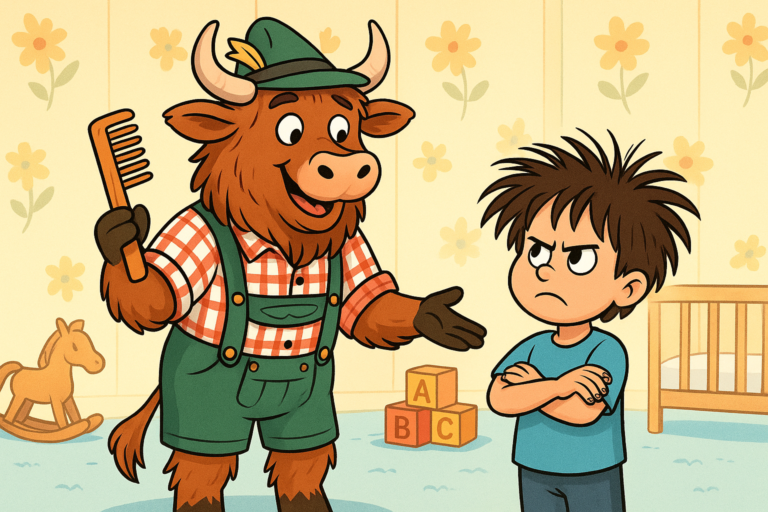
A personified yak German teacher that explains German two-way prepositions with dative and accusative cases.

German Two-Way Prepositions: Dative Or Accusative Made Easy

German two-way prepositions look sneaky because they can use either dative or accusative. Luckily, the choice is not random. German is dramatic, yes, but not completely feral.

By the end, you will know the simple question to ask, the nine core prepositions to learn, the article changes, and how to build your own sentences without staring sadly at dem and den.

The Tiny Rule That Saves Your Sanity

Use accusative when the sentence answers “where to?” Use dative when the sentence answers “where?”

QuestionGerman QuestionCaseSimple IdeaExample
Where to?Wohin?AccusativeDirection or destinationIch gehe in den Park.
I am going into the park.
Where?Wo?DativeLocation or positionIch bin in dem Park.
I am in the park.

That is the big idea. Not “movement” in general. A person can dance, swim, or run in one place and still use dative. What matters is whether the phrase shows a new destination.

The Nine German Two-Way Prepositions

The core German two-way prepositions are an, auf, hinter, in, neben, über, unter, vor, and zwischen. They are also called Wechselpräpositionen, but unless you enjoy long grammar words before breakfast, “two-way prepositions” is enough.

an

Meaning: at, on, to, by a vertical surface or edge

Accusative: Ich hänge das Bild an die Wand. — I hang the picture on the wall.

Dative: Das Bild hängt an der Wand. — The picture is hanging on the wall.

auf

Meaning: on, onto, on top of a horizontal surface

Accusative: Ich lege das Handy auf den Tisch. — I put the phone onto the table.

Dative: Das Handy liegt auf dem Tisch. — The phone is lying on the table.

in

Meaning: in, into

Accusative: Wir gehen in das Kino. — We are going into the cinema.

Dative: Wir sind in dem Kino. — We are in the cinema.

hinter

Meaning: behind

Accusative: Der Hund läuft hinter das Sofa. — The dog runs behind the sofa.

Dative: Der Hund schläft hinter dem Sofa. — The dog is sleeping behind the sofa.

neben

Meaning: next to, beside

Accusative: Stell den Stuhl neben den Tisch. — Put the chair next to the table.

Dative: Der Stuhl steht neben dem Tisch. — The chair is next to the table.

vor

Meaning: in front of, before

Accusative: Ich stelle mich vor die Tür. — I stand myself in front of the door.

Dative: Ich stehe vor der Tür. — I am standing in front of the door.

über

Meaning: over, above, across, about

Accusative: Die Katze springt über den Zaun. — The cat jumps over the fence.

Dative: Die Lampe hängt über dem Tisch. — The lamp hangs above the table.

unter

Meaning: under, among

Accusative: Der Ball rollt unter das Bett. — The ball rolls under the bed.

Dative: Der Ball liegt unter dem Bett. — The ball is under the bed.

zwischen

Meaning: between

Accusative: Setz dich zwischen die Kinder. — Sit down between the children.

Dative: Du sitzt zwischen den Kindern. — You are sitting between the children.

Dative Or Accusative? Ask These Two Questions

When you see a two-way preposition, do not panic and throw articles around like confetti. Ask one of these questions:

Wohin? = Accusative

Wohin? means “where to?” It points to a destination, direction, or change of place.

Ich gehe in den Supermarkt.
I am going into the supermarket.

Wohin gehe ich?
Where am I going? Into the supermarket. Accusative wins. Tiny trophy.

Wo? = Dative

Wo? means “where?” It points to a location or position.

Ich bin in dem Supermarkt.
I am in the supermarket.

Wo bin ich?
Where am I? In the supermarket. Dative calmly adjusts its glasses.

The Biggest Trap: Movement Is Not Always Accusative

Many beginners learn “movement = accusative” and then German immediately trips them with a banana peel. Better rule: movement toward a destination = accusative. Location, even with movement inside that location, usually uses dative.

SentenceMeaningCaseWhy?
Ich laufe in den Park.I run into the park.AccusativeThe park is the destination.
Ich laufe in dem Park.I run in the park.DativeThe running happens inside the park.
Sie springt auf den Tisch.She jumps onto the table.AccusativeShe ends up on the table.
Sie springt auf dem Tisch.She jumps on the table.DativeShe is already on the table, causing chaos there.

Article Changes With Two-Way Prepositions

The preposition chooses the case, and the case changes the article. This is where der, den, dem, and friends start swapping hats.

Gender / NumberNominativeAccusativeDativeAccusative ExampleDative Example
Masculineder Tischden Tischdem Tischauf den Tisch — onto the tableauf dem Tisch — on the table
Femininedie Wanddie Wandder Wandan die Wand — onto the wallan der Wand — on the wall
Neuterdas Bettdas Bettdem Bettunter das Bett — under the bedunter dem Bett — under the bed
Pluraldie Stühledie Stühleden Stühlenzwischen die Stühle — between the chairszwischen den Stühlen — between the chairs

Useful Contractions You Will See Everywhere

German often squishes a preposition and article together. Very efficient. Slightly smug.

ContractionFull FormMeaningExample
insin dasinto theIch gehe ins Büro. — I am going into the office.
imin demin theIch bin im Büro. — I am in the office.
ansan dasto the / onto theWir fahren ans Meer. — We are going to the sea.
aman demat the / on theWir sind am Meer. — We are at the sea.
aufsauf dasonto theDas Kind klettert aufs Sofa. — The child climbs onto the sofa.

Two Verbs That Make This Much Easier

German often uses pairs of verbs that show either putting something somewhere or being somewhere. These pairs are pure gold for two-way prepositions.

Action VerbMeaningUsesPosition VerbMeaningUses
legento lay / put flatAccusative destinationliegento lie / be lyingDative location
stellento put / place uprightAccusative destinationstehento stand / be standingDative location
setzento set / seatAccusative destinationsitzento sit / be sittingDative location
hängento hang somethingAccusative destinationhängento hang / be hangingDative location

Ich lege das Buch auf den Tisch. — I put the book onto the table.

Das Buch liegt auf dem Tisch. — The book is lying on the table.

Sie stellt die Flasche neben den Laptop. — She puts the bottle next to the laptop.

Die Flasche steht neben dem Laptop. — The bottle is next to the laptop.

Real-Life Sentence Pairs

Here are practical sentence pairs. Read them slowly and notice how the destination version uses accusative, while the location version uses dative.

PrepositionAccusative: Where To?Dative: Where?
anIch gehe an den See.
I am going to the lake.
Ich sitze an dem See.
I am sitting by the lake.
aufLeg die Schlüssel auf den Tisch.
Put the keys onto the table.
Die Schlüssel liegen auf dem Tisch.
The keys are on the table.
hinterDie Katze läuft hinter das Auto.
The cat runs behind the car.
Die Katze ist hinter dem Auto.
The cat is behind the car.
inWir gehen in die Stadt.
We are going into town.
Wir sind in der Stadt.
We are in town.
nebenSetz dich neben mich.
Sit down next to me.
Du sitzt neben mir.
You are sitting next to me.
überDer Vogel fliegt über das Haus.
The bird flies over the house.
Die Wolke ist über dem Haus.
The cloud is above the house.
unterSchieb die Tasche unter den Stuhl.
Push the bag under the chair.
Die Tasche ist unter dem Stuhl.
The bag is under the chair.
vorIch stelle das Fahrrad vor die Tür.
I put the bike in front of the door.
Das Fahrrad steht vor der Tür.
The bike is in front of the door.
zwischenStell den Topf zwischen die Teller.
Put the pot between the plates.
Der Topf steht zwischen den Tellern.
The pot is between the plates.

Common Two-Way Preposition Phrases

These phrases appear constantly in daily German. Each one includes the meaning and an example sentence, because vocabulary without examples is just a tiny dictionary having a bad day.

German PhraseEnglish MeaningExample 1Example 2Example 3
in den Parkinto the parkWir gehen in den Park.
We are going into the park.
Der Hund läuft in den Park.
The dog runs into the park.
Ich bringe das Kind in den Park.
I take the child to the park.
im Parkin the parkWir sind im Park.
We are in the park.
Der Hund spielt im Park.
The dog plays in the park.
Ich lese im Park.
I read in the park.
auf den Tischonto the tableLeg das Buch auf den Tisch.
Put the book onto the table.
Ich stelle den Teller auf den Tisch.
I put the plate onto the table.
Sie legt ihr Handy auf den Tisch.
She puts her phone onto the table.
auf dem Tischon the tableDas Buch liegt auf dem Tisch.
The book is on the table.
Der Teller steht auf dem Tisch.
The plate is on the table.
Ihr Handy liegt auf dem Tisch.
Her phone is on the table.
an die Wandonto the wallIch hänge das Foto an die Wand.
I hang the photo on the wall.
Er klebt den Zettel an die Wand.
He sticks the note onto the wall.
Wir stellen das Regal an die Wand.
We put the shelf against the wall.
an der Wandon the wallDas Foto hängt an der Wand.
The photo is on the wall.
Der Zettel klebt an der Wand.
The note is stuck on the wall.
Das Regal steht an der Wand.
The shelf stands against the wall.
unter das Bettunder the bedDer Ball rollt unter das Bett.
The ball rolls under the bed.
Ich schiebe die Box unter das Bett.
I push the box under the bed.
Die Katze kriecht unter das Bett.
The cat crawls under the bed.
unter dem Bettunder the bedDer Ball liegt unter dem Bett.
The ball is under the bed.
Die Box ist unter dem Bett.
The box is under the bed.
Die Katze schläft unter dem Bett.
The cat sleeps under the bed.
neben michnext to meSetz dich neben mich.
Sit down next to me.
Komm neben mich.
Come next to me.
Stell dich neben mich.
Stand next to me.
neben mirnext to meDu sitzt neben mir.
You are sitting next to me.
Der Hund liegt neben mir.
The dog is lying next to me.
Meine Tasche steht neben mir.
My bag is next to me.

Pronouns Also Change

Two-way prepositions do not only affect nouns. Pronouns change too. This is why neben mich and neben mir are both correct, but they mean different things.

NominativeAccusativeDativeAccusative ExampleDative Example
ichmichmirSetz dich neben mich.
Sit down next to me.
Du sitzt neben mir.
You are sitting next to me.
dudichdirIch setze mich neben dich.
I sit down next to you.
Ich sitze neben dir.
I am sitting next to you.
erihnihmSie stellt sich vor ihn.
She stands in front of him.
Sie steht vor ihm.
She is standing in front of him.
siesieihrEr setzt sich neben sie.
He sits down next to her.
Er sitzt neben ihr.
He is sitting next to her.
wirunsunsDer Hund läuft zwischen uns.
The dog runs between us.
Der Hund steht zwischen uns.
The dog is standing between us.

When The Meaning Changes In English Too

Sometimes English makes the difference clear with words like “in” and “into.” Sometimes it does not. German still wants the distinction, because apparently German has standards.

GermanEnglishCaseWhat It Really Shows
Ich gehe ins Zimmer.I go into the room.AccusativeI enter the room.
Ich gehe im Zimmer.I walk in the room.DativeI walk around inside the room.
Sie fährt an den Strand.She drives to the beach.AccusativeThe beach is the destination.
Sie fährt am Strand.She drives along/at the beach.DativeThe driving happens at the beach area.
Er springt über den Fluss.He jumps over the river.AccusativeHe crosses over it.
Die Brücke ist über dem Fluss.The bridge is over the river.DativeThe bridge is located above it.

Quick Notes On Each Preposition

Some prepositions have tiny personality quirks. Nothing terrifying. Just enough to keep your German notebook interesting.

  • an often means “at” or “on” when something touches a vertical surface, edge, border, water, or event. Ich bin am Bahnhof. — I am at the train station.
  • auf often means “on top of,” especially on a horizontal surface. Die Tasse steht auf dem Tisch. — The cup is on the table.
  • in is used for being inside places. Ich wohne in der Stadt. — I live in the city.
  • vor can mean “in front of” or “before” in time. Wir treffen uns vor dem Kino. — We meet in front of the cinema.
  • über can mean “above,” “over,” or “about.” Wir sprechen über den Film. — We are talking about the movie.
  • unter can mean “under” or “among.” Unter den Gästen ist ein Arzt. — Among the guests is a doctor.

Important: Not Every Preposition Follows This Rule

The wo/wohin trick only works with two-way prepositions. Other prepositions are bossy and always take one case.

Ich gehe zu dem Arzt. — I am going to the doctor. Zu always takes dative, even though there is direction.

Das Geschenk ist für dich. — The gift is for you. Für always takes accusative, even though nobody is moving anywhere. Rude, but consistent.

Common Mistakes And Easy Fixes

MistakeWhy It HappensBetter GermanMeaning
Ich gehe in dem Supermarkt.This means you are walking around inside the supermarket.Ich gehe in den Supermarkt.I am going into the supermarket.
Das Buch liegt auf den Tisch.Liegen describes location, not destination.Das Buch liegt auf dem Tisch.The book is on the table.
Ich bin in die Küche.Bin describes location here.Ich bin in der Küche.I am in the kitchen.
Setz dich neben mir.With setzen, you move to a new seat.Setz dich neben mich.Sit down next to me.
Wir fahren im Kino.That sounds like you are driving inside the cinema. Please do not.Wir fahren ins Kino.We are going to the cinema.

Mini Practice: Choose Dative Or Accusative

Choose the correct article. Ask wo? or wohin? before you answer.

  1. Ich lege das Buch auf ___ Tisch. den / dem
  2. Das Buch liegt auf ___ Tisch. den / dem
  3. Wir gehen in ___ Küche. die / der
  4. Wir sind in ___ Küche. die / der
  5. Der Hund läuft unter ___ Stuhl. den / dem
  6. Der Hund schläft unter ___ Stuhl. den / dem
  7. Stell die Lampe neben ___ Bett. das / dem
  8. Die Lampe steht neben ___ Bett. das / dem
Show Answers

1. den — onto the table, accusative
2. dem — on the table, dative
3. die — into the kitchen, accusative
4. der — in the kitchen, dative
5. den — under the chair as destination, accusative
6. dem — under the chair as location, dative
7. das — next to the bed as destination, accusative
8. dem — next to the bed as location, dative

Fast Reference Table

GermanEnglish MeaningAccusative ExampleDative Example
anat, on, toan den Bahnhof — to the train stationam Bahnhof — at the train station
aufon, ontoauf den Tisch — onto the tableauf dem Tisch — on the table
hinterbehindhinter das Haus — behind the househinter dem Haus — behind the house
inin, intoin die Schule — to schoolin der Schule — at school
nebennext toneben den Stuhl — next to the chairneben dem Stuhl — next to the chair
überover, above, aboutüber den Fluss — over the riverüber dem Fluss — above the river
unterunder, amongunter den Tisch — under the tableunter dem Tisch — under the table
vorin front of, beforevor die Tür — in front of the doorvor der Tür — in front of the door
zwischenbetweenzwischen die Häuser — between the houseszwischen den Häusern — between the houses

FAQ: German Two-Way Prepositions

What Are German Two-Way Prepositions?

German two-way prepositions are prepositions that can take either accusative or dative. The nine core ones are an, auf, hinter, in, neben, über, unter, vor, and zwischen.

Ich gehe in den Garten. — I am going into the garden. Accusative.

Ich bin in dem Garten. — I am in the garden. Dative.

How Do I Know If I Need Dative Or Accusative?

Ask wohin? for accusative and wo? for dative.

Wohin gehst du? — Where are you going? Ich gehe in die Küche. — I am going into the kitchen.

Wo bist du? — Where are you? Ich bin in der Küche. — I am in the kitchen.

Is Movement Always Accusative In German?

No. Movement toward a destination uses accusative. Movement inside one location usually uses dative.

Ich schwimme in den See. — I swim into the lake. Accusative.

Ich schwimme in dem See. — I swim in the lake. Dative.

Is “Entlang” A Two-Way Preposition?

Entlang means “along,” and it behaves differently depending on position and style. Beginners should learn the nine core two-way prepositions first. That gives you the pattern you will use most often.

Wir gehen den Fluss entlang. — We walk along the river.

What Is The Best Way To Practice?

Practice in pairs: one sentence with a destination and one sentence with a location.

Ich lege den Stift auf den Tisch. — I put the pen onto the table.

Der Stift liegt auf dem Tisch. — The pen is on the table.

Final Yak

German two-way prepositions are much easier when you stop asking “Is there movement?” and start asking “Where?” or “Where to?”

Wohin? Use accusative: Ich gehe in den Park. — I am going into the park.

Wo? Use dative: Ich bin in dem Park. — I am in the park.

That little question does most of the heavy lifting. Your job is just to learn the nine prepositions, watch the article changes, and resist the urge to blame dem for everything. It has feelings. Probably.