


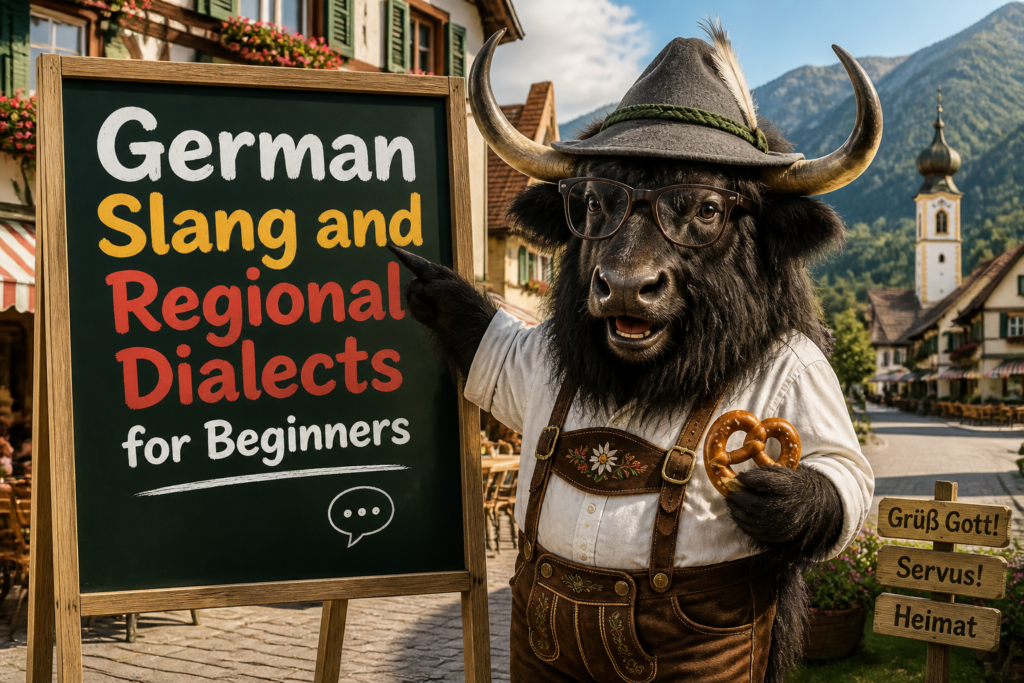
German can sound very different depending on where people are speaking it. A student in Berlin, a cashier in Munich, and a friend from Vienna may all be using German, but not always the same German. Delightful. Also mildly annoying, which is basically the language-learning experience in one sentence.
This guide gives you beginner-friendly slang, regional words, and real-life phrases you will actually hear. You will learn what they mean, how to say them, when to use them, and when to stay polite and keep your inner cowboy in the stable.
For the big picture on standard German, start with the main learner path at German learning basics. For a closer look at regional vocabulary, see regional words in German and the companion guide on German slang and regional dialects.
What Counts As Slang Or A Dialect?
Slang is informal language people use in everyday conversation. It changes quickly and often feels casual, friendly, or trendy. Dialect is a regional variety of German with its own pronunciation, vocabulary, and sometimes grammar.
Beginner tip: learn standard German first, then add regional words like spices. Too much too soon and suddenly you sound like a confused tourist who has been adopted by three different grandmas.
If you want to compare standard German with casual forms, the lesson on du vs. Sie is especially useful, because slang and formality love to clash in real life.
| German | Pronunciation | Meaning | Example Sentence | Translation | Learner Note |
|---|---|---|---|---|---|
| Hallo | HA-loh | hello | Hallo, wie geht’s? | Hello, how’s it going? | Neutral and safe everywhere. |
| Hi | hai | hi | Hi, alles klar? | Hi, everything okay? | Very casual, common in texting and speaking. |
| Servus | SAIR-voos | hi / bye | Servus, wir sehen uns morgen. | Hi / Bye, see you tomorrow. | Common in Austria and Bavaria. Friendly, regional. |
| Moin | moin | hi / good day | Moin, hast du kurz Zeit? | Hi, do you have a minute? | Used in northern Germany. Not only morning. |
| Grüß dich | grooss dish | hello (familiar) | Grüß dich, wie läuft’s? | Hello, how’s it going? | Common in southern Germany and Austria. |
| Tschüss | chooss | bye | Tschüss, bis später! | Bye, see you later! | Very common and neutral-casual. |
| Ciao | chow | bye / hi | Ciao, bis morgen. | Bye, see you tomorrow. | Borrowed from Italian; casual. |
| Na? | nah? | hey / what’s up? | Na? Alles gut bei dir? | Hey? Everything good with you? | Very short, very German, very sneaky. |
| Alles klar? | AH-les klar? | all good? | Alles klar? Dann gehen wir. | All good? Then let’s go. | Works as greeting or check-in. |
| Passt | PAST | that’s fine / okay | Passt, wir treffen uns um sieben. | Okay, we’ll meet at seven. | Very common in spoken German, especially in the south and Austria. |
| Genau | geh-NOW | exactly / right | Ja, genau, das meine ich. | Yes, exactly, that’s what I mean. | Useful agreement word in conversation. |
Everyday Slang You Will Hear A Lot
These are not the wildest street slang words on the planet. Good. Beginners do better with useful language than with vocabulary that only works at 2 a.m. in a video game chat.
| German | Pronunciation | Meaning | Example Sentence | Translation | Learner Note |
|---|---|---|---|---|---|
| cool | kool | cool | Das ist echt cool. | That is really cool. | Used in many situations; safe casual praise. |
| krass | krass | awesome / intense / crazy | Der Film war krass. | The movie was intense / amazing. | Meaning depends on context. Very common in youth speech. |
| echt | echt | really / genuine | Das ist echt gut. | That is really good. | Often used for emphasis. |
| mega | MEH-gah | super / very | Ich bin mega müde. | I am super tired. | Casual intensifier, especially spoken language. |
| voll | foll | very / totally | Das ist voll lecker. | That is really tasty. | Informal intensifier; not just “full.” |
| okay / okayy | oh-KAY / oh-KAY | okay | Okay, dann machen wir das so. | Okay, then let’s do it like that. | Spelling may vary in texting, but standard is okay. |
| okay, passt | oh-KAY, past | fine, works for me | Passt, ich komme um acht. | Fine, I’ll come at eight. | Very useful spoken response. |
| kein Problem | kine pro-BLAYM | no problem | Kein Problem, ich helfe dir gern. | No problem, I’m happy to help you. | Friendly and common. |
| schon gut | shohn goot | it’s fine / don’t worry | Schon gut, alles in Ordnung. | It’s fine, everything is okay. | Useful for calming things down. |
| na ja | nah YAH | well / not great | Na ja, es geht so. | Well, it’s so-so. | Softens an answer. Very common. |
| geht so | gate zoh | so-so | Wie war das Essen? — Geht so. | How was the food? — So-so. | Neutral, honest, not dramatic. |
| läuft | loyft | it’s going well | Alles läuft. | Everything is going well. | Very common casual reply. |
Real-Life Slang For Friends, Texts, And Casual Chat
| German | Pronunciation | Meaning | Example Sentence | Translation | Learner Note |
|---|---|---|---|---|---|
| Alter | AL-ter | dude / mate | Alter, das war knapp! | Dude, that was close! | Very informal. Use only with friends. |
| Digga | DIG-ga | dude / bro | Digga, kommst du mit? | Bro, are you coming with us? | Youth slang. Not for formal situations. |
| Läuft bei dir | loyft bay deer | nice, you’re doing well | Läuft bei dir mit dem neuen Job. | You’re doing well with the new job. | Friendly, informal praise. |
| Chill mal | chill mahl | calm down | Chill mal, es ist nicht so schlimm. | Calm down, it’s not that bad. | Can sound blunt if used badly. |
| abgehen | AP-gay-en | to rock / be awesome | Die Party geht ab. | The party is rocking. | Very colloquial. Watch the context. |
| was geht? | vas gate? | what’s up? | Was geht? Hast du Zeit? | What’s up? Do you have time? | Common casual greeting. |
| Na was? | nah vas? | and? | Na was? Hast du es geschafft? | And? Did you manage it? | Can sound impatient depending on tone. |
| irre | IR-uh | crazy / amazing | Das ist ja irre! | That is crazy! | Old-school but still heard in speech. |
| klappen | KLAP-pen | to work out | Es klappt heute leider nicht. | It won’t work today, unfortunately. | Super useful everyday verb. |
| kein Bock | kine bok | no motivation / no desire | Ich habe keinen Bock auf Hausaufgaben. | I don’t feel like doing homework. | Very informal. Not for polite conversation. |
| absolut | AP-zoh-loot | totally | Absolut, ich stimme dir zu. | Absolutely, I agree with you. | Can be a strong agreement word. |
| safe | sayf | for sure / definitely | Safe, ich bin dabei. | For sure, I’m in. | Youth slang, especially in cities. |
Some slang is borrowed from English, but the meaning is not always identical. German speakers may use safe to mean “definitely,” while English speakers might hear “safe” and think “not dangerous.” Languages are playful like that. Slightly rude, even.
Regional Words You Will Hear In Germany, Austria, And Switzerland
These words are common in certain regions. You do not need to memorize all of them at once, but they are useful if you travel, chat with locals, or suddenly find yourself in a bakery trying to decode a bread roll. German dialects are wonderfully stubborn.
| German | Pronunciation | Meaning | Example Sentence | Translation | Learner Note |
|---|---|---|---|---|---|
| Brötchen | BROOT-chən | bread roll | Ich hätte gern zwei Brötchen. | I would like two bread rolls. | Standard in much of Germany. |
| Semmel | ZEM-mel | bread roll | Ich nehme eine Semmel. | I’ll take one bread roll. | Common in Bavaria and Austria. |
| Wecken | VEK-ən | bread roll | Ein Wecken bitte. | One bread roll, please. | Used in parts of southern Germany and Switzerland. |
| Pfannkuchen | FAN-koo-khen | pancake / jam doughnut depending on region | Ich esse gern Pfannkuchen. | I like eating pancakes. | Can be confusing: in Berlin it may mean doughnut. |
| Berliner | ber-LEE-ner | jam doughnut | Zum Kaffee gibt es einen Berliner. | There is a jam doughnut with coffee. | Use regionally if you want to avoid confusion. |
| Karotte | ka-ROT-te | carrot | Ich kaufe Karotten und Kartoffeln. | I’m buying carrots and potatoes. | More common in Austria and parts of Switzerland. |
| Möhre | MÖ-rə | carrot | Die Möhren sind frisch. | The carrots are fresh. | Common in Germany, especially north and west. |
| Erdapfel | EERT-ap-fel | potato | In Österreich sagt man oft Erdapfel. | In Austria, people often say potato. | Classic Austrian regional word. |
| Grumbeere | GROOM-beh-re | potato | Die Grumbeere sind gekocht. | The potatoes are cooked. | Regional dialect word in parts of southwest Germany. |
| Jause | YOW-zə | snack / packed meal | Wir machen eine Jause. | We’re having a snack. | Common in Austria and parts of Switzerland. |
| Znüni | ts-NYOO-nee | mid-morning snack | Um zehn gibt es Znüni. | At ten there is a mid-morning snack. | Swiss German word, very local. |
| Velo | VAY-lo | bicycle | Ich fahre mit dem Velo. | I ride by bicycle. | Common in Swiss German and Swiss Standard German. |
One tiny region can change one tiny word and suddenly everyone is arguing about lunch. That is the beauty of German. And yes, the bread roll is serious business.
Pronunciation Tips For Slang And Dialects
| Sound | Quick Tip | Example | What To Listen For |
|---|---|---|---|
| ch | Soft air sound after front vowels; harsher after back vowels. | ich, machen | Different in ich vs. ach. |
| r | Often a throat sound or light vocalized ending. | Servus, wir | Do not over-roll it like Spanish unless needed. |
| ei | Sounds like English “eye.” | kein, geil | Very common in casual speech. |
| ie | Sounds like English “ee.” | müde is not mie, but i matters in other words. | Long vowel, often in everyday words. |
| z | Sounds like “ts.” | Zeit, Znüni | Beginner trap number one? Probably. |
| sp / st | At the beginning of a word, often sounds like “shp” / “sht.” | sprechen, stehen | Listen for the extra sh-like sound. |
| ß | Sounds like a sharp “ss.” | groß, heißen | Not used in Switzerland; there it becomes ss. |
Slang is about style. Dialect is about place. And pronunciation is where both of them start making trouble on purpose.
Useful Mini Phrases For Real Conversations
| German | Pronunciation | Meaning | Example Sentence | Translation | Learner Note |
|---|---|---|---|---|---|
| Wie bitte? | vee BIT-teh? | pardon? | Wie bitte? Kannst du das wiederholen? | Pardon? Can you repeat that? | Polite and very useful. |
| Was meinst du? | vas mine-st doo? | what do you mean? | Was meinst du? Ich verstehe es nicht. | What do you mean? I don’t understand it. | Helpful when someone uses slang you missed. |
| Keine Ahnung | KINE AH-noong | no idea | Keine Ahnung, wo er ist. | No idea where he is. | Extremely common, casual. |
| Wirklich? | VEERK-lish? | really? | Wirklich? Das wusste ich nicht. | Really? I didn’t know that. | Works in many situations. |
| Ach so | akh zoh | oh, I see | Ach so, jetzt verstehe ich. | Oh, I see, now I understand. | Great little comprehension signal. |
| Stimmt | shtimpt | that’s true / correct | Stimmt, das ist richtig. | True, that’s right. | Short agreement word. |
| Na klar | nah klar | of course | Na klar, ich helfe dir. | Of course, I’ll help you. | Friendly and natural. |
| Vielleicht | fee-LIHT | maybe | Vielleicht kommt er später. | Maybe he will come later. | Not slang, but very useful in casual speech. |
Common Mistakes And Easy Fixes
| Mistake | Better Version | Why It Matters |
|---|---|---|
| Using slang with strangers in formal situations | Use Guten Tag, Wie geht es Ihnen?, or standard German first. | Slang can sound rude or too familiar. |
| Thinking every region uses the same word | Learn both Brötchen and Semmel, or Karotte and Möhre. | Regional vocabulary changes fast and can confuse beginners. |
| Using Alter or Digga with everyone | Save them for close friends and casual settings. | These are highly informal. |
| Assuming safe means the same as in English | In German, safe often means “for sure.” | False friend-ish behavior, because of course language likes to prank you. |
| Pronouncing ch like English “k” | Try a soft hissy sound in ich and a rougher sound in machen. | Clearer and more natural. |
| Forgetting that dialect words may be local | If unsure, use standard German and ask, “Was heißt das?” | Standard German is your safe base. |
If a regional word confuses you, that is normal. Even native speakers sometimes switch back to standard German when the audience changes. That is not failure. That is survival.
Quick Practice
Try translating these into English, then back into simple German:
- Passt. → ________
- Na ja, es geht so. → ________
- Ich habe keinen Bock. → ________
- Servus, bis morgen. → ________
- Das ist echt krass. → ________
- Alles läuft. → ________
- Keine Ahnung. → ________
- Was geht? → ________
Now pick the better choice:
- For a teacher: Alter or Guten Tag? → Guten Tag
- In Austria: Semmel or Brötchen? → both may be understood, but Semmel is more local
- With friends in texting: Wie geht es Ihnen? or Was geht?? → Was geht?
- In Switzerland: ß or ss? → ss
For extra practice with question forms, the lesson on German question words is a smart next stop. Slang loves questions, and questions love context.
Quick Reference Summary
- Use standard German first when you are unsure.
- Slang is informal and often friendly, but not always safe for formal situations.
- Regional words vary by country and region: Germany, Austria, and Switzerland do not always use the same vocabulary.
- Pronunciation matters a lot, especially ch, r, z, sp, and st.
- Good beginner slang includes Na?, Passt, Kein Problem, Alles klar?, and Ach so.
- Friendly regional words include Servus, Moin, Semmel, Jause, and Velo.
- Be careful with youth slang like Alter, Digga, and kein Bock.
For a reliable outside reference on standard usage, the boring-but-helpful Duden is always a solid place to check word meanings and spelling.
Yak takeaway: learn standard German first, then sprinkle in slang and regional words like a sensible human, not a vocabulary maniac. That way, you sound natural without accidentally ordering a bread roll with the confidence of a regional dictionary.