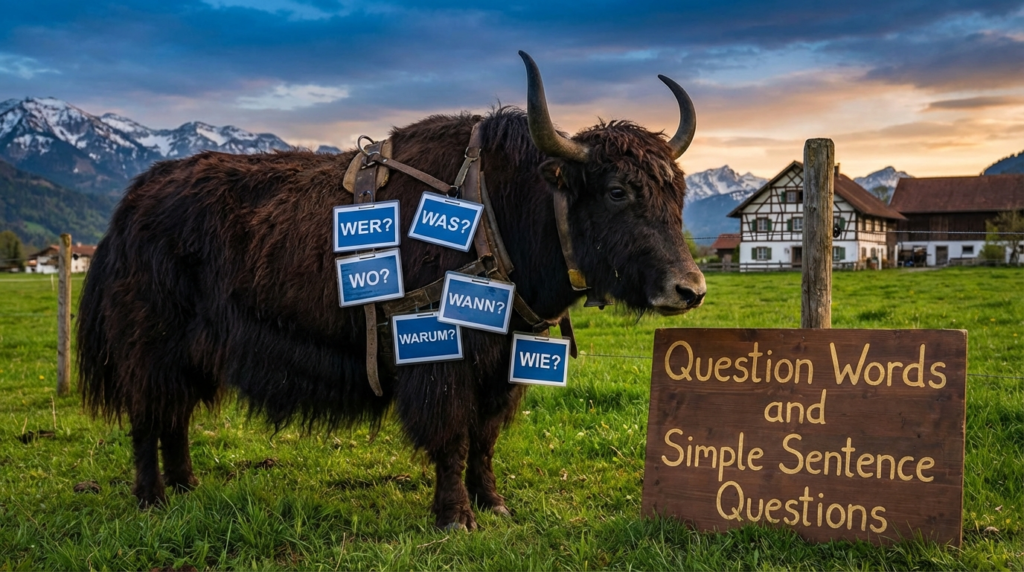
German Question Words And Simple Sentence Questions
Learn how to ask basic questions in German without sounding like a confused robot.
German questions are much friendlier than they first look. Once you know the main question words and one simple word order rule, you can ask about people, places, time, reasons, prices, and all the other things humans keep needing to ask.
The big idea is this: in many German questions, the verb comes early. That is the whole scary mystery. Very dramatic. Not actually very hard.
Yak Box: The Core Pattern
Question word + verb + subject + … ?
Wo wohnst du? = Where do you live?
For yes/no questions, just start with the verb:
Wohnst du in Berlin? = Do you live in Berlin?
What German Question Words Do
German question words help you ask for a specific kind of information. Think of them as little tools:
- wer asks about a person
- wo asks about a place
- wann asks about time
- warum asks for a reason
- wie asks about manner or condition
Most of them begin with w-, which is handy. German basically made a club for question words and gave them matching jackets.
The Most Useful German Question Words
| German | English Meaning | Example Sentence |
|---|---|---|
| wer | who | Wer ist das? Who is that? |
| was | what | Was machst du? What are you doing? |
| wo | where | Wo wohnst du? Where do you live? |
| wohin | where to | Wohin gehst du? Where are you going? |
| woher | where from | Woher kommst du? Where are you from? |
| wann | when | Wann beginnt der Film? When does the movie start? |
| warum | why | Warum lernst du Deutsch? Why are you learning German? |
| wie | how | Wie heißt du? What is your name? / Literally: How are you called? |
| wie viel | how much | Wie viel kostet das? How much does that cost? |
| wie viele | how many | Wie viele Bücher hast du? How many books do you have? |
| welcher / welche / welches | which | Welches Buch willst du? Which book do you want? |
| wem | to whom | Wem gibst du das Geschenk? To whom are you giving the gift? |
| wen | whom | Wen siehst du? Whom do you see? |
| wessen | whose | Wessen Jacke ist das? Whose jacket is that? |
Two Easy Ways To Ask Questions In German
1) Question Word Questions
Use a question word when you want specific information.
Pattern: question word + verb + subject + rest
- Wo arbeitest du? = Where do you work?
- Wann kommst du? = When are you coming?
- Warum lachst du? = Why are you laughing?
2) Yes/No Questions
Use these when the answer can be yes or no.
Pattern: verb + subject + rest
- Hast du Zeit? = Do you have time?
- Kommst du morgen? = Are you coming tomorrow?
- Ist das dein Handy? = Is that your phone?
Rule To Remember: The Verb Jumps Forward
In normal German statements, the verb is often in the second position:
- Du wohnst in Hamburg. = You live in Hamburg.
In a yes/no question, the verb moves to the first position:
- Wohnst du in Hamburg? = Do you live in Hamburg?
In a question with a question word, that question word comes first, and the verb comes right after it:
- Wo wohnst du? = Where do you live?
That is the core pattern. You do not need twelve flowcharts and a spiritual retreat.
Useful Real-Life Questions
| German Question | English Meaning |
|---|---|
| Wie heißt du? | What is your name? |
| Woher kommst du? | Where are you from? |
| Wo wohnst du? | Where do you live? |
| Was machst du beruflich? | What do you do for work? |
| Wann hast du Zeit? | When do you have time? |
| Warum lernst du German? | Why are you learning German? |
| Wie geht es dir? | How are you? |
| Wie viel kostet das? | How much does that cost? |
| Welchen Kaffee möchtest du? | Which coffee would you like? |
| Kannst du mir helfen? | Can you help me? |
One tiny correction before your brain starts a rebellion: in the sentence Warum lernst du German?, the natural German sentence is actually Warum lernst du Deutsch? = Why are you learning German? The table keeps the English meaning in the second column, but the actual language name in German is Deutsch.
Tiny But Important Differences
Wo / Wohin / Woher
wo = where (location)
Wo bist du? = Where are you?
wohin = where to (destination)
Wohin fährst du? = Where are you going?
woher = where from (origin)
Woher kennt ihr euch? = How do you know each other from? / More naturally: Where do you know each other from?
Wie Viel / Wie Viele
wie viel = how much (uncountable or amount)
Wie viel Wasser trinkst du? = How much water do you drink?
wie viele = how many (countable plural nouns)
Wie viele Geschwister hast du? = How many siblings do you have?
Practice: Turn Statements Into Questions
Take the statement and turn it into a question. Try it before peeking. Your future German-speaking self will be mildly impressed.
| Statement | Question |
|---|---|
| Du kommst morgen. You are coming tomorrow. | Kommst du morgen? Are you coming tomorrow? |
| Du wohnst in Köln. You live in Cologne. | Wo wohnst du? Where do you live? |
| Das Ticket kostet 20 Euro. The ticket costs 20 euros. | Wie viel kostet das Ticket? How much does the ticket cost? |
| Er lernt Deutsch wegen seiner Arbeit. He is learning German because of his job. | Warum lernt er Deutsch? Why is he learning German? |
| Sie fährt nach Berlin. She is traveling to Berlin. | Wohin fährt sie? Where is she going? |
Common Mistakes And Fast Fixes
- Mistake: Wo du wohnst?
Fix: Wo wohnst du?
The verb should come right after the question word. - Mistake: Wie viele Geld hast du?
Fix: Wie viel Geld hast du?
Geld is uncountable here, so use wie viel. - Mistake: Wo gehst du?
Fix: Wohin gehst du?
Use wohin when you mean destination. - Mistake: Was heißt du?
Fix: Wie heißt du?
German asks “How are you called?” not “What are you called?” - Mistake: forgetting the question mark
Fix: add ?
Yes, punctuation matters. German is organized like that.
Quick Reference Summary
| Pattern | Meaning | Example |
|---|---|---|
| Question word + verb + subject | Question asking for specific information | Wann kommt der Zug? When does the train arrive? |
| Verb + subject + rest | Yes/no question | Hast du Hunger? Are you hungry? |
| wo | where | Wo ist mein Handy? Where is my phone? |
| wohin | where to | Wohin läufst du? Where are you running to? |
| woher | where from | Woher hast du das? Where did you get that from? |
| wie viel / wie viele | how much / how many | Wie viele Leute kommen? How many people are coming? |
Final Yak
If you remember only two things, make it these: question word + verb, and yes/no questions start with the verb. Once that clicks, German questions stop looking terrifying and start looking oddly neat. Which, to be fair, is very on brand for German.