


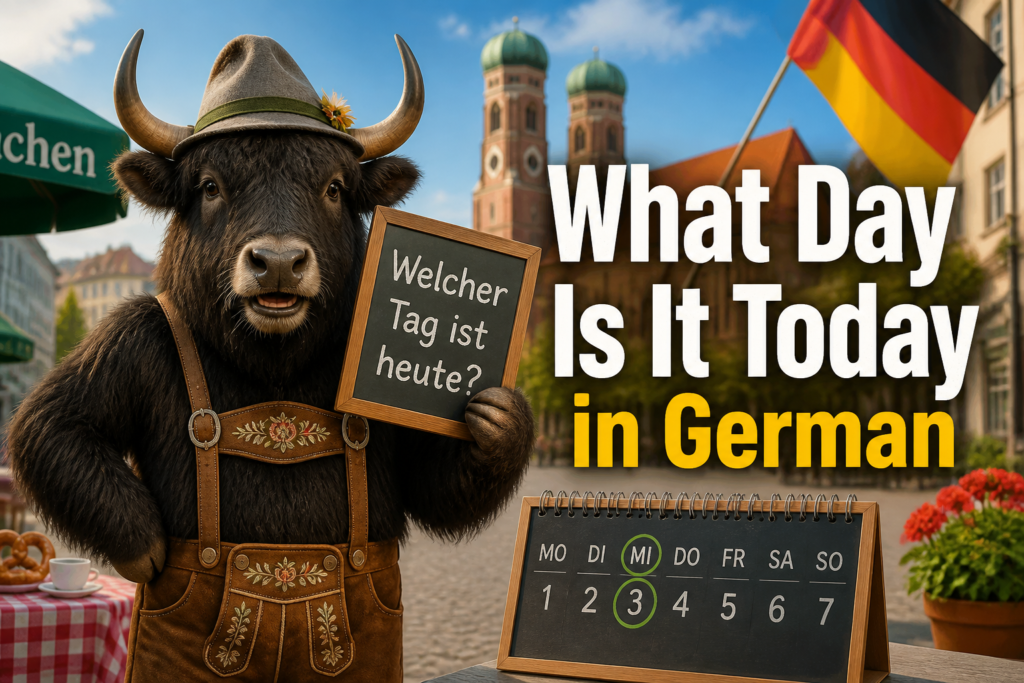
If you want to ask what day it is today in German, the most common question is „Welcher Tag ist heute?“ Simple. Useful. And the kind of phrase that instantly stops you from staring at your phone like it personally betrayed you.
Today's Date in German
See today's date in German, then use the lesson below to ask and answer the question naturally.
Loading today's date...
- Full date
- Numeric date
- Spoken German
Now you know today's date in German. Keep reading to learn how to ask what day it is, answer with confidence, and talk about dates naturally.
German day words are easy to learn, but they do have a few small traps: nouns are capitalized, one day gets a special ending, and some phrases sound more natural than the word-for-word English version. This guide gives you the practical version, so you can ask, answer, and talk about days without sounding like a textbook that fell asleep in class.
By the end, you’ll know how to ask for the day, answer naturally, use the weekday names, and avoid the most common beginner mistakes. Tiny daily victory, achieved.
The Main Question: What Day Is It Today?
| German | Pronunciation | Meaning | Example Sentence | Translation | Learner Note |
|---|---|---|---|---|---|
| Welcher Tag ist heute? | VEL-kher tahk ist HOY-teh | What day is it today? | Welcher Tag ist heute? | What day is it today? | Very common and natural. Good for asking about the date in general. |
| Was ist heute für ein Tag? | vahs ist HOY-teh fyr ayn tahk | What kind of day is it today? | Was ist heute für ein Tag? | What kind of day is it today? | Also common. Sounds a little more conversational. |
| Welcher Wochentag ist heute? | VEL-kher VOH-khen-tahk ist HOY-teh | What weekday is it today? | Welcher Wochentag ist heute? | What weekday is it today? | Slightly more specific. Great if you want the weekday, not just “the day.” |
| Heute ist Montag. | HOY-teh ist MOHN-tahk | Today is Monday. | Heute ist Montag. | Today is Monday. | Clean, simple answer pattern. |
German often uses heute (“today”) at the start of the sentence. That makes the answer feel direct and natural. No drama, no extra words, no theatrical sighing.
Tip: In German, weekday names are nouns, so they are capitalized: Montag, Dienstag, Mittwoch, and so on. English does not capitalize weekdays, but German absolutely does. German likes its nouns dressed properly.
The Seven Weekdays In German
Here are the weekdays you’ll use all the time. These are standard German forms used in Germany, Austria, and Switzerland, though pronunciation can vary a little by region.
| German | Pronunciation | Meaning | Example Sentence | Translation | Learner Note |
|---|---|---|---|---|---|
| Montag | MOHN-tahk | Monday | Am Montag habe ich Deutschunterricht. | On Monday, I have German class. | Montag is masculine: der Montag. |
| Dienstag | DEENS-tahk | Tuesday | Am Dienstag gehe ich einkaufen. | On Tuesday, I go shopping. | Common in schedules and appointments. |
| Mittwoch | MIT-vokh | Wednesday | Am Mittwoch arbeite ich von zu Hause. | On Wednesday, I work from home. | ch sounds like the soft sound in “loch,” not “k.” |
| Donnerstag | DON-ers-tahk | Thursday | Am Donnerstag habe ich einen Termin. | On Thursday, I have an appointment. | Very common in everyday planning. |
| Freitag | FRY-tahk | Friday | Am Freitag treffen wir uns. | On Friday, we meet up. | Often used for social plans. |
| Samstag | ZAMS-tahk | Saturday | Am Samstag schlafe ich lange. | On Saturday, I sleep in. | In spoken German, Samstag is most common in Germany. |
| Sonntag | ZON-tahk | Sunday | Am Sonntag besuche ich meine Familie. | On Sunday, I visit my family. | A quiet, family, or rest day in many places. |
One small pronunciation thing: Mittwoch looks scarier than it is. It’s basically “MIT-vokh.” No need to wrestle it in public.
How To Answer “What Day Is It Today?”
There are a few natural ways to answer. The simplest one is:
| Pattern | Meaning | German Example | English Translation | Learner Note |
|---|---|---|---|---|
| Heute ist + weekday. | Today is + weekday. | Heute ist Dienstag. | Today is Tuesday. | Most direct and common answer. |
| Es ist + weekday. | It is + weekday. | Es ist Freitag. | It is Friday. | Also natural, especially in short answers. |
| Heute haben wir + weekday. | Today we have + weekday. | Heute haben wir Mittwoch. | Today we have Wednesday. | Sometimes used in schools, work, or planning. A little less direct. |
If someone asks „Welcher Tag ist heute?“, you can simply say:
- Heute ist Mittwoch. — Today is Wednesday.
- Es ist Mittwoch. — It is Wednesday.
- Wir haben Mittwoch. — We have Wednesday. (Sounds odd in English, but German speakers use this kind of date talk in some contexts.)
That last one is more of a set expression than a sentence to translate word for word. German likes patterns. English likes making learners suspicious for no reason.
Useful Day Words And Time Phrases
These phrases help you talk about days, schedules, and routines. They come up in class, at work, in messages, and when arranging plans. In other words: everywhere.
| German | Pronunciation | Meaning | Example Sentence | Translation | Learner Note |
|---|---|---|---|---|---|
| heute | HOY-teh | today | Heute habe ich keine Zeit. | Today I don’t have time. | Very common. Put it early in the sentence for a natural feel. |
| gestern | GES-tern | yesterday | Gestern war ich müde. | Yesterday I was tired. | Great for simple past talk. |
| morgen | MOHR-ghen | tomorrow | Morgen gehe ich ins Büro. | Tomorrow I’m going to the office. | Can also mean “morning” in some contexts, but as a standalone word it often means tomorrow. |
| am Montag | ahm MOHN-tahk | on Monday | Am Montag beginnt der Kurs. | The course starts on Monday. | am = an dem. Common with days. |
| jeden Montag | YAY-den MOHN-tahk | every Monday | Jeden Montag lerne ich neue Wörter. | Every Monday I learn new words. | Use jeden with recurring days. |
| nächsten Montag | NEKH-sten MOHN-tahk | next Monday | Nächsten Montag habe ich einen Termin. | Next Monday I have an appointment. | Be careful: in German, nächsten Montag can mean the coming Monday. Context matters. |
| letzten Montag | LET-sten MOHN-tahk | last Monday | Letzten Montag hat es geregnet. | Last Monday it rained. | Often used for recent past dates. |
| am Wochenende | ahm VOHK-en-en-deh | on the weekend | Am Wochenende entspanne ich mich. | On the weekend I relax. | Wochenende is neuter: das Wochenende. |
| unter der Woche | OON-ter dehr VOHK-heh | during the week / on weekdays | Unter der Woche arbeite ich viel. | During the week I work a lot. | Useful when contrasting weekdays and weekend. |
| der Wochentag | dehr VOH-khen-tahk | weekday | Der Wochentag ist wichtig für meinen Kurs. | The weekday is important for my course. | General noun for a weekday. |
| das Datum | dahs DAH-toom | the date | Welches Datum ist heute? | What is the date today? | Different from Tag. Use this if you want the calendar date. |
Question Patterns You’ll Actually Use
German questions are usually straightforward. The verb moves forward, and the rest follows. A small miracle, really.
| Pattern | Meaning | German Example | English Translation | Learner Note |
|---|---|---|---|---|
| Welcher Tag ist heute? | What day is it today? | Welcher Tag ist heute? | What day is it today? | Standard question for the weekday. |
| Welcher Wochentag ist heute? | What weekday is it today? | Welcher Wochentag ist heute? | What weekday is it today? | More specific version. |
| Welches Datum ist heute? | What is the date today? | Welches Datum ist heute? | What is the date today? | Use this when you need the full calendar date. |
| Was haben wir heute? | What do we have today? | Was haben wir heute? | What do we have today? | Can be used in school or schedule conversations. |
That last one can sound like “What do we have today?” instead of “What day is it?” So it depends on context. German loves context. A bit too much, sometimes.
How To Say The Date With The Day
When Germans talk about dates, they often combine the weekday with the calendar date.
| German | Pronunciation | Meaning | Example Sentence | Translation | Learner Note |
|---|---|---|---|---|---|
| Heute ist Montag, der 5. Juni. | HOY-teh ist MOHN-tahk, dehr fuenf-teh YOO-nee | Today is Monday, June 5th. | Heute ist Montag, der 5. Juni. | Today is Monday, June 5th. | German dates often use the article with the day number. |
| Am Montag, dem 5. Juni, habe ich frei. | ahm MOHN-tahk, dehm fuenf-teh YOO-nee, hah-beh ikh fry | On Monday, June 5th, I’m free. | Am Montag, dem 5. Juni, habe ich frei. | On Monday, June 5th, I’m free. | This is a more formal written style. |
| Es ist der 5. Juni. | es ist dehr fuenf-teh YOO-nee | It is June 5th. | Es ist der 5. Juni. | It is June 5th. | Use this when the date matters more than the weekday. |
If you want to go deeper into basic greeting and small-talk patterns that often come before or after date talk, these guides may help: useful German greetings and say hello in German.
Mini Grammar Note: “Am” With Days
With weekdays, German often uses am, which is a contraction of an dem. You’ll hear this all the time.
| Pattern | Meaning | German Example | English Translation | Learner Note |
|---|---|---|---|---|
| am + weekday | on + day of the week | am Montag | on Monday | Very common with activities, appointments, and routines. |
| am Wochenende | on the weekend | am Wochenende | on the weekend | Even though Wochenende is neuter, the phrase is fixed. |
| jeden + weekday | every + weekday | jeden Freitag | every Friday | Used for repeating actions. |
Example: Ich habe am Dienstag einen Termin. That means “I have an appointment on Tuesday.” Nice and tidy. German likes a tidy calendar.
Quick Pronunciation Help
Just enough pronunciation help to make the words less intimidating and more cooperative.
| Sound | German Example | Simple Help | Learner Note |
|---|---|---|---|
| ch | Mittwoch, ich | Soft throat sound, like the end of Scottish “loch” | Don’t pronounce it like English “ch” in “chair.” |
| ie | Dienstag does not have it, but Montag and others are straightforward | Usually long “ee” | Useful in many German words even if not in every weekday. |
| ä | Not in the weekday list, but common in date-related words | Like the “e” in “bed” | Keep it short and clear. |
| z | Wochenzeit not used here, but in general | Usually “ts” | German z is rarely like English “z.” |
| r | Freitag, Donnerstag | Often light or throaty, depending on region | Don’t worry about sounding perfect. Do worry about making it understandable. |
Want a boring but solid reference for weekday names and usage? Duden’s entry for Wochentag is a reliable place to peek when you want the official version without the fluff.
Practice Time
Try these quick exercises. No gold star is required, but you may feel oddly superior afterward.
- Translate: “Today is Thursday.” → Heute ist Donnerstag.
- Translate: “What weekday is it today?” → Welcher Wochentag ist heute?
- Translate: “On Friday I have a meeting.” → Am Freitag habe ich ein Meeting.
- Translate: “Every Monday I study German.” → Jeden Montag lerne ich Deutsch.
- Fill the blank: _____ ist heute? → Welcher Tag
- Fill the blank: Am _____ gehe ich einkaufen. → any weekday, for example Dienstag
- Correct the sentence: heute ist montag. → Heute ist Montag.
- Correct the sentence: Am Mittwoch ich habe einen Termin. → Am Mittwoch habe ich einen Termin.
Extra challenge: Say these aloud.
- Heute ist Dienstag.
- Am Donnerstag habe ich frei.
- Jeden Sonntag besuche ich meine Familie.
- Welches Datum ist heute?
Common Mistakes And Easy Fixes
| Wrong | Better | Why |
|---|---|---|
| welcher tag ist heute? | Welcher Tag ist heute? | German nouns are capitalized. |
| Heute ist montag. | Heute ist Montag. | Weekdays are nouns, so they need capitalization too. |
| in Montag | am Montag | Use am with weekdays, not in. |
| auf Montag | am Montag | auf is not the normal choice here. |
| Ich habe Mittwoch frei. | Ich habe am Mittwoch frei. | Use am for “on Wednesday.” |
| Was ist das Datum heute? | Welches Datum ist heute? | Welches fits better with Datum here. |
One more useful note: if you want to ask for the calendar date, use Welches Datum ist heute?. If you want the weekday, use Welcher Tag ist heute? Different question, different answer. Small difference, big usefulness.
Regional Notes: Germany, Austria, And Switzerland
The weekday words themselves are standard across German-speaking regions. The main differences are in everyday usage and sometimes the way people refer to Saturday.
| Expression | Germany | Austria | Switzerland | Learner Note |
|---|---|---|---|---|
| Samstag | Most common | Common | Common | Standard word for Saturday. |
| Sonnabend | Used in some northern areas | Rare | Rare | Regional, less common than Samstag. |
| am Wochenende | Very common | Very common | Very common | Safe choice everywhere. |
If you’re learning standard German, stick with Samstag. It’s broadly useful and unlikely to confuse anyone unless they’re trying very hard to be mysterious.
For more broad German learning support, the main hub is here: learn German.
Quick Reference Summary
- Welcher Tag ist heute? = What day is it today?
- Welcher Wochentag ist heute? = What weekday is it today?
- Heute ist Montag. = Today is Monday.
- Am Montag = on Monday
- Jeden Montag = every Monday
- Welches Datum ist heute? = What is the date today?
- Weekday names are capitalized: Montag, Dienstag, Mittwoch, etc.
- Use am with weekdays in most everyday sentences.
Yak Takeaway: If you remember only one thing, make it this: Welcher Tag ist heute? Ask it, answer with Heute ist + weekday, and keep am Montag ready for plans. That’s enough German to survive the calendar without throwing it out the window.