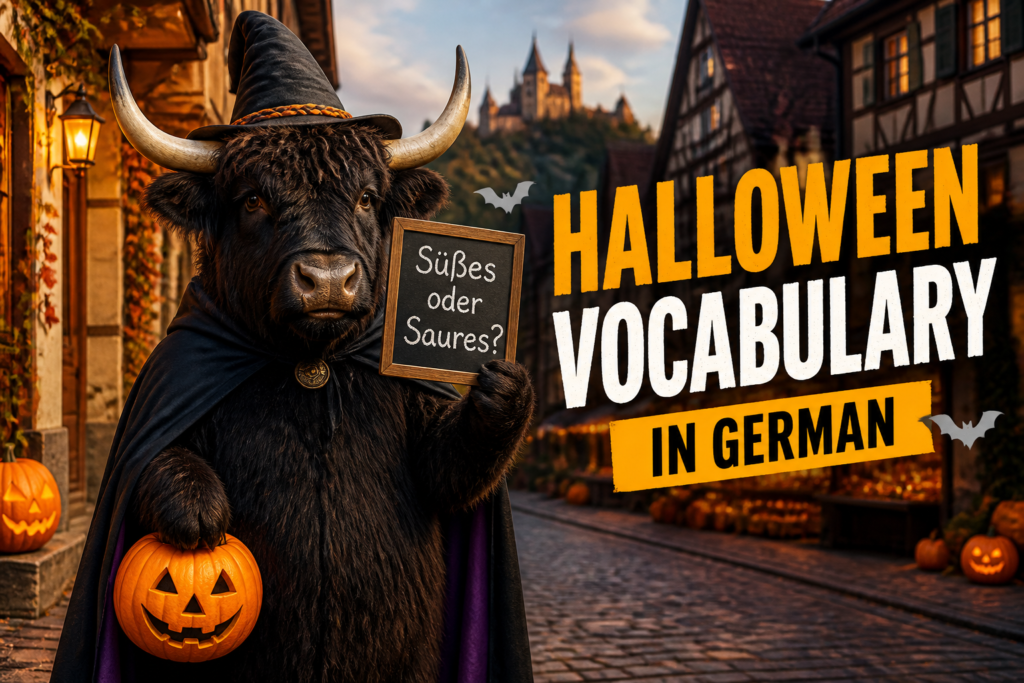
If Halloween makes you think of costumes, candy, and slightly ridiculous fake cobwebs, good news: German has plenty of useful words for all of that. The holiday is not as big in every German-speaking region as it is in the US, but people still understand it, especially in cities, shops, schools, and online. And yes, the pumpkin has a respectable German life too.
In this guide, you’ll learn practical Halloween vocabulary in German, plus real phrases you can actually use. By the end, you’ll be able to talk about costumes, trick-or-treating, spooky decorations, and Halloween plans without sounding like you just copied a haunted dictionary.
For a useful comparison of seasonal vocabulary, you can also check the Christmas vocabulary in German guide later, because apparently German learning enjoys one holiday at a time and then demands more.
Halloween Basics In German
Here are the core words you’ll see again and again. These are the building blocks for most Halloween conversations.
| German | Pronunciation | Meaning | Example Sentence | Translation | Learner Note |
|---|---|---|---|---|---|
| Halloween | HAL-oh-ween | Halloween | Wir feiern Halloween mit Freunden. | We celebrate Halloween with friends. | Same word as English. Easy win for once. |
| die Kürbislaterne | KUER-bis-la-TER-neh | pumpkin lantern / jack-o’-lantern | Die Kürbislaterne steht vor der Tür. | The jack-o’-lantern is standing in front of the door. | Literal word, very useful. die because nouns are fussy in German. |
| der Kürbis | KUER-bis | pumpkin / squash | Ich kaufe einen Kürbis für Halloween. | I’m buying a pumpkin for Halloween. | Plural: die Kürbisse. |
| die Verkleidung | fer-KLY-doong | costume, disguise | Deine Verkleidung ist echt gruselig. | Your costume is really spooky. | Also used for “disguise.” |
| das Kostüm | kos-TUEM | costume | Mein Kostüm ist heute ein Vampir. | My costume is a vampire today. | Very common for party costumes. Plural: die Kostüme. |
| gruselig | GROO-ze-lig | spooky, creepy | Das Haus sieht wirklich gruselig aus. | The house looks really spooky. | Useful all year, not just on Halloween. |
| die Hexe | HEK-seh | witch | Die Hexe fliegt auf einem Besen. | The witch flies on a broom. | Plural: die Hexen. |
| das Gespenst | guh-SHPENST | ghost | Im alten Haus gibt es ein Gespenst. | There is a ghost in the old house. | More old-fashioned or story-like than der Geist. |
| der Geist | gyst | ghost, spirit | Ich glaube nicht an Geister. | I don’t believe in ghosts. | Plural changes vowel: Geister. |
| der Vampir | vam-PEER | vampire | Der Vampir trägt einen schwarzen Umhang. | The vampire is wearing a black cape. | Easy and common. Plural: die Vampire. |
| das Monster | MON-ster | monster | Das Monster versteckt sich im Keller. | The monster is hiding in the cellar. | Very similar to English. |
| die Spinne | SHPIN-neh | spider | Eine Spinne sitzt an der Wand. | A spider is sitting on the wall. | Common in decorations and spooky stories. |
Quick pronunciation note: In German, sp at the beginning of a word often sounds like “shp,” so Spinne is not “spin-neh” with a plain English s. German likes to be just a little dramatic.
Useful Halloween Words And Phrases
These are the practical phrases you’ll actually want for parties, decorations, texts, and simple conversation.
| German | Pronunciation | Meaning | Example Sentence | Translation | Learner Note |
|---|---|---|---|---|---|
| Süßes oder Saures | ZOOSS-es o-der ZOW-res | trick-or-treat | Die Kinder rufen: Süßes oder Saures! | The children shout: “Trick or treat!” | Very common Halloween phrase in German-speaking countries. |
| die Süßigkeiten | ZOOSS-eech-KYT-en | candy, sweets | Wir haben viele Süßigkeiten gekauft. | We bought a lot of candy. | Plural-only in this meaning. |
| die Bonbons | bon-BONS | candies, sweets | Die Bonbons sind im Korb. | The candies are in the bowl. | Often used for wrapped candies. |
| die Maske | MASK-eh | mask | Ich trage eine Maske zum Kostüm. | I’m wearing a mask with my costume. | Can be Halloween or medical depending on context. Fun times. |
| die Party | PAR-tee | party | Heute Abend ist eine Halloween-Party. | There is a Halloween party tonight. | Very common borrowed word. |
| feiern | FY-ern | to celebrate | Wir feiern Halloween mit Musik. | We celebrate Halloween with music. | Regular verb: ich feiere, du feierst, er/sie feiert. |
| erschrecken | er-SHREK-en | to scare, to frighten | Das Monster will die Gäste erschrecken. | The monster wants to scare the guests. | Be careful: sich erschrecken means “to get scared.” |
| schrecklich | SHREK-likh | terrible, horrifying | Das Wetter war schrecklich. | The weather was terrible. | Useful beyond Halloween. Nice dramatic word. |
| unheimlich | OON-hyme-likh | uncanny, eerie | Im Wald war es unheimlich. | It was eerie in the forest. | Often stronger and more atmospheric than gruselig. |
| die Geisterbahn | GY-ster-bahn | haunted ride / ghost train | Die Geisterbahn ist sehr beliebt. | The haunted ride is very popular. | Great word for fairs and amusement parks. |
| die Laterne | la-TER-neh | lantern | Die Laternen leuchten im Dunkeln. | The lanterns shine in the dark. | Plural: Laternen. |
| die Dekoration | deh-ko-ra-TSYON | decoration | Die Dekoration ist sehr kreativ. | The decoration is very creative. | Often used in plural too: Dekorationen. |
If you want one phrase to remember first, make it Süßes oder Saures. It’s the German equivalent of “trick or treat,” and it’s exactly the sort of phrase that makes you sound prepared instead of mildly haunted.
More Halloween Words For Decorations, Weather, And Mood
Halloween language is not just about monsters. A lot of it is about atmosphere: dark streets, candles, costumes, and that cheerful little feeling of “something is watching you.” Excellent for vocabulary, slightly less excellent for sleep.
| German | Pronunciation | Meaning | Example Sentence | Translation | Learner Note |
|---|---|---|---|---|---|
| die Kerze | KER-tsuh | candle | Auf dem Tisch steht eine Kerze. | There is a candle on the table. | Useful in homes, restaurants, and spooky scenes. |
| das Licht | likht | light | Mach bitte das Licht an. | Please turn the light on. | Very common everyday noun. |
| die Dunkelheit | DOON-kel-hyt | darkness | In der Dunkelheit hört man alles besser. | In the darkness, you hear everything better. | Sounds more literary than dark words in English. |
| dunkel | DOON-kel | dark | Der Keller ist sehr dunkel. | The basement is very dark. | Also used for colors: dunkelblau, dunkelgrün. |
| der Schatten | SHAT-ten | shadow | Ein Schatten bewegt sich am Fenster. | A shadow is moving at the window. | Plural: Schatten — same form. |
| das Spukhaus | SHPOOK-house | haunted house | Das Spukhaus ist nur eine Attraktion. | The haunted house is only an attraction. | Compound noun: spuken means to haunt. |
| spuken | SHPOO-ken | to haunt, to spook | In dem Haus soll es spuken. | They say the house is haunted. | Often used in stories and folklore. |
| der Besen | BAY-zen | broom | Die Hexe fliegt auf einem Besen. | The witch flies on a broom. | Plural: die Besen. |
| der Umhang | OOM-hangk | cloak, cape | Der Vampir trägt einen schwarzen Umhang. | The vampire is wearing a black cape. | Very useful for costumes. |
| die Maske | MASK-eh | mask | Ohne Maske sieht das Kostüm anders aus. | Without the mask, the costume looks different. | Can be protective, decorative, or scary. |
| furchterregend | FOORH-tuh-er-RAY-gent | frightening, terrifying | Das war eine furchterregende Szene. | That was a terrifying scene. | A bit stronger than gruselig. |
| blutig | BLOO-tikh | bloody | Die Wunde sieht blutig aus. | The wound looks bloody. | Use carefully; can be graphic. |
Pronunciation note: German ch can sound soft or harsh depending on the word. In gruselig, furchterregend, and ich-type words, it’s not a hard English “k.” It’s lighter and more hissy. A tiny sound, big attitude.
Halloween Costumes And Dress-Up Language
Costume talk is especially handy at parties, school events, and social media posts. German often uses das Kostüm, but Verkleidung also works well, especially when you mean “disguise” or “dress-up.”
| German | Pronunciation | Meaning | Example Sentence | Translation | Learner Note |
|---|---|---|---|---|---|
| sich verkleiden | zikh fer-KLY-den | to dress up, to disguise oneself | Die Kinder verkleiden sich als Monster. | The children dress up as monsters. | Reflexive verb: sich is part of the verb. |
| als | alss | as | Er geht als Zombie zur Party. | He’s going to the party as a zombie. | Used for roles and costumes: als Hexe, als Vampir. |
| die Perücke | peh-RUE-keh | wig | Sie trägt eine rote Perücke. | She’s wearing a red wig. | Plural: Perücken. |
| die Maske | MASK-eh | mask | Die Maske passt gut zum Kostüm. | The mask matches the costume well. | Useful in many contexts. |
| das Make-up | MAYK-opp | makeup | Das Make-up ist ziemlich aufwendig. | The makeup is quite elaborate. | Common borrowed term. |
| die Schminke | SHMINK-uh | makeup, face paint | Die Schminke ist schwarz und weiß. | The makeup is black and white. | Often used for theatrical or costume makeup. |
| der Hut | hoot | hat | Die Hexe trägt einen schwarzen Hut. | The witch is wearing a black hat. | Plural: die Hüte. |
| der Zombie | ZOM-bee | zombie | Mein Kostüm ist ein Zombie. | My costume is a zombie. | Very international word. |
| der Skelett | skeh-LETT | skeleton | Das Skelett hängt an der Tür. | The skeleton is hanging on the door. | Common in decorations. |
| die Knochen | KNOH-hen | bones | Die Knochen sind im Kostüm sichtbar. | The bones are visible in the costume. | Plural of der Knochen. |
Grammar note: After als, the noun usually stays in the simple form you’d expect. For example: als Hexe, als Vampir, als Zombie. No extra article is needed in many costume phrases.
Spooky Places And Halloween Settings
Some Halloween vocabulary is really about where the action happens: a haunted house, a dark forest, a cellar, or a creepy old castle. German loves these words because they sound like they were invented for mystery novels and school plays.
| German | Pronunciation | Meaning | Example Sentence | Translation | Learner Note |
|---|---|---|---|---|---|
| das Haus | house | house | Das Haus wirkt verlassen. | The house looks abandoned. | Very basic, very useful. |
| verlassen | fer-LAS-en | abandoned, deserted | Die Straße ist verlassen. | The street is deserted. | Also a verb: to leave. |
| der Wald | valt | forest, woods | Im Wald ist es nachts unheimlich. | In the forest, it is eerie at night. | Plural: die Wälder. |
| der Keller | KEL-ler | basement, cellar | Im Keller stehen alte Kisten. | There are old boxes in the basement. | Very common spooky setting. |
| das Schloss | shloss | castle | Das Schloss sieht bei Nacht geheimnisvoll aus. | The castle looks mysterious at night. | Can also mean “lock,” so context matters. |
| geheimnisvoll | geh-HYM-nis-fol | mysterious | Die Musik klingt geheimnisvoll. | The music sounds mysterious. | Great word for atmosphere. |
| die Tür | tueur | door | Bitte mach die Tür zu. | Please close the door. | Plural: die Türen. |
| das Fenster | FEN-ster | window | Etwas bewegt sich am Fenster. | Something is moving at the window. | Useful in any suspense scene. |
| die Nacht | nakht | night | In der Nacht hört man Schritte. | At night, you hear footsteps. | Often paired with spooky vocabulary. |
| der Friedhof | FREED-hohf | cemetery | Der Friedhof ist alt und still. | The cemetery is old and quiet. | Use respectfully; not a casual joke word. |
Interesting bit: In Germany, Halloween is generally more commercial than traditional. You’ll see costumes, parties, and decorations, but the bigger cultural fall season word often remains things like autumn festivals and, for later in the year, Christmas markets. German-speaking life loves a seasonal transition. Very organized. Slightly suspicious.
Helpful Phrases For Halloween Conversations
These are the kinds of sentences you can use in real life: at a party, in a message, in class, or while planning decorations.
| German | Pronunciation | Meaning | Example Sentence | Translation | Learner Note |
|---|---|---|---|---|---|
| Was für ein gruseliges Kostüm! | vas fuer ayn GROO-ze-li-gess kos-TUEM | What a spooky costume! | Was für ein gruseliges Kostüm! | What a spooky costume! | Great compliment at a party. |
| Du siehst toll aus. | doo zietst tohl ows | You look great. | Du siehst toll aus. Das Kostüm passt dir gut. | You look great. The costume suits you well. | Friendly and natural. |
| Ich bin als … verkleidet. | ikh bin als fer-KLY-det | I’m dressed up as … | Ich bin als Hexe verkleidet. | I’m dressed up as a witch. | Use als + role. |
| Hast du Süßigkeiten? | hast doo ZOOSS-eech-KYT-en | Do you have candy? | Hast du Süßigkeiten? Ich habe Hunger. | Do you have candy? I’m hungry. | Very useful for party snacks. Slightly dangerous if asked too often. |
| Die Kinder gehen von Haus zu Haus. | dee KIN-der gay-en fon hows zoo hows | The children go from house to house. | Die Kinder gehen von Haus zu Haus. | The children go from house to house. | Useful for describing trick-or-treating. |
| Mach bitte das Licht an. | makh BIT-te das likht an | Please turn the light on. | Mach bitte das Licht an. Es ist dunkel. | Please turn the light on. It’s dark. | Everyday phrase, not just Halloween. |
| Das ist echt unheimlich. | das ist eht OON-hyme-likh | That’s really creepy. | Das ist echt unheimlich. | That’s really creepy. | Natural and common. |
| Keine Angst! | KY-nuh angst | No fear! / Don’t be scared! | Keine Angst! Das ist nur Deko. | No fear! It’s only decoration. | Useful to calm someone down. |
| Das ist nur ein Scherz. | das ist noor ayn shersts | That’s just a joke. | Das ist nur ein Scherz. Kein echtes Monster. | That’s just a joke. No real monster. | Handy when things get a bit too dramatic. |
| Wir gehen zu einer Halloween-Party. | veer gay-en zoo yn-er HAL-oh-ween PAR-tee | We’re going to a Halloween party. | Wir gehen zu einer Halloween-Party. | We’re going to a Halloween party. | Preposition zu is common for going to an event. |
| Die Deko ist super. | dee DAY-koh ist zoo-per | The decoration is great. | Die Deko ist super. | The decoration is great. | Deko is short and casual for Dekoration. |
| Ich liebe Halloween. | ikh LEE-beh HAL-oh-ween | I love Halloween. | Ich liebe Halloween. | I love Halloween. | Simple, clean, and useful. |
Duden’s entry for Halloween is a boring but reliable place to check spelling and usage if you want to see how German reference sources handle the word.
German Halloween Grammar That Actually Helps
You do not need to solve all German grammar to talk about Halloween. Thankfully. But a few patterns will make your sentences sound much more natural.
| Pattern | Meaning | German Example | English Translation | Learner Note |
|---|---|---|---|---|
| Ich bin als … verkleidet. | I am dressed up as … | Ich bin als Vampir verkleidet. | I am dressed up as a vampire. | verkleidet works like an adjective here. |
| Wir feiern … | We celebrate … | Wir feiern Halloween am 31. Oktober. | We celebrate Halloween on October 31. | feiern is the natural verb for holidays and parties. |
| Süßes oder Saures? | Trick or treat? | Süßes oder Saures? | Trick or treat? | Short, direct, and very Halloween-ish. |
| Etwas ist gruselig/unheimlich. | Something is spooky/creepy. | Das Haus ist gruselig. | The house is spooky. | gruselig is milder; unheimlich feels eerier. |
| Es gibt … | There is / there are … | Es gibt viele Süßigkeiten. | There are lots of sweets. | Very useful for describing a party or event. |
| von Haus zu Haus | from house to house | Die Kinder gehen von Haus zu Haus. | The children go from house to house. | Nice phrase for trick-or-treating. |
| zu einer Party gehen | to go to a party | Wir gehen zu einer Party. | We’re going to a party. | zu often means “to” for events. |
| mit + dative | with + noun | mit Freunden | with friends | mit always takes the dative case. |
Mini rule: German nouns are capitalized. So it is der Kürbis, die Hexe, das Kostüm, die Süßigkeiten. The capitals are not decorative. German is just committed to the bit.
Practice Section
Try these quick exercises. A little practice now saves you from later standing in a shop and waving at pumpkins like an exhausted mime.
| Task | Prompt | Answer | Note |
|---|---|---|---|
| Translate | What is “pumpkin” in German? | der Kürbis | Plural: die Kürbisse. |
| Translate | What is “ghost” in German? | das Gespenst / der Geist | Gespenst sounds more spooky-story-like. |
| Fill In The Blank | Wir feiern ________. | Halloween | Same spelling as English. |
| Fill In The Blank | Die Kinder rufen: ________ oder Saures! | Süßes | Classic phrase. |
| Spot The Difference | gruselig vs unheimlich | gruselig = spooky/creepy; unheimlich = eerie/uncanny | unheimlich can feel a bit stronger or more atmospheric. |
| Transform | Ich bin ein Vampir. → say “I’m dressed up as a vampire.” | Ich bin als Vampir verkleidet. | Use als + role/costume. |
| Correct The Sentence | Die kinder gehen von haus zu haus. | Die Kinder gehen von Haus zu Haus. | Nouns are capitalized in German. |
| Pronunciation Check | Spinne | “SHPIN-neh” | sp at the beginning usually sounds like “shp.” |
Now try saying these aloud:
- Ich liebe Halloween.
- Das Kostüm ist gruselig.
- Die Kinder gehen von Haus zu Haus.
- Wir haben viele Süßigkeiten.
- Mach bitte das Licht an.
If you want a second round of seasonal vocabulary, the main Learn German page is a good place to keep moving through related topics.
Common Mistakes And Easy Fixes
| Common Mistake | Better Version | Why It Matters |
|---|---|---|
| das Halloween | Halloween | In German, the holiday usually appears without an article. |
| Ich bin verkleidet als ein Vampir. | Ich bin als Vampir verkleidet. | The natural word order is als + noun in costume talk. |
| Die kinder | Die Kinder | Nouns are capitalized. |
| ein spooky Haus | ein gruseliges Haus | Use German adjectives when possible for a more natural sentence. |
| Ich habe Angst von Geistern. | Ich habe Angst vor Geistern. | Angst vor means “fear of.” The preposition is vor, not von. |
| Wir feiern in Halloween. | Wir feiern Halloween. | No preposition needed here. |
| die Süßigkeit | die Süßigkeiten | When you mean candy in general, the plural is more common. |
| Es ist sehr gruslig. | Es ist sehr gruselig. | Watch the spelling: gruselig has -elig. |
Germany, Austria, And Switzerland Notes
Halloween vocabulary is mostly shared across standard German, but the vibe can differ a little by region.
- Germany: Halloween is widely understood and commonly used in shops, media, and among younger people.
- Austria: Also understood, but some people may treat it as more of an imported commercial holiday.
- Switzerland: Also known, though local customs and regional preferences may be stronger in everyday life.
In all three, the basic words like Halloween, Kürbis, Hexe, Vampir, and Party will get you very far. German-speaking people may not all celebrate Halloween the same way, but they will absolutely understand the vocabulary. Language, as usual, is the easy part. Human behavior is the weird part.
Quick Reference Summary
| Word Or Phrase | Meaning | Best Use |
|---|---|---|
| Halloween | Halloween | Holiday name |
| Süßes oder Saures | trick or treat | Children asking for candy |
| der Kürbis | pumpkin | Decorations and jack-o’-lanterns |
| das Kostüm | costume | Party outfits |
| die Verkleidung | costume, disguise | Dressing up |
| gruselig | spooky | Friendly spooky tone |
| unheimlich | eerie, uncanny | More atmospheric spooky tone |
| die Hexe | witch | Costumes and stories |
| der Vampir | vampire | Costumes and spooky characters |
| die Süßigkeiten | candy | Treats and snacks |
| feiern | to celebrate | Events and holidays |
| verkleiden | to dress up | Costume talk |
Yak takeaway: If you can say Ich bin als Vampir verkleidet and Süßes oder Saures, you already have the Halloween basics covered. Add gruselig, Kürbis, and Halloween-Party, and suddenly your German sounds a lot less ghostly and a lot more useful.