


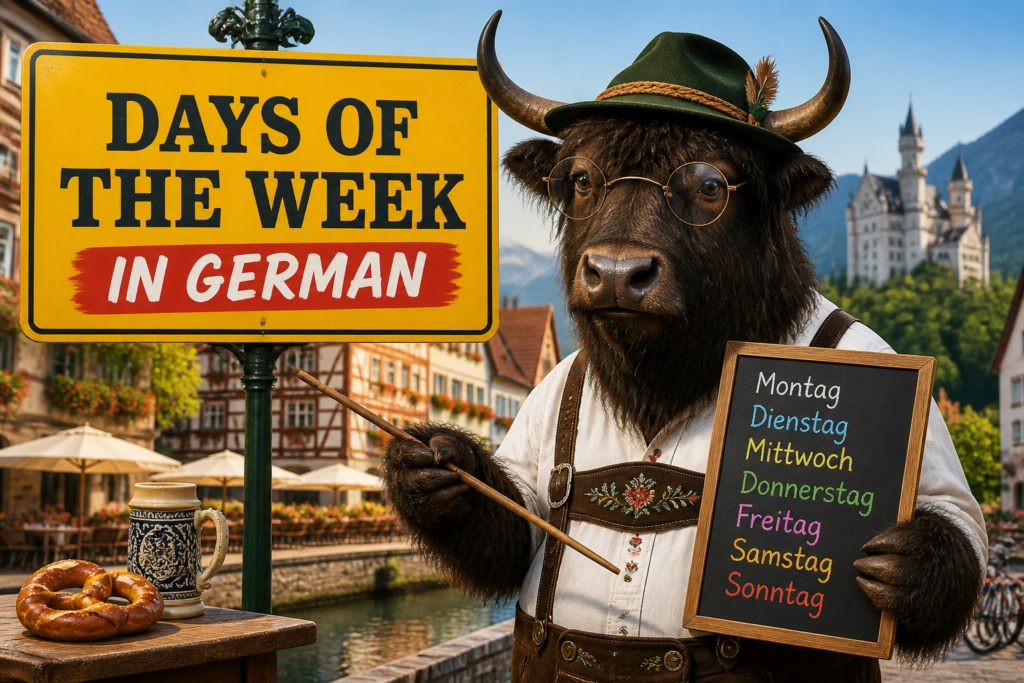
If you can say the days of the week in German, you can already talk about plans, routines, classes, meetings, trips, deadlines, and all the other little calendar dramas of life. Useful stuff. Not exactly glamorous, but wildly practical.
For the broader learning path, visit our parent guide.
The nice part? German weekdays are very regular, very logical, and mostly easy to recognise once you notice the patterns. The slightly annoying part? They are all masculine nouns, capitalised, and sometimes used with little time expressions that English does not always mirror neatly. Germany likes order. Shocking, really.
By the end of this guide, you will know the German days of the week, how to pronounce them, how to use them in real sentences, and how to talk about things happening on a day, every day, or this day without sounding like a textbook wearing a tie.
The German Days Of The Week At A Glance
| German | Pronunciation | Meaning | Example Sentence | Translation | Learner Note |
|---|---|---|---|---|---|
| der Montag | MOHN-tahk | Monday | Am Montag habe ich Deutschunterricht. | On Monday I have German class. | All weekdays are masculine: der Montag. |
| der Dienstag | DEENS-tahk | Tuesday | Am Dienstag gehe ich einkaufen. | On Tuesday I go shopping. | Ends in -tag like many weekday names. |
| der Mittwoch | MIT-vokh | Wednesday | Am Mittwoch ist das Meeting. | On Wednesday is the meeting. | Literally “mid-week.” |
| der Donnerstag | DON-ers-tahk | Thursday | Am Donnerstag arbeite ich von zu Hause. | On Thursday I work from home. | Pay attention to the st in the middle. |
| der Freitag | FRY-tahk | Friday | Am Freitag gehen wir ins Café. | On Friday we go to the café. | A very popular day, obviously. |
| der Samstag | ZAMS-tahk | Saturday | Am Samstag schlafen viele Leute länger. | On Saturday many people sleep longer. | Also common in Germany: der Sonnabend. |
| der Sonntag | ZONN-tahk | Sunday | Am Sonntag besuchen wir meine Eltern. | On Sunday we visit my parents. | Sunday is usually quieter in Germany. |
All seven are masculine nouns, so you say der Montag, der Dienstag, and so on. In normal conversation, the article often changes to am when you say “on Monday,” because am = an dem. German loves shrinking things when it can.
Yak wisdom: If you remember the days in order, you can already talk about routines, schedules, and plans without panic. That is a ridiculous amount of practical power for seven little words.
How To Say “On Monday,” “Every Monday,” And “This Monday”
The weekday itself is only half the story. The little words around it matter too. English says “on Monday,” but German usually says am Montag. For repeated habits, German often uses the weekday without an article: montags or jeden Montag.
| Pattern | Meaning | German Example | English Translation | Learner Note |
|---|---|---|---|---|
| am + weekday | on Monday, on Tuesday, etc. | Am Montag habe ich frei. | On Monday I have free time. | Most common way to say a day in a sentence. |
| jeden + weekday | every Monday | Jeden Dienstag gehe ich joggen. | Every Tuesday I go jogging. | jeden takes accusative, but don’t panic; it is a fixed pattern. |
| weekday + -s | on Mondays, on Tuesdays | Montags arbeite ich spät. | On Mondays I work late. | Shows a repeated habit. Very useful. Very German. |
| diesen + weekday | this Monday | Diesen Freitag fahren wir nach Köln. | This Friday we are going to Cologne. | Use diesen when you mean the current or coming week’s day. |
| nächsten + weekday | next Monday | Nächsten Montag beginnt der Kurs. | Next Monday the course starts. | Often used for the coming weekday, not necessarily seven days away in all contexts. |
| letzten + weekday | last Monday | Letzten Mittwoch war ich krank. | Last Wednesday I was sick. | Common in everyday conversation. |
One small warning: am Montag means “on Monday,” but Montag by itself can appear in schedules, headlines, or notes where the day is already clear. German likes to save words when context does the job. Lazy? Efficient? Both.
Useful Day-Of-The-Week Phrases
Below are the phrases you will actually hear in real life. Not museum German. Not “translate this sentence for a grammar exercise and then forget it forever” German. Real German.
| German | Pronunciation | Meaning | Example Sentence | Translation | Learner Note |
|---|---|---|---|---|---|
| heute | HOY-tuh | today | Heute habe ich keine Zeit. | Today I do not have time. | Very common in everyday speech. |
| morgen | MOHR-gən | tomorrow | Morgen treffen wir uns. | Tomorrow we are meeting. | Lowercase morgen = tomorrow; uppercase der Morgen = morning. |
| übermorgen | UE-ber-MOHR-gən | the day after tomorrow | Übermorgen ist mein Termin. | The day after tomorrow is my appointment. | Very handy, and yes, longer than English. German enjoys this. |
| gestern | GES-tern | yesterday | Gestern war das Wetter schlecht. | Yesterday the weather was bad. | Simple and useful. |
| vorgestern | FOR-GES-tern | the day before yesterday | Vorgestern habe ich dich angerufen. | The day before yesterday I called you. | Another classic German compound. Efficient little beast. |
| am Wochenende | am VOH-khə-nen-en-duh | on the weekend | Am Wochenende fahren wir ans Meer. | On the weekend we are going to the sea. | Very common in Germany and Austria. Swiss German often uses similar ideas, but local wording can vary. |
| unter der Woche | OON-ter der VOH-khə | during the week / on weekdays | Unter der Woche arbeite ich viel. | During the week I work a lot. | Good phrase for routines and schedules. |
| am frühen Morgen | am FRÜH-en MOR-gən | early in the morning | Am frühen Morgen ist es ruhig. | Early in the morning it is quiet. | Time words often come before the rest of the sentence idea. |
| am Abend | am AH-bent | in the evening | Am Abend lerne ich Vokabeln. | In the evening I study vocabulary. | Useful with day routines. |
| die Woche | DEE VOH-khə | week | Die Woche war lang. | The week was long. | Woche is feminine: die Woche. |
| der Wochentag | VOH-khen-tahk | weekday | Der Wochentag ist wichtig für meinen Plan. | The weekday is important for my plan. | Compound noun: Woche + Tag. |
| der Feiertag | FY-er-tahk | public holiday | Am Feiertag sind viele Geschäfte geschlossen. | On the public holiday many shops are closed. | Not a weekday, but very useful for schedules. |
If you want the boring-but-reliable official spelling and usage help for weekday names, Duden is a good place to check. Not exactly a beach read, but very trustworthy.
How The Weekdays Are Built
Most German weekdays end in -tag, which means “day.” That makes the words feel a bit more obvious than English once you see the pattern.
| German | Word Parts | Literal Idea | Easy Memory Tip |
|---|---|---|---|
| Montag | Mond + tag | moon day | Think of the moon; it is not “Monday” because Monday is fun, sadly. |
| Dienstag | historically connected to a service/gathering day | Tuesday | No need to overthink it. Learn the word as a unit. |
| Mittwoch | mitte + woche | middle of the week | This one is nice and logical. |
| Donnerstag | related historically to thunder | Thursday | Think “thunder day” if that helps. |
| Freitag | historically linked with freedom / Frigg | Friday | Just remember it as the “finally” day. |
| Samstag | historical roots; often replaced by Sonnabend in some areas | Saturday | Different regions use different forms. |
| Sonntag | Sonne + tag | sun day | A sunny name for a restful day. |
Only Mittwoch is transparently built from modern words in a way beginners usually recognise immediately. The others are mostly historical leftovers. Language, as usual, is an organised mess.
Pronunciation Tips That Actually Help
You do not need to sound like a phonetics professor. You just need to be understood. Here are the spots English speakers usually need to pay attention to.
| Sound | Example | How To Say It | Learner Note |
|---|---|---|---|
| ch | Woche | soft hissy sound, like “kh” but lighter | Not the hard “ch” in English “chair.” |
| g at the end | Montag, Freitag | often sounds like a soft “k” | Final devoicing is normal in German. |
| st | Donnerstag | often sounds like “sht” in many native pronunciations | This is common at the start or inside words after a consonant cluster in standard German pronunciation. |
| ei | Freitag | “eye” | German ei usually sounds like English “eye.” |
| ie | Dienstag | “ee” | Long vowel sound. |
| au | Samstag is not a clear example, but Woche is not either | “ow” as in “now” | Good to know for other German words. |
| r | Donnerstag | light German r, often more throaty or reduced | Do not over-roll it unless that feels natural. |
Two pronunciation points to remember: Mittwoch is not “mitt-woch” with a giant English t, and Donnerstag often sounds smoother than it looks. German spelling is polite like that.
Real-Life Sentences With The Weekdays
Here are some realistic examples you can steal for your own speaking and writing. Because sometimes the best learning strategy is shameless imitation. In a wholesome way.
| German | Pronunciation | Meaning | Example Sentence | Translation | Learner Note |
|---|---|---|---|---|---|
| Am Montag habe ich frei. | am MOHN-tahk HAH-buh ikh fry | I am free on Monday. | Am Montag habe ich frei. | On Monday I have free time. | frei haben means to have time off. |
| Ich arbeite jeden Dienstag. | ikh AR-bye-te YAY-den DEENS-tahk | I work every Tuesday. | Ich arbeite jeden Dienstag. | I work every Tuesday. | jeden + day = repeated schedule. |
| Mittwochs habe ich einen Kurs. | MIT-vohks HAH-buh ikh EYE-nen koors | I have a class on Wednesdays. | Mittwochs habe ich einen Kurs. | On Wednesdays I have a class. | Mittwochs = every Wednesday / on Wednesdays. |
| Am Donnerstag muss ich früh aufstehen. | am DON-ers-tahk moos ikh fryf OWF-shtay-en | I have to get up early on Thursday. | Am Donnerstag muss ich früh aufstehen. | On Thursday I have to get up early. | muss = must / have to. |
| Freitags gehe ich oft ins Fitnessstudio. | FRY-tahks GAY-uh ikh oft ins FIT-ness-shtoo-dee-oh | On Fridays I often go to the gym. | Freitags gehe ich oft ins Fitnessstudio. | On Fridays I often go to the gym. | Habit form with -s. |
| Am Samstag treffen wir uns im Park. | am ZAMS-tahk TREH-fen veer oons im park | We are meeting in the park on Saturday. | Am Samstag treffen wir uns im Park. | We are meeting in the park on Saturday. | uns treffen = to meet each other. |
| Sonntags schlafe ich länger. | ZONN-tahks SHLAH-fuh ikh LENG-er | On Sundays I sleep longer. | Sonntags schlafe ich länger. | On Sundays I sleep longer. | Very natural for routines. |
| Nächsten Montag fahren wir nach Berlin. | NEKH-stən MOHN-tahk FAH-ren veer nahkh behr-LEEN | Next Monday we are going to Berlin. | Nächsten Montag fahren wir nach Berlin. | Next Monday we are going to Berlin. | nächsten is often used for the coming weekday. |
| Diesen Freitag habe ich Geburtstag. | DEE-zən FRY-tahk HAH-buh ikh geh-BEER-ts-tahk | I have my birthday this Friday. | Diesen Freitag habe ich Geburtstag. | This Friday is my birthday. | Great for future plans and events. |
| Letzten Mittwoch war das Büro geschlossen. | LET-stən MIT-vokh vahr dahs bü-roh ge-SHLOSS-en | The office was closed last Wednesday. | Letzten Mittwoch war das Büro geschlossen. | Last Wednesday the office was closed. | Use letzten for a past weekday. |
| Unter der Woche esse ich meistens zu Hause. | OON-ter der VOH-khə ESS-uh ikh MY-stens tsu HOW-zuh | During the week I usually eat at home. | Unter der Woche esse ich meistens zu Hause. | During the week I usually eat at home. | Good for routine descriptions. |
| Am Wochenende mache ich nichts. | am VOH-khə-nen-en-duh MAH-khuh ikh nikhts | At the weekend I do nothing. | Am Wochenende mache ich nichts. | On the weekend I do nothing. | Sometimes the best schedule is no schedule. |
For broader date and calendar language, it helps to connect weekdays with months and dates. If you want to keep going, take a look at Months of the Year in German and Write the Date in German.
Germany, Austria, And Switzerland: A Small But Useful Difference
For the weekday names themselves, standard German is very stable across Germany, Austria, and Switzerland. But one small difference is worth knowing: Samstag and Sonnabend.
| Region | Common Word | Notes |
|---|---|---|
| Germany | Samstag | Most common in everyday standard German. |
| North Germany and some other areas | Sonnabend | Still used, but less common nationwide. |
| Austria | Samstag | Standard and very common. |
| Switzerland | Samstag | Standard form; local Swiss German varieties may sound different in speech, but the written standard is the same. |
If you are learning standard German for broad use, Samstag is the safest choice. Sonnabend is not wrong, but it is regional. Think “useful extra flavour,” not “must memorise immediately or perish.”
Grammar Notes You Actually Need
German weekdays are simple, but there are a few grammar habits worth learning early. These keep your sentences sounding natural instead of slightly scrambled.
| Rule | German Example | English Translation | Learner Note |
|---|---|---|---|
| Weekdays are capitalised | Der Montag ist schnell da. | Monday comes quickly. | All German nouns are capitalised, including weekday names. |
| Use am for a specific day | Am Freitag gehe ich schwimmen. | On Friday I go swimming. | am = an dem. |
| Use jeden for every + day | Jeden Montag habe ich Training. | Every Monday I have training. | jeden is the accusative form of jeder. |
| Use weekday + s for habit | Montags arbeite ich von zu Hause. | On Mondays I work from home. | Very common in speech and writing. |
| Word order stays normal | Am Mittwoch beginnt der Kurs. | On Wednesday the course begins. | Time phrase first, verb second. Classic German structure. |
Notice that the verb usually stays in second position, even when the time expression comes first. So Am Mittwoch beginnt der Kurs is normal, while English word-for-word order is not the goal here. German grammar is a bit bossy about that.
Memory trick: am = one day, jeden = every single one of that day, and Montags = usually on Mondays.
Common Mistakes And Easy Fixes
Here are the errors English speakers make most often. Not because the topic is hard. Because German likes tiny details with very big opinions.
| Mistake | Better German | Why |
|---|---|---|
| Ich gehe in Montag. | Ich gehe am Montag. | Use am for a weekday, not in. |
| Montag ich gehe. | Am Montag gehe ich. | German usually wants the verb in second position. |
| die Montag | der Montag | Weekdays are masculine. |
| am Montags | montags or am Montag | Do not mix the two patterns. Pick one. |
| jedes Montag | jeden Montag | Montag is masculine, so jeden, not jedes. |
| der Mittwochs | mittwochs | Habit form uses lowercase and no article. |
| am Wochenend | am Wochenende | The noun is das Wochenende, with -e. |
One extra thing: morgen can mean “tomorrow,” but der Morgen means “morning.” Same spelling idea, very different meaning. German likes these little traps, because apparently it enjoys keeping learners humble.
Quick Practice
Try these out before moving on. Quick practice beats passive nodding every time.
| Task | Answer | Hint |
|---|---|---|
| Translate: “On Wednesday” | Am Mittwoch | Use am + weekday. |
| Translate: “Every Friday” | Jeden Freitag | jeden for “every.” |
| Translate: “On Sundays I relax.” | Sonntags entspanne ich mich. | Habit form with -s. |
| Translate: “Next Tuesday” | Nächsten Dienstag | Coming weekday in many everyday contexts. |
| Fill in the blank: ______ Montag habe ich einen Test. | Am | Specific day. |
| Fill in the blank: _______ Mittwoch gehe ich ins Büro. | Jeden or Mittwochs | Both can work, but the meaning changes slightly. |
| Correct the sentence: Ich habe frei in Freitag. | Ich habe am Freitag frei. | am, not in. |
| Correct the sentence: Die Montag ist stressig. | Der Montag ist stressig. | Masculine article. |
If you want a little more weekday-and-calendar context, check the main guide on Days of the Week in German later too. Yes, that is the same topic in a neat little learning loop. Very efficient. Very on-brand.
Mini Summary
- Montag, Dienstag, Mittwoch, Donnerstag, Freitag, Samstag, Sonntag are the seven weekdays in German.
- They are all masculine: der Montag, der Dienstag, and so on.
- Use am + weekday for a specific day: am Freitag.
- Use jeden + weekday for “every Monday,” “every Tuesday,” etc.
- Use the weekday + -s for recurring habits: montags, freitags.
- Samstag is standard across most places; Sonnabend is a regional alternative in Germany.
- morgen means “tomorrow,” while der Morgen means “morning.” Sneaky, but learnable.
Once you know the weekdays, you are suddenly able to talk about routines, appointments, travel, lessons, work shifts, and weekend plans with much more confidence. That is a lot of everyday German for a very small lesson. Nice trade.
Yak takeaway: learn the seven weekday names, pair them with am and jeden, and you can start sounding like a person with a calendar instead of a random word collector.