


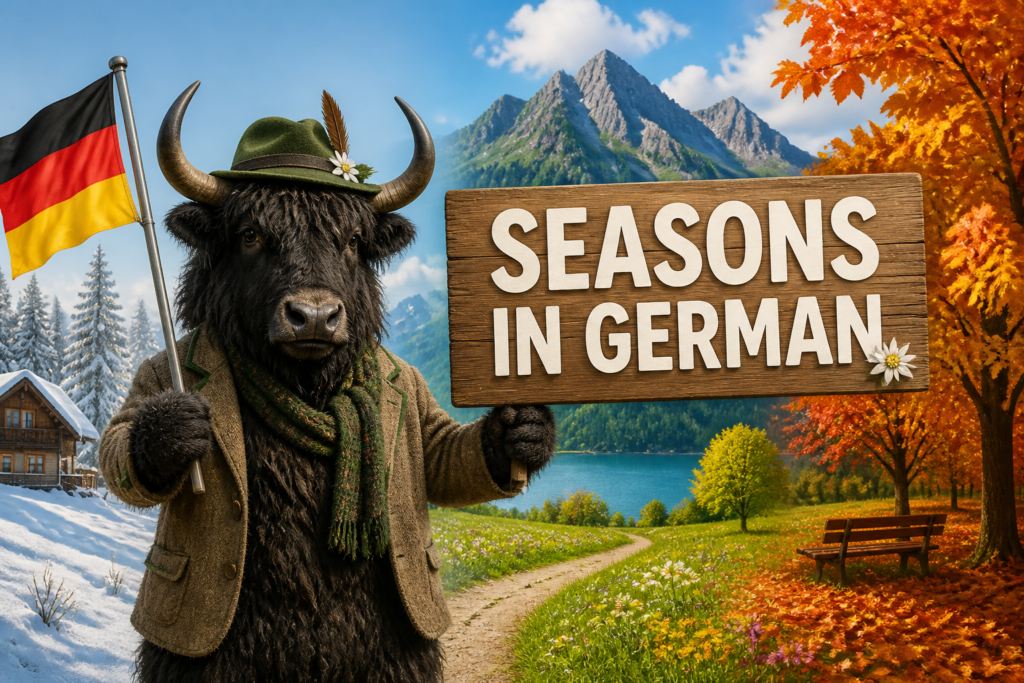
Jahreszeiten are one of those topics that seem simple until German quietly adds articles, capitalization, and a few sneaky little usage habits. Convenient. Because why should the four seasons be just four seasons when they can also be a grammar snack?
In German, seasons are usually used with articles, and they also show up in plenty of everyday phrases about weather, holidays, travel, and what people are grumbling about outside. By the end of this guide, you’ll be able to name the seasons, talk about them naturally, and use the most common season phrases without sounding like a textbook with a coffee problem.
The Four Seasons In German
The basic German words for the seasons are easy enough, but they still deserve proper attention. German likes to capitalize nouns, so all season names start with a capital letter.
| German | Pronunciation | Meaning | Example Sentence | Translation | Learner Note |
|---|---|---|---|---|---|
| der Frühling | FROOH-ling | spring | Im Frühling blühen viele Blumen. | Many flowers bloom in spring. | Masculine noun: der Frühling. |
| der Sommer | ZOM-er | summer | Im Sommer fahren viele Menschen ans Meer. | In summer, many people go to the sea. | Masculine noun. Very common in daily conversation. |
| der Herbst | HERBST | autumn, fall | Im Herbst werden die Tage kürzer. | In autumn, the days get shorter. | Use Herbst more often in Germany; Fall is understood but less common. |
| der Winter | VIN-ter | winter | Im Winter wird es früh dunkel. | In winter, it gets dark early. | Masculine noun. Final -er is a schwa-like ending, not a hard “er”. |
Notice the pattern: in German, seasons are usually used with im, which is short for in dem. That’s the dative case doing its little paperwork job.
Quick yak rule: In German, you usually say im Frühling, im Sommer, im Herbst, and im Winter — not just “Frühling” floating around by itself unless the sentence really wants that structure.
How To Say “In Spring” And Similar Phrases
German season phrases are very useful because they show up in weather talk, travel plans, and small talk. People talk about the weather a lot. Not because they are spiritually committed to meteorology. Mostly because it is there, and it changes.
| German | Pronunciation | Meaning | Example Sentence | Translation | Learner Note |
|---|---|---|---|---|---|
| im Frühling | im FROOH-ling | in spring | Im Frühling gehe ich gern spazieren. | In spring, I like going for walks. | im = in + dem. |
| im Sommer | im ZOM-er | in summer | Im Sommer essen wir oft draußen. | In summer, we often eat outside. | Very common with outdoor activities. |
| im Herbst | im HERBST | in autumn | Im Herbst regnet es oft. | It often rains in autumn. | Great for weather talk. |
| im Winter | im VIN-ter | in winter | Im Winter trinke ich viel Tee. | In winter, I drink a lot of tea. | Tea: extremely on-brand for German winter life. |
If you want a boring but reliable reference for the season words, Duden is always there, being exactly as serious as it looks.
Useful Season Words And Everyday Phrases
Here are practical words and phrases you’ll actually hear when talking about the seasons in German. These are the ones that help you sound normal in real life, which is a low bar but somehow still worth aiming for.
| German | Pronunciation | Meaning | Example Sentence | Translation | Learner Note |
|---|---|---|---|---|---|
| die Jahreszeit | YAH-res-tsite | season | Meine Lieblingsjahreszeit ist der Frühling. | My favorite season is spring. | Plural: die Jahreszeiten. |
| der Frühling | FROOH-ling | spring | Der Frühling beginnt im März. | Spring begins in March. | Use der, not die. |
| blühen | BLYOO-en | to bloom | Die Blumen blühen im Frühling. | The flowers bloom in spring. | Often used with flowers, trees, and gardens. |
| warm | varm | warm | Es wird langsam warm. | It is slowly getting warm. | Useful for spring and summer. |
| heiß | hice | hot | Heute ist es sehr heiß. | Today it is very hot. | Watch the spelling: ß, not ss. |
| der Sommerurlaub | ZOM-er-OOR-laub | summer holiday | Wir planen unseren Sommerurlaub. | We are planning our summer holiday. | Compound noun: one word in German, because of course it is. |
| die Sonne | ZON-eh | sun | Die Sonne scheint heute. | The sun is shining today. | Very common with weather expressions. |
| scheinen | SHY-nen | to shine | Die Sonne scheint durch die Wolken. | The sun shines through the clouds. | Often used in weather forecasts. |
| der Herbst | HERBST | autumn, fall | Im Herbst färben sich die Blätter bunt. | In autumn, the leaves turn colorful. | färben sich = turn color. |
| die Blätter | BLET-ter | leaves | Die Blätter fallen von den Bäumen. | The leaves fall from the trees. | Plural of das Blatt. |
| kalt | kalt | cold | Im Winter ist es oft kalt. | It is often cold in winter. | Very frequent adjective in weather talk. |
| schneien | SHNYE-en | to snow | Es schneit heute den ganzen Tag. | It is snowing all day today. | Used impersonally with es. |
| der Schnee | shnay | snow | Der Schnee liegt auf der Straße. | The snow is on the street. | Mass noun; no plural in everyday use. |
| rutschen | ROOCH-ten | to slip; to slide | Auf dem Eis rutscht man leicht aus. | You slip easily on the ice. | Useful in winter safety talk. |
| der Regen | RAY-gen | rain | Im Herbst gibt es oft Regen. | In autumn, there is often rain. | Weather nouns often work with es gibt. |
German weather talk often uses es in a very impersonal way: Es regnet. Es schneit. Es ist kalt. No drama, no subject doing the action. Just weather being weather.
Common Seasonal Phrases You’ll Hear All The Time
These phrases are short, natural, and extremely handy. Use them when talking about plans, weather, habits, or the annual emotional roller coaster that comes with each season.
| German | Pronunciation | Meaning | Example Sentence | Translation | Learner Note |
|---|---|---|---|---|---|
| Es ist Frühling. | es ist FROOH-ling | It is spring. | Es ist Frühling, und die Tage werden länger. | It is spring, and the days are getting longer. | Simple and natural. |
| Der Sommer ist da. | der ZOM-er ist da | Summer is here. | Endlich ist der Sommer da. | Finally, summer is here. | Great for excited, conversational German. |
| Im Herbst wird es früh dunkel. | im HERBST wird es fru DOON-kel | It gets dark early in autumn. | Im Herbst wird es oft früher dunkel als im Sommer. | In autumn, it often gets dark earlier than in summer. | Useful comparison phrase. |
| Es ist Winter. | es ist VIN-ter | It is winter. | Es ist Winter, also brauchen wir warme Jacken. | It is winter, so we need warm jackets. | Very simple and common. |
| Es taut. | es taout | It is thawing. | Es taut nach dem Schneefall. | It is thawing after the snowfall. | Useful in winter and early spring. |
| der Schneefall | SHNYE-fal | snowfall | Der Schneefall hat heute Morgen angefangen. | The snowfall started this morning. | Compound noun: Schnee + Fall. |
| die Hitze | HIT-seh | heat | Die Hitze ist heute schwer auszuhalten. | The heat is hard to stand today. | Often used when summer gets intense. |
| angenehm | AN-ge-naym | pleasant | Das Wetter ist heute angenehm. | The weather is pleasant today. | Very useful for small talk. |
| unbeständig | oon-be-shten-dich | changeable, unsettled | Das Wetter ist im Frühling oft unbeständig. | The weather is often changeable in spring. | Good word for forecasts. |
| der Wetterbericht | VET-ter-be-richt | weather report | Ich höre mir den Wetterbericht an. | I listen to the weather report. | Common everyday noun. |
| die Temperatur | tem-pe-ra-TOOR | temperature | Die Temperatur steigt am Nachmittag. | The temperature rises in the afternoon. | Formal but very common. |
| der Sonnenaufgang | ZON-en-OWF-gang | sunrise | Der Sonnenaufgang ist im Sommer sehr früh. | Sunrise is very early in summer. | Great travel and photography word. |
| der Sonnenuntergang | ZON-en-OON-ter-gang | sunset | Wir gehen zum Sonnenuntergang an den See. | We are going to the lake for sunset. | Very common in travel and social media captions. |
A good way to sound natural is to pair season words with weather verbs: scheinen, regnen, schneien, and werden. These are the workhorses. No fancy outfit. Just reliable German.
Season Prepositions And Grammar That Keep Showing Up
Season words are a nice way to practice the dative case without turning your day into a grammar emergency. The most useful pattern is:
im + season = in spring / in summer / in autumn / in winter
| Pattern | Meaning | German Example | English Translation | Learner Note |
|---|---|---|---|---|
| im Frühling | in spring | Im Frühling wird alles grün. | Everything turns green in spring. | im = in dem |
| im Sommer | in summer | Im Sommer machen viele Leute Urlaub. | Many people go on holiday in summer. | Very common travel phrase. |
| im Herbst | in autumn | Im Herbst sammeln Kinder Kastanien. | In autumn, children collect chestnuts. | Nice seasonal image, very German. |
| im Winter | in winter | Im Winter tragen wir Mützen und Schals. | In winter we wear hats and scarves. | Classic clothing vocabulary. |
Another useful point: if you say in der Nacht or im Winter, the article changes because German prepositions like to drag nouns into case changes whether the nouns asked for it or not.
Goethe-Institut has plenty of practical German learning material if you want more structured practice after this.
Real-Life Sentences About Each Season
These examples show how season words actually behave in everyday German. Read them aloud if you can. German loves rhythm, and your mouth will get used to the shape faster than your brain will complain about it.
| German | Pronunciation | Meaning | Example Sentence | Translation | Learner Note |
|---|---|---|---|---|---|
| Im Frühling gehe ich oft joggen. | im FROOH-ling GAY-eh ich oft JOG-en | In spring, I often go jogging. | Im Frühling gehe ich oft joggen. | In spring, I often go jogging. | oft = often. |
| Im Sommer essen wir Eis. | im ZOM-er ESS-en veer ice | In summer, we eat ice cream. | Im Sommer essen wir Eis. | In summer, we eat ice cream. | Eis can mean ice cream here, not “ice.” |
| Im Herbst machen wir lange Spaziergänge. | im HERBST MAH-chen veer LANG-eh shpah-TSYEHR-geng-eh | In autumn, we take long walks. | Im Herbst machen wir lange Spaziergänge. | In autumn, we take long walks. | Spaziergang is a walk for leisure. |
| Im Winter bleibt man lieber drinnen. | im VIN-ter blybt man LEE-ber DRIN-en | In winter, people prefer to stay inside. | Im Winter bleibt man lieber drinnen. | In winter, people prefer to stay inside. | Very natural general statement. |
| Der Frühling ist meine Lieblingsjahreszeit. | der FROOH-ling ist MY-neh LEE-blings-YAH-res-tsite | Spring is my favorite season. | Der Frühling ist meine Lieblingsjahreszeit. | Spring is my favorite season. | Use Lieblings- for “favorite.” |
| Der Sommer ist oft heiß. | der ZOM-er ist oft hice | Summer is often hot. | Der Sommer ist oft heiß. | Summer is often hot. | heiß with ß. |
| Im Herbst fallen die Blätter. | im HERBST FAH-len dee BLET-ter | The leaves fall in autumn. | Im Herbst fallen die Blätter. | The leaves fall in autumn. | Simple, natural, and useful. |
| Im Winter brauchen wir warme Kleidung. | im VIN-ter BROW-chen veer VAR-me KLY-dung | In winter, we need warm clothing. | Im Winter brauchen wir warme Kleidung. | In winter, we need warm clothing. | brauchen = to need. |
Germany, Austria, And Switzerland: Small Seasonal Differences
The season names themselves are the same across standard German, but the way people talk about weather, holidays, and regional habits can vary a little.
| Topic | Germany | Austria | Switzerland | Learner Note |
|---|---|---|---|---|
| Season names | Frühling, Sommer, Herbst, Winter | Same | Same | No drama here. The names are standard. |
| Autumn word | Herbst is standard | Herbst is standard | Herbst is standard | Fall may be understood, but Herbst is safer. |
| Winter sports talk | Very common in some regions | Very common in alpine areas | Very common in alpine areas | Context matters more than vocabulary here. |
| Holiday language | Urlaub for vacation | Urlaub also common | Ferien and Urlaub both occur | Season talk often mixes with holiday talk. |
If you hear Ferien, that often means school holidays or a longer break, while Urlaub usually means vacation time. Small difference, big usefulness.
Pronunciation Notes For Season Words
German season words are beginner-friendly, but a few sounds are worth noticing so they don’t ambush you later.
| Sound | Example | Quick Tip | Learner Note |
|---|---|---|---|
| Frühling | FROOH-ling | ü sounds like “ee” with rounded lips. | This sound is very common in German. It is worth practicing early. |
| Herbst | HERBST | Keep the final st crisp. | At the end of a word, b often sounds more like p, and d like t. |
| Winter | VIN-ter | The final -er is light, not strongly pronounced. | Don’t overdo the ending. |
| Jahreszeit | YAH-res-tsite | z sounds like ts. | That ts sound shows up a lot in German. |
| Frühling / blühen | FROOH / BLYOO-en | ü takes practice; it is not just “u.” | Try saying “ee” while rounding your lips. |
| heiß | hice | ei sounds like “eye.” | That makes it much easier to recognize the word in speech. |
Here’s a tiny practical pronunciation note: German ei is usually “eye,” while ie is usually long “ee.” So heiß is “hice,” but ziehen would be “tsee-hen.” German spelling is very generous once you learn its habits. Mildly bossy, but generous.
Common Mistakes And Easy Fixes
These are the kinds of mistakes English-speaking learners make most often. Fortunately, they are easy to fix once you know what to look for.
- Wrong: in Frühling → Right: im Frühling
Use im for seasons in most everyday sentences. - Wrong: die Sommer when talking about the season → Right: der Sommer
Season names are nouns, and Sommer is masculine. - Wrong: im fall → Right: im Herbst
In German, Herbst is the standard word for autumn. - Wrong: Das Wetter ist cold → Right: Das Wetter ist kalt.
German and English are not doing a cute little code-switching performance here. - Wrong: Der Schnee schneit → Right: Es schneit.
It is the weather that snows, not the snow itself “snowing.” - Wrong: Die Sonne scheinen → Right: Die Sonne scheint.
Remember verb endings. German does enjoy them. - Wrong: Im Winter ist früh dunkel → Right: Im Winter wird es früh dunkel.
Use wird es for “it gets.” - Wrong: Capitalizing only at the start of the sentence → Right: Frühling, Sommer, Herbst, Winter
All nouns are capitalized in German.
Mini Practice
Try these quick drills. Short practice is better than heroic suffering, which German learners sadly invent for themselves all the time.
| Task | Prompt | Answer | Learner Note |
|---|---|---|---|
| Fill In The Blank | ___ Sommer ist oft heiß. | Der | Season names usually need articles. |
| Translate | In winter it is cold. | Im Winter ist es kalt. | Use es ist for weather. |
| Choose The Best Word | Spring / autumn = ___ | Frühling / Herbst | Both are common and useful. |
| Correct The Sentence | Im Frühling die Blumen blühen. | Im Frühling blühen die Blumen. | German main clauses usually keep the verb in second position. |
| Translate | Many people go on holiday in summer. | Im Sommer machen viele Leute Urlaub. | Urlaub machen is a very natural phrase. |
| Choose The Weather Verb | It ___ today. (snow) | schneit | Es schneit. is the full sentence. |
If you want a quick check on word meanings or usage, the German learning hub is a useful place to keep going, and this seasons guide gives you a tidy way back to the topic.
Quick Reference Summary
- der Frühling = spring
- der Sommer = summer
- der Herbst = autumn / fall
- der Winter = winter
- Use im + season: im Frühling, im Sommer, im Herbst, im Winter
- German season names are nouns, so they are capitalized.
- Herbst is the standard word for autumn in Germany, Austria, and Switzerland.
- Weather sentences often use es: Es regnet, Es schneit, Es ist kalt.
- Handy season vocabulary includes blühen, scheinen, kalt, heiß, Schnee, Regen, and Wetterbericht.
Seasons in German are simple once you stop trying to fight the articles. Learn the four names, use im, and build a few weather sentences around them. That’s enough to sound practical, natural, and delightfully un-panicked. Yak takeaway: Frühling, Sommer, Herbst, Winter — and always remember to bring the article along for the ride.