


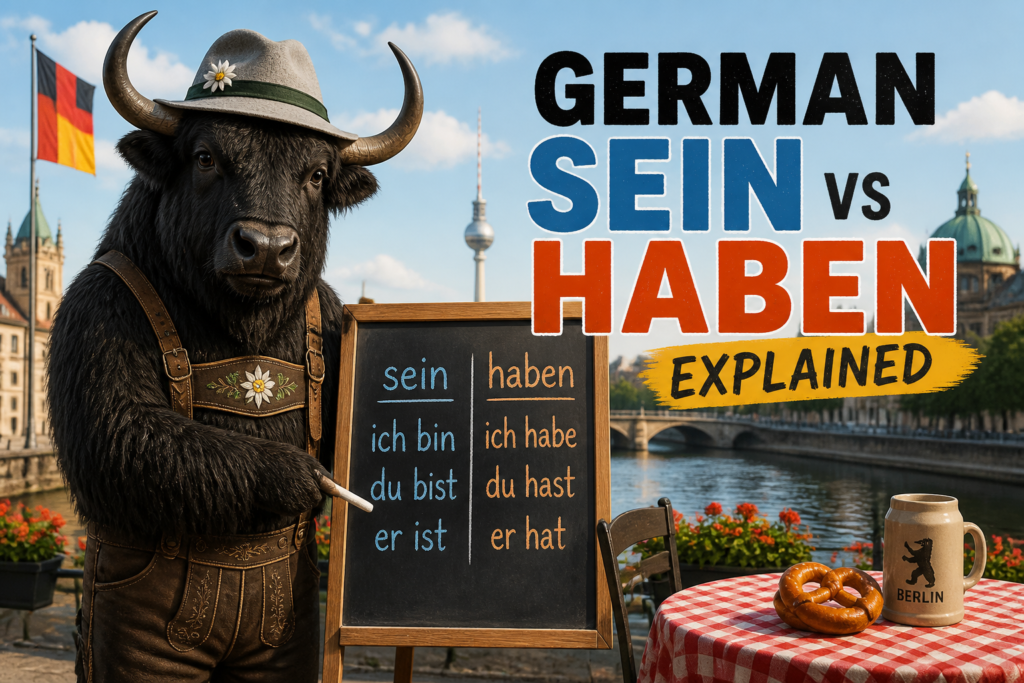
If German verbs were a comedy duo, sein and haben would be the ones stealing the scene in almost every lesson. They mean “to be” and “to have,” sure, but they also show up in lots of grammar that looks innocent and then suddenly becomes very German about it.
The good news: once you understand when to use sein and when to use haben, a bunch of beginner German starts making sense much faster. You’ll also be ready for the two most common past tenses, because German loves making life efficient by using these two verbs everywhere.
By the end of this guide, you’ll know the basic meaning, the present tense forms, the most common uses, and the simple logic behind choosing one or the other. Nothing mystical. Just useful German, as it should be.
For the broader learning path, visit our parent guide.
For a quick official reference, Duden is the boring-but-reliable giant in the room. Extremely unglamorous. Very helpful.
Quick Answer: Sein Vs Haben
In simple beginner German:
- sein = to be
- haben = to have
- They are both irregular verbs, so their forms change a lot.
- They are also helper verbs in the past tense, which is why they matter so much.
Small warning: English learners often think “have” always means possession. In German, haben does mean possession, yes, but it also works as a helper verb in perfect tenses. Meanwhile sein means “to be,” but it also helps form some past tenses and is used for movement or change.
German is polite like that: the same tiny verbs do a lot of heavy lifting.
Present Tense Conjugation
Here are the present tense forms you need most often. Learn these early. They show up everywhere, like that one friend who always arrives before everyone else and pretends it was effortless.
| Pronoun | Sein | Haben | Meaning |
|---|---|---|---|
| ich | bin | habe | I am / I have |
| du | bist | hast | you are / you have |
| er / sie / es | ist | hat | he / she / it is / has |
| wir | sind | haben | we are / have |
| ihr | seid | habt | you all are / have |
| sie / Sie | sind | haben | they are / have / you are / have (formal) |
Pronunciation help: sein sounds like “zine” with a soft z-like s at the start. haben sounds like “HAH-ben.” The h is light, not dramatic.
Remember: German always capitalizes the first-person pronoun Ich in titles? No. Not in normal text. Only nouns are capitalized, not pronouns. German doesn’t give extra badges for pronouns.
Basic Meaning And Real-Life Examples
| German | Pronunciation | Meaning | Example Sentence | Translation | Learner Note |
|---|---|---|---|---|---|
| Ich bin müde. | ikh bin MYU-deh | I am tired. | Ich bin müde. | I am tired. | Use sein for states and descriptions. |
| Ich habe Zeit. | ikh HAH-beh tsite | I have time. | Ich habe Zeit. | I have time. | Use haben for possession, feelings, and many common expressions. |
| Wir sind hier. | veer zint heer | We are here. | Wir sind hier. | We are here. | sein is also used for location. |
| Er hat ein Auto. | ehr hat ayn OWW-toh | He has a car. | Er hat ein Auto. | He has a car. | haben is the standard possession verb. |
Small learner note: In German, “I am hungry” is Ich habe Hunger, not Ich bin Hunger. That second one sounds like you are trying to become a sandwich.
When To Use Sein
Sein is used for a few core ideas:
- identity: Ich bin Anna. = I am Anna.
- description: Das Wetter ist gut. = The weather is good.
- location: Wir sind zu Hause. = We are at home.
- movement or change in the past perfect: Ich bin gegangen. = I went / I have gone.
- some set expressions: Es ist kalt. = It is cold.
Examples:
| German | Pronunciation | Meaning | Example Sentence | Translation | Learner Note |
|---|---|---|---|---|---|
| Ich bin Lehrer. | ikh bin LAY-rer | I am a teacher. | Ich bin Lehrer. | I am a teacher. | Nouns stay capitalized: Lehrer. |
| Sie ist krank. | zee ist krank | She is sick. | Sie ist krank. | She is sick. | sein + adjective is a very common pattern. |
| Das Buch ist auf dem Tisch. | das book ist owf dem tish | The book is on the table. | Das Buch ist auf dem Tisch. | The book is on the table. | Location often uses sein. |
| Ich bin nach Berlin gefahren. | ikh bin nahkh ber-LEEN guh-FAHR-en | I went/traveled to Berlin. | Ich bin nach Berlin gefahren. | I went/traveled to Berlin. | Movement verbs often take sein in the past. |
When To Use Haben
Haben is used for:
- possession: Ich habe ein Handy. = I have a phone.
- age in German style: Ich habe zwei Brüder. = I have two brothers.
- many everyday expressions: Ich habe Hunger. = I am hungry.
- perfect tense helper verb for many actions: Ich habe gearbeitet. = I worked / I have worked.
Examples:
| German | Pronunciation | Meaning | Example Sentence | Translation | Learner Note |
|---|---|---|---|---|---|
| Ich habe ein Problem. | ikh HAH-beh ayn proh-BLEHM | I have a problem. | Ich habe ein Problem. | I have a problem. | Very common phrase. Sadly. |
| Wir haben Zeit. | veer HAH-ben tsite | We have time. | Wir haben Zeit. | We have time. | Useful for arranging plans. |
| Er hat Hunger. | ehr hat HUN-ger | He is hungry. | Er hat Hunger. | He is hungry. | German uses haben here, not sein. |
| Ich habe das Buch gelesen. | ikh HAH-beh das book guh-LEH-zen | I read / have read the book. | Ich habe das Buch gelesen. | I read / have read the book. | Perfect tense with many verbs uses haben. |
Easy Rule For The Perfect Tense
This is where sein and haben become extra important. In German, the common past tense for speaking is the perfect tense, made with a helper verb plus a past participle.
Rule → Example
| Pattern | Meaning | German Example | English Translation | Learner Note |
|---|---|---|---|---|
| haben + past participle | many actions, possessions, experiences | Ich habe gegessen. | I ate / I have eaten. | Very common default pattern. |
| sein + past participle | movement or change of state | Ich bin gekommen. | I came / I have come. | Common with verbs of motion and change. |
Here’s the simple beginner rule:
- If the action is mostly about doing something, it often uses haben.
- If the action is mostly about moving or changing, it often uses sein.
Common sein verbs in the perfect tense include: gehen, kommen, fahren, laufen, reisen, bleiben, werden, and passieren. Not every movement verb, but many of them.
Common haben verbs in the perfect tense include: machen, kaufen, essen, trinken, lesen, lernen, sehen, and wohnen.
For more on verb forms, see German Regular Verb Conjugation and German Tenses Explained.
Full Conjugation: Sein
| Person | Form | Example | Translation |
|---|---|---|---|
| ich | bin | Ich bin müde. | I am tired. |
| du | bist | Du bist spät. | You are late. |
| er / sie / es | ist | Er ist nett. | He is nice. |
| wir | sind | Wir sind zu Hause. | We are at home. |
| ihr | seid | Ihr seid hier. | You all are here. |
| sie / Sie | sind | Sie sind freundlich. | They are friendly / You are friendly (formal). |
Learner note: sein is irregular, so the stem changes a lot. That’s normal. German verbs enjoy a little chaos just to keep the students awake.
Full Conjugation: Haben
| Person | Form | Example | Translation |
|---|---|---|---|
| ich | habe | Ich habe Zeit. | I have time. |
| du | hast | Du hast ein Auto. | You have a car. |
| er / sie / es | hat | Sie hat Hunger. | She is hungry. |
| wir | haben | Wir haben Glück. | We are lucky / We have luck. |
| ihr | habt | Ihr habt recht. | You all are right. |
| sie / Sie | haben | Sie haben ein Zimmer. | They have a room / You have a room (formal). |
Pronunciation note: the h in haben is clear, but not exaggerated. In fast speech, ich habe can sound a bit like ich hab. That dropped e is very common in spoken German.
German Phrases You’ll Hear All The Time
These are useful enough to learn as chunks. Chunks are great. They save brain energy. Love that for you.
| German | Pronunciation | Meaning | Example Sentence | Translation | Learner Note |
|---|---|---|---|---|---|
| Ich bin fertig. | ikh bin FEHR-tikh | I’m done / ready. | Ich bin fertig. | I’m done / ready. | Useful at home, school, and work. |
| Ich habe keine Ahnung. | ikh HAH-beh KINE-eh AH-noong | I have no idea. | Ich habe keine Ahnung. | I have no idea. | Very common. No idea, but make it grammatical. |
| Hast du Zeit? | hast doo tsite | Do you have time? | Hast du Zeit? | Do you have time? | Useful for informal conversation. |
| Wir sind spät dran. | veer zint shpayt dran | We are running late. | Wir sind spät dran. | We are running late. | sein for a temporary state. |
| Ich habe Recht. | ikh HAH-beh rekht | I am right. | Ich habe Recht. | I am right. | Yes, German says “have right,” not “be right.” |
| Es ist mir egal. | es ist meer eh-GAHL | I don’t care. | Es ist mir egal. | I don’t care. | Very handy. Slightly cool. Slightly rude if said sharply. |
| Ich habe Hunger. | ikh HAH-beh HUN-ger | I’m hungry. | Ich habe Hunger. | I’m hungry. | Not sein. |
| Ich bin dran. | ikh bin dran | It’s my turn / I’m next. | Ich bin dran. | It’s my turn / I’m next. | Common in queues and games. |
| Wir haben Glück. | veer HAH-ben gluck | We are lucky. | Wir haben Glück. | We are lucky. | Another “have” expression that isn’t literal possession. |
| Sie ist verheiratet. | zee ist fair-HY-rah-tet | She is married. | Sie ist verheiratet. | She is married. | State/condition, so sein. |
Common Confusions
English speakers often guess wrong with a few everyday phrases. That’s normal. German hides the simple answer behind a slightly weird-looking phrase, just to make sure you’re paying attention.
| English Idea | Correct German | Wrong Guess | Why |
|---|---|---|---|
| I am 20 years old. | Ich bin 20 Jahre alt. | Ich habe 20 Jahre alt. | Age uses sein, not haben. |
| I am hungry. | Ich habe Hunger. | Ich bin hungrig. | Ich bin hungrig can exist, but Ich habe Hunger is the everyday one. |
| I am cold. | Mir ist kalt. / Es ist kalt. | Ich habe kalt. | Weather and physical feeling use different patterns in German. |
| I have a fever. | Ich habe Fieber. | Ich bin Fieber. | Illness expressions often use haben. |
| I am interested. | Ich bin interessiert. | Ich habe interessiert. | Descriptions use sein. |
If you want a deeper look at modal verbs too, German Modal Verbs Explained is the next logical stop. German grammar likes to travel in packs.
Helpful Sound And Spelling Notes
Sein has the sound ei, which is usually pronounced like “eye” in standard German. So sein sounds close to “zine.”
Haben has a short a sound in the first syllable, like “hah.” Don’t stretch it into “hay-ben.” That’s not the vibe.
Learner note: In German, nouns are capitalized, but verbs are not. So das Sein can be a noun meaning “being,” while sein is the verb “to be.” Same spelling family, different job.
Spelling note: In spoken fast German, people may drop the final e in habe, bist, or haben-forms in casual speech. In writing, keep the full standard forms unless you are deliberately writing informal dialogue.
Practice Section
Try these before moving on. Tiny effort now, fewer “why is German doing this to me” moments later.
| Task | Answer | Learner Note |
|---|---|---|
| 1. I am at home. | Ich bin zu Hause. | Use sein for location. |
| 2. I have time. | Ich habe Zeit. | Very common phrase with haben. |
| 3. She is tired. | Sie ist müde. | Adjective after sein. |
| 4. We have a car. | Wir haben ein Auto. | Possession uses haben. |
| 5. He went to school. | Er ist zur Schule gegangen. | Movement verb with sein in the perfect tense. |
| 6. I ate. | Ich habe gegessen. | Action verb with haben. |
Spot the difference:
- Ich bin krank. = I am sick.
- Ich habe eine Krankheit. = I have an illness.
- Ich bin müde. = I am tired.
- Ich habe Schlaf. = I have sleep. This is not the normal way to say “I’m sleepy.” Use Ich bin müde or Ich bin schläfrig.
Fill in the blank:
- Ich ___ hungrig. → bin
- Du ___ ein Auto. → hast
- Wir ___ zu Hause. → sind
- Er ___ Zeit. → hat
Translation check:
- Sie ist Lehrerin. → She is a teacher.
- Ich habe keine Ahnung. → I have no idea.
- Wir sind spät dran. → We are running late.
- Er hat Recht. → He is right.
Common Mistakes And Fixes
These are the ones English speakers trip over most often.
| Wrong | Correct | Why |
|---|---|---|
| Ich habe müde. | Ich bin müde. | Feelings and states usually use sein. |
| Ich bin ein Auto. | Ich habe ein Auto. | Possession uses haben. |
| Du bist Hunger. | Du hast Hunger. | Hungry = haben Hunger. |
| Er hat 18 Jahre. | Er ist 18 Jahre alt. | Age uses sein + alt. |
| Wir haben hier. | Wir sind hier. | Location generally uses sein. |
| Ich habe gegangen. | Ich bin gegangen. | gehen takes sein in the perfect tense. |
One more useful reminder: in German, Sie can mean “she,” “they,” or formal “you.” The verb form is the same for sie and Sie: sind or haben. Context does the heavy lifting. Annoying, but manageable.
Quick Reference Summary
- sein = to be
- haben = to have
- sein is used for identity, description, location, age, and many movement verbs in the perfect tense
- haben is used for possession, many everyday expressions, and most perfect tense forms
- Memorize: ich bin, du bist, er/sie/es ist, wir sind, ihr seid, sie/Sie sind
- Memorize: ich habe, du hast, er/sie/es hat, wir haben, ihr habt, sie/Sie haben
- If you’re not sure in the perfect tense, ask: is it mostly movement/change? Then sein is more likely.
Back to the Learn German hub if you want the full picture, not just the two verbs doing all the work like underpaid grammar interns.
Yak Takeaway: sein is your “to be” verb for identity, description, and movement-based past forms; haben is your “to have” verb for possession, many fixed expressions, and most perfect tense forms. Learn their forms early, and German starts feeling a lot less random.