
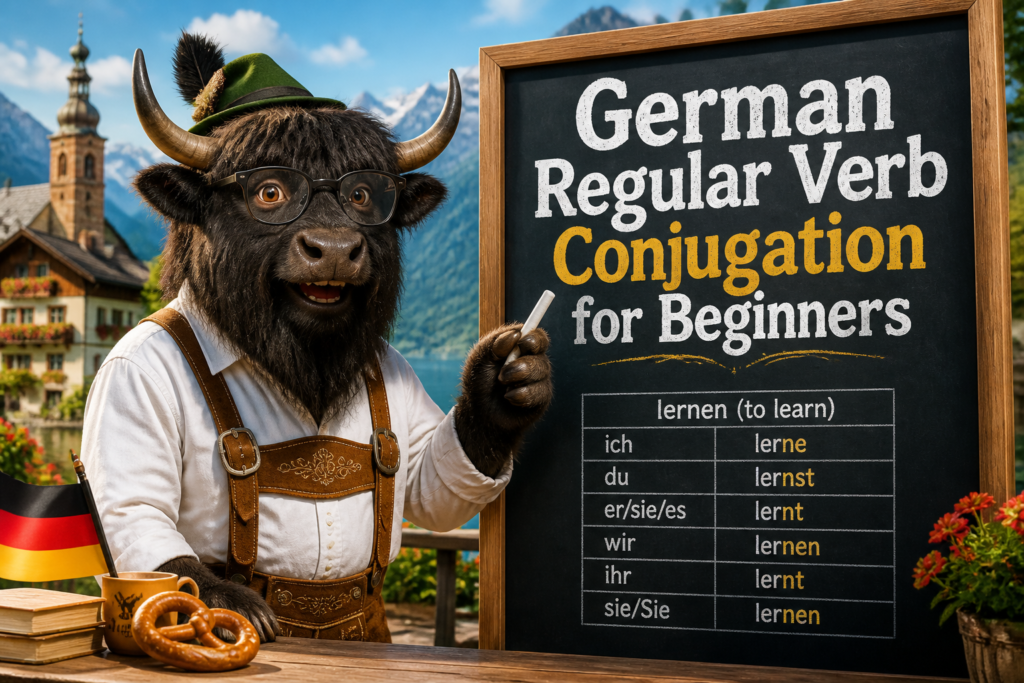
German regular verb conjugation chart

German Regular Verb Conjugation for Beginners

German regular verbs are surprisingly polite. They behave, they follow patterns, and once you see the pattern, they stop looking like tiny language goblins. This guide shows you how to conjugate regular German verbs in the present tense, so you can say things like “I learn,” “she works,” and “we play” without guesswork.

For the broader learning path, visit our parent guide.

By the end, you’ll understand how to build the present tense with regular verbs, how the endings change with pronouns, and how to avoid the classic beginner traps. If you want the bigger grammar picture later, keep German tenses explained nearby. It’s the sensible adult in the room.

One more thing: German verb conjugation is not random. It is annoyingly structured in a way that becomes satisfying once it clicks.

What A Regular Verb Is

A regular verb follows a predictable pattern in the present tense. You take the verb stem and add a personal ending. That’s the whole party.

Example: lernen means “to learn.” In the present tense, it becomes ich lerne, du lernst, er lernt, and so on.

The base idea is simple:

  • Remove the -en ending from the infinitive
  • Keep the verb stem
  • Add the correct present-tense ending

So lernen → stem lern-ich lerne. No drama. No mystery fog.

The Present Tense Endings

Here are the endings you will use with most regular verbs.

PronounEndingExample With lernenMeaning
ich-eich lerneI learn
du-stdu lernstyou learn
er / sie / es-ter lernthe / she / it learns
wir-enwir lernenwe learn
ihr-tihr lerntyou all learn
sie / Sie-ensie lernen / Sie lernenthey learn / you learn (formal)

Notice something useful: the wir and sie/Sie forms usually look like the infinitive. That’s helpful, and also a little suspicious in a German sort of way.

How To Build A Regular Present Tense Verb

Use this simple rule:

Infinitive minus -en plus the correct ending = present tense.

Let’s try it with machen (to do / make).

PatternGermanMeaningExample SentenceTranslation
ich + stem + eich macheI do / makeIch mache Hausaufgaben.I do homework.
du + stem + stdu machstyou do / makeDu machst das gut.You do that well.
er/sie/es + stem + ter machthe / she / it does / makesEr macht Kaffee.He makes coffee.
wir + infinitive formwir machenwe do / makeWir machen eine Pause.We take a break.
ihr + stem + tihr machtyou all do / makeIhr macht gute Arbeit.You all do good work.
sie/Sie + infinitive formsie machen / Sie machenthey do / you do (formal)Sie machen das morgen.You do that tomorrow.

Useful Regular Verbs You Will Actually Use

Here are common regular verbs for everyday German. These are the useful ones, not the dusty dictionary ornaments that show up once a century and only to ruin your quiz score.

GermanPronunciationMeaningExample SentenceTranslationLearner Note
lernenLEHR-nento learnIch lerne Deutsch.I learn German.Very common for students.
machenMAH-khento do / makeWir machen Sport.We do sports.Very flexible everyday verb.
spielenSHEE-plento playDie Kinder spielen draußen.The children are playing outside.Good for hobbies and games.
arbeitenAR-bye-tento workIch arbeite heute.I work today.Stem ends in -t, so watch the spelling.
wohnenVOH-nento live / resideWir wohnen in Berlin.We live in Berlin.Very useful for introductions.
kaufenKOW-fento buyIch kaufe Brot.I buy bread.Common in shops and supermarkets.
fragenFRAH-gento askSie fragt nach dem Weg.She asks for directions.Often used with nach.
antwortenAN-vor-tento answerIch antworte sofort.I answer immediately.Often takes dative in real grammar, but the conjugation is regular.
redenRAY-dento talk / speakWir reden später.We talk later.Neutral and very common.
spielenSHEE-plento playEr spielt Gitarre.He plays guitar.Also used for instruments.
öffnenERF-nento openIch öffne das Fenster.I open the window.Watch the umlaut and ö sound.
packenPAK-ento packWir packen die Tasche.We pack the bag.Useful for travel.

Example Sentences With Regular Verbs

Here are the forms in real sentences. Read them aloud. German verbs like to sound impressive, but they usually just want practice.

GermanPronunciationMeaningExample SentenceTranslationLearner Note
ich lerneikh LEHR-nehI learnIch lerne jeden Tag neue Wörter.I learn new words every day.jeden Tag = every day.
du machstdoo MAKHSTyou do / makeDu machst das sehr gut.You do that very well.du is informal singular.
er arbeitetair AR-bye-tethe worksEr arbeitet in einem Büro.He works in an office.Because the stem ends in -t, an extra -e- is kept: arbeit-et.
sie wohntzee VOHNTshe livesSie wohnt in Köln.She lives in Cologne.wohnen becomes wohnt.
wir spielenveer SHEE-plenwe playWir spielen Karten.We play cards.Good example of the infinitive-looking form.
ihr kaufteer KOWFTyou all buyIhr kauft Brot und Käse.You all buy bread and cheese.ihr is informal plural.
sie fragenzee FRAH-genthey askSie fragen nach dem Preis.They ask about the price.Small but useful: nach often means “about / for.”
Sie machenzee MAH-khenyou do / make (formal)Wie machen Sie das?How do you do that?Capital Sie = formal “you.”

A Tiny Pronunciation Survival Guide

For beginners, pronunciation matters because it helps the forms stick. Also, if you say them out loud, the endings stop feeling so abstract and start feeling like actual language instead of grammar wallpaper.

German EndingHow It SoundsExampleQuick Note
-elike “uh” or “eh”ich lerneLight ending, not stressed.
-stlike “sht” with a sharp tdu lernstDo not swallow the t.
-tclear ter lerntShort and crisp.
-entwo small syllables: “en”wir lernenVery common in German.

One helpful sound note: German final -en can sound reduced in fast speech, but beginners should pronounce it clearly at first. Clean is better than clever.

Special Spelling Rule: Verbs Ending In -d, -t, -m, Or -n

Some regular verbs need an extra -e- before the endings -st and -t. This helps the verb sound pronounceable.

Compare:

PatternGerman ExampleEnglish TranslationLearner Note
regular stemlernen → du lernstyou learnNo extra vowel needed.
stem ending in -tarbeiten → du arbeitestyou workExtra -e- makes pronunciation easier.
stem ending in -dreden → du redestyou talkSame idea: easier to say.
stem ending in -m / -nzeichnen → du zeichnestyou drawAlso often gets the extra -e-.

So if arbeiten becomes du arbeitest, that is normal. German is being helpful for once. Treasure the moment.

Where The Verb Goes In The Sentence

In a normal German statement, the conjugated verb usually comes in second position. That means the verb is not always the second word, but it is the second main idea.

PatternGerman ExampleEnglish TranslationLearner Note
subject firstIch lerne Deutsch.I learn German.Simple and standard.
time firstHeute lerne ich Deutsch.Today I learn German.Verb still stays in second position.
object firstDeutsch lerne ich heute.German I learn today.Possible, but more dramatic and less beginner-friendly.

If you want the full sentence order story, see German sentence structure. That guide explains why German loves putting the verb on a strict little leash.

Regular Verb Conjugation Patterns To Memorize

These are the core patterns worth memorizing first:

  • ich → verb stem + -e
  • du → verb stem + -st
  • er / sie / es → verb stem + -t
  • wir → infinitive form
  • ihr → verb stem + -t
  • sie / Sie → infinitive form

That pattern covers a huge amount of everyday German. It is the engine of the present tense.

Practice: Fill In The Missing Verb Forms

Try these before checking the answers. Small practice beats heroic cramming every time.

  • 1. Ich ________ Deutsch lernen. (lernen)
  • 2. Du ________ jeden Tag. (arbeiten)
  • 3. Er ________ Kaffee. (machen)
  • 4. Wir ________ in München. (wohnen)
  • 5. Ihr ________ schnell. (spielen)
  • 6. Sie ________ nach dem Weg. (fragen)

Answers:

  • 1. lerne
  • 2. arbeitest
  • 3. macht
  • 4. wohnen
  • 5. spielt
  • 6. fragt

Common Mistakes And Easy Fixes

MistakeWrongCorrectWhy It Matters
using the infinitive for every personich lernenich lerneich needs -e.
mixing up du and ihrdu lerntdu lernstdu takes -st, not -t.
forgetting the extra vowel in arbeitendu arbeitstdu arbeitestPronunciation needs the extra -e-.
capitalizing random verbsIch Lerne Deutsch.Ich lerne Deutsch.Only nouns are capitalized.
putting the verb in the wrong placeIch Deutsch lerne.Ich lerne Deutsch.Verb usually stays in second position.
using Sie like siesie lernen to a teacherSie lernenCapital Sie is formal “you.”

A quick extra note on sein and haben: they are not regular verbs, so don’t force them into this pattern. They do their own thing, as important verbs often do. See German sein vs haben for the difference.

Regular Verbs Vs Irregular Verbs

Regular verbs follow the pattern you just learned. Irregular verbs change in the stem, the endings, or both. For now, focus on regular verbs first. That gives you a strong base and keeps your brain from filing a formal complaint.

If you are wondering whether every verb in German acts this nicely, the answer is no. Of course not. That would be too easy.

But the good news is that once you know the regular pattern, a lot of German becomes instantly readable and usable.

Quick Reference Summary

  • Infinitive = base form, usually ends in -en or -n
  • Drop -en to find the stem
  • Add the right ending for the subject
  • ich-e
  • du-st
  • er/sie/es-t
  • wir-en
  • ihr-t
  • sie/Sie-en
  • Watch verbs ending in -d, -t, -m, or -n
  • Remember: nouns are capitalized, verbs are not
  • In normal statements, the conjugated verb usually comes in second position

For extra practice and a more complete overview, the plain old reliable Duden is useful for checking forms and spelling. A boring source is often the best source. Annoying, but true.

German regular verb conjugation gets much easier once you stop seeing every verb as a separate problem and start seeing the pattern. Learn the endings, practice a few common verbs, and suddenly the language becomes a lot less mysterious. Tiny victory, big payoff.

Yak takeaway: regular German verbs are just stems with endings glued on. Learn the glue, and the sentence stops wobbling.