


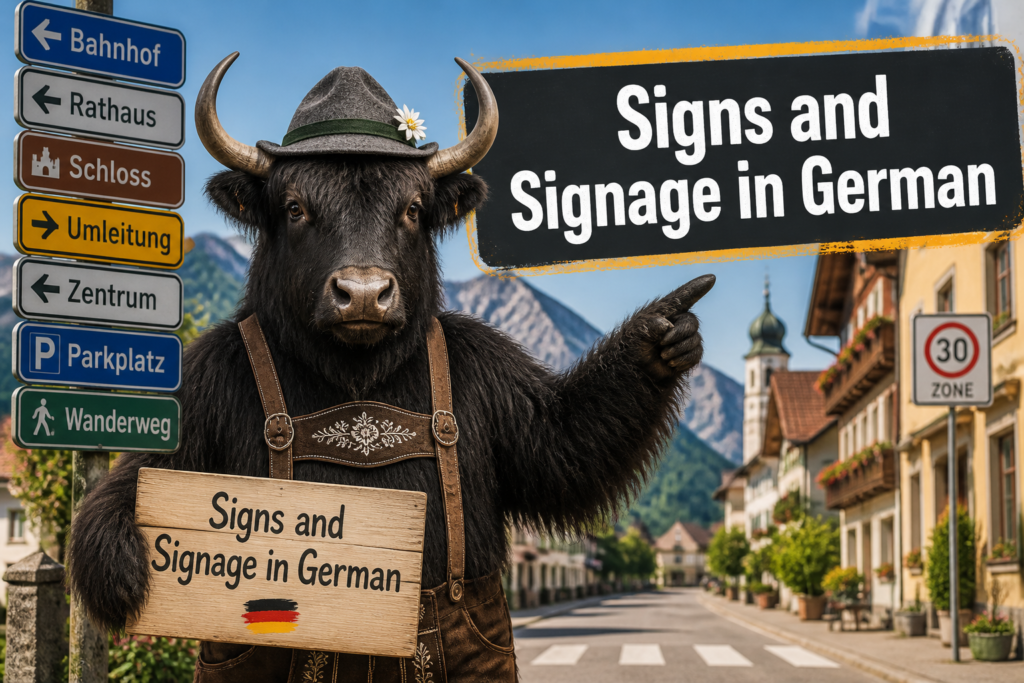
If you can read signs in German, everyday life gets a lot easier. Train stations, shops, roads, bathrooms, office buildings, hospitals, and even the occasional stern-looking note on a door all start making more sense. Germany loves signs. Not in a cute way. In a “please follow the instructions or chaos will occur” way.
This guide teaches the most useful German words and phrases for signs and signage, plus pronunciation help, example sentences, and the little usage details that stop you from sounding like a confused tourist in a hallway. By the end, you’ll be able to understand common public signs, ask about them, and read the basic “do this / don’t do that” messages without panic.
For a bigger everyday vocabulary base, you can also keep the essential German words and phrases page nearby. It plays nicely with this topic because signs are basically vocabulary in hard hats.
The Most Common Sign Words
Start with the simple nouns. These show up everywhere, and once you know them, many signs become surprisingly easy to decode.
| German | Pronunciation | Meaning | Example Sentence | Translation | Learner Note |
|---|---|---|---|---|---|
| das Schild | sheelt | sign, signboard | Das Schild ist sehr klein. | The sign is very small. | Neutral everyday word for a sign. |
| die Beschilderung | beh-shil-deh-roong | signage, signposting | Die Beschilderung im Bahnhof ist gut. | The signage in the station is good. | Common in stations, buildings, airports. |
| der Hinweis | HIN-vyss | notice, hint, information sign | Ein Hinweis an der Tür erklärt alles. | A notice on the door explains everything. | Very useful for written notices. |
| die Aufschrift | OWF-shrift | writing, label, inscription | Auf der Aufschrift steht “Bitte klingeln”. | The label says “Please ring the bell.” | Good for text printed on signs and labels. |
| das Piktogramm | pik-toh-grahm | pictogram, symbol | Das Piktogramm zeigt den Ausgang. | The pictogram shows the exit. | Useful for restroom and safety symbols. |
| die Tafel | TAH-fel | board, signboard, board with information | Die Tafel vor dem Café ist neu. | The signboard in front of the café is new. | Can also mean a chalkboard or board. |
| das Aushängeschild | OWS-hen-ge-shilt | showpiece, poster sign, emblem | Das ist das Aushängeschild des Hotels. | That is the hotel’s showpiece. | More figurative than literal, but useful. |
| der Wegweiser | VAYK-vy-zer | direction sign, signpost | Folgen Sie dem Wegweiser zum Bahnhof. | Follow the signpost to the station. | Very common in travel and hiking. |
| die Leuchtreklame | LOYT-reh-klah-meh | neon sign, illuminated advertising | Die Leuchtreklame ist nachts gut sichtbar. | The neon sign is clearly visible at night. | More for shops and city streets. |
| die Warnung | VAR-noong | warning | Die Warnung ist deutlich sichtbar. | The warning is clearly visible. | Often appears on safety signs. |
Quick spelling note: German nouns are capitalized. Yes, all of them. The signs are following the rules, unlike some people’s handwriting.
Useful Phrases You’ll See On Signs
These are the phrases that actually help you move through stations, shops, buildings, and streets without guessing like a badly informed detective.
| German | Pronunciation | Meaning | Example Sentence | Translation | Learner Note |
|---|---|---|---|---|---|
| Bitte hier klingeln | BIT-te hee-er KLING-eln | Please ring here / ring the bell here | Bitte hier klingeln, wenn die Tür geschlossen ist. | Please ring here if the door is closed. | Common on apartment doors and offices. |
| Eingang | EYN-gang | entrance | Der Eingang ist auf der linken Seite. | The entrance is on the left side. | Watch for Ausgang = exit. |
| Ausgang | OWS-gang | exit | Der Ausgang ist am Ende des Flurs. | The exit is at the end of the hallway. | Very common in public buildings. |
| Eintritt | EYN-trit | entry, admission | Der Eintritt ist frei. | Admission is free. | Common in museums, parks, events. |
| Bitte nicht betreten | BIT-te nicht beh-TREH-ten | Please do not enter | Bitte nicht betreten wegen Baustelle. | Please do not enter because of construction. | Very common warning sign. |
| Vorsicht | FOR-zhiht | caution, careful | Vorsicht! Der Boden ist nass. | Caution! The floor is wet. | Often used on warning signs. |
| Achtung | AHK-toong | attention, warning | Achtung, Stufe! | Attention, step! | Short, strong, and very common. |
| Rauchen verboten | ROW-khen fer-BOH-ten | smoking prohibited | Im Bahnhof ist Rauchen verboten. | Smoking is prohibited in the station. | Important public rule phrase. |
| Parken verboten | PAR-ken fer-BOH-ten | parking prohibited | Vor dem Haus ist Parken verboten. | Parking is prohibited in front of the house. | Common on streets and driveways. |
| Privat | pree-VAHT | private | Der Hof ist privat. | The yard is private. | Often means “no public access.” |
| Geöffnet | geh-ÖFF-net | open | Das Geschäft ist heute geöffnet. | The shop is open today. | Useful on doors and business hours signs. |
| Geschlossen | geh-SHLOSS-en | closed | Die Praxis ist sonntags geschlossen. | The practice is closed on Sundays. | Very useful on opening-hours signs. |
| Heute geschlossen | HOY-te geh-SHLOSS-en | closed today | Die Apotheke ist heute geschlossen. | The pharmacy is closed today. | Short and very common on notices. |
| Öffnungszeiten | ÖF-noongs-tsy-ten | opening hours | Die Öffnungszeiten stehen an der Tür. | The opening hours are on the door. | Plural only. Very common. |
| Montag bis Freitag | MON-tahk bis FRY-tahk | Monday to Friday | Wir haben Montag bis Freitag geöffnet. | We are open Monday to Friday. | Classic business-hours wording. |
Notice how many signs use short, clipped wording. German signage does not waste time. It gets to the point and moves on with its life.
Directions And Wayfinding Signs
In stations, airports, hospitals, and office buildings, direction signs often use very predictable vocabulary. Once you know the core words, you can follow the arrows like a professional.
| German | Pronunciation | Meaning | Example Sentence | Translation | Learner Note |
|---|---|---|---|---|---|
| rechts | rekhts | right | Der Aufzug ist rechts. | The elevator is on the right. | Used in directions and on maps. |
| links | links | left | Der Ausgang ist links. | The exit is on the left. | Very common on signs and instructions. |
| geradeaus | geh-RAH-deh-ows | straight ahead | Gehen Sie geradeaus bis zur Ampel. | Go straight ahead until the traffic light. | Very useful for asking and giving directions. |
| oben | OH-ben | up, above | Die Toiletten sind oben. | The toilets are upstairs. | Can mean physically above or upstairs. |
| unten | OON-ten | down, below | Die Garderobe ist unten. | The coat check is downstairs. | Often paired with oben. |
| Aufzug | OWF-tsook | elevator, lift | Der Aufzug ist neben der Treppe. | The elevator is next to the stairs. | Germany says Aufzug; Swiss German often uses Lift. |
| Treppe | TREP-peh | stairs, staircase | Bitte die Treppe benutzen. | Please use the stairs. | Often appears on wayfinding signs. |
| Flur | floor | hallway, corridor | Der Flur ist lang und hell. | The hallway is long and bright. | Useful in buildings and hotels. |
| Gang | gang | corridor, aisle | Im Gang stehen viele Koffer. | There are many suitcases in the corridor. | Common too, especially in some contexts. |
| Ausgang Notausgang | OWS-gang NOHT-ows-gang | exit, emergency exit | Der Notausgang ist dort hinten. | The emergency exit is back there. | “Notausgang” is the emergency exit sign you really want to spot fast. |
Grammar note: “Gehen Sie geradeaus” is polite and formal. You’ll see Sie on many signs and instructions because public German likes keeping things respectful and slightly bossy.
Rules, Warnings, And Prohibitions
This is where German signage gets serious. A lot of public signs use the passive style or very short commands. That’s normal. It is not rude; it is efficient. Germans do not write “Hey friend, maybe perhaps could you possibly…” on a wet floor sign.
| German | Pronunciation | Meaning | Example Sentence | Translation | Learner Note |
|---|---|---|---|---|---|
| Verboten | fer-BOH-ten | forbidden, prohibited | Das Betreten ist verboten. | Entering is prohibited. | Very common in warnings and rules. |
| Verbotsschilder | fer-BOTS-shil-der | prohibition signs | Verbotsschilder hängen an der Tür. | Prohibition signs are hanging on the door. | Compound noun, very German, very long. |
| Benutzen Sie bitte den anderen Eingang | beh-NOOT-zen zee BIT-te den AHN-der-en EYN-gang | Please use the other entrance | Benutzen Sie bitte den anderen Eingang. | Please use the other entrance. | Polite instruction with Sie. |
| Nicht rauchen | nikht ROW-khen | No smoking | Hier dürfen wir nicht rauchen. | We are not allowed to smoke here. | Often seen as a short sign, sometimes with a symbol. |
| Nicht stören | nikht STÖH-ren | Do not disturb | Bitte nicht stören. | Please do not disturb. | Common on hotel door signs. |
| Vorsicht Stufe | FOR-zhiht STOO-feh | Caution: step | Vorsicht, hier ist eine Stufe. | Caution, there is a step here. | Very typical on small warning signs. |
| Rutschgefahr | ROOTSH-geh-fahr | slippery surface, risk of slipping | Rutschgefahr bei Nässe. | Slippery when wet. | Extremely useful in public spaces. |
| Lebensgefahr | LAY-bens-geh-fahr | danger to life | Lebensgefahr! Nicht näher kommen. | Danger to life! Do not come closer. | Strong warning. Not a phrase to ignore. |
| Abstellen verboten | AP-shtel-len fer-BOH-ten | no parking / no placing items here | Das Fahrrad darf hier nicht abgestellt werden. | The bike may not be parked here. | Often used for bikes, bags, and cars. |
| Nur für Kunden | noor fyr KOON-den | for customers only | Die Toilette ist nur für Kunden. | The toilet is for customers only. | Very common in cafés and shops. |
Small language trap: verboten means “forbidden,” but English speakers often expect a full sentence. On signs, German is happy to keep it short. The missing subject is just part of the style.
Opening Hours, Closed Signs, And Shop Notices
When you’re standing in front of a door, these are the words that matter most. Is it open? Closed? Only open on weekdays? On a break? German signage loves timing, because apparently the universe is powered by schedules.
| German | Pronunciation | Meaning | Example Sentence | Translation | Learner Note |
|---|---|---|---|---|---|
| Öffnungszeiten | ÖF-noongs-tsy-ten | opening hours | Die Öffnungszeiten stehen auf dem Schild. | The opening hours are on the sign. | Plural word; very common on doors and websites. |
| Montags geschlossen | MON-tahks geh-SHLOSS-en | closed on Mondays | Das Geschäft ist montags geschlossen. | The shop is closed on Mondays. | Adverb form is common on signs. |
| Mittagspause | MIT-tahks-pow-zeh | lunch break, midday break | Wir machen von 12 bis 13 Uhr Mittagspause. | We take a lunch break from 12 to 1 p.m. | Very common in small businesses. |
| Wegen Urlaub geschlossen | VAY-gen OOHR-lowp geh-SHLOSS-en | closed for vacation | Die Praxis ist wegen Urlaub geschlossen. | The practice is closed for vacation. | Common on handwritten signs. |
| Bitte läuten | BIT-te LOY-ten | Please ring the bell | Bitte läuten, wenn niemand da ist. | Please ring if nobody is there. | Very common in Austria; in Germany you often see Bitte klingeln. |
| Bitte klingeln | BIT-te KLING-eln | Please ring the bell | Bitte klingeln Sie an der Tür. | Please ring the bell at the door. | Standard in Germany. |
| Geschäftszeiten | geh-SHÄFTS-tsy-ten | business hours | Die Geschäftszeiten sind auf der Website. | The business hours are on the website. | More formal than Öffnungszeiten. |
| Feiertag | FY-er-tahk | public holiday | Am Feiertag ist alles geschlossen. | Everything is closed on the public holiday. | Very useful in Germany, Austria, and Switzerland. |
Germany vs Austria note: Bitte klingeln is more standard in Germany, while Bitte läuten is especially common in Austria and also understood elsewhere. Both mean “please ring the bell.”
Toilets, Restrooms, And Public Facilities
One of the first things many learners want to read correctly is the restroom sign. Sensible. Practical. Delightfully human. Also, extremely helpful when your confidence drops and the coffee was too strong.
| German | Pronunciation | Meaning | Example Sentence | Translation | Learner Note |
|---|---|---|---|---|---|
| die Toilette | toy-LET-teh | toilet, restroom | Wo ist die Toilette? | Where is the toilet? | Very common and neutral. |
| das WC | vey-tseh | toilet, restroom | Das WC ist im Erdgeschoss. | The restroom is on the ground floor. | Very common on signs and in buildings. |
| Herren | HER-ren | men | Die Herrentoilette ist dort. | The men’s toilet is there. | Usually appears on restroom signs. |
| Damen | DAH-men | women | Die Damentoilette ist links. | The women’s toilet is on the left. | Very common pairing with Herren. |
| barrierefrei | bah-REE-eh-reh-fry | accessible, barrier-free | Das WC ist barrierefrei. | The restroom is accessible. | Important public-access word. |
| Behindertentoilette | beh-HIN-der-ten-toy-LET-teh | accessible toilet | Die Behindertentoilette ist unten. | The accessible toilet is downstairs. | Respectful and common in official signage. |
| Baby-Wickelraum | BAY-bee VIK-el-rowm | baby changing room | Der Baby-Wickelraum ist neben dem WC. | The baby changing room is next to the restroom. | Useful in malls and public buildings. |
| Ruhebereich | ROO-heh-beh-raykh | quiet zone, quiet area | Der Ruhebereich ist bitte leise zu halten. | Please keep the quiet area quiet. | Common in trains and waiting rooms. |
| Wickelraum | VIK-el-rowm | changing room for babies | Ein Wickelraum ist im Erdgeschoss. | A changing room is on the ground floor. | Also seen alone without “Baby-”. |
Safety, Emergency, And Exit Signs
Some signs are worth knowing immediately because they help you stay safe or leave a building quickly. The good news: these are usually short, clear, and repeated often. German loves repeating important things. It’s one of its hobbies.
| German | Pronunciation | Meaning | Example Sentence | Translation | Learner Note |
|---|---|---|---|---|---|
| Notausgang | NOHT-ows-gang | emergency exit | Der Notausgang darf nicht blockiert werden. | The emergency exit must not be blocked. | Very important sign word. |
| Feueralarm | FOY-er-ah-lahm | fire alarm | Im Fall von Feueralarm bitte ruhig bleiben. | In the event of a fire alarm, please stay calm. | Common in buildings and trains. |
| Erste Hilfe | EHR-ste HIL-feh | first aid | Die Erste Hilfe ist dort hinten. | First aid is back there. | Very common on safety signs. |
| Notruf | NOHT-roof | emergency call | Der Notruf ist nur im Notfall zu benutzen. | The emergency call is to be used only in an emergency. | Important public safety word. |
| Notfall | NOHT-fall | emergency | Bei Notfall bitte den Notruf wählen. | In an emergency, please call emergency services. | Often appears in hospitals and public spaces. |
| Fluchtweg | FLOOKT-vayk | escape route | Der Fluchtweg muss frei bleiben. | The escape route must stay clear. | Very common on building signs. |
| Rettungsweg | RET-toongs-vayk | rescue route | Der Rettungsweg ist hier markiert. | The rescue route is marked here. | Another very common safety word. |
| Sanitäter | zah-nee-TAY-ter | paramedic | Der Sanitäter kommt sofort. | The paramedic is coming right away. | Useful in emergency contexts. |
Yak Wisdom: If a German sign says Notausgang, do not admire the typography. Follow it.
Road Signs And Transport Signs
Road signs are where German becomes extra compact. If you drive, take trains, or just navigate cities on foot, these words come up constantly.
| German | Pronunciation | Meaning | Example Sentence | Translation | Learner Note |
|---|---|---|---|---|---|
| Einbahnstraße | EYN-bahn-shtrah-seh | one-way street | Die Straße ist eine Einbahnstraße. | The street is a one-way street. | Classic road sign word. |
| Umleitung | OOM-ly-toong | detour, diversion | Es gibt eine Umleitung wegen Bauarbeiten. | There is a detour because of construction work. | Very common on road signs. |
| Baustelle | BOW-shtel-leh | construction site | Die Baustelle ist gut markiert. | The construction site is clearly marked. | Common on streets and sidewalks. |
| Haltestelle | HAL-teh-shtel-leh | bus/tram stop | Die Haltestelle ist gleich hier. | The stop is right here. | Very useful in public transport. |
| Bahnhof | BAHN-hohf | train station | Der Bahnhof ist sehr groß. | The station is very big. | A basic travel word. |
| Gleis | glyss | platform, track | Der Zug fährt von Gleis 4 ab. | The train departs from platform 4. | Very important in train stations. |
| Abfahrt | AP-fahrt | departure | Die Abfahrt ist um 8 Uhr. | Departure is at 8 o’clock. | Opposite: Ankunft = arrival. |
| Ankunft | AHN-koonft | arrival | Die Ankunft ist pünktlich. | The arrival is on time. | Very common in transport boards. |
| Fahrplan | FAHR-plan | timetable | Der Fahrplan hängt am Eingang. | The timetable is hanging at the entrance. | Useful for buses and trains. |
| Umsteigen | OOM-shty-gen | to transfer, change trains | Sie müssen in Köln umsteigen. | You have to change trains in Cologne. | Often appears on travel signs. |
Pronunciation note: Gleis sounds like “glyss,” not “glace.” And Baustelle has that “ow” sound in Bau, like “cow” without the k. German is nice like that. Occasionally.
Useful Symbol And Icon Vocabulary
Many German signs rely on symbols, arrows, and icons. That means the text may be short, but the meaning is still clear if you know the key vocabulary.
| German | Pronunciation | Meaning | Example Sentence | Translation | Learner Note |
|---|---|---|---|---|---|
| der Pfeil | pfyl | arrow | Der Pfeil zeigt nach links. | The arrow points left. | The pf sound can feel weird at first. |
| das Symbol | zim-BOL | symbol | Das Symbol bedeutet “kein Zutritt”. | The symbol means “no entry.” | Very common on signs. |
| das Zeichen | TSY-khen | sign, symbol | Das Zeichen ist leicht zu verstehen. | The sign is easy to understand. | Broader word; can mean many kinds of signs. |
| der Aufkleber | OWF-kleh-ber | sticker, label | Der Aufkleber zeigt die Richtung an. | The sticker shows the direction. | Common for labels on doors and machines. |
| die Markierung | mar-KEE-rung | marking, marking line | Die Markierung auf dem Boden hilft sehr. | The marking on the floor helps a lot. | Useful in buildings, roads, and trails. |
| die Beschriftung | beh-SHRIFT-oong | labeling, caption, text on a sign | Die Beschriftung ist gut lesbar. | The labeling is easy to read. | Helpful when talking about signs and diagrams. |
| lesbar | LAYS-bar | readable | Die Schrift ist kaum lesbar. | The writing is barely readable. | Very handy adjective for signage. |
| deutlich | DOYT-likh | clear, distinct | Der Hinweis ist deutlich geschrieben. | The notice is written clearly. | Common on official signs. |
Mini Guide To Reading Sign Language Style German
Signs often use short noun phrases, infinitives, and passive constructions. That sounds technical, but in practice it just means the sign avoids full storytelling and goes straight to the point.
| Pattern | Meaning | German Example | English Translation | Learner Note |
|---|---|---|---|---|
| Noun phrase | Very short sign label | Eingang | Entrance | Common on doors and arrows. |
| Verb + object | Instruction | Bitte klingeln | Please ring the bell | Short, direct, and normal on signs. |
| Passive-style rule | Rule or prohibition | Das Rauchen ist verboten. | Smoking is prohibited. | More formal than Nicht rauchen. |
| Adjective / participle | State or status | Geschlossen | Closed | Very common on shop doors. |
| Preposition + noun | Location | Am Eingang | At the entrance | Useful for directions and notices. |
Simple rule: if a sign looks short and blunt, that’s usually normal German, not broken German. The sign is probably trying to save everyone time.
Germany, Austria, And Switzerland Differences
Most signage vocabulary is shared across German-speaking countries, but a few words vary by region. These differences are worth knowing so you don’t stare at a sign like it personally offended your family.
| Meaning | Germany | Austria | Switzerland | Note |
|---|---|---|---|---|
| to ring the bell | klingeln | läuten | läuten / klingeln | Both are understood broadly; Austria favors läuten. |
| elevator | Aufzug | Lift | Lift | Switzerland and Austria commonly use Lift. |
| train station | Bahnhof | Bahnhof | Bahnhof | Same word, same useful stress. |
| restroom sign | WC, Toilette | WC, Toilette | WC, Toilette | Very consistent across regions. |
| no entry | Kein Zutritt | Kein Zutritt | Kein Zutritt | Standard official wording. |
For regional listening practice and standard usage, the very boring but useful Duden is a solid reference. Boring sources are often the best ones. Truly thrilling, in a paperwork kind of way.
Common Mistakes And Easy Fixes
| Common Mistake | Better Version | Why |
|---|---|---|
| sign = das Sign | das Schild / das Zeichen | sign in English does not usually become Sign in German everyday speech. |
| Bitte nicht einsteigen for “no entry” | Bitte nicht betreten / Kein Zutritt | einsteigen means to board a vehicle, not to enter a building. |
| Ausgang confused with Abgang | Ausgang | Ausgang is exit. Abgang is a different word and not the usual sign word. |
| toilet = die Toilet | die Toilette | The German noun ends in -e. |
| open = offen on signs | geöffnet | offen means open in general, but geöffnet is the standard sign word for opening hours. |
| Do not disturb = Nicht stören Sie | Bitte nicht stören | On signs, the short infinitive phrase is normal. |
| Emergency exit = Notausfahrt | Notausgang | Notausfahrt is usually for vehicles leaving in an emergency, not a building exit. |
One more pronunciation help: German final consonants often sound softer or devoiced at the end. So geschlossen ends more like “guh-SHLOSS-en,” not with an extra English “d” or “b” sound hiding at the end. Sneaky little rule, very German.
Quick Practice
Try these before your brain pretends it has been busy elsewhere.
- Translate: “The exit is on the right.” → Der Ausgang ist rechts.
- Translate: “Please ring the bell.” → Bitte klingeln. / Bitte hier klingeln.
- Translate: “Smoking prohibited.” → Rauchen verboten.
- Translate: “The shop is closed today.” → Das Geschäft ist heute geschlossen.
- Choose the right word: entrance or exit? Eingang = entrance, Ausgang = exit.
- Choose the right word: stop or station? Haltestelle = stop, Bahnhof = train station.
- Spot the sign word: Beschilderung means signage, not “shielding.”
- Say it politely: “Go straight ahead.” → Gehen Sie geradeaus.
If you want extra everyday practice, the main German learning hub is a handy place to keep moving after this. Signs are one thing. Living in the language is the real game.
Quick Reference Summary
- Schild = sign
- Eingang = entrance
- Ausgang = exit
- Geöffnet = open
- Geschlossen = closed
- Bitte klingeln = please ring the bell
- Bitte nicht betreten = do not enter
- Vorsicht / Achtung = caution / attention
- Rauchen verboten = no smoking
- Notausgang = emergency exit
- Umleitung = detour
- Öffnungszeiten = opening hours
- WC = restroom
For more sign vocabulary, train yourself to notice the short words first: Eingang, Ausgang, Verboten, Geöffnet, Geschlossen, Vorsicht. German signage is basically a survival cheat sheet with better typography.
Yak Takeaway: Learn the main sign words, and German spaces stop feeling mysterious. Doors, stations, bathrooms, and warnings all become a lot easier to read. Small words, big relief.