


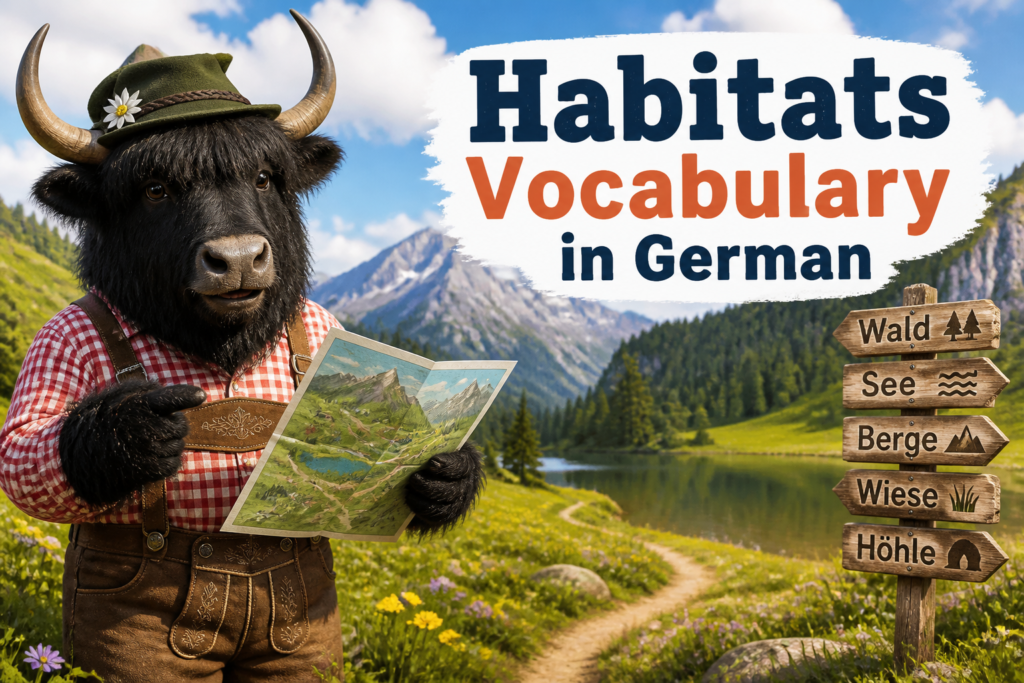
If you can name the habitat, you can suddenly talk about a lot more than “forest” and “sea.” You can describe where animals live, how landscapes change, and why a place feels dry, wet, wild, or weirdly full of mosquitoes. Very useful. Slightly itchy, but useful.
For the broader learning path, visit our parent guide.
This guide teaches practical German habitat vocabulary for English-speaking learners, with clear pronunciation help, example sentences, and the kind of notes that save you from sounding like you learned German from a museum label written in 1894.
For broader landscape terms, it also helps to know the related Geography Vocabulary in German. And if you want a clean dictionary-style backup for word meanings, Duden is the boring authority that keeps showing up for a reason.
Core Habitat Words You’ll See Often
These are the most useful habitat words in everyday German. They work in school topics, nature descriptions, travel, zoo signs, documentaries, and those conversations where somebody says “the area is very rural” and everyone suddenly pretends they know what rural means.
| German | Pronunciation | Meaning | Example Sentence | Translation | Learner Note |
|---|---|---|---|---|---|
| der Wald | vahlt | forest, woods | Der Wald ist im Herbst besonders schön. | The forest is especially beautiful in autumn. | Masculine noun: der. Very common. |
| die Wiese | VEE-zuh | meadow, grassland | Auf der Wiese grasen Schafe. | Sheep are grazing on the meadow. | Feminine noun: die. |
| das Feld | felt | field | Das Feld liegt hinter dem Dorf. | The field lies behind the village. | Neuter noun: das. |
| das Moor | mohr | moor, bog | Im Moor wachsen seltene Pflanzen. | Rare plants grow in the bog. | Wetland habitat; often in nature texts. |
| das Sumpfgebiet | ZOOMP-fgeh-beet | swamp area, marshland | Das Sumpfgebiet ist schwer zugänglich. | The swamp area is hard to access. | Compound noun; very descriptive. |
| die Küste | KOOS-tuh | coast | Wir fahren an die Küste. | We’re going to the coast. | Common in travel and geography. |
| das Meer | mehr | sea | Das Meer ist heute sehr ruhig. | The sea is very calm today. | Can mean sea or ocean in many contexts. |
| der Strand | shtrahnt | beach, shore | Am Strand ist viel los. | There’s a lot going on at the beach. | Works for seaside beaches. |
| der Fluss | floos | river | Der Fluss fließt durch die Stadt. | The river flows through the city. | Final ss sounds like a sharp “s.” |
| der See | zay | lake | Der See ist im Sommer beliebt. | The lake is popular in summer. | Careful: der See = lake, not sea. |
| das Gebirge | guh-BIR-guh | mountain range | Das Gebirge zieht viele Wanderer an. | The mountain range attracts many hikers. | Useful for landscapes and tourism. |
| der Berg | berk | mountain, hill | Der Berg ist noch schneebedeckt. | The mountain is still covered in snow. | Can be smaller than das Gebirge. |
Habitats In Nature And Science
German often uses compound nouns for habitat words. That means you glue words together and make one long noun. Elegant? Not really. Efficient? Absolutely.
| German | Pronunciation | Meaning | Example Sentence | Translation | Learner Note |
|---|---|---|---|---|---|
| der Lebensraum | LAY-bens-rowm | habitat, living space | Der Lebensraum des Wolfs wird kleiner. | The wolf’s habitat is getting smaller. | Very important word for wildlife and environment topics. |
| der Lebensraumverlust | LAY-bens-rowm-fer-LOOST | habitat loss | Lebensraumverlust bedroht viele Arten. | Habitat loss threatens many species. | Common in environmental writing. |
| die Tierwelt | TEER-velt | wildlife | Die Tierwelt in diesem Gebiet ist vielfältig. | The wildlife in this area is diverse. | Literally “animal world.” |
| die Pflanzenwelt | PLANT-sen-velt | plant life | Die Pflanzenwelt ist an der Küste anders als im Gebirge. | The plant life is different on the coast than in the mountains. | Good for ecology descriptions. |
| das Ökosystem | URR-ko-zee-stem | ecosystem | Ein gesundes Ökosystem braucht Vielfalt. | A healthy ecosystem needs diversity. | Note the umlaut: Ö. |
| die Biodiversität | bee-oh-dee-fer-zi-TAYT | biodiversity | Biodiversität ist in vielen Regionen gefährdet. | Biodiversity is endangered in many regions. | Academic and environmental writing. |
| das Biotop | bee-oh-topp | biotope, natural habitat area | Das Biotop ist für Amphibien wichtig. | The biotope is important for amphibians. | More technical than Lebensraum. |
| das Habitat | hah-bee-TAHT | habitat | Das Habitat des Frosches ist feucht. | The frog’s habitat is moist. | Borrowed word; common in scientific contexts. |
| die Artenvielfalt | AR-ten-fy-fehlt | species diversity | Die Artenvielfalt nimmt ab. | Species diversity is decreasing. | Useful phrase in news and ecology. |
| die Naturlandschaft | nah-TOOR-lahnt-shaft | natural landscape | Die Naturlandschaft ist hier noch gut erhalten. | The natural landscape is still well preserved here. | Formal but common. |
Yak wisdom: In German, a habitat is often not just “a place.” It’s a Lebensraum — a living space. Much more dramatic. Much more German.
Specific Habitat Types
These are the words you’ll want when you need to get more specific than “nature place.” Which, to be fair, is not a technical term in any language.
| German | Pronunciation | Meaning | Example Sentence | Translation | Learner Note |
|---|---|---|---|---|---|
| der Regenwald | RAY-gen-vahlt | rainforest | Im Regenwald gibt es sehr viele Arten. | There are many species in the rainforest. | Compound noun: rain + forest. |
| die Savanne | za-VA-nuh | savanna | Die Savanne ist trocken und warm. | The savanna is dry and warm. | Common in geography and biology. |
| die Steppe | SHTEP-uh | steppe | In der Steppe gibt es wenig Bäume. | There are few trees in the steppe. | Useful for climate and landscape descriptions. |
| die Wüste | VOOS-tuh | desert | In der Wüste ist Wasser knapp. | Water is scarce in the desert. | Feminine noun. |
| die Tundra | TOON-drah | tundra | Die Tundra ist sehr kalt und windig. | The tundra is very cold and windy. | Often used in science topics. |
| das Korallenriff | ko-RAH-len-rif | coral reef | Das Korallenriff ist stark gefährdet. | The coral reef is highly endangered. | Great example of a compound noun. |
| die Mangroven | man-GRO-vun | mangroves | Mangroven schützen die Küste. | Mangroves protect the coast. | Usually plural in German. |
| das Feuchtgebiet | FOYT-ge-beet | wetland | Feuchtgebiete sind wichtige Lebensräume. | Wetlands are important habitats. | Very practical in ecology. |
| das Auenland | OW-en-lahnt | floodplain landscape | Das Auenland ist bei Hochwasser besonders feucht. | The floodplain is especially wet during high water. | Aue means river meadow or floodplain. |
| der Fels | felss | rock, cliff, crag | Der Fels ist steil und karg. | The rock face is steep and barren. | Useful for mountain and coast descriptions. |
Useful Habitat Phrases For Real Life
These phrases are especially handy in class, while reading articles, or when describing a place you visited. They also sound a lot more natural than just stacking random nouns together and hoping for the best. Bold strategy. Usually a terrible one.
| German | Pronunciation | Meaning | Example Sentence | Translation | Learner Note |
|---|---|---|---|---|---|
| in freier Natur | in FRY-er nah-TOOR | in the wild, in nature | Der Wolf lebt in freier Natur. | The wolf lives in the wild. | Common in animal descriptions. |
| natürlicher Lebensraum | nah-TYOOR-licher LAY-bens-rowm | natural habitat | Der See ist der natürliche Lebensraum vieler Vögel. | The lake is the natural habitat of many birds. | Good for formal descriptions. |
| vom Aussterben bedroht | fom OWSS-shtair-ben beh-DROHT | endangered | Viele Arten sind vom Aussterben bedroht. | Many species are endangered. | Very common in environmental German. |
| unter Schutz stehen | UN-ter shooht shteyn | to be protected | Dieses Gebiet steht unter Schutz. | This area is protected. | Important phrase; not literally “stand under protection.” |
| die Landschaft prägen | dee LAHNT-shaft PRAY-gen | to shape the landscape | Flüsse prägen die Landschaft. | Rivers shape the landscape. | Useful verb phrase for geography. |
| sich anpassen an | zish AN-pas-sen ahn | to adapt to | Tiere passen sich an ihren Lebensraum an. | Animals adapt to their habitat. | Reflexive verb; word order matters. |
| ein ideales Klima | ine ee-dee-AH-les KLEE-mah | an ideal climate | Die Insel hat ein ideales Klima für Palmen. | The island has an ideal climate for palm trees. | Klima is neuter: das Klima. |
| feucht und warm | foycht unt varm | humid and warm | Das Klima ist dort feucht und warm. | The climate there is humid and warm. | eu sounds like “oy.” |
| kalt und trocken | kalt unt tro-ken | cold and dry | Die Gegend ist im Winter kalt und trocken. | The area is cold and dry in winter. | Simple, natural description. |
| reich an Pflanzen | rykh ahn PLANT-sen | rich in plants | Die Wiese ist reich an Pflanzen. | The meadow is rich in plants. | reich an + dative. |
| arm an Wasser | ahrm ahn VAH-ser | poor in water | Die Wüste ist arm an Wasser. | The desert is poor in water. | Very useful pattern. |
| für viele Tiere geeignet sein | foor FEE-leh TEE-reh guh-YEEG-net zine | to be suitable for many animals | Das Gebiet ist für viele Tiere geeignet. | The area is suitable for many animals. | Good for formal and school language. |
Quick Grammar Notes That Matter
German habitat words behave like normal nouns: they are capitalized, they have grammatical gender, and they often appear in compounds. Yes, German likes to make one word do the work of three. It’s efficient in a slightly suspicious way.
| Pattern | Meaning | German Example | English Translation | Learner Note |
|---|---|---|---|---|
| der / die / das | noun gender articles | der Wald, die Wiese, das Moor | the forest, the meadow, the bog | Always learn the article with the noun. |
| Plural forms | more than one | die Wälder, die Wiesen, die Moore | the forests, the meadows, the bogs | German plurals vary a lot. Don’t guess blindly. |
| in + dative | location inside/at | im Wald, in der Wüste, im Meer | in the forest, in the desert, in the sea | in dem often becomes im. |
| auf + dative | on a surface / at a place | auf der Wiese, auf dem Feld | on the meadow, in the field | Common with open areas. |
| an + dative | at, by, on the edge of | am See, an der Küste | at the lake, on the coast | an dem becomes am. |
| Compound noun | two or more words fused together | Regenwald, Feuchtgebiet, Lebensraumverlust | rainforest, wetland, habitat loss | Main noun usually goes at the end. |
| Adjective before noun | describing a noun | ein feuchtes Gebiet | a wet area | Adjective endings change with article and case. |
Germany, Austria, And Switzerland Notes
Most habitat vocabulary is shared across standard German, but a few regional preferences pop up.
| German | Region | Meaning | Note |
|---|---|---|---|
| der Strand | Germany / Austria / Switzerland | beach, shore | Standard and widely used everywhere. |
| die Au | Germany / Austria | floodplain, riverside meadow | Very useful in landscape names; less common in everyday beginner vocabulary. |
| der Sumpf | Germany / Austria / Switzerland | swamp | Common standard word; Sumpfgebiet sounds more formal. |
| der Weiher | Germany / Switzerland / Austria | pond, small lake | More common in some regions than in others. |
| der Teich | Germany / Austria / Switzerland | pond | Very standard and useful. |
Small regional differences exist, but if you know der Wald, der Fluss, der See, die Wüste, and das Moor, you are already in strong shape. The rest is mostly making the sentence behave.
Common Mistakes And Easy Fixes
| Wrong | Better | Why |
|---|---|---|
| die See for “lake” | der See | der See means lake. die See usually means seas, but it’s rare in singular use and confusing for learners. |
| das Wald | der Wald | Wald is masculine. |
| auf den Wiese | auf der Wiese | auf with location usually takes dative, so the article is der, not den. |
| im Küste | an der Küste | You normally say “at/on the coast” with an, not in. |
| ein Habitat von Tieren | der Lebensraum von Tieren | Habitat exists in German, but Lebensraum is more natural in everyday and school German. |
| Walds | Wälder | Plural of Wald changes the vowel and adds -er. |
Pronunciation Tip: German Sounds In These Words
Watch a few predictable sounds:
- W sounds like English v: Wald = “valt”ish.
- ei sounds like “eye”: Regenwald has a clear ey sound in the first part.
- ie sounds like long “ee”: Tier = “teer.”
- eu/äu sounds like “oy”: Feuchtgebiet starts with foycht.
- ch is soft in many words: feucht = “foycht,” not “fookt.”
- Final b, d, g often sound voiceless at the end of words, so Gebirg-type endings can sound harsher than English expects.
Mini Practice
Try these quick drills. Tiny effort, decent payoff. A classic language-learning bargain.
- Translate: “The habitat is wet.” → Der Lebensraum ist feucht.
- Translate: “Many animals live in the forest.” → Viele Tiere leben im Wald.
- Choose the correct article: ___ Wiese → die Wiese
- Choose the correct article: ___ Meer → das Meer
- Choose the correct phrase: “at the coast” → an der Küste
- Make it plural: der Berg → die Berge
- Fill in the blank: Das Gebiet steht ___ Schutz. → unter
- Correct the sentence: Im Wiese grasen Schafe. → Auf der Wiese grasen Schafe.
Extra Challenge: Swap The Habitat
Replace the habitat word while keeping the sentence pattern:
- Der Wolf lebt im Wald. → swap Wald with Gebirge, Moor, or Regenwald.
- Die Vögel sind an der Küste. → swap Küste with See or Wiese.
- Das Gebiet ist reich an Pflanzen. → swap Pflanzen with Tieren or Wasser.
Quick Reference Summary
- Lebensraum = habitat, living space
- Wald = forest
- Wiese = meadow
- Fluss = river
- See = lake
- Küste = coast
- Meer = sea
- Wüste = desert
- Moor = bog, moor
- Feuchtgebiet = wetland
- Regenwald = rainforest
- Korallenriff = coral reef
If you want to sound natural, start with the common words, then add one or two solid phrases like vom Aussterben bedroht, in freier Natur, and unter Schutz stehen. That already covers a lot of real conversations, lessons, and wildlife texts without wandering off into dictionary swamp territory.
Yak takeaway: In German, habitat vocabulary is mostly about clear nouns, smart compounds, and a few useful patterns like im Wald, an der Küste, and unter Schutz stehen. Learn the word with its article, and the language stops feeling like a foggy nature trail with no signs.