Welcome to this free English story from Yak Yacker! Today we retell the famous legend of the Pied Piper of Hamelin. Long ago, the German town of Hamelin had a big problem-too many rats! The people were desperate, until a strange piper offered to help. But when the mayor broke his promise, the piper took a terrible revenge. This classic tale is full of mystery and music, and it is perfect for A2 elementary English learners.
Our interactive story includes clickable word help, so you can check new vocabulary as you read. There is also story audio, so you can listen and improve your pronunciation. After the story, you will find lesson notes that explain useful grammar and phrases.
Reading in English should be enjoyable and stress-free. With this story, you can practice your skills at your own pace. Just read, listen, and learn-no pressure! Enjoy the adventure of the Pied Piper.
A long time ago, the town of Hamelin had a . There were of rats . The rats were in the houses, in the shops, and even in the beds. The people of Hamelin were very upset.
One day, the people went to the mayor. "Please help us!" they cried. "We cannot live with all these rats!" The mayor , "I will give a thousand gold coins to the person who can make the rats ."
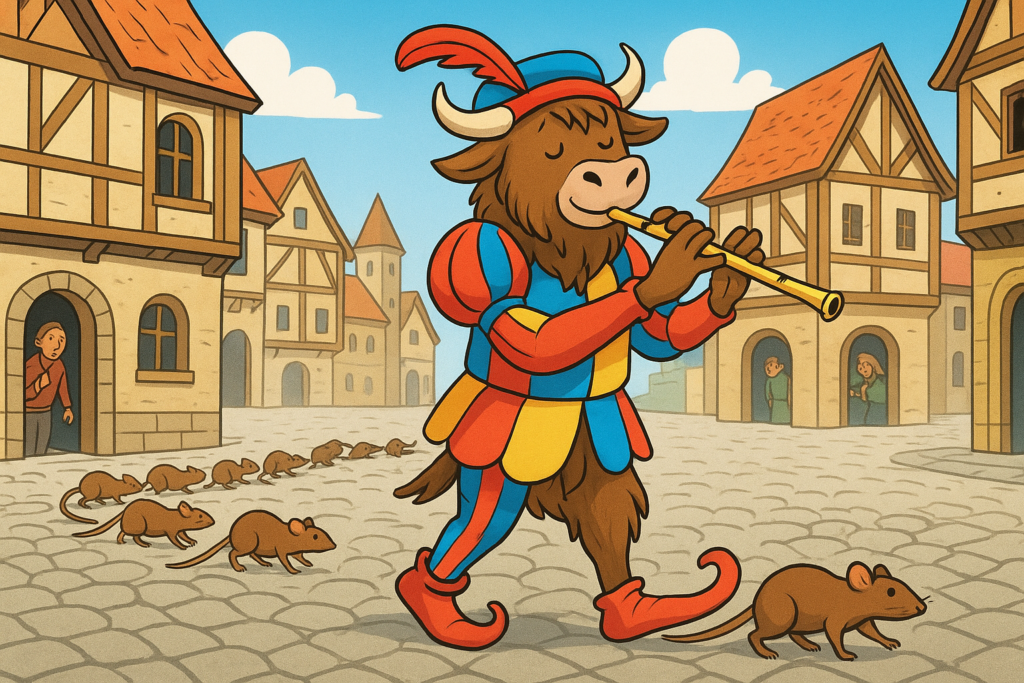
The next day, a man arrived in Hamelin. He was tall and thin, with bright, colorful clothes. He carried a long, golden pipe. "I can make the rats leave your town," he said. "Will you really a thousand gold coins?" "Yes, I promise," said the mayor.
Then, the piper the street. He put his pipe to his mouth and began to . The music was soft and magical. All the rats and listened. Then, they began to follow him. The piper walked slowly down to the river, and the rats followed, jumping into the water and disappearing.
After that, the piper went back to the mayor. "I did what I promised," he said. "Now please give me my thousand gold coins." But the mayor . "I will not give you so much money," he said. "You only played a little ."
The piper was very . "You ," he said. He walked out into the street again. This time, he played a different tune, a happy and wonderful sound. All the children of Hamelin heard the music and of their houses.
The piper walked the mountain, and the children danced behind him, smiling and laughing. Only one little boy could not follow. He had a and he was too . He watched the other children disappear into a big door that opened in the mountain and then closed again.
The people . They looked for their children, but they never found them. The little lame boy told them, "The piper took them because you did not ." Hamelin learned a sad lesson that day, and the colorful piper was never seen again.
Long ago, Hamelin town had a big rat problem. Rats were everywhere, making people very upset.
The people asked the mayor for help. He promised a thousand gold coins to anyone who could get rid of the rats.
A strange man with a golden pipe came and offered to remove the rats for the promised money. The mayor agreed.
The piper played magical music. All the rats followed him to the river and drowned.
The piper asked for his payment, but the mayor refused, saying the piper only played a short tune.
Angry, the piper played a different happy tune. All the children ran out to follow him.
The piper led the children to a mountain door that closed behind them. One lame boy couldn't keep up and saw it happen.
The people never found their children. The boy told them it was because they broke their promise. Hamelin learned a sad lesson, and the piper was never seen again.
The story has many words that are useful in everyday English. Let's look at some key words and how to use them.
- mayor - the leader of a town or city. Example: The mayor gave a speech.
- pipe - a musical instrument that you blow into. Example: The piper played a golden pipe.
- promise (verb/noun) - to say you will definitely do something. Example: I promise to help you. / He broke his promise.
- disappear - to go away so you cannot see it. Example: The rats disappeared into the river.
- lame - not able to walk well. Example: The little boy was lame and slow.
In the story, the mayor made a promise but then broke it. In English, we use common patterns to talk about promises. You can use 'promise to + verb' or 'promise + (that) + clause'. And when a promise isn't kept, we say 'break a promise'. If you keep it, you 'keep your promise'.
- Promise to + base verb: 'He promised to pay the piper.'
- Promise + (that): 'He promised that he would give 1000 coins.'
- Keep a promise: 'She always keeps her promises.'
- Break a promise: 'The mayor broke his promise, and bad things happened.'
When you tell a story, it helps to use sequence words. They show the order of events. In the Pied Piper, events happened one after another. You can use words like first, then, next, after that, and finally.
- First, the rats came to Hamelin.
- Then, the piper arrived and played his pipe.
- After that, the rats followed him into the river.
- Finally, the piper took the children because the mayor broke his promise.
Now you know the sad legend of Hamelin. Think about promises in your own life. Do you always keep your promises? Try to use the new words and phrases when you speak English. Maybe retell the story to a friend, using sequence words. Promises are important, so remember: if you make a promise, try your best to keep it!
- Practice: Retell the story using 'promise to', 'keep a promise', and sequence words.
The Pied Piper of Hamelin comes from the English / legend tradition tradition and is best known as a legend/poem story. This Yak Yacker article is an original learner retelling based on Traditional/Browning poem public domain, so the wording here is simplified for modern learners rather than copied from one old edition.
Older printings, translations, and retellings of this story can vary quite a bit. The original audience was usually kids/general, but this version is adapted for A2 Elementary learners studying English. Can be dark; simplify ending if needed.
If you want to look into the source tradition, start with Project Gutenberg.
If you want to keep going, browse more in our English section and review the A2 English Vocabulary List. After that, try English Question Words for another useful next step.