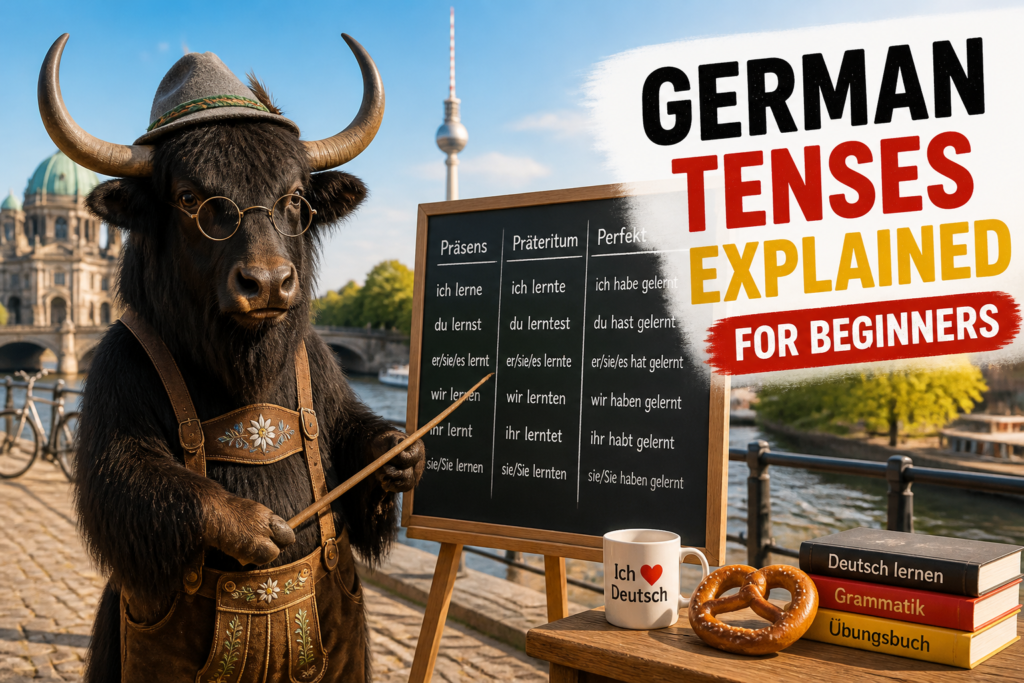
If German tenses have ever made you stare into the middle distance like a person betrayed by a textbook, you are in very normal company. The good news: beginners only need three main tenses to start speaking and understanding a lot of real German. Those are the present tense, the Präteritum, and the Perfekt.
By the end of this guide, you will know when to use each tense, how they are built, and which one Germans actually use in everyday speech. Yes, there is a bit of grammar. No, it is not a trapdoor into misery.
In real life, tense choice is often simpler than it looks. A German child can say Ich gehe for “I’m going / I go,” and a friend can say Ich bin gestern gegangen for “I went yesterday.” The trick is not memorising every tense like a robot with a flashcard addiction. It is learning the pattern and noticing what sounds natural.
The Big Picture: Three Tenses You Need First
German has several tenses, but beginners can do a lot with just these three:
- Present tense — for what is happening now, what happens usually, and often even for near-future plans.
- Präteritum — a simple past tense, used a lot in writing and in a few common spoken verbs.
- Perfekt — the everyday spoken past tense in most of Germany.
The most important beginner rule is this: if you want to talk about the past in normal conversation, Perfekt is usually your first choice. If you are reading a story, a news article, or a formal text, you will see more Präteritum.
Yak Wisdom: In German, the past is not one big pile of grammar rubble. Spoken German likes Perfekt, written German likes Präteritum, and the present tense quietly does more jobs than it should.
1. Present Tense: The Workhorse
The present tense is called Präsens in German. It is the tense you will use most often. It works for actions happening now, repeated habits, facts, and sometimes future plans with a time phrase.
| Pattern | Meaning | German Example | English Translation | Learner Note |
|---|---|---|---|---|
| ich lerne | I learn / I am learning | Ich lerne heute Deutsch. | I’m learning German today. | Present tense can mean “I am learning” or “I learn.” Context does the heavy lifting. |
| du gehst | you go | Du gehst nach Hause. | You are going home. | Second person singular often ends in -st. |
| er/sie/es macht | he/she/it does | Sie macht Kaffee. | She is making coffee. | Third person singular often ends in -t. |
The present tense is built from the verb stem plus endings. For regular verbs, this is very predictable. If you want a deeper look at that pattern, see German regular verb conjugation.
Simple conjugation pattern for machen:
| Pronoun | German | Translation |
|---|---|---|
| ich | mache | I do / I make |
| du | machst | you do |
| er/sie/es | macht | he/she/it does |
| wir | machen | we do |
| ihr | macht | you all do |
| sie/Sie | machen | they do / you do (formal) |
Two useful present tense examples:
- Ich wohne in Berlin. — I live in Berlin.
- Wir essen um acht Uhr. — We eat at eight o’clock.
Notice how the present tense can also describe a future plan when the time is clear:
- Morgen fahre ich nach Köln. — Tomorrow I’m going to Cologne.
That is very normal German. The sentence does not need a special future tense just to be dramatic about tomorrow.
2. Perfekt: The Everyday Past
Perfekt is the past tense people use most in everyday spoken German. If you are telling a friend what happened today, yesterday, or last weekend, this is usually the tense you want.
Perfekt is made with two parts:
- a helping verb: haben or sein
- the past participle, usually at the end of the sentence
If you need help choosing haben or sein, the guide on German sein vs haben is the friendly version of that topic, not the scary one.
Basic pattern:
| Pattern | Meaning | German Example | English Translation | Learner Note |
|---|---|---|---|---|
| haben + participle | have done | Ich habe Pizza bestellt. | I ordered pizza. | Most verbs use haben. |
| sein + participle | become / go / move | Wir sind nach Hause gegangen. | We went home. | Common with movement and change of state. |
Examples with Perfekt:
- Ich habe gestern gearbeitet. — I worked yesterday.
- Sie ist früh aufgestanden. — She got up early.
- Wir haben den Zug verpasst. — We missed the train.
Pronunciation note: the past participle often starts with ge-, but not always. Also, many regular verbs end in -t, while many irregular verbs end in -en. German likes patterns, but never so much that it becomes too easy.
Practical learner tip: In speaking, Perfekt is the safest past tense to use if you are not sure. Germans will understand you. Nobody is waiting to grade your soul.
3. Präteritum: The Simple Past You See In Writing
Präteritum is often called the simple past. It appears a lot in books, newspapers, stories, and formal writing. In speech, it is less common than Perfekt, but some verbs show up in Präteritum all the time.
The most common spoken-life Präteritum verbs are:
- sein → war = was
- haben → hatte = had
- werden → wurde = became / was made
- können → konnte = could
- müssen → musste = had to
- wollen → wollte = wanted to
- dürfen → durfte = was allowed to
Examples:
- Ich war müde. — I was tired.
- Wir hatten keine Zeit. — We had no time.
- Er konnte nicht kommen. — He could not come.
For many regular verbs, the Präteritum is especially common in written German, but not always in casual speaking. For example:
| Verb | Präteritum | Example | Translation |
|---|---|---|---|
| machen | machte | Ich machte meine Hausaufgaben. | I did my homework. |
| spielen | spielte | Wir spielten draußen. | We played outside. |
In daily conversation, many Germans would prefer Ich habe meine Hausaufgaben gemacht or Wir haben draußen gespielt. In a story or article, machte and spielten feel perfectly normal.
If you want a simple rule, here it is: Perfekt for speaking, Präteritum for writing. That is not the whole story, but it is a very useful beginner shortcut.
How The Three Tenses Compare
The same idea can be expressed in all three tenses. Here is a side-by-side view using the verb arbeiten:
| Tense | German | English | When To Use It |
|---|---|---|---|
| Present | Ich arbeite heute. | I work today / I am working today. | Now, habits, facts, near future. |
| Präteritum | Ich arbeitete gestern. | I worked yesterday. | Writing, storytelling, formal style. |
| Perfekt | Ich habe gestern gearbeitet. | I worked yesterday. | Everyday conversation. |
One important detail: English often uses different forms to make the difference between “I work” and “I am working.” German present tense usually covers both. Context decides.
When Germans Actually Use Each Tense
Here is the beginner-friendly version of real usage:
- Present: almost everything in daily life.
- Perfekt: spoken past, messages, conversations, storytelling.
- Präteritum: written past, formal writing, and a few very common verbs in speech.
This means you can already do a lot without knowing every tense in the German universe. In fact, many learners overthink tense choice and then say nothing at all, which is not exactly the goal of language learning.
Here is a very practical example:
- Heute gehe ich ins Büro. — Today I go to the office / I’m going to the office.
- Gestern bin ich ins Büro gegangen. — Yesterday I went to the office.
- Damals ging ich jeden Tag ins Büro. — Back then I went to the office every day.
The last sentence sounds more written or narrative. In everyday spoken German, many people would still say Ich bin damals jeden Tag ins Büro gegangen.
Useful Grammar Notes Without The Panic
There are a few small grammar ideas that help a lot with tenses. No fireworks, just useful stuff.
| Topic | Simple Rule | Example | English Translation |
|---|---|---|---|
| Verb position | The conjugated verb is usually in position 2 in main clauses. | Heute lerne ich Deutsch. | Today I’m learning German. |
| Perfekt structure | Helping verb near the start, participle at the end. | Ich habe heute viel gelernt. | I studied a lot today. |
| Separable verbs | Prefix often splits off in present and Perfekt. | Ich stehe auf. / Ich bin aufgestanden. | I get up. / I got up. |
Separable verbs are common in German. They look a bit annoying at first, because of course they do, but they follow rules. If you know a verb like aufstehen, you will soon spot the pieces: auf + stehen.
Also, remember that Perfekt is not formed with sein or haben just because the verb is “past.” It depends on the verb. Movement and change of state often use sein; most others use haben.
Easy memory trick: If something is a completed event in conversation, Perfekt is usually your friend. If you are telling a story in writing, Präteritum often sounds better. If it is happening now or regularly, use the present tense.
Common Beginner Mistakes And Fixes
- Mistake: Using Präteritum in casual conversation for every verb.
Fix: Use Perfekt for most spoken past tense. - Mistake: Putting the participle in the wrong place.
Fix: In Perfekt, the participle goes at the end of the clause. - Mistake: Forgetting the helping verb.
Fix: Perfekt needs haben or sein. - Mistake: Thinking present tense only means “right now.”
Fix: Present tense also covers habits and future plans with context. - Mistake: Overusing “I am” style translations word for word.
Fix: Translate the meaning, not every English word.
A classic example: English learners may want to say Ich bin gegessen after “I have eaten.” But that is not how the meaning works. The correct sentence is Ich habe gegessen. Eating is not movement, so it uses haben.
Another classic: Ich war nach Hause gegangen is grammatically possible, but in many everyday situations it sounds like a detail from a story rather than a normal chat message. If you are simply saying “I went home,” Ich bin nach Hause gegangen is the standard answer.
Mini Practice: Choose The Right Tense
Try these. Don’t overthink it. Your brain already knows more than it thinks.
- 1. “I drink coffee every morning.” → __________________
- 2. “Yesterday I ate pasta.” → __________________
- 3. “She was at home.” → __________________
- 4. “We watched a film.” → __________________
- 5. “Tomorrow I go to school.” → __________________
Suggested answers:
- 1. Ich trinke jeden Morgen Kaffee.
- 2. Gestern habe ich Pasta gegessen.
- 3. Sie war zu Hause.
- 4. Wir haben einen Film geschaut.
- 5. Morgen gehe ich zur Schule.
Now switch the tense:
- Ich lerne Deutsch. → Ich habe Deutsch gelernt.
- Er ist müde. → Er war müde.
- Wir essen zusammen. → Wir haben zusammen gegessen.
Quick Reference Summary
| Tense | German Name | Main Use | Example |
|---|---|---|---|
| Present | Präsens | Now, habits, facts, near future | Ich lerne Deutsch. |
| Simple Past | Präteritum | Writing, stories, formal style, a few common spoken verbs | Ich lernte Deutsch. |
| Present Perfect | Perfekt | Everyday spoken past | Ich habe Deutsch gelernt. |
- Use present tense for the biggest number of everyday sentences.
- Use Perfekt for normal spoken past tense.
- Use Präteritum mainly in writing and with common verbs like war, hatte, and modal verbs.
For more practice with past forms, it helps to review German modal verbs explained, because modal verbs often show up in Präteritum even in everyday speech. Very German of them.
If you want the broader language roadmap, the main hub at Learn German is a good next stop after this one.
For a boring-but-useful outside reference, the Duden is always there, being extremely serious about German while the rest of us just try to order coffee correctly.
Yak takeaway: Start with the present tense, use Perfekt for everyday past events, and keep Präteritum for reading, writing, and those stubborn little verbs that insist on being different. That is plenty to begin with, and it will already make your German sound a lot more natural.