
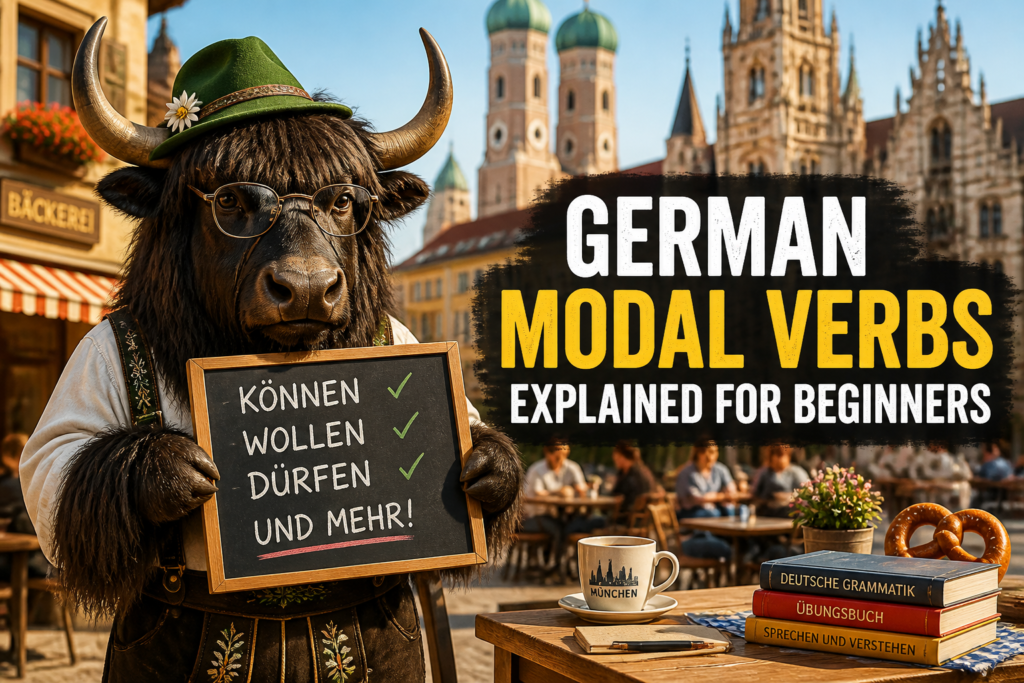
German modal verbs are the tiny control freaks of German grammar. They do not carry the whole sentence on their own, but they quietly change the meaning of another verb: can, want, must, may, should, and so on. If you can use them well, you suddenly sound much more natural, much faster.
By the end of this guide, you will understand how können, wollen, dürfen, and the rest work in everyday German, how they change in the present tense, and how to build simple sentences without panic and without grammar fumes.
One small warning: modal verbs are common, useful, and a little bossy. That is kind of their whole personality.
German learning hub | This modal verbs guide
What Modal Verbs Do
Modal verbs usually go with another verb. They tell you things like ability, permission, desire, obligation, or advice. In English, that is the job of words like can, want to, may, must, and should. German does the same thing, but with its own rules.
The main idea is simple: the modal verb changes the meaning of the second verb. The second verb usually moves to the end of the sentence in its base form.
Example: Ich kann heute kommen. = I can come today.
That little kommen stays at the end. German likes doing this sort of thing. Very tidy. Slightly annoying. Very German.
The Most Important Modal Verbs
These are the modal verbs beginners meet first:
| German | Pronunciation | Meaning | Example Sentence | Translation | Learner Note |
|---|---|---|---|---|---|
| können | KUH-nen | can, be able to | Ich kann Deutsch sprechen. | I can speak German. | Very common for ability. |
| wollen | VOL-en | want to | Wir wollen ins Café gehen. | We want to go to the café. | Use for desire or intention. |
| dürfen | DÜR-fen | may, be allowed to | Du darfst hier parken. | You are allowed to park here. | About permission, not ability. |
| müssen | MÜS-sen | must, have to | Ich muss arbeiten. | I have to work. | Strong obligation. |
| sollen | ZOL-len | should, be supposed to | Du sollst mehr Wasser trinken. | You should drink more water. | Often advice or expectation. |
| mögen | MEU-gen | to like | Ich mag Schokolade. | I like chocolate. | Often used as a normal verb too. |
| möchten | MEUCH-ten | would like | Ich möchte einen Kaffee. | I would like a coffee. | Very useful and polite. |
| lassen | LAH-sen | to let, allow | Meine Eltern lassen mich lange aufbleiben. | My parents let me stay up late. | Not always taught first, but very useful. |
For pronunciation, the most common beginner challenge is the ü in können, müssen, and dürfen. If that sound still feels weird, that is normal. German vowels love being dramatic.
For a boring but reliable reference, Duden is always a safe place to check meanings and forms.
How To Build A Sentence With A Modal Verb
The basic pattern is:
Subject + modal verb + other information + main verb at the end
| Pattern | Meaning | German Example | English Translation | Learner Note |
|---|---|---|---|---|
| Ich kann + verb | I can | Ich kann heute kommen. | I can come today. | Main verb goes to the end. |
| Du musst + verb | You have to | Du musst früh aufstehen. | You have to get up early. | Watch the verb bracket: musst … aufstehen. |
| Er will + verb | He wants to | Er will ein Auto kaufen. | He wants to buy a car. | Infinitive stays unchanged. |
| Wir dürfen + verb | We may / are allowed to | Wir dürfen hier sitzen. | We are allowed to sit here. | Permission, not possibility. |
| Ihr sollt + verb | You should | Ihr sollt leise sein. | You should be quiet. | Often advice, sometimes instruction. |
Rule: the modal verb is conjugated, but the main verb stays in the infinitive.
Example: Ich kann gut kochen. = I can cook well.
German word order can feel like it is testing your patience, but this pattern is one of the most regular things in the language. That is the good news for once.
Present Tense Forms You Need First
Modal verbs are irregular in the present tense. That means they do not follow the normal beginner pattern from regular verbs like German regular verb conjugation.
Here is the most useful set for beginners:
| Pronoun | können | wollen | dürfen | müssen | sollen |
|---|---|---|---|---|---|
| ich | kann | will | darf | muss | soll |
| du | kannst | willst | darfst | musst | sollst |
| er / sie / es | kann | will | darf | muss | soll |
| wir | können | wollen | dürfen | müssen | sollen |
| ihr | könnt | wollt | dürft | müsst | sollt |
| sie / Sie | können | wollen | dürfen | müssen | sollen |
Mini note: singular forms often lose the umlaut in the present tense stem change pattern, but the plural forms usually bring it back: kann, kannst, können; muss, musst, müssen.
If that looks a bit chaotic, it is. But it is consistent chaos, which is better than random chaos.
Meaning And Use Of Each Core Modal Verb
Können = Can, Be Able To
Use können for ability or possibility.
| German | Pronunciation | Meaning | Example Sentence | Translation | Learner Note |
|---|---|---|---|---|---|
| Ich kann schwimmen. | ikh kahn SHVIM-men | I can swim. | Ich kann schwimmen. | I can swim. | Use for skill. |
| Kannst du mir helfen? | kahnst doo meer HEL-fen | Can you help me? | Kannst du mir helfen? | Can you help me? | Very common everyday request. |
| Hier kann man gut essen. | heer kahn man goot ES-sen | One can eat well here. | Hier kann man gut essen. | You can eat well here. | General “you” with man. |
Wollen = Want To
wollen expresses desire, intention, or a strong plan.
| German | Pronunciation | Meaning | Example Sentence | Translation | Learner Note |
|---|---|---|---|---|---|
| Ich will nach Hause gehen. | ikh vil nahkh HOW-zeh GEH-en | I want to go home. | Ich will nach Hause gehen. | I want to go home. | Strong and direct. |
| Wir wollen morgen fahren. | veer VOL-en MOR-gen FAH-ren | We want to leave tomorrow. | Wir wollen morgen fahren. | We want to leave tomorrow. | Often means “plan to.” |
| Willst du mitkommen? | vilst doo MIT-koh-men | Do you want to come along? | Willst du mitkommen? | Do you want to come along? | Casual, very common. |
Learner note: ich will can sound strong, even a bit pushy, because it is direct. In polite situations, ich möchte is usually softer.
Dürfen = May, Be Allowed To
dürfen is about permission. It does not mean ability. That difference matters a lot.
| German | Pronunciation | Meaning | Example Sentence | Translation | Learner Note |
|---|---|---|---|---|---|
| Darf ich hier sitzen? | darf ikh heer ZIT-sen | May I sit here? | Darf ich hier sitzen? | May I sit here? | Useful in cafés, trains, waiting rooms. |
| Du darfst nicht rauchen. | doo darfst nihkt ROW-khen | You are not allowed to smoke. | Du darfst nicht rauchen. | You are not allowed to smoke. | Use nicht for negating permission. |
| Hier dürfen Kinder spielen. | heer DÜR-fen KIN-der SHPEE-len | Children are allowed to play here. | Hier dürfen Kinder spielen. | Children are allowed to play here. | Plural form: dürfen. |
Müssen = Must, Have To
müssen is for obligation, necessity, or strong requirement.
| German | Pronunciation | Meaning | Example Sentence | Translation | Learner Note |
|---|---|---|---|---|---|
| Ich muss heute arbeiten. | ikh moos HOY-teh AR-bye-ten | I have to work today. | Ich muss heute arbeiten. | I have to work today. | Very common in daily life. |
| Wir müssen jetzt gehen. | veer MÜS-sen yetst GEH-en | We must go now. | Wir müssen jetzt gehen. | We must go now. | Good for time pressure. |
| Musst du wirklich schon los? | moost doo VEER-khlihkh shon lohs | Do you really have to leave already? | Musst du wirklich schon los? | Do you really have to leave already? | Friendly everyday German. |
Sollen = Should, Be Supposed To
sollen is used for advice, expectation, or reported instructions.
| German | Pronunciation | Meaning | Example Sentence | Translation | Learner Note |
|---|---|---|---|---|---|
| Du sollst mehr schlafen. | doo zollst mear SHLAH-fen | You should sleep more. | Du sollst mehr schlafen. | You should sleep more. | Advice from another person or rule. |
| Ich soll morgen anrufen. | ikh zoll MOR-gen AN-roo-fen | I am supposed to call tomorrow. | Ich soll morgen anrufen. | I am supposed to call tomorrow. | Often what someone told you to do. |
| Was soll das? | vahs zoll dahs | What is that supposed to mean? | Was soll das? | What is that supposed to mean? | Very common expression. |
Möchten = Would Like
möchten is one of the most useful beginner expressions in polite German. It comes from mögen, but it works like “would like.”
| German | Pronunciation | Meaning | Example Sentence | Translation | Learner Note |
|---|---|---|---|---|---|
| Ich möchte einen Tee. | ikh MEUCH-teh EYE-nen tay | I would like a tea. | Ich möchte einen Tee. | I would like a tea. | Polite in cafés and shops. |
| Wir möchten bezahlen. | veer MEUCH-ten beh-tsah-len | We would like to pay. | Wir möchten bezahlen. | We would like to pay. | Excellent restaurant phrase. |
| Möchtest du mitkommen? | MEUCH-test doo MIT-koh-men | Would you like to come along? | Möchtest du mitkommen? | Would you like to come along? | Soft and friendly. |
Useful Everyday Phrases
Below are practical phrases you will actually hear in real life, not just in textbook land where everyone speaks like a polite robot.
| German | Pronunciation | Meaning | Example Sentence | Translation | Learner Note |
|---|---|---|---|---|---|
| Ich kann nicht. | ikh kahn nihkt | I can’t. | Ich kann nicht heute kommen. | I can’t come today. | Use for inability or impossibility. |
| Ich will nicht. | ikh vil nihkt | I don’t want to. | Ich will nicht aufstehen. | I don’t want to get up. | Strong refusal; not always polite. |
| Ich darf nicht. | ikh darf nihkt | I’m not allowed to. | Ich darf nicht rauchen. | I’m not allowed to smoke. | Permission, not ability. |
| Ich muss nicht. | ikh moos nihkt | I do not have to. | Ich muss heute nicht arbeiten. | I do not have to work today. | Important: this is not “must not.” |
| Du musst nicht. | doo moost nihkt | You do not have to. | Du musst nicht warten. | You do not have to wait. | Common beginner confusion. |
| Ich möchte … | ikh MEUCH-teh | I would like … | Ich möchte ein Wasser. | I would like a water. | Very polite for ordering. |
| Kann ich …? | kahn ikh | Can I …? | Kann ich hier sitzen? | Can I sit here? | Good question starter. |
| Darf ich …? | darf ikh | May I …? | Darf ich etwas fragen? | May I ask something? | More about permission than ability. |
| Was soll ich tun? | vahs zoll ikh toon | What should I do? | Was soll ich tun? | What should I do? | Useful in advice situations. |
| Ich soll … | ikh zoll | I am supposed to … | Ich soll morgen anrufen. | I’m supposed to call tomorrow. | Often from instructions or messages. |
| Wir wollen … | veer VOL-en | We want to … | Wir wollen früh gehen. | We want to leave early. | Natural in plans. |
| Du kannst … | doo kahnst | You can … | Du kannst hier warten. | You can wait here. | Useful for giving permission too. |
Small but important note: in German, nicht müssen means “do not have to,” not “must not.” If you want “must not,” use nicht dürfen.
The Big Beginner Confusion: Müssen Nicht Vs. Nicht Dürfen
This one trips up a lot of learners because English and German are not playing the same game.
| German | Meaning | English | Example | Translation |
|---|---|---|---|---|
| Ich muss nicht kommen. | not necessary | I do not have to come. | Ich muss nicht kommen. | I do not have to come. |
| Ich darf nicht kommen. | not allowed | I am not allowed to come. | Ich darf nicht kommen. | I am not allowed to come. |
Rule:
- müssen nicht = no obligation
- nicht dürfen = no permission
That tiny difference changes the whole sentence. German loves tiny differences. It keeps things lively, if slightly irritating.
Modal Verb Sentence Word Order
Modal verbs are a classic example of German word order. The modal verb comes in second position in normal statements, and the main verb goes to the end.
| Pattern | Meaning | German Example | English Translation | Learner Note |
|---|---|---|---|---|
| Ich + modal verb + rest + verb | statement | Ich kann heute nicht kommen. | I can’t come today. | Not goes before the main verb phrase. |
| Question + modal verb + subject + verb | yes/no question | Kannst du morgen anrufen? | Can you call tomorrow? | Modal verb moves to position 1. |
| W-question + modal verb + subject + verb | question word first | Warum musst du so früh gehen? | Why do you have to leave so early? | Verb still goes to the end. |
Example: Heute muss ich früh gehen. = Today I have to leave early.
Notice how the time word heute comes first. German often likes time + modal + subject + rest + verb. It is not a hard rule, but it is very common.
Practice Section
Try these quick exercises. No dramatic suspense. Just useful repetition.
1) Fill In The Blank
- Ich ___ heute nicht kommen. = I can’t come today.
- Du ___ hier nicht rauchen. = You may not smoke here.
- Wir ___ morgen früh aufstehen. = We have to get up early tomorrow.
- Ich ___ einen Kaffee, bitte. = I would like a coffee, please.
- Was ___ ich tun? = What should I do?
Answers: kann, darfst, müssen, möchte, soll.
2) Make The Sentence Natural
- Correct the order: Ich kommen kann heute.
- Correct the order: Du gehen musst jetzt.
- Correct the order: Wir möchten Kaffee trinken heute.
- Correct the order: Kann morgen du helfen?
Possible answers:
- Ich kann heute kommen.
- Du musst jetzt gehen.
- Wir möchten heute Kaffee trinken.
- Kannst du morgen helfen?
3) Choose The Right Modal Verb
- You are allowed to sit here. = dürfen
- You want to stay home. = wollen
- You should drink water. = sollen
- You have to go now. = müssen
- You can speak German. = können
Common Mistakes And Fixes
| Mistake | Why It Happens | Correct Version | Quick Fix |
|---|---|---|---|
| Ich kann sprechen Deutsch. | English word order sneaks in. | Ich kann Deutsch sprechen. | Main verb goes to the end. |
| Ich möchte ein Kaffee. | Article looks familiar, but gender matters. | Ich möchte einen Kaffee. | Kaffee is masculine here: einen. |
| Ich darf schwimmen. | Confusing ability with permission. | Ich kann schwimmen. | können = can. |
| Ich muss nicht rauchen. | Trying to say “must not.” | Ich darf nicht rauchen. | müssen nicht = not have to. |
| Kann du helfen? | Modal verb not conjugated correctly. | Kannst du helfen? | Use the right form for du. |
| Ich will ein Wasser, bitte. | Sounds a bit blunt in some contexts. | Ich möchte ein Wasser, bitte. | möchte is softer and polite. |
One more thing: German modal verbs are irregular, so do not try to force them into the pattern of weak verbs from German weak and strong verbs for beginners. They have their own little kingdom.
Quick Reference Summary
- können = can, be able to
- wollen = want to
- dürfen = may, be allowed to
- müssen = must, have to
- sollen = should, be supposed to
- möchten = would like
- Modal verb goes in the conjugated position.
- Main verb usually goes to the end in infinitive form.
- müssen nicht = do not have to
- nicht dürfen = not allowed to
If you want to go further, modal verbs also connect nicely with separable verbs, which is where German starts casually rearranging your sentence like furniture. That topic is explained in German separable and inseparable prefix verbs.
Yak takeaway: modal verbs are small, common, and ridiculously useful. Learn können, wollen, dürfen, and müssen first, and suddenly German everyday life gets much easier. A bit bossy, yes. But at least predictably bossy.