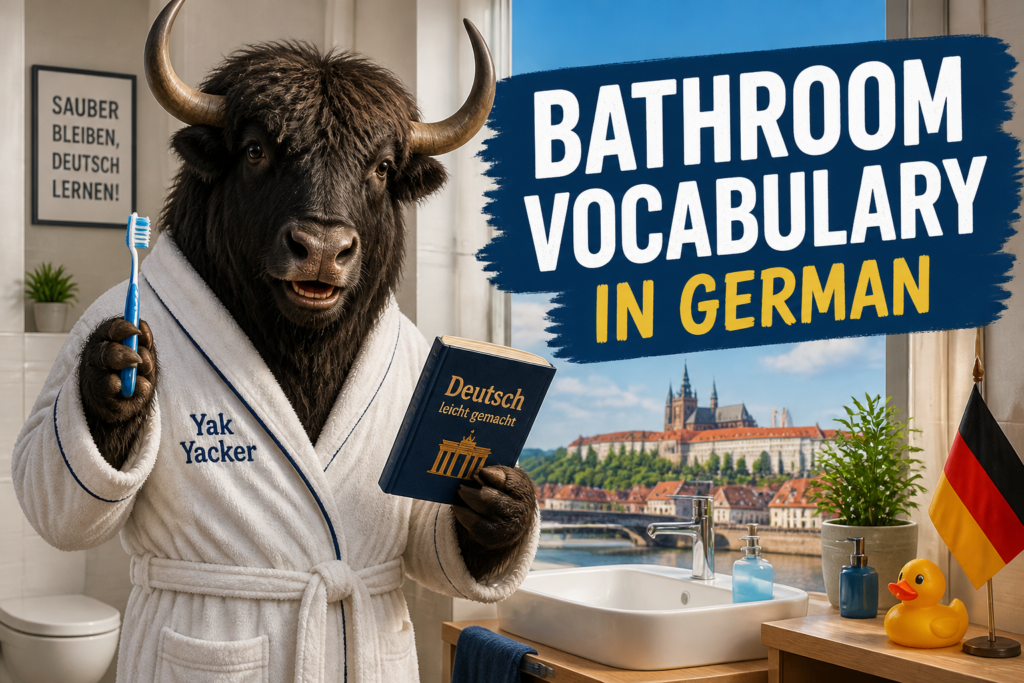
If you are in a German-speaking country and need the bathroom, you do not want to stand there doing interpretive dance. Let’s fix that. This guide gives you the practical Bathroom Vocabulary in German you will actually use in homes, hotels, cafés, train stations, and the occasional awkward emergency.
The good news: German bathroom language is mostly very logical. The less-good news: the words can still be sneaky. For example, das Bad often means “bathroom” or “bath,” while die Toilette is “toilet.” And yes, people do sometimes ask for das WC, because apparently one bathroom word is never enough.
This article focuses on standard German used in Germany, with a few notes where Austria or Switzerland may differ. For a related overview, you can also check the earlier guide on Bathroom Vocabulary in German and the broader Learn German page. If you want the official, boring, and therefore trustworthy version of some word meanings, Duden is always a decent place to peek.
Quick Starter: The Most Useful Bathroom Words
| German | Pronunciation | Meaning | Example Sentence | Translation | Learner Note |
|---|---|---|---|---|---|
| das Bad | bahd | bathroom; bath | Das Bad ist oben. | The bathroom is upstairs. | Very common at home or in hotels. |
| die Toilette | toy-LET-teh | toilet | Wo ist die Toilette? | Where is the toilet? | Polite and very widely used. |
| das WC | veh-tseh | toilet; restroom | Das WC ist dort. | The restroom is over there. | Common in signs, especially in Europe. |
| die Dusche | DOO-shuh | shower | Ich gehe jetzt duschen. | I’m going to shower now. | duschen is the verb. |
| die Badewanne | BAH-deh-vah-nuh | bathtub | Die Badewanne ist sehr klein. | The bathtub is very small. | Long compound noun, classic German style. |
| das Waschbecken | VASH-bek-en | sink; washbasin | Das Waschbecken ist kaputt. | The sink is broken. | Useful in hotels and rentals. |
| der Spiegel | SPEE-guhl | mirror | Der Spiegel ist beschlagen. | The mirror is fogged up. | Great word for real-life bathroom chatter. |
| das Handtuch | HAHND-tooch | towel | Ich brauche ein Handtuch. | I need a towel. | ch at the end sounds soft, like “huh” but quieter. |
One tiny pronunciation note: Toilette is not pronounced like English “toy-let.” The middle syllable gets the stress: toy-LET-teh. German loves a good middle-syllable surprise.
Everyday Bathroom Phrases You Will Actually Use
| German | Pronunciation | Meaning | Example Sentence | Translation | Learner Note |
|---|---|---|---|---|---|
| Wo ist die Toilette? | voh ist dee toy-LET-teh | Where is the toilet? | Entschuldigung, wo ist die Toilette? | Excuse me, where is the toilet? | Polite, safe, and useful almost anywhere. |
| Wo ist das WC? | voh ist dahs veh-tseh | Where is the restroom? | Wo ist das WC bitte? | Where is the restroom, please? | Very common on signs and in public places. |
| Ich muss auf die Toilette. | ikh moos owf dee toy-LET-teh | I need to use the toilet. | Entschuldigung, ich muss auf die Toilette. | Sorry, I need to use the toilet. | Natural and clear. The phrase sounds more polite than blunt English. |
| Ich suche die Toilette. | ikh ZOO-kheh dee toy-LET-teh | I’m looking for the toilet. | Ich suche die Toilette im Erdgeschoss. | I’m looking for the toilet on the ground floor. | Very handy in buildings and restaurants. |
| Darf ich die Toilette benutzen? | darf ikh dee toy-LET-teh beh-NOO-tsen | May I use the toilet? | Darf ich bitte die Toilette benutzen? | May I please use the toilet? | Polite; good in someone’s home or at work. |
| Gibt es hier eine Toilette? | gibt es heer AI-nuh toy-LET-teh | Is there a toilet here? | Gibt es hier eine Toilette für Gäste? | Is there a toilet here for guests? | Useful when you are not sure where it is. |
| Ich gehe duschen. | ikh GEH-eh DOO-shen | I’m going to shower. | Ich gehe gleich duschen. | I’m going to shower soon. | duschen is a common everyday verb. |
| Kann ich kurz ins Bad? | kan ikh koorts ins bahd | Can I quickly go to the bathroom? | Kann ich kurz ins Bad gehen? | Can I quickly go to the bathroom? | Very natural at home; kurz here means “for a moment.” |
| Das Wasser ist kalt/heiß. | dahs VAHS-ser ist kalt / heiss | The water is cold/hot. | Das Wasser ist zu kalt. | The water is too cold. | Good for showers, sinks, and hotel complaints. |
| Die Dusche funktioniert nicht. | dee DOO-shuh funk-tsee-oh-NEERT nicht | The shower isn’t working. | Entschuldigung, die Dusche funktioniert nicht. | Excuse me, the shower isn’t working. | Great repair phrase for rentals and hotels. |
| Ich brauche Seife. | ikh BRAW-kheh ZAI-feh | I need soap. | Haben Sie Seife im Bad? | Do you have soap in the bathroom? | Seife = soap; simple and useful. |
| Ich brauche Toilettenpapier. | ikh BRAW-kheh toy-LET-ten-pah-peer | I need toilet paper. | Es gibt kein Toilettenpapier mehr. | There is no toilet paper left. | Long noun, but very practical. German does love a compound. |
A useful tip: in public, die Toilette is usually safe and polite. Das Klo also exists, but it is more casual. You would use it with friends, not in a fancy restaurant unless you enjoy chaos.
Bathroom Objects and Fixtures
| German | Pronunciation | Meaning | Example Sentence | Translation | Learner Note |
|---|---|---|---|---|---|
| der Wasserhahn | der VAH-ser-hahn | faucet; tap | Der Wasserhahn tropft. | The faucet is dripping. | Common in homes and hotels. |
| der Abfluss | der AHP-floos | drain | Der Abfluss ist verstopft. | The drain is clogged. | Very useful if something goes wrong. |
| die Seife | dee ZAI-feh | soap | Die Seife riecht gut. | The soap smells good. | riechen means “to smell.” |
| die Zahnbürste | dee TSAHN-boor-stuh | toothbrush | Hast du meine Zahnbürste gesehen? | Have you seen my toothbrush? | Important if you are traveling. Very important. |
| die Zahnpasta | dee TSAHN-pahs-tah | toothpaste | Ich habe keine Zahnpasta dabei. | I don’t have any toothpaste with me. | dabei haben = to have with you. |
| das Shampoo | sham-POO | shampoo | Haben Sie Shampoo im Bad? | Do you have shampoo in the bathroom? | Borrowed word; same English origin, different stress. |
| die Bürste | BEUR-stuh | brush | Die Bürste liegt neben dem Waschbecken. | The brush is next to the sink. | Can also mean other kinds of brushes. |
| der Mülleimer | der MOOL-eye-mer | trash can | Der Mülleimer ist voll. | The trash can is full. | der noun; plural is die Mülleimer. |
| die Toilette | toy-LET-teh | toilet | Die Toilette ist sauber. | The toilet is clean. | Useful for hotel reviews and everyday comments. |
| der Toilettensitz | der toy-LET-ten-zeets | toilet seat | Der Toilettensitz ist offen. | The toilet seat is open. | Compound noun: Toilette + Sitz. |
| die Klobrille | dee KLOH-bri-luh | toilet seat rim | Bitte die Klobrille hochklappen. | Please lift the toilet seat rim. | More casual than Toilettensitz. |
| die Lüftung | dee LOOF-toong | ventilation | Die Lüftung funktioniert nicht gut. | The ventilation doesn’t work well. | Handy in apartments and hotels. |
Notice the capitalization: all German nouns are capitalized. So it is die Seife, der Spiegel, and das Handtuch. That rule is not optional. German nouns are not shy, and they refuse to stay lowercase.
Verbs and Actions in the Bathroom
| German | Pronunciation | Meaning | Example Sentence | Translation | Learner Note |
|---|---|---|---|---|---|
| duschen | DOO-shen | to shower | Ich dusche morgens. | I shower in the morning. | Regular verb; easy to use. |
| sich waschen | zikh VASH-en | to wash oneself | Ich wasche mir die Hände. | I wash my hands. | Reflexive verb. The little mir is common in German. |
| rasieren | rah-zee-REN | to shave | Er rasiert sich jeden Morgen. | He shaves every morning. | Often used reflexively: sich rasieren. |
| putzen | POOT-tsen | to clean; brush | Ich putze das Waschbecken. | I clean the sink. | Can also mean brushing teeth: Zähne putzen. |
| Zähne putzen | TSAY-nuh POOT-tsen | to brush teeth | Die Kinder putzen vor dem Schlafengehen Zähne. | The children brush their teeth before going to bed. | Very common everyday phrase. |
| sich die Hände waschen | zikh dee HEN-deh VASH-en | to wash one’s hands | Bitte wasch dir die Hände. | Please wash your hands. | dir = to yourself, informal singular. |
| spülen | SHPUE-len | to rinse; flush | Die Toilette spült nicht richtig. | The toilet does not flush properly. | Watch the umlaut: u changes to ü. |
| abwischen | AP-vish-en | to wipe off | Kannst du den Spiegel abwischen? | Can you wipe off the mirror? | Separable verb: wisch…ab in some forms. |
| auffüllen | OWF-fool-en | to refill | Bitte die Seife auffüllen. | Please refill the soap. | Useful for hotels, cafés, and homes. |
| wechseln | VEK-seln | to change; replace | Ich muss die Handtücher wechseln. | I need to change the towels. | Good general verb for swapping things. |
| benutzen | beh-NOO-tsen | to use | Darf ich Ihr Bad benutzen? | May I use your bathroom? | Polite and flexible. |
| trocken | TROK-en | dry | Das Handtuch ist trocken. | The towel is dry. | Not a verb, but very useful bathroom adjective. |
German often uses reflexive verbs in bathroom situations: sich waschen, sich rasieren, sich die Hände waschen. If that looks strange, think of it as “to wash oneself” or “to shave oneself.” English is a little lazier here, which is very on brand.
Bathroom Signs And Public Place Language
| German | Pronunciation | Meaning | Example Sentence | Translation | Learner Note |
|---|---|---|---|---|---|
| WC | veh-tseh | restroom; toilet | Das WC ist im ersten Stock. | The restroom is on the first floor. | Very common on doors and signs. |
| Herrentoilette | HAIR-ren-toy-LET-teh | men’s toilet | Die Herrentoilette ist links. | The men’s toilet is on the left. | Often seen in public buildings. |
| Damentoilette | DAH-men-toy-LET-teh | women’s toilet | Die Damentoilette ist rechts. | The women’s toilet is on the right. | Formal and practical. |
| Behindertentoilette | beh-HIN-der-ten-toy-LET-teh | accessible toilet | Die Behindertentoilette ist barrierefrei. | The accessible toilet is barrier-free. | barrierefrei means accessible. |
| frei | fry | free; available | Die Toilette ist frei. | The toilet is free/available. | In signs, it means “not occupied.” |
| besetzt | beh-ZETST | occupied | Die Toilette ist besetzt. | The toilet is occupied. | Very handy in public restrooms. |
| geschlossen | guh-SHLOS-sen | closed | Die Toilette ist geschlossen. | The toilet is closed. | Good sign vocabulary in shops and cafés. |
| offen | OF-en | open | Ist die Toilette offen? | Is the restroom open? | Simple and common. |
| nur für Kunden | noor feel KOON-den | for customers only | Die Toilette ist nur für Kunden. | The toilet is for customers only. | Important in restaurants and cafés. |
In Switzerland, you may also see WC used very often, and it feels completely normal. In Austria, WC is also common, while Toilette remains broadly understood everywhere. Language travel tip: signs are usually friendlier than your anxiety.
Polite Phrases For Homes, Hotels, And Restaurants
- Entschuldigung, wo ist die Toilette? — Excuse me, where is the toilet?
- Entschuldigen Sie, wo ist das WC? — Excuse me, where is the restroom? (formal)
- Darf ich kurz Ihr Bad benutzen? — May I quickly use your bathroom? (formal)
- Ich brauche bitte frische Handtücher. — I need fresh towels, please.
- Die Dusche funktioniert nicht. — The shower doesn’t work.
- Das Waschbecken ist verstopft. — The sink is clogged.
- Es gibt kein warmes Wasser. — There is no hot water.
- Könnten Sie mir bitte Seife bringen? — Could you please bring me soap?
- Ist die Toilette hier für Gäste? — Is the toilet here for guests?
- Ich habe meine Zahnbürste vergessen. — I forgot my toothbrush.
Formal vs informal: use Sie with strangers, staff, and anyone you do not know well. Use du with friends, close acquaintances, and people who have clearly offered it. Bathroom questions are already awkward enough; no need to make them worse with the wrong pronoun.
Common Confusion: Bathroom, Toilet, And Washroom
| German | Typical Meaning | Use | Example | Translation | Learner Note |
|---|---|---|---|---|---|
| das Bad | bathroom; bath | Home, hotel, apartment | Das Bad ist klein. | The bathroom is small. | Can mean the whole bathroom area. |
| die Toilette | toilet | General, polite | Wo ist die Toilette? | Where is the toilet? | Most universally useful in conversation. |
| das WC | restroom | Signs, public places | Das WC ist dort hinten. | The restroom is back there. | Short, practical, very common in Europe. |
| das Klo | loo; toilet | Casual, informal | Wo ist das Klo? | Where is the loo? | Fine with friends, not usually in formal settings. |
| das Badezimmer | bathroom | More specific, indoor room | Das Badezimmer ist oben rechts. | The bathroom is upstairs on the right. | Often used in homes and real estate. |
A small but useful note: English speakers often say “bathroom” even when they mean “toilet.” German can do this too with das Bad or das Badezimmer, but in public places die Toilette or das WC is usually the safer choice.
Germany, Austria, And Switzerland Notes
| Topic | Germany | Austria | Switzerland | Learner Note |
|---|---|---|---|---|
| Restroom sign | WC, Toilette | WC, Toilette | WC is very common | All are understood, but WC is especially common on signs. |
| Casual word | Klo | Klo | Klo | Informal everywhere, but still casual. |
| Bathroom as room | Bad, Badezimmer | Bad, Badezimmer | Bad, Badezimmer | Useful in homes, hotels, and apartments. |
| Accessible toilet | Behindertentoilette | Behindertentoilette | Behindertentoilette | You will see this on public buildings and travel signs. |
If you are reading hotel signs or station signs, the word WC is your best friend. It is short, international, and boring in exactly the helpful way you want from bathroom vocabulary.
Mini Practice: Translate These Into German
- Where is the toilet?
- I need soap.
- The shower does not work.
- Do you have a towel?
- I am looking for the restroom.
- The sink is broken.
- May I use the bathroom?
- I forgot my toothbrush.
- The toilet is occupied.
- There is no toilet paper.
Try saying them out loud too. German bathroom vocabulary is practical, and practical vocabulary sticks faster when you use it in a real-life little scenario instead of just staring at it like it owes you money.
Show Answers
1. Wo ist die Toilette?
2. Ich brauche Seife.
3. Die Dusche funktioniert nicht.
4. Haben Sie ein Handtuch?
5. Ich suche die Toilette.
6. Das Waschbecken ist kaputt.
7. Darf ich das Bad benutzen?
8. Ich habe meine Zahnbürste vergessen.
9. Die Toilette ist besetzt.
10. Es gibt kein Toilettenpapier.
Common Mistakes And Easy Fixes
| Common Mistake | Better German | Why |
|---|---|---|
| Wo ist das Toilette? | Wo ist die Toilette? | Toilette is feminine: die, not das. |
| Ich gehe an die Toilette. | Ich gehe auf die Toilette. | German usually says auf die Toilette gehen for “to go to the toilet.” |
| Ich brauche ein Seife. | Ich brauche Seife. / Ich brauche eine Seife. | Seife is usually uncountable here, so no article is often best. |
| Das Dusche ist kaputt. | Die Dusche ist kaputt. | Dusche is feminine: die. |
| Ich will die Toilette benutzen. | Ich möchte die Toilette benutzen. | möchte sounds more polite than will. |
| Die Wasser ist kalt. | Das Wasser ist kalt. | Wasser is neuter: das. |
| Ich putze meine Zähne mir. | Ich putze mir die Zähne. | German word order places the reflexive pronoun before the object here. |
If the gender feels random, yes, sometimes it is. But bathroom words do follow patterns once you see them enough. die Dusche, die Toilette, der Spiegel, das Waschbecken. Not poetic, but useful. Which is more than can be said for many hotel bathrooms.
Pronunciation Tips For Bathroom Words
- ch in duschen, Waschbecken, Toilettenpapier: usually a soft hiss-like sound, not a hard English “k.”
- sch in Dusche, Spiegel: sounds like English “sh.”
- sp at the start of Spiegel: often sounds like shp.
- st at the start of words often sounds like sht, though Toilette does not use this pattern.
- z in Seife is not the main issue, but in German words like Toilette and Zahnbürste, watch the crisp consonants.
- ü in Lüftung is the rounded vowel in your mouth that English does not really have. It is awkward, because of course it is.
For a solid pronunciation reference, the Goethe-Institut and Cambridge-style dictionaries are useful for hearing how words sound. If you want a plain vocabulary check, Duden is still the dependable option.
Quick Reference Summary
- die Toilette = toilet, the safest all-purpose word
- das WC = restroom, very common on signs
- das Bad / das Badezimmer = bathroom, especially at home
- duschen = to shower
- das Waschbecken = sink
- der Wasserhahn = faucet/tap
- die Seife = soap
- das Handtuch = towel
- die Zahnbürste = toothbrush
- Toilette ist besetzt = the toilet is occupied
- Toilette ist frei = the toilet is free/available
- auf die Toilette gehen = to go to the toilet
If you remember only three things, make them Wo ist die Toilette?, Ich brauche Seife., and Die Dusche funktioniert nicht. That covers polite survival, basic hygiene, and a nice little emergency complaint. Very efficient. Very adult.
For more practical everyday German, the next useful step is the Health Vocabulary in German guide, because bathroom problems and health problems enjoy showing up in the same neighborhood. Yak takeaway: learn the bathroom words now, and future-you will thank you in very unglamorous but deeply useful ways.