If you ever need to talk about a bug in Spanish, congratulations: you are now in a highly practical, mildly dramatic situation. Maybe there is a mosquito in your room, an ant army in the kitchen, or some mysterious thing on the wall that is absolutely not getting invited to your evening. This guide gives you the Spanish you actually need, without turning the topic into a tiny zoology seminar.
For the broader learning path, visit our parent guide.
We’ll cover common insect names, useful phrases, pronunciation help, and a few natural expressions you might hear in real life. For broader animal vocabulary, you can also explore animal names in Spanish, and if you want to describe where bugs live, habitats vocabulary in Spanish is a nice follow-up. Creepy? A little. Useful? Absolutely.
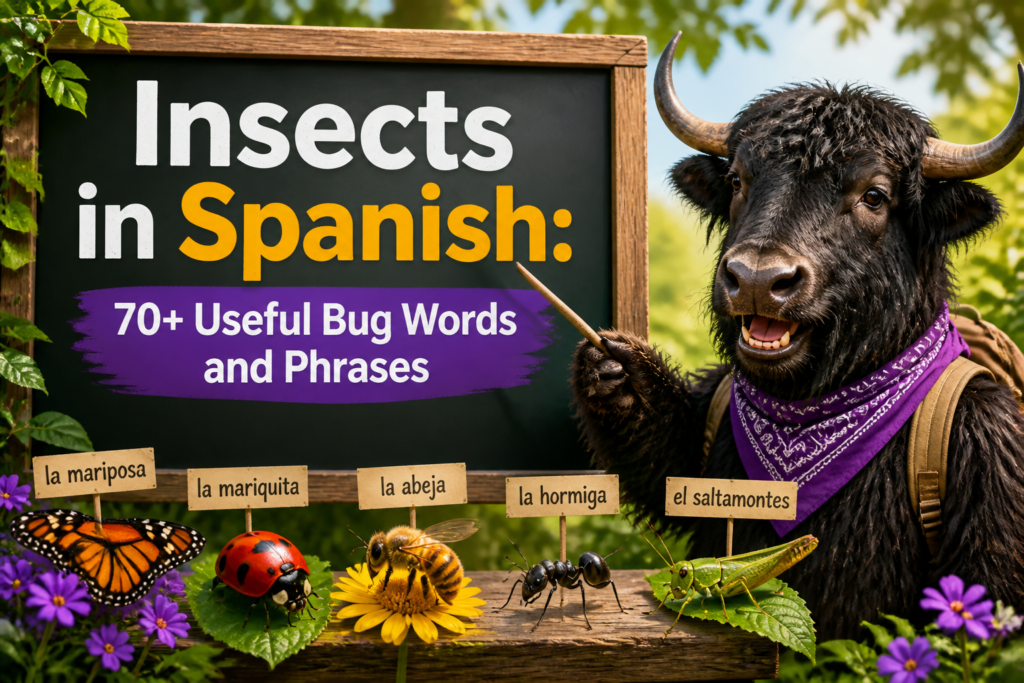
Yak wisdom: if you can name the bug, you’re already less helpless. Still annoyed, yes. Less helpless, also yes.
Quick Pronunciation Notes For Bug Words
Spanish insect words are usually friendly to English speakers, but a few sounds matter. The rolled r in perro-style words can appear in some bug names like garrapata and mariposa is easier than it looks. The letter j sounds like a strong airy h, as in insecto? Not there, but useful in related words. The letter h is silent, because Spanish enjoys keeping beginners humble.
For standard Latin American Spanish, these bug names work almost everywhere. In Spain, some everyday insect words differ a bit, and saltamontes and grillo may appear in different everyday habits of speech, but the core vocabulary here is widely understood. If you want to check a dictionary form, the boring-but-reliable Diccionario de la lengua española is always there doing the paperwork.
Common Insects In Spanish
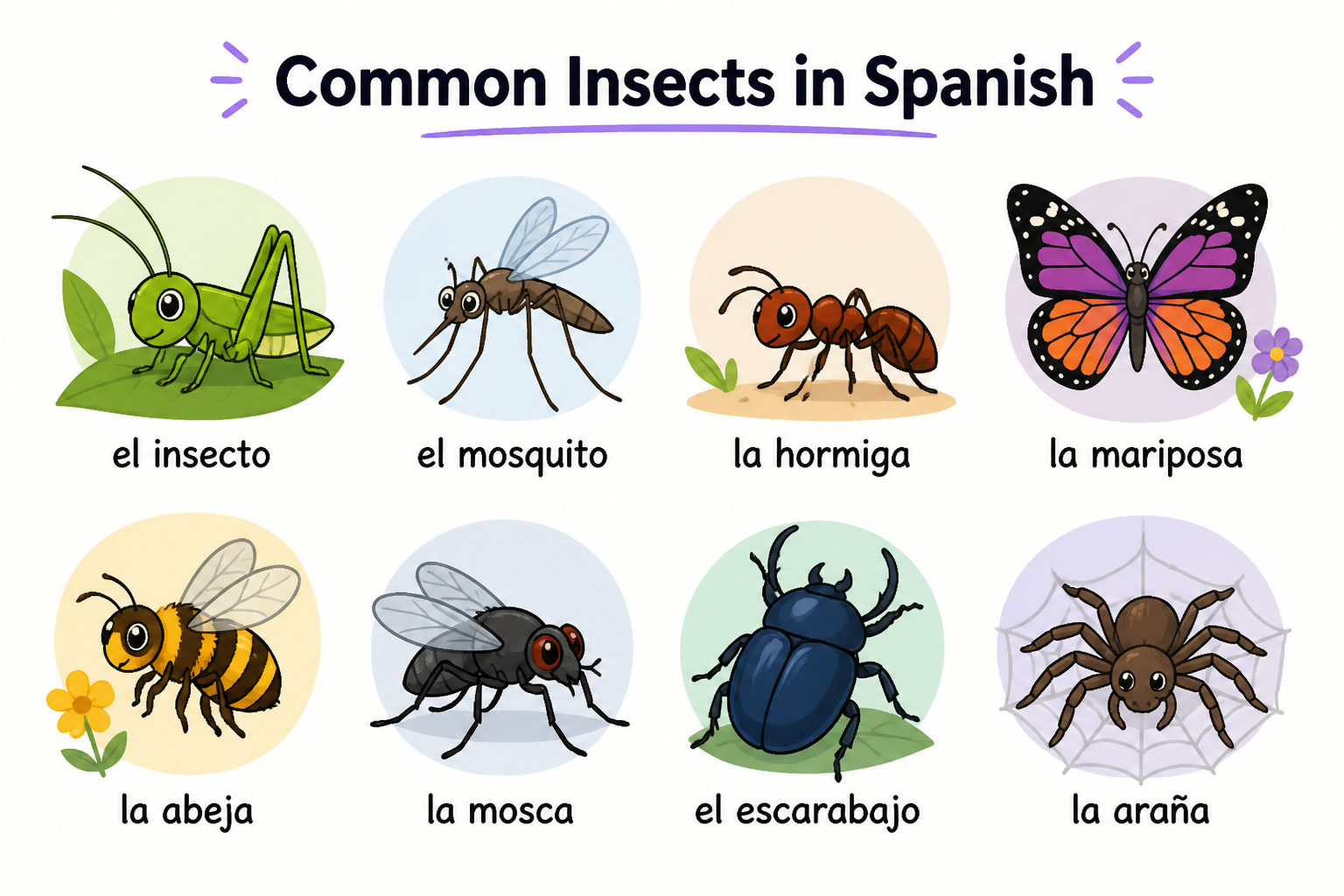
Here are the most useful insect words first. These are the ones you’ll actually hear, not the ones trapped in a dusty field guide somewhere.
| Spanish | Pronunciation | Meaning | Example Sentence | Translation | Learner Note |
|---|---|---|---|---|---|
| el insecto | een-SEHK-toh | insect | Vi un insecto en la pared. | I saw an insect on the wall. | General word for “insect.” |
| el mosquito | mos-KEE-toh | mosquito | Hay un mosquito en mi cuarto. | There’s a mosquito in my room. | Very common in daily speech. |
| la hormiga | or-MEE-gah | ant | Hay hormigas en la cocina. | There are ants in the kitchen. | h is silent. |
| la abeja | ah-BEH-hah | bee | Una abeja está volando cerca de la ventana. | A bee is flying near the window. | Useful in gardens and parks. |
| la avispa | ah-VEESS-pah | wasp | ¡Cuidado, hay una avispa! | Careful, there’s a wasp! | More threatening than a bee. Usually. |
| la mariposa | mah-ree-POH-sah | butterfly | Vimos una mariposa amarilla. | We saw a yellow butterfly. | Feminine noun. |
| el escarabajo | es-kah-rah-BAH-hoh | beetle | Encontré un escarabajo en el jardín. | I found a beetle in the garden. | The j is a soft throat sound. |
| la cucaracha | koo-kah-RAH-chah | cockroach | No quiero ver una cucaracha en la cocina. | I do not want to see a cockroach in the kitchen. | Yes, this word gets used a lot. |
| la mosca | MOS-kah | fly | Hay una mosca en mi sopa. | There is a fly in my soup. | Also used in expressions later. |
| la pulga | POOL-gah | flea | El perro tiene pulgas. | The dog has fleas. | Often used in pet contexts. |
| la garrapata | gah-rah-PAH-tah | tick | Le quité una garrapata al perro. | I removed a tick from the dog. | Tricky word, but very useful outdoors. |
| el grillo | GREE-yoh | cricket | Oigo grillos por la noche. | I hear crickets at night. | Double l is often a y sound in Latin America. |
More Bug Words You’ll Actually Use
Once you move beyond the “please leave my house” stage, these words help you describe what kind of bug you saw. Because apparently one insect is never enough trouble.
| Spanish | Pronunciation | Meaning | Example Sentence | Translation | Learner Note |
|---|---|---|---|---|---|
| la libélula | lee-BEH-loo-lah | dragonfly | Una libélula pasó por el lago. | A dragonfly passed by the lake. | Accent mark on the é. |
| el saltamontes | sal-tah-MON-tes | grasshopper | El saltamontes saltó muy alto. | The grasshopper jumped very high. | Literally “mountain jumper.” |
| la luciérnaga | loo-thee-ERN-ah-gah / loo-see-ERN-ah-gah | firefly | Había luciérnagas en el campo. | There were fireflies in the field. | Pronunciation varies by region. |
| el gusano | goo-SAH-noh | worm / caterpillar | Vi un gusano en el suelo. | I saw a worm on the ground. | Can refer to different crawling creatures. |
| la larva | LAR-vah | larva | La larva se convirtió en mariposa. | The larva became a butterfly. | Useful in science or nature talk. |
| el zángano | SAHN-gah-noh | drone bee; bumblebee drone | El zángano no recoge polen. | The drone bee does not collect pollen. | Also means a lazy person in some contexts. |
| el bicho | BEE-choh | bug / critter / creepy thing | Hay un bicho en la pared. | There’s a bug on the wall. | Very common, very flexible, very vague. |
| el bichito | bee-CHEE-toh | little bug | Pobrecito bichito, está en la ventana. | Poor little bug, it’s on the window. | Diminutive can sound cute or ironic. |
| la plaga | PLAH-gah | plague, infestation, pest problem | Tenemos una plaga de mosquitos. | We have a mosquito infestation. | Use for a big pest problem, not one bug. |
| el nido | NEE-doh | nest | El nido está en el árbol. | The nest is in the tree. | Helpful when talking about bees or wasps. |
| la colmena | kol-MEH-nah | beehive | Las abejas están dentro de la colmena. | The bees are inside the hive. | More specific than nido. |
| el capullo | kah-POO-yoh | cocoon | La oruga está dentro del capullo. | The caterpillar is inside the cocoon. | Also an insult in some places, so context matters. |
Useful Phrases For Real Life
These are the phrases you need when a bug appears and your dignity leaves the room first.
| Spanish | Pronunciation | Meaning | Example Sentence | Translation | Learner Note |
|---|---|---|---|---|---|
| ¡Hay un insecto aquí! | eye oon een-SEHK-toh ah-KEE | There’s an insect here! | ¡Hay un insecto aquí en la mesa! | There’s an insect here on the table! | Good emergency phrase. |
| ¡Mata al mosquito! | MAH-tah al mos-KEE-toh | Kill the mosquito! | ¡Mata al mosquito antes de dormir! | Kill the mosquito before sleeping! | Direct and natural. |
| ¿Dónde está la cucaracha? | DON-deh es-TAH lah koo-kah-RAH-chah | Where is the cockroach? | ¿Dónde está la cucaracha? No la veo. | Where is the cockroach? I can’t see it. | Useful when the panic is organized into a question. |
| No me gustan los bichos. | noh meh GOOS-tahn los BEE-chohs | I don’t like bugs. | No me gustan los bichos ni un poquito. | I don’t like bugs one bit. | Very natural everyday phrasing. |
| Me picó un mosquito. | meh pee-KOH oon mos-KEE-toh | A mosquito bit/stung me. | Me picó un mosquito en el brazo. | A mosquito bit me on the arm. | picar is the common verb for bug bites/stings. |
| Me mordió un perro. | meh mor-DYOH oon PEH-rroh | A dog bit me. | Me mordió un perro, no un insecto. | A dog bit me, not an insect. | Good contrast with picar. |
| Hay muchos mosquitos esta noche. | eye MOO-chohs mos-KEE-tohs es-tah NOH-cheh | There are a lot of mosquitoes tonight. | Hay muchos mosquitos esta noche por la lluvia. | There are a lot of mosquitoes tonight because of the rain. | Great for weather and outdoor talk. |
| Tengo alergia a las picaduras. | TEN-go ah-LEHR-hyah ah lahs pee-kah-DOO-rahs | I’m allergic to bites/stings. | Tengo alergia a las picaduras de abeja. | I’m allergic to bee stings. | Very useful if you need to explain a reaction. |
| Por favor, cierre la ventana. | por fah-VOR SYEH-rreh lah ben-TAH-nah | Please close the window. | Por favor, cierre la ventana; entran mosquitos. | Please close the window; mosquitoes get in. | Polite and practical. |
| ¿Hay veneno para insectos? | eye beh-NEH-noh PAH-rah een-SEHK-tohs | Is there insect poison/spray? | ¿Hay veneno para insectos en la tienda? | Is there insect spray in the store? | Very handy for shopping and emergencies. |
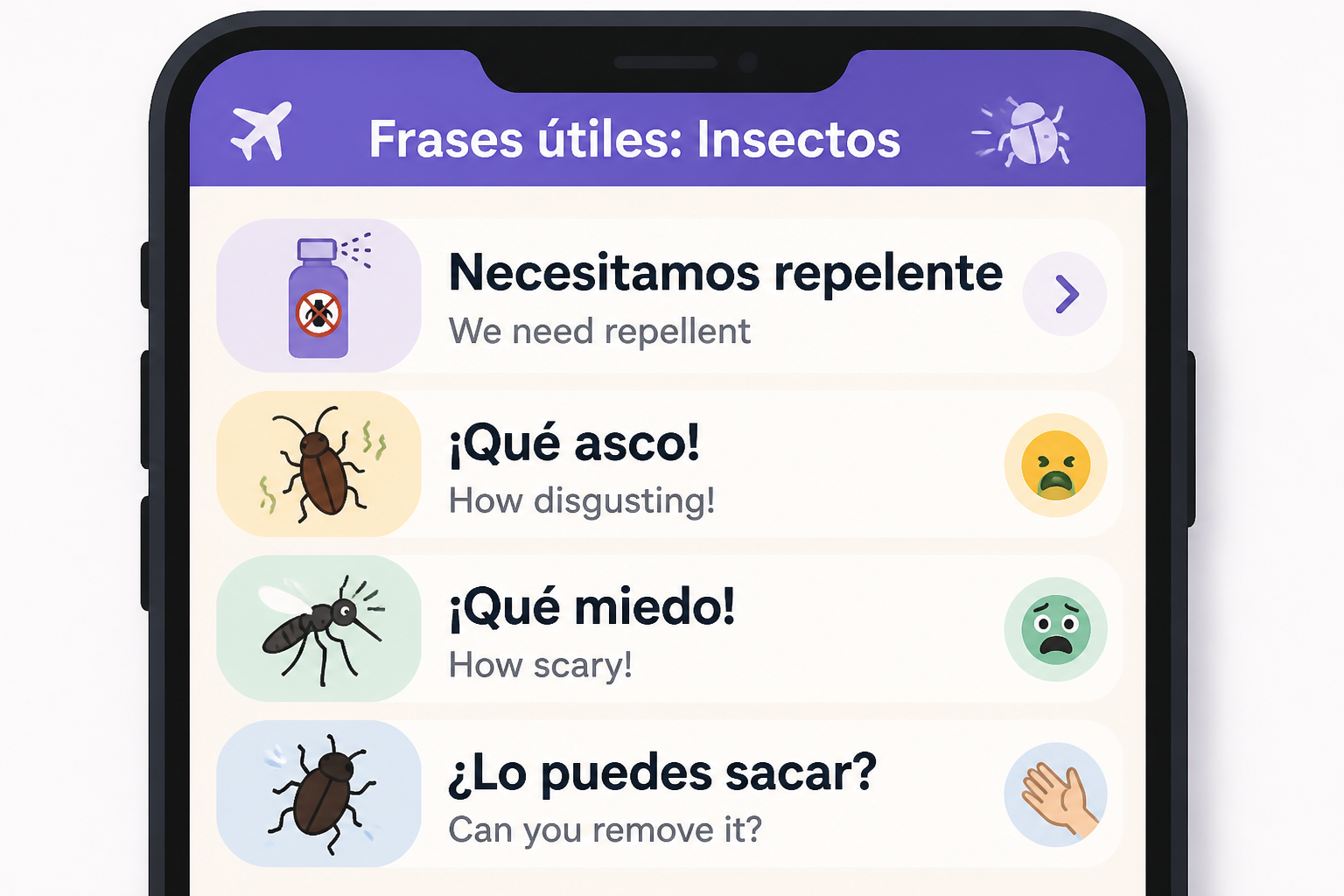
| Necesitamos repelente. | neh-seh-see-TAH-mohs reh-peh-LEN-teh | We need repellent. | Necesitamos repelente para los mosquitos. | We need mosquito repellent. | One of those life-saving travel words. |
| ¡Qué asco! | keh AH-skoh | How disgusting! | ¡Qué asco, una cucaracha! | Gross, a cockroach! | Very common reaction phrase. |
| ¡Qué miedo! | keh MYEH-doh | How scary! | ¡Qué miedo, está gigante ese bicho! | So scary, that bug is huge! | Good for dramatic situations. |
| ¿Lo puedes sacar? | loh PWEH-des sah-KAR | Can you remove it? | ¿Lo puedes sacar de mi cuarto? | Can you take it out of my room? | Neutral and very useful. |
Nature Words That Help You Talk About Insects
Insect vocabulary gets much easier when you know a few nature words around it. These help you describe where bugs are, what they’re doing, and why you are leaving the picnic immediately.
| Spanish | Pronunciation | Meaning | Example Sentence | Translation | Learner Note |
|---|---|---|---|---|---|
| el jardín | el har-DEEN | garden | Hay abejas en el jardín. | There are bees in the garden. | Accent on the final syllable. |
| el campo | EL KAHM-poh | countryside, field | Vimos muchos insectos en el campo. | We saw many insects in the countryside. | Common in nature stories. |
| el árbol | EL AHR-bol | tree | La colmena está en el árbol. | The beehive is in the tree. | Watch the accent mark. |
| la hoja | LA OH-hah | leaf | Una hormiga sube por la hoja. | An ant climbs up the leaf. | h is silent. |
| la flor | lah FLOR | flower | La abeja está sobre la flor. | The bee is on the flower. | Very common pairing with bees. |
| el suelo | EL SWEH-loh | ground, floor | Un gusano está en el suelo. | A worm is on the ground. | Can mean floor or ground. |
| la ventana | lah ben-TAH-nah | window | La mosca está en la ventana. | The fly is on the window. | Great with indoor bug talk. |
| la cocina | lah koh-SEE-nah | kitchen | No quiero cucarachas en la cocina. | I do not want cockroaches in the kitchen. | Probably one of the most emotionally charged places. |
| la noche | LA NOH-cheh | night | Los mosquitos salen por la noche. | Mosquitoes come out at night. | Very common for insects. |
| la lluvia | LA YOO-vyah | rain | Después de la lluvia hay más mosquitos. | After the rain there are more mosquitoes. | Useful for real-life observations. |