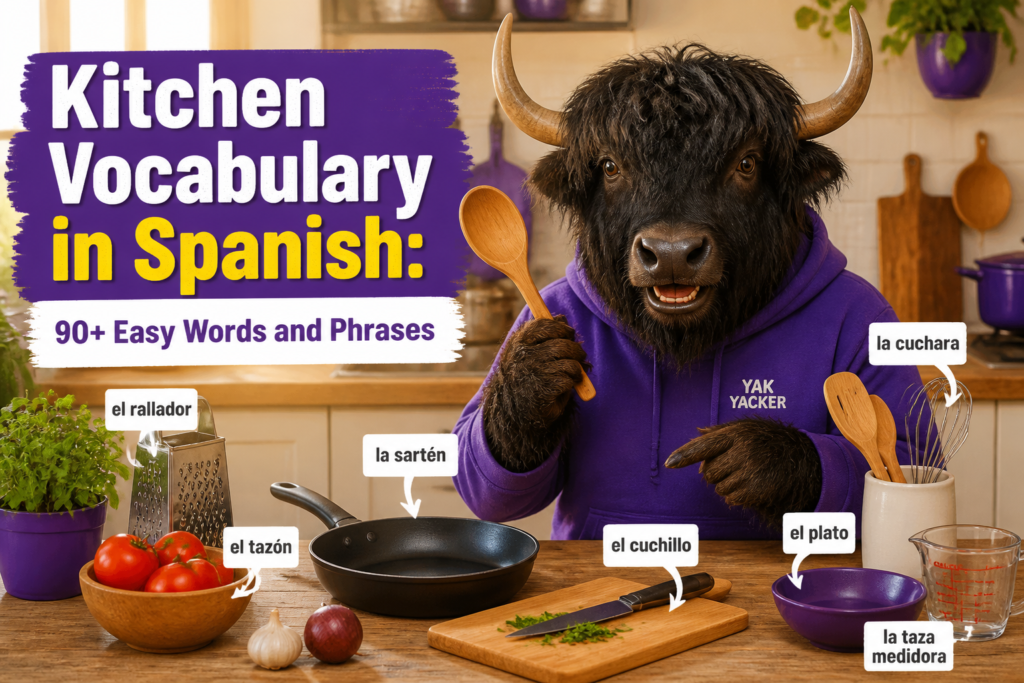
If you have ever stood in a Spanish-speaking kitchen doing the international language of vague pointing, this one is for you. The goal here is simple: by the end, you’ll be able to name the most common kitchen items, talk about basic actions like cutting and boiling, and survive a recipe without pretending “that round thing over there” is a valid noun.
Kitchen words are super useful because they show up everywhere: at home, in apartments, in cooking videos, in restaurants, and in polite little conversations about who washed the dishes. Also, Spanish kitchens come with a few handy language quirks, like gender and articles, so this is a sneaky way to learn grammar without making it feel like homework.
Quick note: this guide uses standard Latin American Spanish by default. When a common Spain Spanish or regional difference matters, you’ll see it clearly.
For the broader learning path, visit our parent guide.
For a related grammar refresher, compare this with Spanish el, la, un, una: Definite and Indefinite Articles and Gender and Number Rules in Spanish. Yes, Spanish nouns like to keep you busy.
Kitchen Basics You’ll Use All The Time
Start with the common stuff. These are the words you’ll see in kitchens, recipes, and everyday conversation. And yes, la cocina can mean both “the kitchen” and “cooking” depending on context. Spanish enjoys multitasking.
| Spanish | Pronunciation | Meaning | Example Sentence | Translation | Learner Note |
|---|---|---|---|---|---|
| la cocina | lah koh-SEE-nah | kitchen | La cocina es pequeña. | The kitchen is small. | Feminine noun: la cocina. |
| la mesa | MEH-sah | table | La mesa está limpia. | The table is clean. | Useful for meals and prep space. |
| la silla | SEE-yah | chair | Hay cuatro sillas en la cocina. | There are four chairs in the kitchen. | Great with hay for “there is / there are.” |
| el refrigerador | reh-free-heh-rah-DOR | fridge | El refrigerador está vacío. | The fridge is empty. | In many places, people also say la nevera. |
| la nevera | neh-VEH-rah | fridge | Puse la leche en la nevera. | I put the milk in the fridge. | Very common in Latin America. |
| el congelador | kon-heh-lah-DOR | freezer | El pollo está en el congelador. | The chicken is in the freezer. | Use for the freezer compartment. |
| la estufa | es-TOO-fah | stove | La estufa no funciona bien. | The stove does not work well. | In Spain, la cocina can also mean stove in some contexts. |
| el horno | OR-no | oven | El pan está en el horno. | The bread is in the oven. | The h is silent. |
Little pronunciation tip: Spanish vowels are clean and steady. cocina is not “koh-SEE-nuh.” Keep the final vowel crisp. Spanish does not want the vowel mush that English sometimes brings to the party.
Tools And Kitchen Items
These are the practical nouns you need to grab, use, wash, or complain about later when they disappear into a drawer. If you know these, you can follow a basic recipe without panicking.
| Spanish | Pronunciation | Meaning | Example Sentence | Translation | Learner Note |
|---|---|---|---|---|---|
| la olla | OY-yah | pot | La sopa está en la olla. | The soup is in the pot. | The ll is usually like “y” in Latin America. |
| la sartén | sahr-TEN | frying pan | Calienta la sartén primero. | Heat the pan first. | Accent mark matters: sartén. |
| la cuchara | koo-CHA-rah | spoon | Necesito una cuchara para la sopa. | I need a spoon for the soup. | Feminine: una cuchara. |
| el tenedor | teh-neh-DOR | fork | ¿Dónde está el tenedor? | Where is the fork? | Common in restaurants and homes. |
| el cuchillo | koo-CHEE-yoh | knife | No toques el cuchillo con la mano mojada. | Don’t touch the knife with wet hands. | The ll sound is important. |
| el plato | PLAH-toh | plate | El plato está caliente. | The plate is hot. | Can also mean “dish” as food. |
| el vaso | BAH-soh | glass, cup | Quiero un vaso de agua. | I want a glass of water. | For drinking glasses. |
| la taza | TAH-sah | mug, cup | Tomo café en una taza grande. | I drink coffee in a big mug. | Good for coffee and tea. |
| el bol / el tazón | bol / tah-SON | bowl | Mezcla todo en un tazón. | Mix everything in a bowl. | Tazón is common in Latin America. |
| la tabla para cortar | TAH-blah pah-rah kor-TAR | cutting board | Usa la tabla para cortar la cebolla. | Use the cutting board to cut the onion. | Very handy phrase. |
Food Preparation Verbs
These verbs are the engine of kitchen Spanish. Recipes love them. So do people asking for help. Master these and suddenly Spanish instructions stop sounding like a mysterious cooking spell.
| Spanish | Pronunciation | Meaning | Example Sentence | Translation | Learner Note |
|---|---|---|---|---|---|
| cortar | kor-TAR | to cut | Voy a cortar el tomate. | I’m going to cut the tomato. | Basic kitchen verb. |
| picar | pee-KAR | to chop, to mince | Pica la cebolla en trozos pequeños. | Chop the onion into small pieces. | Very common in recipes. |
| pelar | peh-LAR | to peel | Hay que pelar las papas. | The potatoes need to be peeled. | Often used with hay que for “it’s necessary to.” |
| mezclar | mes-KLAR | to mix | Mezcla los ingredientes en un bol. | Mix the ingredients in a bowl. | Very flexible verb. |
| batir | bah-TEER | to beat, whisk | Voy a batir los huevos. | I’m going to whisk the eggs. | Used for eggs, cream, and batter. |
| freír | fray-EER | to fry | Vamos a freír los plátanos. | We’re going to fry the plantains. | The accent in freír helps keep the stress clear. |
| hervir | ehr-VEER | to boil | Haz hervir el agua. | Bring the water to a boil. | The h is silent. |
| hornear | or-neh-AR | to bake | Vamos a hornear el pastel. | We’re going to bake the cake. | Used for bread, cake, pizza, and more. |
| asar | ah-SAR | to roast, grill | Vamos a asar pollo esta noche. | We’re going to roast/grill chicken tonight. | Context decides the exact English meaning. |
| calentar | kah-len-TAR | to heat, warm up | Calienta la leche un poco. | Warm the milk a little. | Useful in microwave and stove contexts. |
| enfriar | en-FREE-AR | to cool, chill | Deja enfriar la sopa. | Let the soup cool. | Often used in cooking instructions. |
| servir | ser-VEER | to serve | Sirve la cena a las ocho. | Serve dinner at eight. | Also means “to be useful” in other contexts. |
Ingredients And Common Food Words
Recipes are full of ingredient nouns, and Spanish loves its little article-gender dance. Here’s a strong starter set, plus a few everyday foods that show up in kitchens constantly.
| Spanish | Pronunciation | Meaning | Example Sentence | Translation | Learner Note |
|---|---|---|---|---|---|
| el agua | AH-gwah | water | El agua está fría. | The water is cold. | Uses el for sound reasons, but it is feminine: el agua. |
| la leche | LEH-cheh | milk | Necesito leche para el café. | I need milk for the coffee. | Silent h in spelling? No—there isn’t one here. Easy. |
| el pan | pahn | bread | Compré pan fresco. | I bought fresh bread. | Very common in everyday life. |
| el arroz | ah-ROTH / ah-ROS | rice | El arroz está listo. | The rice is ready. | In Spain, the final z sounds like “th”; in Latin America, usually like “s.” |
| la pasta | PAHS-tah | pasta | Vamos a comer pasta hoy. | We’re going to eat pasta today. | Good universal word. |
| el huevo | WEH-boh | egg | Un huevo por persona. | One egg per person. | H is silent. |
| la harina | ah-REE-nah | flour | Necesitas harina para este pan. | You need flour for this bread. | Common in baking. |
| el azúcar | ah-SOO-kar | sugar | No le pongas mucho azúcar. | Don’t add too much sugar. | Accent on the first syllable. |
| la sal | sahl | salt | Agrega sal al gusto. | Add salt to taste. | Useful phrase: al gusto. |
| la mantequilla | mahn-teh-KEE-yah | butter | La mantequilla está en la mesa. | The butter is on the table. | ll often sounds like “y.” |
| el aceite | ah-SEH-teh | oil | Necesitamos aceite para cocinar. | We need oil for cooking. | Very common with frying and salads. |
| el vinagre | bee-NAH-greh | vinegar | El vinagre tiene un sabor fuerte. | Vinegar has a strong taste. | Great for salads and dressings. |
| el queso | KEH-soh | cheese | Me encanta el queso. | I love cheese. | One of life’s reliable joys. |
| la carne | KAR-neh | meat | ¿Quieres carne o pollo? | Do you want meat or chicken? | Feminine noun. |
| el pollo | POH-yoh | chicken | El pollo está en el horno. | The chicken is in the oven. | The ll is not “l-l.” |
| el pescado | pes-KAH-doh | fish | El pescado está fresco. | The fish is fresh. | Useful at markets and restaurants. |
| la verdura | behr-DOO-rah | vegetable | Las verduras son saludables. | Vegetables are healthy. | Plural is very common: las verduras. |
| la fruta | FROO-tah | fruit | Compro fruta en el mercado. | I buy fruit at the market. | Great everyday word. |
| la cebolla | seh-BOH-yah | onion | La cebolla me hace llorar. | Onion makes me cry. | Yes, onions are rude everywhere. |
| el tomate | toh-MAH-teh | tomato | Necesito un tomate maduro. | I need a ripe tomato. | Very common in salads and sauces. |
| la papa / la patata | PAH-pah / pah-TAH-tah | potato | En mi casa comemos papa todos los días. | At my house we eat potatoes every day. | Papa is common in Latin America; patata is common in Spain. |
| el ajo | AH-hoh | garlic | Agrega ajo al sofrito. | Add garlic to the sautéed base. | The j sounds like a strong “h.” |
| el limón | lee-MON | lemon, lime | Quiero limón en mi agua. | I want lemon/lime in my water. | Can vary by country. |
| la naranja | nah-RAHN-hah | orange | Compré jugo de naranja. | I bought orange juice. | The j sound is soft and throaty. |
Kitchen Actions And Useful Phrases
These are the phrases that make you sound like an actual human in a kitchen instead of a tourist holding a spoon and hope. Many of these are everyday commands, requests, and polite questions.
| Spanish | Pronunciation | Meaning | Example Sentence | Translation | Learner Note |
|---|---|---|---|---|---|
| ¿Dónde está…? | DON-deh es-TAH | Where is…? | ¿Dónde está la sal? | Where is the salt? | Simple lifesaver phrase. |
| Pásame… | PAH-sah-meh | Pass me… | Pásame el plato, por favor. | Pass me the plate, please. | Very useful at the table. |
| Necesito… | neh-seh-SEE-toh | I need… | Necesito una cuchara. | I need a spoon. | Neutral and practical. |
| Voy a… | BOY ah | I’m going to… | Voy a lavar los platos. | I’m going to wash the dishes. | Great for future plans. |
| Vamos a… | BAH-mohs ah | We’re going to… | Vamos a cocinar juntos. | We’re going to cook together. | Common in invitations. |
| ¿Puedes…? | PWEH-des | Can you…? | ¿Puedes cortar el pan? | Can you cut the bread? | Friendly, direct, natural. |
| ¿Me ayudas con…? | meh AH-yoo-dahs kon | Can you help me with…? | ¿Me ayudas con la cena? | Can you help me with dinner? | Polite and very common. |
| Hay que… | eye keh | It’s necessary to… | Hay que lavar las verduras. | The vegetables need to be washed. | Used a lot in instructions. |
| Se necesita… | seh neh-seh-SEE-tah | It is needed / One needs… | Se necesita sal. | Salt is needed. | Common in recipes. | More Spanish to explore