


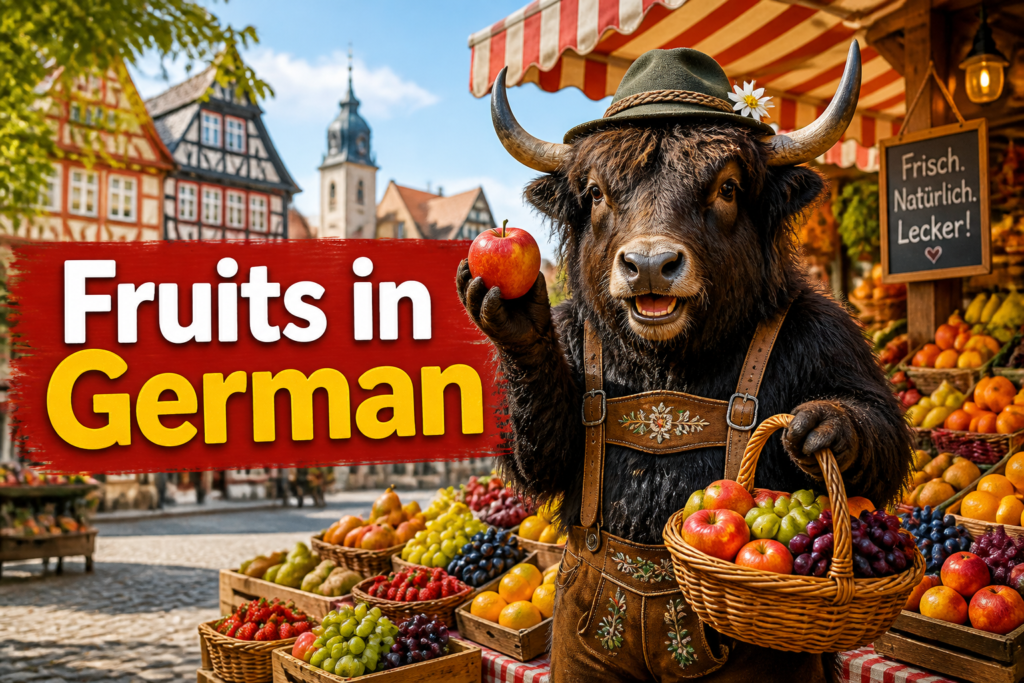
Learning fruit names in German is one of those tiny wins that pays off everywhere: at the supermarket, in a café, at breakfast, at the market, and in that very normal moment when someone offers you einen Apfel and you want to sound like you belong there instead of doing anxious fruit mime.
The good news? German fruit words are practical, memorable, and useful fast. The slightly annoying news? Nouns have genders, plural forms can be weird, and German enjoys capital letters for no apparent emotional reason. Still, once you know the basics, fruit shopping becomes much easier.
If you want a quick refresher on how everyday German words fit together, it also helps to browse the essential German words and phrases and popular German phrases guides. They go nicely with this topic. And yes, the grammar will survive.
Common Fruits In German
Here are the fruits you will actually use in real life first. The pronunciation help is simple, not scholarly. Nobody needs a phonetics dissertation before breakfast.
| German | Pronunciation | Meaning | Example Sentence | Translation | Learner Note |
|---|---|---|---|---|---|
| der Apfel | AH-pfuhl | apple | Ich esse einen Apfel. | I am eating an apple. | Masculine noun: der. Very common. |
| die Banane | bah-NAH-nuh | banana | Die Banane ist reif. | The banana is ripe. | Feminine noun: die. |
| die Orange | oh-RAHN-zheh | orange | Ich kaufe eine Orange. | I’m buying an orange. | Ends in -e, feminine. |
| die Birne | BEER-nuh | pear | Die Birne ist sehr saftig. | The pear is very juicy. | Also means “light bulb” in some contexts. |
| die Erdbeere | EERT-beh-reh | strawberry | Ich mag Erdbeeren mit Joghurt. | I like strawberries with yogurt. | Plural: Erdbeeren. Very useful. |
| die Traube | TROW-buh | grape | Die Trauben sind süß. | The grapes are sweet. | Singular Traube, plural Trauben. |
| die Kirsche | KIR-shuh | cherry | Die Kirschen schmecken toll. | The cherries taste great. | Plural often used in real life. |
| die Pflaume | PFLOW-muh | plum | Ich nehme zwei Pflaumen. | I’ll take two plums. | The pf sound is a little crunchy. That’s normal. |
| die Zitrone | tsi-TROH-nuh | lemon | Bitte mit Zitrone. | With lemon, please. | Useful in cafés and restaurants. |
| die Limette | lee-MET-tuh | lime | Die Limette passt gut zum Drink. | The lime goes well with the drink. | Common in cocktails and soft drinks. |
More Fruits You’ll See Often
| German | Pronunciation | Meaning | Example Sentence | Translation | Learner Note |
|---|---|---|---|---|---|
| die Mango | MAHN-go | mango | Die Mango ist noch nicht reif. | The mango is not ripe yet. | Borrowed word; easy spelling. |
| die Ananas | AH-nah-nahs | pineapple | Ich esse gern Ananas. | I like eating pineapple. | Usually no plural needed in everyday use. |
| die Kiwi | KEE-wee | kiwi | Die Kiwi ist sauer. | The kiwi is sour. | Pronunciation is easy for English speakers. |
| die Melone | meh-LOH-nuh | melon | Im Sommer esse ich gern Melone. | In summer I like eating melon. | Can mean melon generally; context tells you more. |
| die Wassermelone | VAH-ser-meh-LOH-nuh | watermelon | Die Wassermelone ist kalt. | The watermelon is cold. | Compound noun: Wasser + Melone. |
| die Aprikose | ah-pree-KOH-zuh | apricot | Ich probiere eine Aprikose. | I’m trying an apricot. | In some regions you may also hear Marille in Austria. |
| die Heidelbeere | HY-dl-beh-reh | blueberry | Heidelbeeren sind teuer. | Blueberries are expensive. | Very common in shops and recipes. |
| die Himbeere | HIM-beh-reh | raspberry | Ich nehme Himbeeren für den Kuchen. | I’m taking raspberries for the cake. | Looks long, but it is a friendly word. |
| die Brombeere | BROHM-beh-reh | blackberry | Die Brombeeren wachsen im Garten. | The blackberries grow in the garden. | Good for nature words and food words. |
| die Feige | FY-guh | fig | Die Feige schmeckt süß. | The fig tastes sweet. | Short and useful in food descriptions. |
One small note: German often uses the plural in situations where English might use a singular mass noun. So Trauben, Erdbeeren, and Bananen show up a lot in everyday shopping and recipe talk. Plurals are not here to ruin your day. They only want attention.
Helpful memory trick: many fruit names are feminine in German, but not all. Don’t guess too confidently. German loves to make “just memorize it” look like a personality trait.
Useful Fruit Phrases For Real Life
These are the phrases that come up in markets, shops, cafés, kitchens, and casual conversations. They are short, practical, and easy to recycle in real situations.
| German | Pronunciation | Meaning | Example Sentence | Translation | Learner Note |
|---|---|---|---|---|---|
| Ich hätte gern einen Apfel. | ikh HET-tuh gern EYE-nen AH-pfuhl | I’d like an apple. | Ich hätte gern einen Apfel und eine Banane. | I’d like an apple and a banana. | Very natural and polite in shops. |
| Haben Sie frisches Obst? | HAH-ben zee FRISH-es ohpst | Do you have fresh fruit? | Haben Sie frisches Obst aus der Region? | Do you have fresh fruit from the region? | Polite form with Sie. |
| Die Äpfel sind sehr billig. | dee EP-fel zint zair BIL-likh | The apples are very cheap. | Die Äpfel sind heute billig. | The apples are cheap today. | Ä sounds like “eh” in many words. |
| Die Bananen sind reif. | dee bah-NAH-nen zint ryeff | The bananas are ripe. | Die Bananen sind noch nicht reif. | The bananas are not ripe yet. | Ripe = reif, not reife here. |
| Was kostet die Kilo-Tüte Äpfel? | vahs KOS-tet dee KEE-loh-TYOO-tuh EP-fel | How much does the kilo bag of apples cost? | Was kostet ein Kilo Äpfel? | How much is one kilo of apples? | In shops, weight questions are common. |
| Ich nehme zwei Kilo Orangen. | ikh NAY-muh tsvy KEE-loh oh-RAHN-zhən | I’ll take two kilos of oranges. | Ich nehme ein Kilo Orangen. | I’ll take one kilo of oranges. | Orangen is the plural form you’ll hear most. |
| Mit oder ohne Schale? | mit OH-der OH-nuh SHAH-luh | With or without peel? | Mit oder ohne Schale, bitte? | With or without peel, please? | Handy for fruit cups and sliced fruit. |
| Das Obst ist sehr saftig. | dahs ohpst ist zair ZAHF-tikh | The fruit is very juicy. | Die Mango ist saftig. | The mango is juicy. | Obst is usually uncountable in German. |
| Die Erdbeeren schmecken süß. | dee EERT-beh-ren SHMEK-en zües | The strawberries taste sweet. | Die Erdbeeren schmecken heute besonders süß. | The strawberries taste especially sweet today. | schmecken = to taste; often used for food. |
| Ich mag keine Kirschen. | ikh mahk KY-nuh KIR-shen | I don’t like cherries. | Ich mag keine Kirschen, aber mein Bruder schon. | I don’t like cherries, but my brother does. | Use kein with nouns, not nicht. |
| Kann ich noch eine Birne haben? | kahn ikh nokh EYE-nuh BEER-nuh HAH-ben | Can I have another pear? | Kann ich noch eine Banane haben? | Can I have another banana? | Natural in casual requests. |
| Das ist ein leckerer Fruchtsalat. | dahs ist EYN LEK-ker-er FROOKHT-zah-lat | That is a tasty fruit salad. | Der Fruchtsalat ist wirklich lecker. | The fruit salad is really tasty. | Fruchtsalat is a handy compound noun. |
Obst, Früchte, And Fruit Names
This is where German gets a little picky, because of course it does. You’ll often see both Obst and Früchte, but they are not used in exactly the same way.
| Word | Pronunciation | Meaning | Example Sentence | Translation | Learner Note |
|---|---|---|---|---|---|
| das Obst | dahs ohpst | fruit, fruit as a category | Obst ist gesund. | Fruit is healthy. | Usually uncountable in German. |
| die Frucht | dee frookht | fruit, a fruit, produce | Diese Frucht ist exotisch. | This fruit is exotic. | More countable than Obst. |
| die Früchte | dee FRYKH-tuh | fruits | Früchte sind im Sommer günstig. | Fruits are cheap in summer. | Plural of Frucht; pronunciation is a bit tricky. |
| das Obst und Gemüse | dahs ohpst oont guh-MYOO-zuh | fruit and vegetables | Ich kaufe Obst und Gemüse auf dem Markt. | I buy fruit and vegetables at the market. | Very common grocery phrase. |
For everyday shopping, Obst is the safest word. If you want to talk about specific kinds of fruits, use the fruit names directly: Äpfel, Bananen, Orangen, and so on. That keeps your German clean and natural.
Grammar Notes You’ll Actually Use
You do not need a giant grammar mountain here. Just a few practical patterns will make your fruit sentences sound much better.
| Pattern | Meaning | German Example | English Translation | Learner Note |
|---|---|---|---|---|
| Ich hätte gern + noun | Polite way to ask for something | Ich hätte gern eine Mango. | I’d like a mango. | Very useful in cafés and shops. |
| ein / eine + noun | “a / an” | eine Banane, ein Apfel | a banana, an apple | ein with masculine/neuter; eine with feminine. |
| die + plural noun | the + plural | die Äpfel | the apples | Plural articles often look simple. Enjoy that rare moment. |
| keine + noun | no / not any | Ich mag keine Birnen. | I don’t like pears. | Use kein for nouns, not nicht. |
| schmecken + adjective | to taste + description | Die Erdbeeren schmecken süß. | The strawberries taste sweet. | Common for food opinions. |
| mit / ohne | with / without | Mit Zitrone, bitte. | With lemon, please. | Useful in cafés, tea, water, desserts. |
German word order stays pretty sensible in simple fruit sentences. The verb usually comes second:
- Ich kaufe heute Äpfel.
- Wir essen morgens Obst.
- Er nimmt zwei Bananen.
If you want more general practice with these everyday structures, the main German learning page is a good place to keep moving after this article.
Pronunciation Tips For Fruit Words
Most fruit words are friendly, but a few sounds deserve a small heads-up. Nothing dramatic. Just enough to avoid sounding like you swallowed a dictionary.
- ä sounds like the “e” in “bed” in many words: Äpfel = EP-fel.
- ch is softer than English k: Pfirsich = FEER-zikh.
- pf in Pflaume starts with a puffed “p” plus “f”. It is weird, but very German.
- z sounds like “ts”: Zitrone = tsi-TROH-nuh.
- sch sounds like “sh”: Kirsche = KIR-shuh.
- Final consonants are often devoiced: obst sounds more like “ohpst,” not “obz.”
For a dictionary-style pronunciation check, Duden is a solid boring source when you want to confirm spelling, meaning, and form. Boring is good. Boring is reliable.
Germany, Austria, And Switzerland Notes
Most fruit words are the same in standard German across German-speaking countries, but a few regional differences are worth knowing so you do not get blindsided by local vocabulary.
| Standard German | Regionally Different Form | Where You May Hear It | Learner Note |
|---|---|---|---|
| die Aprikose | die Marille | Austria | Same fruit, different word. Don’t panic. |
| die Kartoffel is not a fruit, obviously | Erdapfel is a potato in Austria | Austria | This is a famous trap word. Not a fruit. Not even close. |
| die Zwetschge | die Pflaume / die Zwetschge | Germany, Austria | Can refer to a plum variety; recipes may vary. |
| der Apfel | same | Germany, Austria, Switzerland | One of your safest bets anywhere. |
Most of the time, standard German fruit vocabulary will work perfectly well in shops, travel situations, and everyday conversation. If a regional form pops up, context usually saves the day. German is strict, but not cruel. Usually.
Mini Practice
Try these quick drills. They’re short on purpose. Fruit vocabulary is not a punishment.
- Translate: “I’d like two apples.” → Ich hätte gern zwei Äpfel.
- Translate: “The strawberries are sweet.” → Die Erdbeeren sind süß.
- Fill in the blank: Ich mag keine ____. (cherries) → Kirschen
- Choose the correct article: __ Banane → die
- Choose the correct article: __ Apfel → der
- Say it naturally: Mit oder ohne Schale? = with or without peel?
Want a slightly wider word base before memorizing every fruit in the shop? The guide to compliments in German is oddly useful too, because food and praise both show up in real conversations, and yes, telling someone their fruit salad looks good is a very human thing to do.
Common Mistakes And Easy Fixes
| Mistake | Correct Form | Why |
|---|---|---|
| Ich mag nicht Kirschen. | Ich mag keine Kirschen. | Use kein with nouns, not nicht. |
| Die Obst ist gesund. | Obst ist gesund. | Obst is neuter, so it normally takes no article here. |
| Ein Banane | Eine Banane | Banane is feminine, so use eine. |
| Der Orange | Die Orange | Orange is feminine in standard German. |
| Ich esse ein Erdbeere. | Ich esse eine Erdbeere. | Erdbeere is feminine. |
| Frucht confused with Obst | Use the word that fits the context | Obst is the general category; Frucht is more specific or countable. |
If you are ordering or shopping, Ich hätte gern… is often better than the straight-up English-style Ich will…. The first one sounds polite. The second one sounds bossy. German can do bossy just fine, but the cashier did not ask for that energy.
Yak takeaway: Learn the fruit nouns with their articles, remember Obst for fruit in general, and use Ich hätte gern… when buying food. That alone gets you surprisingly far. Tiny words, big payoff.