Health and symptom icons labeled in Spanish

Health Vocabulary in Spanish: 85 Words and Phrases for Symptoms

SpanishPronunciationMeaningExample SentenceTranslationLearner Note
un pocooon POH-koha littleMe duele un poco la espalda.My back hurts a little.Very common softener.
bastantebahs-TAHN-tehquite / fairly / a lotMe duele bastante la pierna.My leg hurts quite a lot.Flexible word. Context matters.
muchoMOO-chohvery much / a lotMe duele mucho la garganta.My throat hurts a lot.Strong and simple.
muy fuertemwee FWEHR-tehvery strong / severeEl dolor es muy fuerte.The pain is very severe.Good for serious pain.
leveLEH-behmildEs un dolor leve.It’s mild pain.Common in medical descriptions.
graveGRAH-behseriousEs algo grave.It’s something serious.Important adjective in health contexts.
repentinoreh-pehn-TEE-nohsuddenEl dolor fue repentino.The pain was sudden.Useful for describing onset.

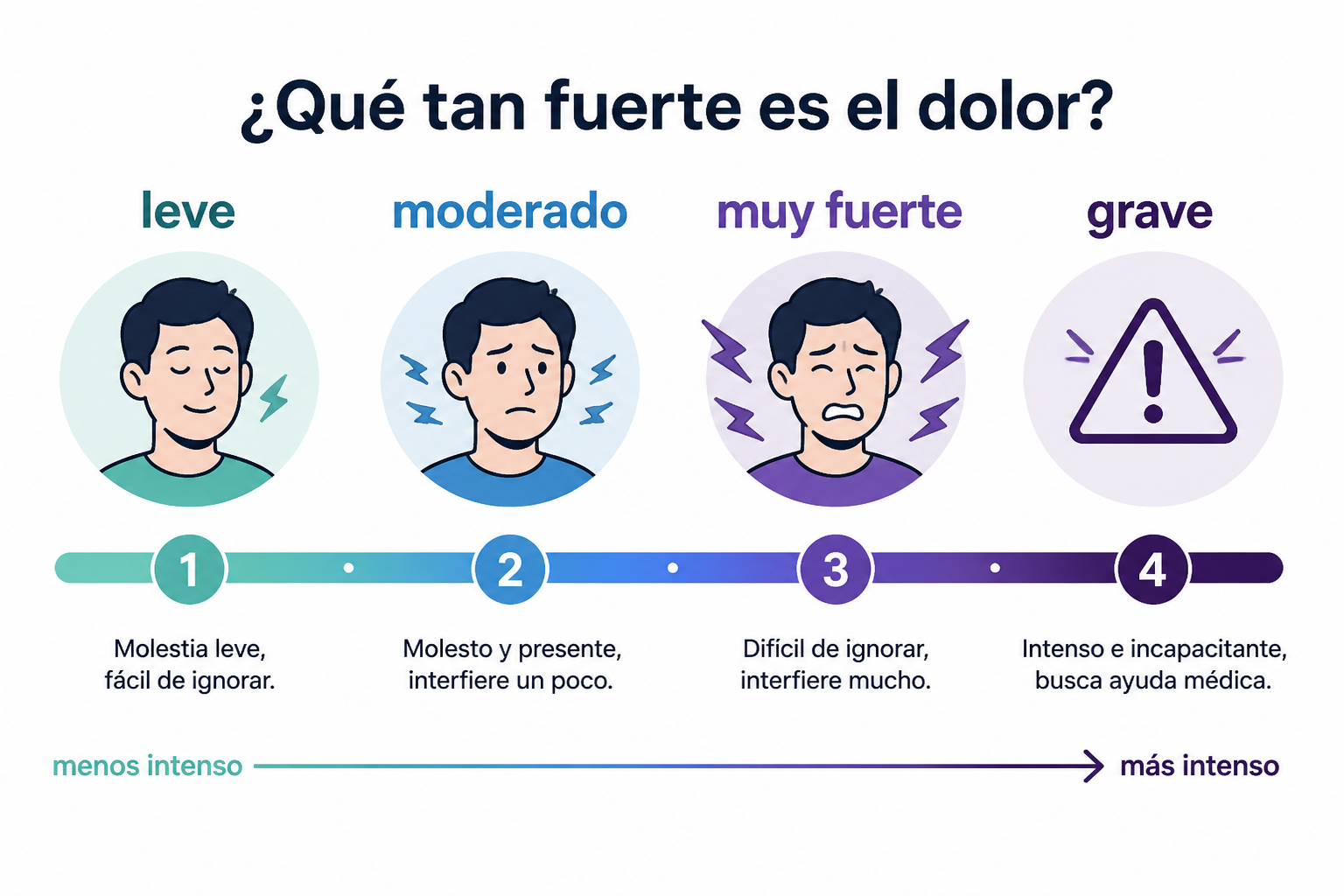
Simple symptom intensity scale from mild to severe

Useful Verbs For Talking About Health

These verbs show up constantly. They are small, stubborn, and ridiculously useful. Learn them and you’ll suddenly understand much more medical Spanish than you expected.

SpanishPronunciationMeaningExample SentenceTranslationLearner Note
sentirseseen-TEER-sehto feel¿Cómo te sientes hoy?How do you feel today?Reflexive verb.
estar enfermo/aehs-TAHR ehn-FEHR-moh / ehn-FEHR-mahto be sickEstoy enfermo y no voy a trabajar.I’m sick and I’m not going to work.Use estar for temporary states.
tenerteh-NEHRto haveTengo tos y fiebre.I have a cough and fever.One of the most common symptom verbs.
tomartoh-MAHRto take / to drinkTomé la medicina después de cenar.I took the medicine after dinner.Often used for medicine.
descansardehs-kahn-SAHRto restNecesito descansar un poco.
SpanishPronunciationMeaningExample SentenceTranslationLearner Note
la medicinalah meh-dee-SEE-nahmedicine / medicationTomé la medicina a tiempo.I took the medicine on time.Can mean medicine in general.
la pastillalah pahs-TEE-yahpillNecesito una pastilla para el dolor.I need a pill for the pain.Very common in pharmacies.
el jarabeel hah-RAH-behsyrupEl jarabe me ayuda a dormir.The syrup helps me sleep.j is a strong throat sound.
la recetalah reh-SEH-tahprescriptionNecesito una receta médica.I need a medical prescription.Different from a cooking recipe.
el médico / la médicael MEH-dee-koh / lah MEH-dee-kahdoctorLa médica me hizo preguntas.The doctor asked me questions.Gendered noun. In many places doctor is also used.
la enfermera / el enfermerolah ehn-fehr-MEH-rah / el ehn-fehr-MEH-rohnurseLa enfermera fue muy amable.The nurse was very kind.Gender changes with the person.
la clínicalah KLEE-nee-kahclinicVoy a la clínica esta tarde.I’m going to the clinic this afternoon.Useful for appointments.
el hospitalel ohs-pee-TAHLhospitalLo llevaron al hospital.They took him to the hospital.h is silent.
la farmacialah fahr-MAH-syahpharmacyVoy a la farmacia a comprar algo.I’m going to the pharmacy to buy something.Very useful when traveling.
la emergencialah eh-mehr-HEN-syahemergencyEs una emergencia.It’s an emergency.Say this clearly and simply.
el seguroel seh-GOO-rohinsurance¿Aceptan seguro médico?Do you accept medical insurance?Common in practical travel Spanish.
la citalah SEE-tahappointmentTengo una cita con el doctor.I have an appointment with the doctor.Very common in medical contexts.

Describing How Bad It Is

Once you know the symptom, the next job is saying how strong it is. Spanish uses simple intensity words for this, and they’re worth memorizing because “a little pain” and “I need help now” are not the same vibe at all.

SpanishPronunciationMeaningExample SentenceTranslationLearner Note
un pocooon POH-koha littleMe duele un poco la espalda.My back hurts a little.Very common softener.
bastantebahs-TAHN-tehquite / fairly / a lotMe duele bastante la pierna.My leg hurts quite a lot.Flexible word. Context matters.
muchoMOO-chohvery much / a lotMe duele mucho la garganta.My throat hurts a lot.Strong and simple.
muy fuertemwee FWEHR-tehvery strong / severeEl dolor es muy fuerte.The pain is very severe.Good for serious pain.
leveLEH-behmildEs un dolor leve.It’s mild pain.Common in medical descriptions.
graveGRAH-behseriousEs algo grave.It’s something serious.Important adjective in health contexts.
repentinoreh-pehn-TEE-nohsuddenEl dolor fue repentino.The pain was sudden.Useful for describing onset.

Simple symptom intensity scale from mild to severe

Useful Verbs For Talking About Health

These verbs show up constantly. They are small, stubborn, and ridiculously useful. Learn them and you’ll suddenly understand much more medical Spanish than you expected.

SpanishPronunciationMeaningExample SentenceTranslationLearner Note
sentirseseen-TEER-sehto feel¿Cómo te sientes hoy?How do you feel today?Reflexive verb.
estar enfermo/aehs-TAHR ehn-FEHR-moh / ehn-FEHR-mahto be sickEstoy enfermo y no voy a trabajar.I’m sick and I’m not going to work.Use estar for temporary states.
tenerteh-NEHRto haveTengo tos y fiebre.I have a cough and fever.One of the most common symptom verbs.
tomartoh-MAHRto take / to drinkTomé la medicina después de cenar.I took the medicine after dinner.Often used for medicine.
descansardehs-kahn-SAHRto restNecesito descansar un poco.
PatternMeaningSpanish ExampleEnglish TranslationLearner Note
Me duele + singular body partOne thing hurtsMe duele la cabeza.My head hurts.Use with singular nouns.
Me duelen + plural body partsMore than one thing hurtsMe duelen los ojos.My eyes hurt.Plural noun = plural verb.
Tengo + symptomI have a symptomTengo fiebre.I have a fever.Very common with health vocabulary.
Siento + symptomI feel a symptomSiento mareo.I feel dizzy.Often used for sensations.

Common Ailments And Basic Health Words

These are the kinds of words you hear in pharmacies, clinics, and everyday conversation. Nothing fancy. Just the practical stuff that helps you survive adult life in another language.

SpanishPronunciationMeaningExample SentenceTranslationLearner Note
la medicinalah meh-dee-SEE-nahmedicine / medicationTomé la medicina a tiempo.I took the medicine on time.Can mean medicine in general.
la pastillalah pahs-TEE-yahpillNecesito una pastilla para el dolor.I need a pill for the pain.Very common in pharmacies.
el jarabeel hah-RAH-behsyrupEl jarabe me ayuda a dormir.The syrup helps me sleep.j is a strong throat sound.
la recetalah reh-SEH-tahprescriptionNecesito una receta médica.I need a medical prescription.Different from a cooking recipe.
el médico / la médicael MEH-dee-koh / lah MEH-dee-kahdoctorLa médica me hizo preguntas.The doctor asked me questions.Gendered noun. In many places doctor is also used.
la enfermera / el enfermerolah ehn-fehr-MEH-rah / el ehn-fehr-MEH-rohnurseLa enfermera fue muy amable.The nurse was very kind.Gender changes with the person.
la clínicalah KLEE-nee-kahclinicVoy a la clínica esta tarde.I’m going to the clinic this afternoon.Useful for appointments.
el hospitalel ohs-pee-TAHLhospitalLo llevaron al hospital.They took him to the hospital.h is silent.
la farmacialah fahr-MAH-syahpharmacyVoy a la farmacia a comprar algo.I’m going to the pharmacy to buy something.Very useful when traveling.
la emergencialah eh-mehr-HEN-syahemergencyEs una emergencia.It’s an emergency.Say this clearly and simply.
el seguroel seh-GOO-rohinsurance¿Aceptan seguro médico?Do you accept medical insurance?Common in practical travel Spanish.
la citalah SEE-tahappointmentTengo una cita con el doctor.I have an appointment with the doctor.Very common in medical contexts.

Describing How Bad It Is

Once you know the symptom, the next job is saying how strong it is. Spanish uses simple intensity words for this, and they’re worth memorizing because “a little pain” and “I need help now” are not the same vibe at all.

SpanishPronunciationMeaningExample SentenceTranslationLearner Note
un pocooon POH-koha littleMe duele un poco la espalda.My back hurts a little.Very common softener.
bastantebahs-TAHN-tehquite / fairly / a lotMe duele bastante la pierna.My leg hurts quite a lot.Flexible word. Context matters.
muchoMOO-chohvery much / a lotMe duele mucho la garganta.My throat hurts a lot.Strong and simple.
muy fuertemwee FWEHR-tehvery strong / severeEl dolor es muy fuerte.The pain is very severe.Good for serious pain.
leveLEH-behmildEs un dolor leve.It’s mild pain.Common in medical descriptions.
graveGRAH-behseriousEs algo grave.It’s something serious.Important adjective in health contexts.
repentinoreh-pehn-TEE-nohsuddenEl dolor fue repentino.The pain was sudden.Useful for describing onset.

Simple symptom intensity scale from mild to severe

Useful Verbs For Talking About Health

These verbs show up constantly. They are small, stubborn, and ridiculously useful. Learn them and you’ll suddenly understand much more medical Spanish than you expected.

SpanishPronunciationMeaningExample SentenceTranslationLearner Note
sentirseseen-TEER-sehto feel¿Cómo te sientes hoy?How do you feel today?Reflexive verb.
estar enfermo/aehs-TAHR ehn-FEHR-moh / ehn-FEHR-mahto be sickEstoy enfermo y no voy a trabajar.I’m sick and I’m not going to work.Use estar for temporary states.
tenerteh-NEHRto haveTengo tos y fiebre.I have a cough and fever.One of the most common symptom verbs.
tomartoh-MAHRto take / to drinkTomé la medicina después de cenar.I took the medicine after dinner.Often used for medicine.
descansardehs-kahn-SAHRto restNecesito descansar un poco.
SpanishPronunciationMeaningExample SentenceTranslationLearner Note
dolordoh-LOHRpainTengo mucho dolor en la pierna.I have a lot of pain in my leg.Very common noun.
me duelemeh DWEH-lehit hurts me / I have pain inMe duele la rodilla.My knee hurts.Use with one body part.
me duelenmeh DWEH-lenthey hurt me / I have pain inMe duelen los pies.My feet hurt.Use with plural body parts.
ardorahr-DOHRburning / burning sensationSiento ardor en los ojos.I feel burning in my eyes.Can be used for skin, eyes, stomach, etc.
picazónpee-kah-SONitchingTengo picazón en la piel.I have itching on my skin.In some places people also say comezón.
hinchazóneen-chah-SONswellingHay hinchazón en el tobillo.There is swelling in the ankle.Medical and clear.
náuseasNOW-seh-ahsnauseaTengo náuseas desde la mañana.I’ve had nausea since morning.Usually plural in Spanish.
mareomah-REH-ohdizzinessSiento mareo cuando me levanto.I feel dizzy when I stand up.Useful for “dizzy” feelings.
tostohscoughTengo tos seca.I have a dry cough.tos seca = dry cough.
estornudarehs-tohr-noo-DAHRto sneezeEmpiezo a estornudar cuando hay polvo.I start sneezing when there is dust.Infinitive verb.
gripeGREE-pehfluTengo gripe y no puedo salir.I have the flu and can’t go out.More serious than a cold.
resfriadores-free-AH-dohcoldCreo que tengo un resfriado.I think I have a cold.Very common in Latin America and Spain.
fiebreFYEH-brehfeverLa fiebre no baja.The fever isn’t going down.Commonly used with tener.
cansanciokahn-SAHN-syohtiredness / fatigueSiento mucho cansancio hoy.I feel very tired today.Can suggest more than ordinary tiredness.
debilidaddeh-bee-lee-DAHDweaknessTengo debilidad en las piernas.I have weakness in my legs.More formal / medical.

Rule: me duele goes with one thing. me duelen goes with more than one.

PatternMeaningSpanish ExampleEnglish TranslationLearner Note
Me duele + singular body partOne thing hurtsMe duele la cabeza.My head hurts.Use with singular nouns.
Me duelen + plural body partsMore than one thing hurtsMe duelen los ojos.My eyes hurt.Plural noun = plural verb.
Tengo + symptomI have a symptomTengo fiebre.I have a fever.Very common with health vocabulary.
Siento + symptomI feel a symptomSiento mareo.I feel dizzy.Often used for sensations.

Common Ailments And Basic Health Words

These are the kinds of words you hear in pharmacies, clinics, and everyday conversation. Nothing fancy. Just the practical stuff that helps you survive adult life in another language.

SpanishPronunciationMeaningExample SentenceTranslationLearner Note
la medicinalah meh-dee-SEE-nahmedicine / medicationTomé la medicina a tiempo.I took the medicine on time.Can mean medicine in general.
la pastillalah pahs-TEE-yahpillNecesito una pastilla para el dolor.I need a pill for the pain.Very common in pharmacies.
el jarabeel hah-RAH-behsyrupEl jarabe me ayuda a dormir.The syrup helps me sleep.j is a strong throat sound.
la recetalah reh-SEH-tahprescriptionNecesito una receta médica.I need a medical prescription.Different from a cooking recipe.
el médico / la médicael MEH-dee-koh / lah MEH-dee-kahdoctorLa médica me hizo preguntas.The doctor asked me questions.Gendered noun. In many places doctor is also used.
la enfermera / el enfermerolah ehn-fehr-MEH-rah / el ehn-fehr-MEH-rohnurseLa enfermera fue muy amable.The nurse was very kind.Gender changes with the person.
la clínicalah KLEE-nee-kahclinicVoy a la clínica esta tarde.I’m going to the clinic this afternoon.Useful for appointments.
el hospitalel ohs-pee-TAHLhospitalLo llevaron al hospital.They took him to the hospital.h is silent.
la farmacialah fahr-MAH-syahpharmacyVoy a la farmacia a comprar algo.I’m going to the pharmacy to buy something.Very useful when traveling.
la emergencialah eh-mehr-HEN-syahemergencyEs una emergencia.It’s an emergency.Say this clearly and simply.
el seguroel seh-GOO-rohinsurance¿Aceptan seguro médico?Do you accept medical insurance?Common in practical travel Spanish.
la citalah SEE-tahappointmentTengo una cita con el doctor.I have an appointment with the doctor.Very common in medical contexts.

Describing How Bad It Is

Once you know the symptom, the next job is saying how strong it is. Spanish uses simple intensity words for this, and they’re worth memorizing because “a little pain” and “I need help now” are not the same vibe at all.

SpanishPronunciationMeaningExample SentenceTranslationLearner Note
un pocooon POH-koha littleMe duele un poco la espalda.My back hurts a little.Very common softener.
bastantebahs-TAHN-tehquite / fairly / a lotMe duele bastante la pierna.My leg hurts quite a lot.Flexible word. Context matters.
muchoMOO-chohvery much / a lotMe duele mucho la garganta.My throat hurts a lot.Strong and simple.
muy fuertemwee FWEHR-tehvery strong / severeEl dolor es muy fuerte.The pain is very severe.Good for serious pain.
leveLEH-behmildEs un dolor leve.It’s mild pain.Common in medical descriptions.
graveGRAH-behseriousEs algo grave.It’s something serious.Important adjective in health contexts.
repentinoreh-pehn-TEE-nohsuddenEl dolor fue repentino.The pain was sudden.Useful for describing onset.

Simple symptom intensity scale from mild to severe

Useful Verbs For Talking About Health

These verbs show up constantly. They are small, stubborn, and ridiculously useful. Learn them and you’ll suddenly understand much more medical Spanish than you expected.

SpanishPronunciationMeaningExample SentenceTranslationLearner Note
sentirseseen-TEER-sehto feel¿Cómo te sientes hoy?How do you feel today?Reflexive verb.
estar enfermo/aehs-TAHR ehn-FEHR-moh / ehn-FEHR-mahto be sickEstoy enfermo y no voy a trabajar.I’m sick and I’m not going to work.Use estar for temporary states.
tenerteh-NEHRto haveTengo tos y fiebre.I have a cough and fever.One of the most common symptom verbs.
tomartoh-MAHRto take / to drinkTomé la medicina después de cenar.I took the medicine after dinner.Often used for medicine.
descansardehs-kahn-SAHRto restNecesito descansar un poco.
SpanishPronunciationMeaningExample SentenceTranslationLearner Note
la cabezalah kah-BEH-sahheadMe golpeé la cabeza.I hit my head.Feminine noun. Use la.
el ojoel OH-hoeyeMe arde el ojo derecho.My right eye burns.j sounds like a strong “h.”
la narizlah nah-REESnoseTengo la nariz tapada.I have a blocked nose.z in Latin America sounds like an s.
la gargantalah gahr-GAHN-tahthroatMe duele la garganta al tragar.My throat hurts when I swallow.Very common with colds and infections.
el pechoel PEH-chochestSiento presión en el pecho.I feel pressure in my chest.Important word in medical settings.
la espaldalah ehs-PAHL-dahbackMe duele la espalda baja.My lower back hurts.espalda baja = lower back.
el brazoel BRAH-soarmMe duele el brazo izquierdo.My left arm hurts.Useful after exercise or injury.
la manolah MAH-nohandMe corté la mano con papel.I cut my hand with paper.Painfully common. Paper is rude like that.
la piernalah PYEHR-nahlegMe duele la pierna al caminar.My leg hurts when I walk.Use for the whole leg.
el pieel pyehfootMe lastimé el pie jugando fútbol.I hurt my foot playing soccer.Plural is los pies.
el estómagoel ehs-TOH-mah-gohstomach / bellyMe duele el estómago después de comer mucho.My stomach hurts after eating a lot.In everyday speech, people often mean the belly area.
la piellah pyehlskinMe pica la piel.My skin itches.Common for allergies and irritation.

Symptoms And How To Say What Hurts

Spanish often uses me duele for “it hurts me” and tengo for “I have” when talking about symptoms. That’s the big pattern. Once you get that, lots of health talk becomes far less mysterious and far less theatrical.

SpanishPronunciationMeaningExample SentenceTranslationLearner Note
dolordoh-LOHRpainTengo mucho dolor en la pierna.I have a lot of pain in my leg.Very common noun.
me duelemeh DWEH-lehit hurts me / I have pain inMe duele la rodilla.My knee hurts.Use with one body part.
me duelenmeh DWEH-lenthey hurt me / I have pain inMe duelen los pies.My feet hurt.Use with plural body parts.
ardorahr-DOHRburning / burning sensationSiento ardor en los ojos.I feel burning in my eyes.Can be used for skin, eyes, stomach, etc.
picazónpee-kah-SONitchingTengo picazón en la piel.I have itching on my skin.In some places people also say comezón.
hinchazóneen-chah-SONswellingHay hinchazón en el tobillo.There is swelling in the ankle.Medical and clear.
náuseasNOW-seh-ahsnauseaTengo náuseas desde la mañana.I’ve had nausea since morning.Usually plural in Spanish.
mareomah-REH-ohdizzinessSiento mareo cuando me levanto.I feel dizzy when I stand up.Useful for “dizzy” feelings.
tostohscoughTengo tos seca.I have a dry cough.tos seca = dry cough.
estornudarehs-tohr-noo-DAHRto sneezeEmpiezo a estornudar cuando hay polvo.I start sneezing when there is dust.Infinitive verb.
gripeGREE-pehfluTengo gripe y no puedo salir.I have the flu and can’t go out.More serious than a cold.
resfriadores-free-AH-dohcoldCreo que tengo un resfriado.I think I have a cold.Very common in Latin America and Spain.
fiebreFYEH-brehfeverLa fiebre no baja.The fever isn’t going down.Commonly used with tener.
cansanciokahn-SAHN-syohtiredness / fatigueSiento mucho cansancio hoy.I feel very tired today.Can suggest more than ordinary tiredness.
debilidaddeh-bee-lee-DAHDweaknessTengo debilidad en las piernas.I have weakness in my legs.More formal / medical.

Rule: me duele goes with one thing. me duelen goes with more than one.

PatternMeaningSpanish ExampleEnglish TranslationLearner Note
Me duele + singular body partOne thing hurtsMe duele la cabeza.My head hurts.Use with singular nouns.
Me duelen + plural body partsMore than one thing hurtsMe duelen los ojos.My eyes hurt.Plural noun = plural verb.
Tengo + symptomI have a symptomTengo fiebre.I have a fever.Very common with health vocabulary.
Siento + symptomI feel a symptomSiento mareo.I feel dizzy.Often used for sensations.

Common Ailments And Basic Health Words

These are the kinds of words you hear in pharmacies, clinics, and everyday conversation. Nothing fancy. Just the practical stuff that helps you survive adult life in another language.

SpanishPronunciationMeaningExample SentenceTranslationLearner Note
la medicinalah meh-dee-SEE-nahmedicine / medicationTomé la medicina a tiempo.I took the medicine on time.Can mean medicine in general.
la pastillalah pahs-TEE-yahpillNecesito una pastilla para el dolor.I need a pill for the pain.Very common in pharmacies.
el jarabeel hah-RAH-behsyrupEl jarabe me ayuda a dormir.The syrup helps me sleep.j is a strong throat sound.
la recetalah reh-SEH-tahprescriptionNecesito una receta médica.I need a medical prescription.Different from a cooking recipe.
el médico / la médicael MEH-dee-koh / lah MEH-dee-kahdoctorLa médica me hizo preguntas.The doctor asked me questions.Gendered noun. In many places doctor is also used.
la enfermera / el enfermerolah ehn-fehr-MEH-rah / el ehn-fehr-MEH-rohnurseLa enfermera fue muy amable.The nurse was very kind.Gender changes with the person.
la clínicalah KLEE-nee-kahclinicVoy a la clínica esta tarde.I’m going to the clinic this afternoon.Useful for appointments.
el hospitalel ohs-pee-TAHLhospitalLo llevaron al hospital.They took him to the hospital.h is silent.
la farmacialah fahr-MAH-syahpharmacyVoy a la farmacia a comprar algo.I’m going to the pharmacy to buy something.Very useful when traveling.
la emergencialah eh-mehr-HEN-syahemergencyEs una emergencia.It’s an emergency.Say this clearly and simply.
el seguroel seh-GOO-rohinsurance¿Aceptan seguro médico?Do you accept medical insurance?Common in practical travel Spanish.
la citalah SEE-tahappointmentTengo una cita con el doctor.I have an appointment with the doctor.Very common in medical contexts.

Describing How Bad It Is

Once you know the symptom, the next job is saying how strong it is. Spanish uses simple intensity words for this, and they’re worth memorizing because “a little pain” and “I need help now” are not the same vibe at all.

SpanishPronunciationMeaningExample SentenceTranslationLearner Note
un pocooon POH-koha littleMe duele un poco la espalda.My back hurts a little.Very common softener.
bastantebahs-TAHN-tehquite / fairly / a lotMe duele bastante la pierna.My leg hurts quite a lot.Flexible word. Context matters.
muchoMOO-chohvery much / a lotMe duele mucho la garganta.My throat hurts a lot.Strong and simple.
muy fuertemwee FWEHR-tehvery strong / severeEl dolor es muy fuerte.The pain is very severe.Good for serious pain.
leveLEH-behmildEs un dolor leve.It’s mild pain.Common in medical descriptions.
graveGRAH-behseriousEs algo grave.It’s something serious.Important adjective in health contexts.
repentinoreh-pehn-TEE-nohsuddenEl dolor fue repentino.The pain was sudden.Useful for describing onset.

Simple symptom intensity scale from mild to severe

Useful Verbs For Talking About Health

These verbs show up constantly. They are small, stubborn, and ridiculously useful. Learn them and you’ll suddenly understand much more medical Spanish than you expected.

SpanishPronunciationMeaningExample SentenceTranslationLearner Note
sentirseseen-TEER-sehto feel¿Cómo te sientes hoy?How do you feel today?Reflexive verb.
estar enfermo/aehs-TAHR ehn-FEHR-moh / ehn-FEHR-mahto be sickEstoy enfermo y no voy a trabajar.I’m sick and I’m not going to work.Use estar for temporary states.
tenerteh-NEHRto haveTengo tos y fiebre.I have a cough and fever.One of the most common symptom verbs.
tomartoh-MAHRto take / to drinkTomé la medicina después de cenar.I took the medicine after dinner.Often used for medicine.
descansardehs-kahn-SAHRto restNecesito descansar un poco.Spanish health vocabulary is one of those topics that feels boring until you desperately need it. Then suddenly words like dolor, fiebre, and me duele become the stars of the show. Tiny emergency, big vocabulary moment.

For the broader learning path, visit our parent guide.

This guide gives you practical Spanish for describing symptoms, body problems, and basic medical situations. It uses standard Latin American Spanish by default, but when a phrase is more common in Spain or varies by region, that gets noted clearly. No drama. Just the words that help you explain what hurts.

By the end, you’ll be able to say what hurts, describe common symptoms, ask for help, and understand the most useful health phrases without guessing like a doomed restaurant server hearing “I’m allergic to everything.”

For extra language nerd comfort, the Real Academia Española has the boring-but-reliable dictionary at the RAE dictionary.

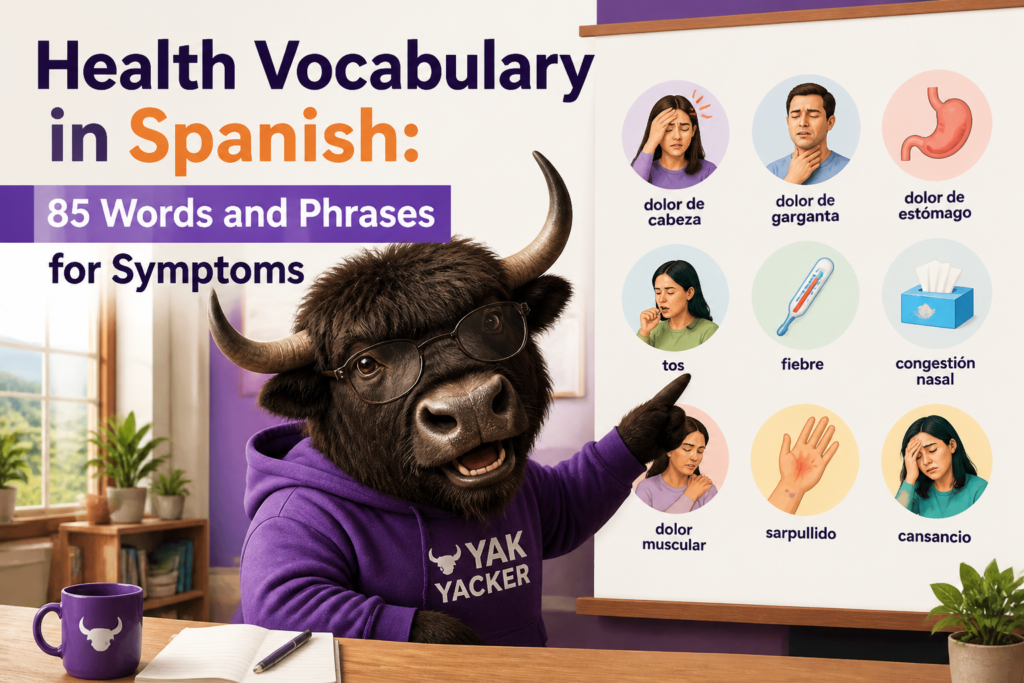
Illustrated Spanish health vocabulary chart with common symptoms and body parts

Quick Starter: The Most Useful Health Phrases

SpanishPronunciationMeaningExample SentenceTranslationLearner Note
Me duele la cabeza.meh DWEH-leh lah kah-BEH-sahMy head hurts / I have a headacheMe duele la cabeza desde ayer.My head has hurt since yesterday.Very common. Use me duele for singular body parts.
Me siento mal.meh SYEN-toh mahlI feel sick / badMe siento mal después de comer.I feel sick after eating.Neutral and useful in many situations.
Tengo fiebre.TEN-goh FYEH-brehI have a feverTengo fiebre y dolor de garganta.I have a fever and a sore throat.Tener is used for many symptoms.
Me duele el estómago.meh DWEH-leh el ehs-TOH-mah-gohMy stomach hurtsMe duele el estómago por algo que comí.My stomach hurts because of something I ate.Estómago often means stomach / belly area.
Necesito un médico.neh-seh-SEE-toh oon MEH-dee-kohI need a doctorNecesito un médico ahora mismo.I need a doctor right now.Polite and direct. Handy in emergencies.
¿Qué me recomienda?keh meh reh-koh-myen-DAHWhat do you recommend for me?¿Qué me recomienda para el dolor?What do you recommend for the pain?Useful in pharmacies and clinics.

Core Vocabulary: Body Parts You’ll Actually Use

When you talk about symptoms, body parts matter. Spanish usually uses the article with body parts: la cabeza, el brazo, la espalda. English often skips that, but Spanish is not going to skip it just because English feels lazy today.

SpanishPronunciationMeaningExample SentenceTranslationLearner Note
la cabezalah kah-BEH-sahheadMe golpeé la cabeza.I hit my head.Feminine noun. Use la.
el ojoel OH-hoeyeMe arde el ojo derecho.My right eye burns.j sounds like a strong “h.”
la narizlah nah-REESnoseTengo la nariz tapada.I have a blocked nose.z in Latin America sounds like an s.
la gargantalah gahr-GAHN-tahthroatMe duele la garganta al tragar.My throat hurts when I swallow.Very common with colds and infections.
el pechoel PEH-chochestSiento presión en el pecho.I feel pressure in my chest.Important word in medical settings.
la espaldalah ehs-PAHL-dahbackMe duele la espalda baja.My lower back hurts.espalda baja = lower back.
el brazoel BRAH-soarmMe duele el brazo izquierdo.My left arm hurts.Useful after exercise or injury.
la manolah MAH-nohandMe corté la mano con papel.I cut my hand with paper.Painfully common. Paper is rude like that.
la piernalah PYEHR-nahlegMe duele la pierna al caminar.My leg hurts when I walk.Use for the whole leg.
el pieel pyehfootMe lastimé el pie jugando fútbol.I hurt my foot playing soccer.Plural is los pies.
el estómagoel ehs-TOH-mah-gohstomach / bellyMe duele el estómago después de comer mucho.My stomach hurts after eating a lot.In everyday speech, people often mean the belly area.
la piellah pyehlskinMe pica la piel.My skin itches.Common for allergies and irritation.

Symptoms And How To Say What Hurts

Spanish often uses me duele for “it hurts me” and tengo for “I have” when talking about symptoms. That’s the big pattern. Once you get that, lots of health talk becomes far less mysterious and far less theatrical.

SpanishPronunciationMeaningExample SentenceTranslationLearner Note
dolordoh-LOHRpainTengo mucho dolor en la pierna.I have a lot of pain in my leg.Very common noun.
me duelemeh DWEH-lehit hurts me / I have pain inMe duele la rodilla.My knee hurts.Use with one body part.
me duelenmeh DWEH-lenthey hurt me / I have pain inMe duelen los pies.My feet hurt.Use with plural body parts.
ardorahr-DOHRburning / burning sensationSiento ardor en los ojos.I feel burning in my eyes.Can be used for skin, eyes, stomach, etc.
picazónpee-kah-SONitchingTengo picazón en la piel.I have itching on my skin.In some places people also say comezón.
hinchazóneen-chah-SONswellingHay hinchazón en el tobillo.There is swelling in the ankle.Medical and clear.
náuseasNOW-seh-ahsnauseaTengo náuseas desde la mañana.I’ve had nausea since morning.Usually plural in Spanish.
mareomah-REH-ohdizzinessSiento mareo cuando me levanto.I feel dizzy when I stand up.Useful for “dizzy” feelings.
tostohscoughTengo tos seca.I have a dry cough.tos seca = dry cough.
estornudarehs-tohr-noo-DAHRto sneezeEmpiezo a estornudar cuando hay polvo.I start sneezing when there is dust.Infinitive verb.
gripeGREE-pehfluTengo gripe y no puedo salir.I have the flu and can’t go out.More serious than a cold.
resfriadores-free-AH-dohcoldCreo que tengo un resfriado.I think I have a cold.Very common in Latin America and Spain.
fiebreFYEH-brehfeverLa fiebre no baja.The fever isn’t going down.Commonly used with tener.
cansanciokahn-SAHN-syohtiredness / fatigueSiento mucho cansancio hoy.I feel very tired today.Can suggest more than ordinary tiredness.
debilidaddeh-bee-lee-DAHDweaknessTengo debilidad en las piernas.I have weakness in my legs.More formal / medical.

Rule: me duele goes with one thing. me duelen goes with more than one.

PatternMeaningSpanish ExampleEnglish TranslationLearner Note
Me duele + singular body partOne thing hurtsMe duele la cabeza.My head hurts.Use with singular nouns.
Me duelen + plural body partsMore than one thing hurtsMe duelen los ojos.My eyes hurt.Plural noun = plural verb.
Tengo + symptomI have a symptomTengo fiebre.I have a fever.Very common with health vocabulary.
Siento + symptomI feel a symptomSiento mareo.I feel dizzy.Often used for sensations.

Common Ailments And Basic Health Words

These are the kinds of words you hear in pharmacies, clinics, and everyday conversation. Nothing fancy. Just the practical stuff that helps you survive adult life in another language.

SpanishPronunciationMeaningExample SentenceTranslationLearner Note
la medicinalah meh-dee-SEE-nahmedicine / medicationTomé la medicina a tiempo.I took the medicine on time.Can mean medicine in general.
la pastillalah pahs-TEE-yahpillNecesito una pastilla para el dolor.I need a pill for the pain.Very common in pharmacies.
el jarabeel hah-RAH-behsyrupEl jarabe me ayuda a dormir.The syrup helps me sleep.j is a strong throat sound.
la recetalah reh-SEH-tahprescriptionNecesito una receta médica.I need a medical prescription.Different from a cooking recipe.
el médico / la médicael MEH-dee-koh / lah MEH-dee-kahdoctorLa médica me hizo preguntas.The doctor asked me questions.Gendered noun. In many places doctor is also used.
la enfermera / el enfermerolah ehn-fehr-MEH-rah / el ehn-fehr-MEH-rohnurseLa enfermera fue muy amable.The nurse was very kind.Gender changes with the person.
la clínicalah KLEE-nee-kahclinicVoy a la clínica esta tarde.I’m going to the clinic this afternoon.Useful for appointments.
el hospitalel ohs-pee-TAHLhospitalLo llevaron al hospital.They took him to the hospital.h is silent.
la farmacialah fahr-MAH-syahpharmacyVoy a la farmacia a comprar algo.I’m going to the pharmacy to buy something.Very useful when traveling.
la emergencialah eh-mehr-HEN-syahemergencyEs una emergencia.It’s an emergency.Say this clearly and simply.
el seguroel seh-GOO-rohinsurance¿Aceptan seguro médico?Do you accept medical insurance?Common in practical travel Spanish.
la citalah SEE-tahappointmentTengo una cita con el doctor.I have an appointment with the doctor.Very common in medical contexts.

Describing How Bad It Is

Once you know the symptom, the next job is saying how strong it is. Spanish uses simple intensity words for this, and they’re worth memorizing because “a little pain” and “I need help now” are not the same vibe at all.

SpanishPronunciationMeaningExample SentenceTranslationLearner Note
un pocooon POH-koha littleMe duele un poco la espalda.My back hurts a little.Very common softener.
bastantebahs-TAHN-tehquite / fairly / a lotMe duele bastante la pierna.My leg hurts quite a lot.Flexible word. Context matters.
muchoMOO-chohvery much / a lotMe duele mucho la garganta.My throat hurts a lot.Strong and simple.
muy fuertemwee FWEHR-tehvery strong / severeEl dolor es muy fuerte.The pain is very severe.Good for serious pain.
leveLEH-behmildEs un dolor leve.It’s mild pain.Common in medical descriptions.
graveGRAH-behseriousEs algo grave.It’s something serious.Important adjective in health contexts.
repentinoreh-pehn-TEE-nohsuddenEl dolor fue repentino.The pain was sudden.Useful for describing onset.

Simple symptom intensity scale from mild to severe

Useful Verbs For Talking About Health

These verbs show up constantly. They are small, stubborn, and ridiculously useful. Learn them and you’ll suddenly understand much more medical Spanish than you expected.

SpanishPronunciationMeaningExample SentenceTranslationLearner Note
sentirseseen-TEER-sehto feel¿Cómo te sientes hoy?How do you feel today?Reflexive verb.
estar enfermo/aehs-TAHR ehn-FEHR-moh / ehn-FEHR-mahto be sickEstoy enfermo y no voy a trabajar.I’m sick and I’m not going to work.Use estar for temporary states.
tenerteh-NEHRto haveTengo tos y fiebre.I have a cough and fever.One of the most common symptom verbs.
tomartoh-MAHRto take / to drinkTomé la medicina después de cenar.I took the medicine after dinner.Often used for medicine.
descansardehs-kahn-SAHRto restNecesito descansar un poco.
SpanishPronunciationMeaningExample SentenceTranslationLearner Note
la medicinalah meh-dee-SEE-nahmedicine / medicationTomé la medicina a tiempo.I took the medicine on time.Can mean medicine in general.
la pastillalah pahs-TEE-yahpillNecesito una pastilla para el dolor.I need a pill for the pain.Very common in pharmacies.
el jarabeel hah-RAH-behsyrupEl jarabe me ayuda a dormir.The syrup helps me sleep.j is a strong throat sound.
la recetalah reh-SEH-tahprescriptionNecesito una receta médica.I need a medical prescription.Different from a cooking recipe.
el médico / la médicael MEH-dee-koh / lah MEH-dee-kahdoctorLa médica me hizo preguntas.The doctor asked me questions.Gendered noun. In many places doctor is also used.
la enfermera / el enfermerolah ehn-fehr-MEH-rah / el ehn-fehr-MEH-rohnurseLa enfermera fue muy amable.The nurse was very kind.Gender changes with the person.
la clínicalah KLEE-nee-kahclinicVoy a la clínica esta tarde.I’m going to the clinic this afternoon.Useful for appointments.
el hospitalel ohs-pee-TAHLhospitalLo llevaron al hospital.They took him to the hospital.h is silent.
la farmacialah fahr-MAH-syahpharmacyVoy a la farmacia a comprar algo.I’m going to the pharmacy to buy something.Very useful when traveling.
la emergencialah eh-mehr-HEN-syahemergencyEs una emergencia.It’s an emergency.Say this clearly and simply.
el seguroel seh-GOO-rohinsurance¿Aceptan seguro médico?Do you accept medical insurance?Common in practical travel Spanish.
la citalah SEE-tahappointmentTengo una cita con el doctor.I have an appointment with the doctor.Very common in medical contexts.

Describing How Bad It Is

Once you know the symptom, the next job is saying how strong it is. Spanish uses simple intensity words for this, and they’re worth memorizing because “a little pain” and “I need help now” are not the same vibe at all.

SpanishPronunciationMeaningExample SentenceTranslationLearner Note
un pocooon POH-koha littleMe duele un poco la espalda.My back hurts a little.Very common softener.
bastantebahs-TAHN-tehquite / fairly / a lotMe duele bastante la pierna.My leg hurts quite a lot.Flexible word. Context matters.
muchoMOO-chohvery much / a lotMe duele mucho la garganta.My throat hurts a lot.Strong and simple.
muy fuertemwee FWEHR-tehvery strong / severeEl dolor es muy fuerte.The pain is very severe.Good for serious pain.
leveLEH-behmildEs un dolor leve.It’s mild pain.Common in medical descriptions.
graveGRAH-behseriousEs algo grave.It’s something serious.Important adjective in health contexts.
repentinoreh-pehn-TEE-nohsuddenEl dolor fue repentino.The pain was sudden.Useful for describing onset.

Simple symptom intensity scale from mild to severe

Useful Verbs For Talking About Health

These verbs show up constantly. They are small, stubborn, and ridiculously useful. Learn them and you’ll suddenly understand much more medical Spanish than you expected.

SpanishPronunciationMeaningExample SentenceTranslationLearner Note
sentirseseen-TEER-sehto feel¿Cómo te sientes hoy?How do you feel today?Reflexive verb.
estar enfermo/aehs-TAHR ehn-FEHR-moh / ehn-FEHR-mahto be sickEstoy enfermo y no voy a trabajar.I’m sick and I’m not going to work.Use estar for temporary states.
tenerteh-NEHRto haveTengo tos y fiebre.I have a cough and fever.One of the most common symptom verbs.
tomartoh-MAHRto take / to drinkTomé la medicina después de cenar.I took the medicine after dinner.Often used for medicine.
descansardehs-kahn-SAHRto restNecesito descansar un poco.Spanish health vocabulary is one of those topics that feels boring until you desperately need it. Then suddenly words like dolor, fiebre, and me duele become the stars of the show. Tiny emergency, big vocabulary moment.

For the broader learning path, visit our parent guide.

This guide gives you practical Spanish for describing symptoms, body problems, and basic medical situations. It uses standard Latin American Spanish by default, but when a phrase is more common in Spain or varies by region, that gets noted clearly. No drama. Just the words that help you explain what hurts.

By the end, you’ll be able to say what hurts, describe common symptoms, ask for help, and understand the most useful health phrases without guessing like a doomed restaurant server hearing “I’m allergic to everything.”

For extra language nerd comfort, the Real Academia Española has the boring-but-reliable dictionary at the RAE dictionary.

Illustrated Spanish health vocabulary chart with common symptoms and body parts

Quick Starter: The Most Useful Health Phrases

SpanishPronunciationMeaningExample SentenceTranslationLearner Note
Me duele la cabeza.meh DWEH-leh lah kah-BEH-sahMy head hurts / I have a headacheMe duele la cabeza desde ayer.My head has hurt since yesterday.Very common. Use me duele for singular body parts.
Me siento mal.meh SYEN-toh mahlI feel sick / badMe siento mal después de comer.I feel sick after eating.Neutral and useful in many situations.
Tengo fiebre.TEN-goh FYEH-brehI have a feverTengo fiebre y dolor de garganta.I have a fever and a sore throat.Tener is used for many symptoms.
Me duele el estómago.meh DWEH-leh el ehs-TOH-mah-gohMy stomach hurtsMe duele el estómago por algo que comí.My stomach hurts because of something I ate.Estómago often means stomach / belly area.
Necesito un médico.neh-seh-SEE-toh oon MEH-dee-kohI need a doctorNecesito un médico ahora mismo.I need a doctor right now.Polite and direct. Handy in emergencies.
¿Qué me recomienda?keh meh reh-koh-myen-DAHWhat do you recommend for me?¿Qué me recomienda para el dolor?What do you recommend for the pain?Useful in pharmacies and clinics.

Core Vocabulary: Body Parts You’ll Actually Use

When you talk about symptoms, body parts matter. Spanish usually uses the article with body parts: la cabeza, el brazo, la espalda. English often skips that, but Spanish is not going to skip it just because English feels lazy today.

SpanishPronunciationMeaningExample SentenceTranslationLearner Note
la cabezalah kah-BEH-sahheadMe golpeé la cabeza.I hit my head.Feminine noun. Use la.
el ojoel OH-hoeyeMe arde el ojo derecho.My right eye burns.j sounds like a strong “h.”
la narizlah nah-REESnoseTengo la nariz tapada.I have a blocked nose.z in Latin America sounds like an s.
la gargantalah gahr-GAHN-tahthroatMe duele la garganta al tragar.My throat hurts when I swallow.Very common with colds and infections.
el pechoel PEH-chochestSiento presión en el pecho.I feel pressure in my chest.Important word in medical settings.
la espaldalah ehs-PAHL-dahbackMe duele la espalda baja.My lower back hurts.espalda baja = lower back.
el brazoel BRAH-soarmMe duele el brazo izquierdo.My left arm hurts.Useful after exercise or injury.
la manolah MAH-nohandMe corté la mano con papel.I cut my hand with paper.Painfully common. Paper is rude like that.
la piernalah PYEHR-nahlegMe duele la pierna al caminar.My leg hurts when I walk.Use for the whole leg.
el pieel pyehfootMe lastimé el pie jugando fútbol.I hurt my foot playing soccer.Plural is los pies.
el estómagoel ehs-TOH-mah-gohstomach / bellyMe duele el estómago después de comer mucho.My stomach hurts after eating a lot.In everyday speech, people often mean the belly area.
la piellah pyehlskinMe pica la piel.My skin itches.Common for allergies and irritation.

Symptoms And How To Say What Hurts

Spanish often uses me duele for “it hurts me” and tengo for “I have” when talking about symptoms. That’s the big pattern. Once you get that, lots of health talk becomes far less mysterious and far less theatrical.

SpanishPronunciationMeaningExample SentenceTranslationLearner Note
dolordoh-LOHRpainTengo mucho dolor en la pierna.I have a lot of pain in my leg.Very common noun.
me duelemeh DWEH-lehit hurts me / I have pain inMe duele la rodilla.My knee hurts.Use with one body part.
me duelenmeh DWEH-lenthey hurt me / I have pain inMe duelen los pies.My feet hurt.Use with plural body parts.
ardorahr-DOHRburning / burning sensationSiento ardor en los ojos.I feel burning in my eyes.Can be used for skin, eyes, stomach, etc.
picazónpee-kah-SONitchingTengo picazón en la piel.I have itching on my skin.In some places people also say comezón.
hinchazóneen-chah-SONswellingHay hinchazón en el tobillo.There is swelling in the ankle.Medical and clear.
náuseasNOW-seh-ahsnauseaTengo náuseas desde la mañana.I’ve had nausea since morning.Usually plural in Spanish.
mareomah-REH-ohdizzinessSiento mareo cuando me levanto.I feel dizzy when I stand up.Useful for “dizzy” feelings.
tostohscoughTengo tos seca.I have a dry cough.tos seca = dry cough.
estornudarehs-tohr-noo-DAHRto sneezeEmpiezo a estornudar cuando hay polvo.I start sneezing when there is dust.Infinitive verb.
gripeGREE-pehfluTengo gripe y no puedo salir.I have the flu and can’t go out.More serious than a cold.
resfriadores-free-AH-dohcoldCreo que tengo un resfriado.I think I have a cold.Very common in Latin America and Spain.
fiebreFYEH-brehfeverLa fiebre no baja.The fever isn’t going down.Commonly used with tener.
cansanciokahn-SAHN-syohtiredness / fatigueSiento mucho cansancio hoy.I feel very tired today.Can suggest more than ordinary tiredness.
debilidaddeh-bee-lee-DAHDweaknessTengo debilidad en las piernas.I have weakness in my legs.More formal / medical.

Rule: me duele goes with one thing. me duelen goes with more than one.

PatternMeaningSpanish ExampleEnglish TranslationLearner Note
Me duele + singular body partOne thing hurtsMe duele la cabeza.My head hurts.Use with singular nouns.
Me duelen + plural body partsMore than one thing hurtsMe duelen los ojos.My eyes hurt.Plural noun = plural verb.
Tengo + symptomI have a symptomTengo fiebre.I have a fever.Very common with health vocabulary.
Siento + symptomI feel a symptomSiento mareo.I feel dizzy.Often used for sensations.

Common Ailments And Basic Health Words

These are the kinds of words you hear in pharmacies, clinics, and everyday conversation. Nothing fancy. Just the practical stuff that helps you survive adult life in another language.

SpanishPronunciationMeaningExample SentenceTranslationLearner Note
la medicinalah meh-dee-SEE-nahmedicine / medicationTomé la medicina a tiempo.I took the medicine on time.Can mean medicine in general.
la pastillalah pahs-TEE-yahpillNecesito una pastilla para el dolor.I need a pill for the pain.Very common in pharmacies.
el jarabeel hah-RAH-behsyrupEl jarabe me ayuda a dormir.The syrup helps me sleep.j is a strong throat sound.
la recetalah reh-SEH-tahprescriptionNecesito una receta médica.I need a medical prescription.Different from a cooking recipe.
el médico / la médicael MEH-dee-koh / lah MEH-dee-kahdoctorLa médica me hizo preguntas.The doctor asked me questions.Gendered noun. In many places doctor is also used.
la enfermera / el enfermerolah ehn-fehr-MEH-rah / el ehn-fehr-MEH-rohnurseLa enfermera fue muy amable.The nurse was very kind.Gender changes with the person.
la clínicalah KLEE-nee-kahclinicVoy a la clínica esta tarde.I’m going to the clinic this afternoon.Useful for appointments.
el hospitalel ohs-pee-TAHLhospitalLo llevaron al hospital.They took him to the hospital.h is silent.
la farmacialah fahr-MAH-syahpharmacyVoy a la farmacia a comprar algo.I’m going to the pharmacy to buy something.Very useful when traveling.
la emergencialah eh-mehr-HEN-syahemergencyEs una emergencia.It’s an emergency.Say this clearly and simply.
el seguroel seh-GOO-rohinsurance¿Aceptan seguro médico?Do you accept medical insurance?Common in practical travel Spanish.
la citalah SEE-tahappointmentTengo una cita con el doctor.I have an appointment with the doctor.Very common in medical contexts.

Describing How Bad It Is

Once you know the symptom, the next job is saying how strong it is. Spanish uses simple intensity words for this, and they’re worth memorizing because “a little pain” and “I need help now” are not the same vibe at all.

SpanishPronunciationMeaningExample SentenceTranslationLearner Note
un pocooon POH-koha littleMe duele un poco la espalda.My back hurts a little.Very common softener.
bastantebahs-TAHN-tehquite / fairly / a lotMe duele bastante la pierna.My leg hurts quite a lot.Flexible word. Context matters.
muchoMOO-chohvery much / a lotMe duele mucho la garganta.My throat hurts a lot.Strong and simple.
muy fuertemwee FWEHR-tehvery strong / severeEl dolor es muy fuerte.The pain is very severe.Good for serious pain.
leveLEH-behmildEs un dolor leve.It’s mild pain.Common in medical descriptions.
graveGRAH-behseriousEs algo grave.It’s something serious.Important adjective in health contexts.
repentinoreh-pehn-TEE-nohsuddenEl dolor fue repentino.The pain was sudden.Useful for describing onset.

Simple symptom intensity scale from mild to severe

Useful Verbs For Talking About Health

These verbs show up constantly. They are small, stubborn, and ridiculously useful. Learn them and you’ll suddenly understand much more medical Spanish than you expected.

SpanishPronunciationMeaningExample SentenceTranslationLearner Note
sentirseseen-TEER-sehto feel¿Cómo te sientes hoy?How do you feel today?Reflexive verb.
estar enfermo/aehs-TAHR ehn-FEHR-moh / ehn-FEHR-mahto be sickEstoy enfermo y no voy a trabajar.I’m sick and I’m not going to work.Use estar for temporary states.
tenerteh-NEHRto haveTengo tos y fiebre.I have a cough and fever.One of the most common symptom verbs.
tomartoh-MAHRto take / to drinkTomé la medicina después de cenar.I took the medicine after dinner.Often used for medicine.
descansardehs-kahn-SAHRto restNecesito descansar un poco.
PatternMeaningSpanish ExampleEnglish TranslationLearner Note
Me duele + singular body partOne thing hurtsMe duele la cabeza.My head hurts.Use with singular nouns.
Me duelen + plural body partsMore than one thing hurtsMe duelen los ojos.My eyes hurt.Plural noun = plural verb.
Tengo + symptomI have a symptomTengo fiebre.I have a fever.Very common with health vocabulary.
Siento + symptomI feel a symptomSiento mareo.I feel dizzy.Often used for sensations.

Common Ailments And Basic Health Words

These are the kinds of words you hear in pharmacies, clinics, and everyday conversation. Nothing fancy. Just the practical stuff that helps you survive adult life in another language.

SpanishPronunciationMeaningExample SentenceTranslationLearner Note
la medicinalah meh-dee-SEE-nahmedicine / medicationTomé la medicina a tiempo.I took the medicine on time.Can mean medicine in general.
la pastillalah pahs-TEE-yahpillNecesito una pastilla para el dolor.I need a pill for the pain.Very common in pharmacies.
el jarabeel hah-RAH-behsyrupEl jarabe me ayuda a dormir.The syrup helps me sleep.j is a strong throat sound.
la recetalah reh-SEH-tahprescriptionNecesito una receta médica.I need a medical prescription.Different from a cooking recipe.
el médico / la médicael MEH-dee-koh / lah MEH-dee-kahdoctorLa médica me hizo preguntas.The doctor asked me questions.Gendered noun. In many places doctor is also used.
la enfermera / el enfermerolah ehn-fehr-MEH-rah / el ehn-fehr-MEH-rohnurseLa enfermera fue muy amable.The nurse was very kind.Gender changes with the person.
la clínicalah KLEE-nee-kahclinicVoy a la clínica esta tarde.I’m going to the clinic this afternoon.Useful for appointments.
el hospitalel ohs-pee-TAHLhospitalLo llevaron al hospital.They took him to the hospital.h is silent.
la farmacialah fahr-MAH-syahpharmacyVoy a la farmacia a comprar algo.I’m going to the pharmacy to buy something.Very useful when traveling.
la emergencialah eh-mehr-HEN-syahemergencyEs una emergencia.It’s an emergency.Say this clearly and simply.
el seguroel seh-GOO-rohinsurance¿Aceptan seguro médico?Do you accept medical insurance?Common in practical travel Spanish.
la citalah SEE-tahappointmentTengo una cita con el doctor.I have an appointment with the doctor.Very common in medical contexts.

Describing How Bad It Is

Once you know the symptom, the next job is saying how strong it is. Spanish uses simple intensity words for this, and they’re worth memorizing because “a little pain” and “I need help now” are not the same vibe at all.

SpanishPronunciationMeaningExample SentenceTranslationLearner Note
un pocooon POH-koha littleMe duele un poco la espalda.My back hurts a little.Very common softener.
bastantebahs-TAHN-tehquite / fairly / a lotMe duele bastante la pierna.My leg hurts quite a lot.Flexible word. Context matters.
muchoMOO-chohvery much / a lotMe duele mucho la garganta.My throat hurts a lot.Strong and simple.
muy fuertemwee FWEHR-tehvery strong / severeEl dolor es muy fuerte.The pain is very severe.Good for serious pain.
leveLEH-behmildEs un dolor leve.It’s mild pain.Common in medical descriptions.
graveGRAH-behseriousEs algo grave.It’s something serious.Important adjective in health contexts.
repentinoreh-pehn-TEE-nohsuddenEl dolor fue repentino.The pain was sudden.Useful for describing onset.

Simple symptom intensity scale from mild to severe

Useful Verbs For Talking About Health

These verbs show up constantly. They are small, stubborn, and ridiculously useful. Learn them and you’ll suddenly understand much more medical Spanish than you expected.

SpanishPronunciationMeaningExample SentenceTranslationLearner Note
sentirseseen-TEER-sehto feel¿Cómo te sientes hoy?How do you feel today?Reflexive verb.
estar enfermo/aehs-TAHR ehn-FEHR-moh / ehn-FEHR-mahto be sickEstoy enfermo y no voy a trabajar.I’m sick and I’m not going to work.Use estar for temporary states.
tenerteh-NEHRto haveTengo tos y fiebre.I have a cough and fever.One of the most common symptom verbs.
tomartoh-MAHRto take / to drinkTomé la medicina después de cenar.I took the medicine after dinner.Often used for medicine.
descansardehs-kahn-SAHRto restNecesito descansar un poco.Spanish health vocabulary is one of those topics that feels boring until you desperately need it. Then suddenly words like dolor, fiebre, and me duele become the stars of the show. Tiny emergency, big vocabulary moment.

For the broader learning path, visit our parent guide.

This guide gives you practical Spanish for describing symptoms, body problems, and basic medical situations. It uses standard Latin American Spanish by default, but when a phrase is more common in Spain or varies by region, that gets noted clearly. No drama. Just the words that help you explain what hurts.

By the end, you’ll be able to say what hurts, describe common symptoms, ask for help, and understand the most useful health phrases without guessing like a doomed restaurant server hearing “I’m allergic to everything.”

For extra language nerd comfort, the Real Academia Española has the boring-but-reliable dictionary at the RAE dictionary.

Illustrated Spanish health vocabulary chart with common symptoms and body parts

Quick Starter: The Most Useful Health Phrases

SpanishPronunciationMeaningExample SentenceTranslationLearner Note
Me duele la cabeza.meh DWEH-leh lah kah-BEH-sahMy head hurts / I have a headacheMe duele la cabeza desde ayer.My head has hurt since yesterday.Very common. Use me duele for singular body parts.
Me siento mal.meh SYEN-toh mahlI feel sick / badMe siento mal después de comer.I feel sick after eating.Neutral and useful in many situations.
Tengo fiebre.TEN-goh FYEH-brehI have a feverTengo fiebre y dolor de garganta.I have a fever and a sore throat.Tener is used for many symptoms.
Me duele el estómago.meh DWEH-leh el ehs-TOH-mah-gohMy stomach hurtsMe duele el estómago por algo que comí.My stomach hurts because of something I ate.Estómago often means stomach / belly area.
Necesito un médico.neh-seh-SEE-toh oon MEH-dee-kohI need a doctorNecesito un médico ahora mismo.I need a doctor right now.Polite and direct. Handy in emergencies.
¿Qué me recomienda?keh meh reh-koh-myen-DAHWhat do you recommend for me?¿Qué me recomienda para el dolor?What do you recommend for the pain?Useful in pharmacies and clinics.

Core Vocabulary: Body Parts You’ll Actually Use

When you talk about symptoms, body parts matter. Spanish usually uses the article with body parts: la cabeza, el brazo, la espalda. English often skips that, but Spanish is not going to skip it just because English feels lazy today.

SpanishPronunciationMeaningExample SentenceTranslationLearner Note
la cabezalah kah-BEH-sahheadMe golpeé la cabeza.I hit my head.Feminine noun. Use la.
el ojoel OH-hoeyeMe arde el ojo derecho.My right eye burns.j sounds like a strong “h.”
la narizlah nah-REESnoseTengo la nariz tapada.I have a blocked nose.z in Latin America sounds like an s.
la gargantalah gahr-GAHN-tahthroatMe duele la garganta al tragar.My throat hurts when I swallow.Very common with colds and infections.
el pechoel PEH-chochestSiento presión en el pecho.I feel pressure in my chest.Important word in medical settings.
la espaldalah ehs-PAHL-dahbackMe duele la espalda baja.My lower back hurts.espalda baja = lower back.
el brazoel BRAH-soarmMe duele el brazo izquierdo.My left arm hurts.Useful after exercise or injury.
la manolah MAH-nohandMe corté la mano con papel.I cut my hand with paper.Painfully common. Paper is rude like that.
la piernalah PYEHR-nahlegMe duele la pierna al caminar.My leg hurts when I walk.Use for the whole leg.
el pieel pyehfootMe lastimé el pie jugando fútbol.I hurt my foot playing soccer.Plural is los pies.
el estómagoel ehs-TOH-mah-gohstomach / bellyMe duele el estómago después de comer mucho.My stomach hurts after eating a lot.In everyday speech, people often mean the belly area.
la piellah pyehlskinMe pica la piel.My skin itches.Common for allergies and irritation.

Symptoms And How To Say What Hurts

Spanish often uses me duele for “it hurts me” and tengo for “I have” when talking about symptoms. That’s the big pattern. Once you get that, lots of health talk becomes far less mysterious and far less theatrical.

SpanishPronunciationMeaningExample SentenceTranslationLearner Note
dolordoh-LOHRpainTengo mucho dolor en la pierna.I have a lot of pain in my leg.Very common noun.
me duelemeh DWEH-lehit hurts me / I have pain inMe duele la rodilla.My knee hurts.Use with one body part.
me duelenmeh DWEH-lenthey hurt me / I have pain inMe duelen los pies.My feet hurt.Use with plural body parts.
ardorahr-DOHRburning / burning sensationSiento ardor en los ojos.I feel burning in my eyes.Can be used for skin, eyes, stomach, etc.
picazónpee-kah-SONitchingTengo picazón en la piel.I have itching on my skin.In some places people also say comezón.
hinchazóneen-chah-SONswellingHay hinchazón en el tobillo.There is swelling in the ankle.Medical and clear.
náuseasNOW-seh-ahsnauseaTengo náuseas desde la mañana.I’ve had nausea since morning.Usually plural in Spanish.
mareomah-REH-ohdizzinessSiento mareo cuando me levanto.I feel dizzy when I stand up.Useful for “dizzy” feelings.
tostohscoughTengo tos seca.I have a dry cough.tos seca = dry cough.
estornudarehs-tohr-noo-DAHRto sneezeEmpiezo a estornudar cuando hay polvo.I start sneezing when there is dust.Infinitive verb.
gripeGREE-pehfluTengo gripe y no puedo salir.I have the flu and can’t go out.More serious than a cold.
resfriadores-free-AH-dohcoldCreo que tengo un resfriado.I think I have a cold.Very common in Latin America and Spain.
fiebreFYEH-brehfeverLa fiebre no baja.The fever isn’t going down.Commonly used with tener.
cansanciokahn-SAHN-syohtiredness / fatigueSiento mucho cansancio hoy.I feel very tired today.Can suggest more than ordinary tiredness.
debilidaddeh-bee-lee-DAHDweaknessTengo debilidad en las piernas.I have weakness in my legs.More formal / medical.

Rule: me duele goes with one thing. me duelen goes with more than one.

PatternMeaningSpanish ExampleEnglish TranslationLearner Note
Me duele + singular body partOne thing hurtsMe duele la cabeza.My head hurts.Use with singular nouns.
Me duelen + plural body partsMore than one thing hurtsMe duelen los ojos.My eyes hurt.Plural noun = plural verb.
Tengo + symptomI have a symptomTengo fiebre.I have a fever.Very common with health vocabulary.
Siento + symptomI feel a symptomSiento mareo.I feel dizzy.Often used for sensations.

Common Ailments And Basic Health Words

These are the kinds of words you hear in pharmacies, clinics, and everyday conversation. Nothing fancy. Just the practical stuff that helps you survive adult life in another language.

SpanishPronunciationMeaningExample SentenceTranslationLearner Note
la medicinalah meh-dee-SEE-nahmedicine / medicationTomé la medicina a tiempo.I took the medicine on time.Can mean medicine in general.
la pastillalah pahs-TEE-yahpillNecesito una pastilla para el dolor.I need a pill for the pain.Very common in pharmacies.
el jarabeel hah-RAH-behsyrupEl jarabe me ayuda a dormir.The syrup helps me sleep.j is a strong throat sound.
la recetalah reh-SEH-tahprescriptionNecesito una receta médica.I need a medical prescription.Different from a cooking recipe.
el médico / la médicael MEH-dee-koh / lah MEH-dee-kahdoctorLa médica me hizo preguntas.The doctor asked me questions.Gendered noun. In many places doctor is also used.
la enfermera / el enfermerolah ehn-fehr-MEH-rah / el ehn-fehr-MEH-rohnurseLa enfermera fue muy amable.The nurse was very kind.Gender changes with the person.
la clínicalah KLEE-nee-kahclinicVoy a la clínica esta tarde.I’m going to the clinic this afternoon.Useful for appointments.
el hospitalel ohs-pee-TAHLhospitalLo llevaron al hospital.They took him to the hospital.h is silent.
la farmacialah fahr-MAH-syahpharmacyVoy a la farmacia a comprar algo.I’m going to the pharmacy to buy something.Very useful when traveling.
la emergencialah eh-mehr-HEN-syahemergencyEs una emergencia.It’s an emergency.Say this clearly and simply.
el seguroel seh-GOO-rohinsurance¿Aceptan seguro médico?Do you accept medical insurance?Common in practical travel Spanish.
la citalah SEE-tahappointmentTengo una cita con el doctor.I have an appointment with the doctor.Very common in medical contexts.

Describing How Bad It Is

Once you know the symptom, the next job is saying how strong it is. Spanish uses simple intensity words for this, and they’re worth memorizing because “a little pain” and “I need help now” are not the same vibe at all.

SpanishPronunciationMeaningExample SentenceTranslationLearner Note
un pocooon POH-koha littleMe duele un poco la espalda.My back hurts a little.Very common softener.
bastantebahs-TAHN-tehquite / fairly / a lotMe duele bastante la pierna.My leg hurts quite a lot.Flexible word. Context matters.
muchoMOO-chohvery much / a lotMe duele mucho la garganta.My throat hurts a lot.Strong and simple.
muy fuertemwee FWEHR-tehvery strong / severeEl dolor es muy fuerte.The pain is very severe.Good for serious pain.
leveLEH-behmildEs un dolor leve.It’s mild pain.Common in medical descriptions.
graveGRAH-behseriousEs algo grave.It’s something serious.Important adjective in health contexts.
repentinoreh-pehn-TEE-nohsuddenEl dolor fue repentino.The pain was sudden.Useful for describing onset.

Simple symptom intensity scale from mild to severe

Useful Verbs For Talking About Health

These verbs show up constantly. They are small, stubborn, and ridiculously useful. Learn them and you’ll suddenly understand much more medical Spanish than you expected.

SpanishPronunciationMeaningExample SentenceTranslationLearner Note
sentirseseen-TEER-sehto feel¿Cómo te sientes hoy?How do you feel today?Reflexive verb.
estar enfermo/aehs-TAHR ehn-FEHR-moh / ehn-FEHR-mahto be sickEstoy enfermo y no voy a trabajar.I’m sick and I’m not going to work.Use estar for temporary states.
tenerteh-NEHRto haveTengo tos y fiebre.I have a cough and fever.One of the most common symptom verbs.
tomartoh-MAHRto take / to drinkTomé la medicina después de cenar.I took the medicine after dinner.Often used for medicine.
descansardehs-kahn-SAHRto restNecesito descansar un poco.
SpanishPronunciationMeaningExample SentenceTranslationLearner Note
dolordoh-LOHRpainTengo mucho dolor en la pierna.I have a lot of pain in my leg.Very common noun.
me duelemeh DWEH-lehit hurts me / I have pain inMe duele la rodilla.My knee hurts.Use with one body part.
me duelenmeh DWEH-lenthey hurt me / I have pain inMe duelen los pies.My feet hurt.Use with plural body parts.
ardorahr-DOHRburning / burning sensationSiento ardor en los ojos.I feel burning in my eyes.Can be used for skin, eyes, stomach, etc.
picazónpee-kah-SONitchingTengo picazón en la piel.I have itching on my skin.In some places people also say comezón.
hinchazóneen-chah-SONswellingHay hinchazón en el tobillo.There is swelling in the ankle.Medical and clear.
náuseasNOW-seh-ahsnauseaTengo náuseas desde la mañana.I’ve had nausea since morning.Usually plural in Spanish.
mareomah-REH-ohdizzinessSiento mareo cuando me levanto.I feel dizzy when I stand up.Useful for “dizzy” feelings.
tostohscoughTengo tos seca.I have a dry cough.tos seca = dry cough.
estornudarehs-tohr-noo-DAHRto sneezeEmpiezo a estornudar cuando hay polvo.I start sneezing when there is dust.Infinitive verb.
gripeGREE-pehfluTengo gripe y no puedo salir.I have the flu and can’t go out.More serious than a cold.
resfriadores-free-AH-dohcoldCreo que tengo un resfriado.I think I have a cold.Very common in Latin America and Spain.
fiebreFYEH-brehfeverLa fiebre no baja.The fever isn’t going down.Commonly used with tener.
cansanciokahn-SAHN-syohtiredness / fatigueSiento mucho cansancio hoy.I feel very tired today.Can suggest more than ordinary tiredness.
debilidaddeh-bee-lee-DAHDweaknessTengo debilidad en las piernas.I have weakness in my legs.More formal / medical.

Rule: me duele goes with one thing. me duelen goes with more than one.

PatternMeaningSpanish ExampleEnglish TranslationLearner Note
Me duele + singular body partOne thing hurtsMe duele la cabeza.My head hurts.Use with singular nouns.
Me duelen + plural body partsMore than one thing hurtsMe duelen los ojos.My eyes hurt.Plural noun = plural verb.
Tengo + symptomI have a symptomTengo fiebre.I have a fever.Very common with health vocabulary.
Siento + symptomI feel a symptomSiento mareo.I feel dizzy.Often used for sensations.

Common Ailments And Basic Health Words

These are the kinds of words you hear in pharmacies, clinics, and everyday conversation. Nothing fancy. Just the practical stuff that helps you survive adult life in another language.

SpanishPronunciationMeaningExample SentenceTranslationLearner Note
la medicinalah meh-dee-SEE-nahmedicine / medicationTomé la medicina a tiempo.I took the medicine on time.Can mean medicine in general.
la pastillalah pahs-TEE-yahpillNecesito una pastilla para el dolor.I need a pill for the pain.Very common in pharmacies.
el jarabeel hah-RAH-behsyrupEl jarabe me ayuda a dormir.The syrup helps me sleep.j is a strong throat sound.
la recetalah reh-SEH-tahprescriptionNecesito una receta médica.I need a medical prescription.Different from a cooking recipe.
el médico / la médicael MEH-dee-koh / lah MEH-dee-kahdoctorLa médica me hizo preguntas.The doctor asked me questions.Gendered noun. In many places doctor is also used.
la enfermera / el enfermerolah ehn-fehr-MEH-rah / el ehn-fehr-MEH-rohnurseLa enfermera fue muy amable.The nurse was very kind.Gender changes with the person.
la clínicalah KLEE-nee-kahclinicVoy a la clínica esta tarde.I’m going to the clinic this afternoon.Useful for appointments.
el hospitalel ohs-pee-TAHLhospitalLo llevaron al hospital.They took him to the hospital.h is silent.
la farmacialah fahr-MAH-syahpharmacyVoy a la farmacia a comprar algo.I’m going to the pharmacy to buy something.Very useful when traveling.
la emergencialah eh-mehr-HEN-syahemergencyEs una emergencia.It’s an emergency.Say this clearly and simply.
el seguroel seh-GOO-rohinsurance¿Aceptan seguro médico?Do you accept medical insurance?Common in practical travel Spanish.
la citalah SEE-tahappointmentTengo una cita con el doctor.I have an appointment with the doctor.Very common in medical contexts.

Describing How Bad It Is

Once you know the symptom, the next job is saying how strong it is. Spanish uses simple intensity words for this, and they’re worth memorizing because “a little pain” and “I need help now” are not the same vibe at all.

SpanishPronunciationMeaningExample SentenceTranslationLearner Note
un pocooon POH-koha littleMe duele un poco la espalda.My back hurts a little.Very common softener.
bastantebahs-TAHN-tehquite / fairly / a lotMe duele bastante la pierna.My leg hurts quite a lot.Flexible word. Context matters.
muchoMOO-chohvery much / a lotMe duele mucho la garganta.My throat hurts a lot.Strong and simple.
muy fuertemwee FWEHR-tehvery strong / severeEl dolor es muy fuerte.The pain is very severe.Good for serious pain.
leveLEH-behmildEs un dolor leve.It’s mild pain.Common in medical descriptions.
graveGRAH-behseriousEs algo grave.It’s something serious.Important adjective in health contexts.
repentinoreh-pehn-TEE-nohsuddenEl dolor fue repentino.The pain was sudden.Useful for describing onset.

Simple symptom intensity scale from mild to severe

Useful Verbs For Talking About Health

These verbs show up constantly. They are small, stubborn, and ridiculously useful. Learn them and you’ll suddenly understand much more medical Spanish than you expected.

SpanishPronunciationMeaningExample SentenceTranslationLearner Note
sentirseseen-TEER-sehto feel¿Cómo te sientes hoy?How do you feel today?Reflexive verb.
estar enfermo/aehs-TAHR ehn-FEHR-moh / ehn-FEHR-mahto be sickEstoy enfermo y no voy a trabajar.I’m sick and I’m not going to work.Use estar for temporary states.
tenerteh-NEHRto haveTengo tos y fiebre.I have a cough and fever.One of the most common symptom verbs.
tomartoh-MAHRto take / to drinkTomé la medicina después de cenar.I took the medicine after dinner.Often used for medicine.
descansardehs-kahn-SAHRto restNecesito descansar un poco.Spanish health vocabulary is one of those topics that feels boring until you desperately need it. Then suddenly words like dolor, fiebre, and me duele become the stars of the show. Tiny emergency, big vocabulary moment.

For the broader learning path, visit our parent guide.

This guide gives you practical Spanish for describing symptoms, body problems, and basic medical situations. It uses standard Latin American Spanish by default, but when a phrase is more common in Spain or varies by region, that gets noted clearly. No drama. Just the words that help you explain what hurts.

By the end, you’ll be able to say what hurts, describe common symptoms, ask for help, and understand the most useful health phrases without guessing like a doomed restaurant server hearing “I’m allergic to everything.”

For extra language nerd comfort, the Real Academia Española has the boring-but-reliable dictionary at the RAE dictionary.

Illustrated Spanish health vocabulary chart with common symptoms and body parts

Quick Starter: The Most Useful Health Phrases

SpanishPronunciationMeaningExample SentenceTranslationLearner Note
Me duele la cabeza.meh DWEH-leh lah kah-BEH-sahMy head hurts / I have a headacheMe duele la cabeza desde ayer.My head has hurt since yesterday.Very common. Use me duele for singular body parts.
Me siento mal.meh SYEN-toh mahlI feel sick / badMe siento mal después de comer.I feel sick after eating.Neutral and useful in many situations.
Tengo fiebre.TEN-goh FYEH-brehI have a feverTengo fiebre y dolor de garganta.I have a fever and a sore throat.Tener is used for many symptoms.
Me duele el estómago.meh DWEH-leh el ehs-TOH-mah-gohMy stomach hurtsMe duele el estómago por algo que comí.My stomach hurts because of something I ate.Estómago often means stomach / belly area.
Necesito un médico.neh-seh-SEE-toh oon MEH-dee-kohI need a doctorNecesito un médico ahora mismo.I need a doctor right now.Polite and direct. Handy in emergencies.
¿Qué me recomienda?keh meh reh-koh-myen-DAHWhat do you recommend for me?¿Qué me recomienda para el dolor?What do you recommend for the pain?Useful in pharmacies and clinics.

Core Vocabulary: Body Parts You’ll Actually Use

When you talk about symptoms, body parts matter. Spanish usually uses the article with body parts: la cabeza, el brazo, la espalda. English often skips that, but Spanish is not going to skip it just because English feels lazy today.

SpanishPronunciationMeaningExample SentenceTranslationLearner Note
la cabezalah kah-BEH-sahheadMe golpeé la cabeza.I hit my head.Feminine noun. Use la.
el ojoel OH-hoeyeMe arde el ojo derecho.My right eye burns.j sounds like a strong “h.”
la narizlah nah-REESnoseTengo la nariz tapada.I have a blocked nose.z in Latin America sounds like an s.
la gargantalah gahr-GAHN-tahthroatMe duele la garganta al tragar.My throat hurts when I swallow.Very common with colds and infections.
el pechoel PEH-chochestSiento presión en el pecho.I feel pressure in my chest.Important word in medical settings.
la espaldalah ehs-PAHL-dahbackMe duele la espalda baja.My lower back hurts.espalda baja = lower back.
el brazoel BRAH-soarmMe duele el brazo izquierdo.My left arm hurts.Useful after exercise or injury.
la manolah MAH-nohandMe corté la mano con papel.I cut my hand with paper.Painfully common. Paper is rude like that.
la piernalah PYEHR-nahlegMe duele la pierna al caminar.My leg hurts when I walk.Use for the whole leg.
el pieel pyehfootMe lastimé el pie jugando fútbol.I hurt my foot playing soccer.Plural is los pies.
el estómagoel ehs-TOH-mah-gohstomach / bellyMe duele el estómago después de comer mucho.My stomach hurts after eating a lot.In everyday speech, people often mean the belly area.
la piellah pyehlskinMe pica la piel.My skin itches.Common for allergies and irritation.

Symptoms And How To Say What Hurts

Spanish often uses me duele for “it hurts me” and tengo for “I have” when talking about symptoms. That’s the big pattern. Once you get that, lots of health talk becomes far less mysterious and far less theatrical.

SpanishPronunciationMeaningExample SentenceTranslationLearner Note
dolordoh-LOHRpainTengo mucho dolor en la pierna.I have a lot of pain in my leg.Very common noun.
me duelemeh DWEH-lehit hurts me / I have pain inMe duele la rodilla.My knee hurts.Use with one body part.
me duelenmeh DWEH-lenthey hurt me / I have pain inMe duelen los pies.My feet hurt.Use with plural body parts.
ardorahr-DOHRburning / burning sensationSiento ardor en los ojos.I feel burning in my eyes.Can be used for skin, eyes, stomach, etc.
picazónpee-kah-SONitchingTengo picazón en la piel.I have itching on my skin.In some places people also say comezón.
hinchazóneen-chah-SONswellingHay hinchazón en el tobillo.There is swelling in the ankle.Medical and clear.
náuseasNOW-seh-ahsnauseaTengo náuseas desde la mañana.I’ve had nausea since morning.Usually plural in Spanish.
mareomah-REH-ohdizzinessSiento mareo cuando me levanto.I feel dizzy when I stand up.Useful for “dizzy” feelings.
tostohscoughTengo tos seca.I have a dry cough.tos seca = dry cough.
estornudarehs-tohr-noo-DAHRto sneezeEmpiezo a estornudar cuando hay polvo.I start sneezing when there is dust.Infinitive verb.
gripeGREE-pehfluTengo gripe y no puedo salir.I have the flu and can’t go out.More serious than a cold.
resfriadores-free-AH-dohcoldCreo que tengo un resfriado.I think I have a cold.Very common in Latin America and Spain.
fiebreFYEH-brehfeverLa fiebre no baja.The fever isn’t going down.Commonly used with tener.
cansanciokahn-SAHN-syohtiredness / fatigueSiento mucho cansancio hoy.I feel very tired today.Can suggest more than ordinary tiredness.
debilidaddeh-bee-lee-DAHDweaknessTengo debilidad en las piernas.I have weakness in my legs.More formal / medical.

Rule: me duele goes with one thing. me duelen goes with more than one.

PatternMeaningSpanish ExampleEnglish TranslationLearner Note
Me duele + singular body partOne thing hurtsMe duele la cabeza.My head hurts.Use with singular nouns.
Me duelen + plural body partsMore than one thing hurtsMe duelen los ojos.My eyes hurt.Plural noun = plural verb.
Tengo + symptomI have a symptomTengo fiebre.I have a fever.Very common with health vocabulary.
Siento + symptomI feel a symptomSiento mareo.I feel dizzy.Often used for sensations.

Common Ailments And Basic Health Words

These are the kinds of words you hear in pharmacies, clinics, and everyday conversation. Nothing fancy. Just the practical stuff that helps you survive adult life in another language.

SpanishPronunciationMeaningExample SentenceTranslationLearner Note
la medicinalah meh-dee-SEE-nahmedicine / medicationTomé la medicina a tiempo.I took the medicine on time.Can mean medicine in general.
la pastillalah pahs-TEE-yahpillNecesito una pastilla para el dolor.I need a pill for the pain.Very common in pharmacies.
el jarabeel hah-RAH-behsyrupEl jarabe me ayuda a dormir.The syrup helps me sleep.j is a strong throat sound.
la recetalah reh-SEH-tahprescriptionNecesito una receta médica.I need a medical prescription.Different from a cooking recipe.
el médico / la médicael MEH-dee-koh / lah MEH-dee-kahdoctorLa médica me hizo preguntas.The doctor asked me questions.Gendered noun. In many places doctor is also used.
la enfermera / el enfermerolah ehn-fehr-MEH-rah / el ehn-fehr-MEH-rohnurseLa enfermera fue muy amable.The nurse was very kind.Gender changes with the person.
la clínicalah KLEE-nee-kahclinicVoy a la clínica esta tarde.I’m going to the clinic this afternoon.Useful for appointments.
el hospitalel ohs-pee-TAHLhospitalLo llevaron al hospital.They took him to the hospital.h is silent.
la farmacialah fahr-MAH-syahpharmacyVoy a la farmacia a comprar algo.I’m going to the pharmacy to buy something.Very useful when traveling.
la emergencialah eh-mehr-HEN-syahemergencyEs una emergencia.It’s an emergency.Say this clearly and simply.
el seguroel seh-GOO-rohinsurance¿Aceptan seguro médico?Do you accept medical insurance?Common in practical travel Spanish.
la citalah SEE-tahappointmentTengo una cita con el doctor.I have an appointment with the doctor.Very common in medical contexts.

Describing How Bad It Is

Once you know the symptom, the next job is saying how strong it is. Spanish uses simple intensity words for this, and they’re worth memorizing because “a little pain” and “I need help now” are not the same vibe at all.

SpanishPronunciationMeaningExample SentenceTranslationLearner Note
un pocooon POH-koha littleMe duele un poco la espalda.My back hurts a little.Very common softener.
bastantebahs-TAHN-tehquite / fairly / a lotMe duele bastante la pierna.My leg hurts quite a lot.Flexible word. Context matters.
muchoMOO-chohvery much / a lotMe duele mucho la garganta.My throat hurts a lot.Strong and simple.
muy fuertemwee FWEHR-tehvery strong / severeEl dolor es muy fuerte.The pain is very severe.Good for serious pain.
leveLEH-behmildEs un dolor leve.It’s mild pain.Common in medical descriptions.
graveGRAH-behseriousEs algo grave.It’s something serious.Important adjective in health contexts.
repentinoreh-pehn-TEE-nohsuddenEl dolor fue repentino.The pain was sudden.Useful for describing onset.

Simple symptom intensity scale from mild to severe

Useful Verbs For Talking About Health

These verbs show up constantly. They are small, stubborn, and ridiculously useful. Learn them and you’ll suddenly understand much more medical Spanish than you expected.

SpanishPronunciationMeaningExample SentenceTranslationLearner Note
sentirseseen-TEER-sehto feel¿Cómo te sientes hoy?How do you feel today?Reflexive verb.
estar enfermo/aehs-TAHR ehn-FEHR-moh / ehn-FEHR-mahto be sickEstoy enfermo y no voy a trabajar.I’m sick and I’m not going to work.Use estar for temporary states.
tenerteh-NEHRto haveTengo tos y fiebre.I have a cough and fever.One of the most common symptom verbs.
tomartoh-MAHRto take / to drinkTomé la medicina después de cenar.I took the medicine after dinner.Often used for medicine.
descansardehs-kahn-SAHRto restNecesito descansar un poco.
SpanishPronunciationMeaningExample SentenceTranslationLearner Note
la cabezalah kah-BEH-sahheadMe golpeé la cabeza.I hit my head.Feminine noun. Use la.
el ojoel OH-hoeyeMe arde el ojo derecho.My right eye burns.j sounds like a strong “h.”
la narizlah nah-REESnoseTengo la nariz tapada.I have a blocked nose.z in Latin America sounds like an s.
la gargantalah gahr-GAHN-tahthroatMe duele la garganta al tragar.My throat hurts when I swallow.Very common with colds and infections.
el pechoel PEH-chochestSiento presión en el pecho.I feel pressure in my chest.Important word in medical settings.
la espaldalah ehs-PAHL-dahbackMe duele la espalda baja.My lower back hurts.espalda baja = lower back.
el brazoel BRAH-soarmMe duele el brazo izquierdo.My left arm hurts.Useful after exercise or injury.
la manolah MAH-nohandMe corté la mano con papel.I cut my hand with paper.Painfully common. Paper is rude like that.
la piernalah PYEHR-nahlegMe duele la pierna al caminar.My leg hurts when I walk.Use for the whole leg.
el pieel pyehfootMe lastimé el pie jugando fútbol.I hurt my foot playing soccer.Plural is los pies.
el estómagoel ehs-TOH-mah-gohstomach / bellyMe duele el estómago después de comer mucho.My stomach hurts after eating a lot.In everyday speech, people often mean the belly area.
la piellah pyehlskinMe pica la piel.My skin itches.Common for allergies and irritation.

Symptoms And How To Say What Hurts

Spanish often uses me duele for “it hurts me” and tengo for “I have” when talking about symptoms. That’s the big pattern. Once you get that, lots of health talk becomes far less mysterious and far less theatrical.

SpanishPronunciationMeaningExample SentenceTranslationLearner Note
dolordoh-LOHRpainTengo mucho dolor en la pierna.I have a lot of pain in my leg.Very common noun.
me duelemeh DWEH-lehit hurts me / I have pain inMe duele la rodilla.My knee hurts.Use with one body part.
me duelenmeh DWEH-lenthey hurt me / I have pain inMe duelen los pies.My feet hurt.Use with plural body parts.
ardorahr-DOHRburning / burning sensationSiento ardor en los ojos.I feel burning in my eyes.Can be used for skin, eyes, stomach, etc.
picazónpee-kah-SONitchingTengo picazón en la piel.I have itching on my skin.In some places people also say comezón.
hinchazóneen-chah-SONswellingHay hinchazón en el tobillo.There is swelling in the ankle.Medical and clear.
náuseasNOW-seh-ahsnauseaTengo náuseas desde la mañana.I’ve had nausea since morning.Usually plural in Spanish.
mareomah-REH-ohdizzinessSiento mareo cuando me levanto.I feel dizzy when I stand up.Useful for “dizzy” feelings.
tostohscoughTengo tos seca.I have a dry cough.tos seca = dry cough.
estornudarehs-tohr-noo-DAHRto sneezeEmpiezo a estornudar cuando hay polvo.I start sneezing when there is dust.Infinitive verb.
gripeGREE-pehfluTengo gripe y no puedo salir.I have the flu and can’t go out.More serious than a cold.
resfriadores-free-AH-dohcoldCreo que tengo un resfriado.I think I have a cold.Very common in Latin America and Spain.
fiebreFYEH-brehfeverLa fiebre no baja.The fever isn’t going down.Commonly used with tener.
cansanciokahn-SAHN-syohtiredness / fatigueSiento mucho cansancio hoy.I feel very tired today.Can suggest more than ordinary tiredness.
debilidaddeh-bee-lee-DAHDweaknessTengo debilidad en las piernas.I have weakness in my legs.More formal / medical.

Rule: me duele goes with one thing. me duelen goes with more than one.

PatternMeaningSpanish ExampleEnglish TranslationLearner Note
Me duele + singular body partOne thing hurtsMe duele la cabeza.My head hurts.Use with singular nouns.
Me duelen + plural body partsMore than one thing hurtsMe duelen los ojos.My eyes hurt.Plural noun = plural verb.
Tengo + symptomI have a symptomTengo fiebre.I have a fever.Very common with health vocabulary.
Siento + symptomI feel a symptomSiento mareo.I feel dizzy.Often used for sensations.

Common Ailments And Basic Health Words

These are the kinds of words you hear in pharmacies, clinics, and everyday conversation. Nothing fancy. Just the practical stuff that helps you survive adult life in another language.

SpanishPronunciationMeaningExample SentenceTranslationLearner Note
la medicinalah meh-dee-SEE-nahmedicine / medicationTomé la medicina a tiempo.I took the medicine on time.Can mean medicine in general.
la pastillalah pahs-TEE-yahpillNecesito una pastilla para el dolor.I need a pill for the pain.Very common in pharmacies.
el jarabeel hah-RAH-behsyrupEl jarabe me ayuda a dormir.The syrup helps me sleep.j is a strong throat sound.
la recetalah reh-SEH-tahprescriptionNecesito una receta médica.I need a medical prescription.Different from a cooking recipe.
el médico / la médicael MEH-dee-koh / lah MEH-dee-kahdoctorLa médica me hizo preguntas.The doctor asked me questions.Gendered noun. In many places doctor is also used.
la enfermera / el enfermerolah ehn-fehr-MEH-rah / el ehn-fehr-MEH-rohnurseLa enfermera fue muy amable.The nurse was very kind.Gender changes with the person.
la clínicalah KLEE-nee-kahclinicVoy a la clínica esta tarde.I’m going to the clinic this afternoon.Useful for appointments.
el hospitalel ohs-pee-TAHLhospitalLo llevaron al hospital.They took him to the hospital.h is silent.
la farmacialah fahr-MAH-syahpharmacyVoy a la farmacia a comprar algo.I’m going to the pharmacy to buy something.Very useful when traveling.
la emergencialah eh-mehr-HEN-syahemergencyEs una emergencia.It’s an emergency.Say this clearly and simply.
el seguroel seh-GOO-rohinsurance¿Aceptan seguro médico?Do you accept medical insurance?Common in practical travel Spanish.
la citalah SEE-tahappointmentTengo una cita con el doctor.I have an appointment with the doctor.Very common in medical contexts.

Describing How Bad It Is

Once you know the symptom, the next job is saying how strong it is. Spanish uses simple intensity words for this, and they’re worth memorizing because “a little pain” and “I need help now” are not the same vibe at all.

SpanishPronunciationMeaningExample SentenceTranslationLearner Note
un pocooon POH-koha littleMe duele un poco la espalda.My back hurts a little.Very common softener.
bastantebahs-TAHN-tehquite / fairly / a lotMe duele bastante la pierna.My leg hurts quite a lot.Flexible word. Context matters.
muchoMOO-chohvery much / a lotMe duele mucho la garganta.My throat hurts a lot.Strong and simple.
muy fuertemwee FWEHR-tehvery strong / severeEl dolor es muy fuerte.The pain is very severe.Good for serious pain.
leveLEH-behmildEs un dolor leve.It’s mild pain.Common in medical descriptions.
graveGRAH-behseriousEs algo grave.It’s something serious.Important adjective in health contexts.
repentinoreh-pehn-TEE-nohsuddenEl dolor fue repentino.The pain was sudden.Useful for describing onset.

Simple symptom intensity scale from mild to severe

Useful Verbs For Talking About Health

These verbs show up constantly. They are small, stubborn, and ridiculously useful. Learn them and you’ll suddenly understand much more medical Spanish than you expected.

SpanishPronunciationMeaningExample SentenceTranslationLearner Note
sentirseseen-TEER-sehto feel¿Cómo te sientes hoy?How do you feel today?Reflexive verb.
estar enfermo/aehs-TAHR ehn-FEHR-moh / ehn-FEHR-mahto be sickEstoy enfermo y no voy a trabajar.I’m sick and I’m not going to work.Use estar for temporary states.
tenerteh-NEHRto haveTengo tos y fiebre.I have a cough and fever.One of the most common symptom verbs.
tomartoh-MAHRto take / to drinkTomé la medicina después de cenar.I took the medicine after dinner.Often used for medicine.
descansardehs-kahn-SAHRto restNecesito descansar un poco.Spanish health vocabulary is one of those topics that feels boring until you desperately need it. Then suddenly words like dolor, fiebre, and me duele become the stars of the show. Tiny emergency, big vocabulary moment.

For the broader learning path, visit our parent guide.

This guide gives you practical Spanish for describing symptoms, body problems, and basic medical situations. It uses standard Latin American Spanish by default, but when a phrase is more common in Spain or varies by region, that gets noted clearly. No drama. Just the words that help you explain what hurts.

By the end, you’ll be able to say what hurts, describe common symptoms, ask for help, and understand the most useful health phrases without guessing like a doomed restaurant server hearing “I’m allergic to everything.”

For extra language nerd comfort, the Real Academia Española has the boring-but-reliable dictionary at the RAE dictionary.

Illustrated Spanish health vocabulary chart with common symptoms and body parts

Quick Starter: The Most Useful Health Phrases

SpanishPronunciationMeaningExample SentenceTranslationLearner Note
Me duele la cabeza.meh DWEH-leh lah kah-BEH-sahMy head hurts / I have a headacheMe duele la cabeza desde ayer.My head has hurt since yesterday.Very common. Use me duele for singular body parts.
Me siento mal.meh SYEN-toh mahlI feel sick / badMe siento mal después de comer.I feel sick after eating.Neutral and useful in many situations.
Tengo fiebre.TEN-goh FYEH-brehI have a feverTengo fiebre y dolor de garganta.I have a fever and a sore throat.Tener is used for many symptoms.
Me duele el estómago.meh DWEH-leh el ehs-TOH-mah-gohMy stomach hurtsMe duele el estómago por algo que comí.My stomach hurts because of something I ate.Estómago often means stomach / belly area.
Necesito un médico.neh-seh-SEE-toh oon MEH-dee-kohI need a doctorNecesito un médico ahora mismo.I need a doctor right now.Polite and direct. Handy in emergencies.
¿Qué me recomienda?keh meh reh-koh-myen-DAHWhat do you recommend for me?¿Qué me recomienda para el dolor?What do you recommend for the pain?Useful in pharmacies and clinics.

Core Vocabulary: Body Parts You’ll Actually Use

When you talk about symptoms, body parts matter. Spanish usually uses the article with body parts: la cabeza, el brazo, la espalda. English often skips that, but Spanish is not going to skip it just because English feels lazy today.

SpanishPronunciationMeaningExample SentenceTranslationLearner Note
la cabezalah kah-BEH-sahheadMe golpeé la cabeza.I hit my head.Feminine noun. Use la.
el ojoel OH-hoeyeMe arde el ojo derecho.My right eye burns.j sounds like a strong “h.”
la narizlah nah-REESnoseTengo la nariz tapada.I have a blocked nose.z in Latin America sounds like an s.
la gargantalah gahr-GAHN-tahthroatMe duele la garganta al tragar.My throat hurts when I swallow.Very common with colds and infections.
el pechoel PEH-chochestSiento presión en el pecho.I feel pressure in my chest.Important word in medical settings.
la espaldalah ehs-PAHL-dahbackMe duele la espalda baja.My lower back hurts.espalda baja = lower back.
el brazoel BRAH-soarmMe duele el brazo izquierdo.My left arm hurts.Useful after exercise or injury.
la manolah MAH-nohandMe corté la mano con papel.I cut my hand with paper.Painfully common. Paper is rude like that.
la piernalah PYEHR-nahlegMe duele la pierna al caminar.My leg hurts when I walk.Use for the whole leg.
el pieel pyehfootMe lastimé el pie jugando fútbol.I hurt my foot playing soccer.Plural is los pies.
el estómagoel ehs-TOH-mah-gohstomach / bellyMe duele el estómago después de comer mucho.My stomach hurts after eating a lot.In everyday speech, people often mean the belly area.
la piellah pyehlskinMe pica la piel.My skin itches.Common for allergies and irritation.

Symptoms And How To Say What Hurts

Spanish often uses me duele for “it hurts me” and tengo for “I have” when talking about symptoms. That’s the big pattern. Once you get that, lots of health talk becomes far less mysterious and far less theatrical.

SpanishPronunciationMeaningExample SentenceTranslationLearner Note
dolordoh-LOHRpainTengo mucho dolor en la pierna.I have a lot of pain in my leg.Very common noun.
me duelemeh DWEH-lehit hurts me / I have pain inMe duele la rodilla.My knee hurts.Use with one body part.
me duelenmeh DWEH-lenthey hurt me / I have pain inMe duelen los pies.My feet hurt.Use with plural body parts.
ardorahr-DOHRburning / burning sensationSiento ardor en los ojos.I feel burning in my eyes.Can be used for skin, eyes, stomach, etc.
picazónpee-kah-SONitchingTengo picazón en la piel.I have itching on my skin.In some places people also say comezón.
hinchazóneen-chah-SONswellingHay hinchazón en el tobillo.There is swelling in the ankle.Medical and clear.
náuseasNOW-seh-ahsnauseaTengo náuseas desde la mañana.I’ve had nausea since morning.Usually plural in Spanish.
mareomah-REH-ohdizzinessSiento mareo cuando me levanto.I feel dizzy when I stand up.Useful for “dizzy” feelings.
tostohscoughTengo tos seca.I have a dry cough.tos seca = dry cough.
estornudarehs-tohr-noo-DAHRto sneezeEmpiezo a estornudar cuando hay polvo.I start sneezing when there is dust.Infinitive verb.
gripeGREE-pehfluTengo gripe y no puedo salir.I have the flu and can’t go out.More serious than a cold.
resfriadores-free-AH-dohcoldCreo que tengo un resfriado.I think I have a cold.Very common in Latin America and Spain.
fiebreFYEH-brehfeverLa fiebre no baja.The fever isn’t going down.Commonly used with tener.
cansanciokahn-SAHN-syohtiredness / fatigueSiento mucho cansancio hoy.I feel very tired today.Can suggest more than ordinary tiredness.
debilidaddeh-bee-lee-DAHDweaknessTengo debilidad en las piernas.I have weakness in my legs.More formal / medical.

Rule: me duele goes with one thing. me duelen goes with more than one.

PatternMeaningSpanish ExampleEnglish TranslationLearner Note
Me duele + singular body partOne thing hurtsMe duele la cabeza.My head hurts.Use with singular nouns.
Me duelen + plural body partsMore than one thing hurtsMe duelen los ojos.My eyes hurt.Plural noun = plural verb.
Tengo + symptomI have a symptomTengo fiebre.I have a fever.Very common with health vocabulary.
Siento + symptomI feel a symptomSiento mareo.I feel dizzy.Often used for sensations.

Common Ailments And Basic Health Words

These are the kinds of words you hear in pharmacies, clinics, and everyday conversation. Nothing fancy. Just the practical stuff that helps you survive adult life in another language.

SpanishPronunciationMeaningExample SentenceTranslationLearner Note
la medicinalah meh-dee-SEE-nahmedicine / medicationTomé la medicina a tiempo.I took the medicine on time.Can mean medicine in general.
la pastillalah pahs-TEE-yahpillNecesito una pastilla para el dolor.I need a pill for the pain.Very common in pharmacies.
el jarabeel hah-RAH-behsyrupEl jarabe me ayuda a dormir.The syrup helps me sleep.j is a strong throat sound.
la recetalah reh-SEH-tahprescriptionNecesito una receta médica.I need a medical prescription.Different from a cooking recipe.
el médico / la médicael MEH-dee-koh / lah MEH-dee-kahdoctorLa médica me hizo preguntas.The doctor asked me questions.Gendered noun. In many places doctor is also used.
la enfermera / el enfermerolah ehn-fehr-MEH-rah / el ehn-fehr-MEH-rohnurseLa enfermera fue muy amable.The nurse was very kind.Gender changes with the person.
la clínicalah KLEE-nee-kahclinicVoy a la clínica esta tarde.I’m going to the clinic this afternoon.Useful for appointments.
el hospitalel ohs-pee-TAHLhospitalLo llevaron al hospital.They took him to the hospital.h is silent.
la farmacialah fahr-MAH-syahpharmacyVoy a la farmacia a comprar algo.I’m going to the pharmacy to buy something.Very useful when traveling.
la emergencialah eh-mehr-HEN-syahemergencyEs una emergencia.It’s an emergency.Say this clearly and simply.
el seguroel seh-GOO-rohinsurance¿Aceptan seguro médico?Do you accept medical insurance?Common in practical travel Spanish.
la citalah SEE-tahappointmentTengo una cita con el doctor.I have an appointment with the doctor.Very common in medical contexts.

Describing How Bad It Is

Once you know the symptom, the next job is saying how strong it is. Spanish uses simple intensity words for this, and they’re worth memorizing because “a little pain” and “I need help now” are not the same vibe at all.

SpanishPronunciationMeaningExample SentenceTranslationLearner Note
un pocooon POH-koha littleMe duele un poco la espalda.My back hurts a little.Very common softener.
bastantebahs-TAHN-tehquite / fairly / a lotMe duele bastante la pierna.My leg hurts quite a lot.Flexible word. Context matters.
muchoMOO-chohvery much / a lotMe duele mucho la garganta.My throat hurts a lot.Strong and simple.
muy fuertemwee FWEHR-tehvery strong / severeEl dolor es muy fuerte.The pain is very severe.Good for serious pain.
leveLEH-behmildEs un dolor leve.It’s mild pain.Common in medical descriptions.
graveGRAH-behseriousEs algo grave.It’s something serious.Important adjective in health contexts.
repentinoreh-pehn-TEE-nohsuddenEl dolor fue repentino.The pain was sudden.Useful for describing onset.

Simple symptom intensity scale from mild to severe

Useful Verbs For Talking About Health

These verbs show up constantly. They are small, stubborn, and ridiculously useful. Learn them and you’ll suddenly understand much more medical Spanish than you expected.

SpanishPronunciationMeaningExample SentenceTranslationLearner Note
sentirseseen-TEER-sehto feel¿Cómo te sientes hoy?How do you feel today?Reflexive verb.
estar enfermo/aehs-TAHR ehn-FEHR-moh / ehn-FEHR-mahto be sickEstoy enfermo y no voy a trabajar.I’m sick and I’m not going to work.Use estar for temporary states.
tenerteh-NEHRto haveTengo tos y fiebre.I have a cough and fever.One of the most common symptom verbs.
tomartoh-MAHRto take / to drinkTomé la medicina después de cenar.I took the medicine after dinner.Often used for medicine.
descansardehs-kahn-SAHRto restNecesito descansar un poco.
SpanishPronunciationMeaningExample SentenceTranslationLearner Note
la medicinalah meh-dee-SEE-nahmedicine / medicationTomé la medicina a tiempo.I took the medicine on time.Can mean medicine in general.
la pastillalah pahs-TEE-yahpillNecesito una pastilla para el dolor.I need a pill for the pain.Very common in pharmacies.
el jarabeel hah-RAH-behsyrupEl jarabe me ayuda a dormir.The syrup helps me sleep.j is a strong throat sound.
la recetalah reh-SEH-tahprescriptionNecesito una receta médica.I need a medical prescription.Different from a cooking recipe.
el médico / la médicael MEH-dee-koh / lah MEH-dee-kahdoctorLa médica me hizo preguntas.The doctor asked me questions.Gendered noun. In many places doctor is also used.
la enfermera / el enfermerolah ehn-fehr-MEH-rah / el ehn-fehr-MEH-rohnurseLa enfermera fue muy amable.The nurse was very kind.Gender changes with the person.
la clínicalah KLEE-nee-kahclinicVoy a la clínica esta tarde.I’m going to the clinic this afternoon.Useful for appointments.
el hospitalel ohs-pee-TAHLhospitalLo llevaron al hospital.They took him to the hospital.h is silent.
la farmacialah fahr-MAH-syahpharmacyVoy a la farmacia a comprar algo.I’m going to the pharmacy to buy something.Very useful when traveling.
la emergencialah eh-mehr-HEN-syahemergencyEs una emergencia.It’s an emergency.Say this clearly and simply.
el seguroel seh-GOO-rohinsurance¿Aceptan seguro médico?Do you accept medical insurance?Common in practical travel Spanish.
la citalah SEE-tahappointmentTengo una cita con el doctor.I have an appointment with the doctor.Very common in medical contexts.

Describing How Bad It Is

Once you know the symptom, the next job is saying how strong it is. Spanish uses simple intensity words for this, and they’re worth memorizing because “a little pain” and “I need help now” are not the same vibe at all.

SpanishPronunciationMeaningExample SentenceTranslationLearner Note
un pocooon POH-koha littleMe duele un poco la espalda.My back hurts a little.Very common softener.
bastantebahs-TAHN-tehquite / fairly / a lotMe duele bastante la pierna.My leg hurts quite a lot.Flexible word. Context matters.
muchoMOO-chohvery much / a lotMe duele mucho la garganta.My throat hurts a lot.Strong and simple.
muy fuertemwee FWEHR-tehvery strong / severeEl dolor es muy fuerte.The pain is very severe.Good for serious pain.
leveLEH-behmildEs un dolor leve.It’s mild pain.Common in medical descriptions.
graveGRAH-behseriousEs algo grave.It’s something serious.Important adjective in health contexts.
repentinoreh-pehn-TEE-nohsuddenEl dolor fue repentino.The pain was sudden.Useful for describing onset.

Simple symptom intensity scale from mild to severe

Useful Verbs For Talking About Health

These verbs show up constantly. They are small, stubborn, and ridiculously useful. Learn them and you’ll suddenly understand much more medical Spanish than you expected.

SpanishPronunciationMeaningExample SentenceTranslationLearner Note
sentirseseen-TEER-sehto feel¿Cómo te sientes hoy?How do you feel today?Reflexive verb.
estar enfermo/aehs-TAHR ehn-FEHR-moh / ehn-FEHR-mahto be sickEstoy enfermo y no voy a trabajar.I’m sick and I’m not going to work.Use estar for temporary states.
tenerteh-NEHRto haveTengo tos y fiebre.I have a cough and fever.One of the most common symptom verbs.
tomartoh-MAHRto take / to drinkTomé la medicina después de cenar.I took the medicine after dinner.Often used for medicine.
descansardehs-kahn-SAHRto restNecesito descansar un poco.
SpanishPronunciationMeaningExample SentenceTranslationLearner Note
la cabezalah kah-BEH-sahheadMe golpeé la cabeza.I hit my head.Feminine noun. Use la.
el ojoel OH-hoeyeMe arde el ojo derecho.My right eye burns.j sounds like a strong “h.”
la narizlah nah-REESnoseTengo la nariz tapada.I have a blocked nose.z in Latin America sounds like an s.
la gargantalah gahr-GAHN-tahthroatMe duele la garganta al tragar.My throat hurts when I swallow.Very common with colds and infections.
el pechoel PEH-chochestSiento presión en el pecho.I feel pressure in my chest.Important word in medical settings.
la espaldalah ehs-PAHL-dahbackMe duele la espalda baja.My lower back hurts.espalda baja = lower back.
el brazoel BRAH-soarmMe duele el brazo izquierdo.My left arm hurts.Useful after exercise or injury.
la manolah MAH-nohandMe corté la mano con papel.I cut my hand with paper.Painfully common. Paper is rude like that.
la piernalah PYEHR-nahlegMe duele la pierna al caminar.My leg hurts when I walk.Use for the whole leg.
el pieel pyehfootMe lastimé el pie jugando fútbol.I hurt my foot playing soccer.Plural is los pies.
el estómagoel ehs-TOH-mah-gohstomach / bellyMe duele el estómago después de comer mucho.My stomach hurts after eating a lot.In everyday speech, people often mean the belly area.
la piellah pyehlskinMe pica la piel.My skin itches.Common for allergies and irritation.

Symptoms And How To Say What Hurts

Spanish often uses me duele for “it hurts me” and tengo for “I have” when talking about symptoms. That’s the big pattern. Once you get that, lots of health talk becomes far less mysterious and far less theatrical.

SpanishPronunciationMeaningExample SentenceTranslationLearner Note
dolordoh-LOHRpainTengo mucho dolor en la pierna.I have a lot of pain in my leg.Very common noun.
me duelemeh DWEH-lehit hurts me / I have pain inMe duele la rodilla.My knee hurts.Use with one body part.
me duelenmeh DWEH-lenthey hurt me / I have pain inMe duelen los pies.My feet hurt.Use with plural body parts.
ardorahr-DOHRburning / burning sensationSiento ardor en los ojos.I feel burning in my eyes.Can be used for skin, eyes, stomach, etc.
picazónpee-kah-SONitchingTengo picazón en la piel.I have itching on my skin.In some places people also say comezón.
hinchazóneen-chah-SONswellingHay hinchazón en el tobillo.There is swelling in the ankle.Medical and clear.
náuseasNOW-seh-ahsnauseaTengo náuseas desde la mañana.I’ve had nausea since morning.Usually plural in Spanish.
mareomah-REH-ohdizzinessSiento mareo cuando me levanto.I feel dizzy when I stand up.Useful for “dizzy” feelings.
tostohscoughTengo tos seca.I have a dry cough.tos seca = dry cough.
estornudarehs-tohr-noo-DAHRto sneezeEmpiezo a estornudar cuando hay polvo.I start sneezing when there is dust.Infinitive verb.
gripeGREE-pehfluTengo gripe y no puedo salir.I have the flu and can’t go out.More serious than a cold.
resfriadores-free-AH-dohcoldCreo que tengo un resfriado.I think I have a cold.Very common in Latin America and Spain.
fiebreFYEH-brehfeverLa fiebre no baja.The fever isn’t going down.Commonly used with tener.
cansanciokahn-SAHN-syohtiredness / fatigueSiento mucho cansancio hoy.I feel very tired today.Can suggest more than ordinary tiredness.
debilidaddeh-bee-lee-DAHDweaknessTengo debilidad en las piernas.I have weakness in my legs.More formal / medical.

Rule: me duele goes with one thing. me duelen goes with more than one.

PatternMeaningSpanish ExampleEnglish TranslationLearner Note
Me duele + singular body partOne thing hurtsMe duele la cabeza.My head hurts.Use with singular nouns.
Me duelen + plural body partsMore than one thing hurtsMe duelen los ojos.My eyes hurt.Plural noun = plural verb.
Tengo + symptomI have a symptomTengo fiebre.I have a fever.Very common with health vocabulary.
Siento + symptomI feel a symptomSiento mareo.I feel dizzy.Often used for sensations.

Common Ailments And Basic Health Words

These are the kinds of words you hear in pharmacies, clinics, and everyday conversation. Nothing fancy. Just the practical stuff that helps you survive adult life in another language.

SpanishPronunciationMeaningExample SentenceTranslationLearner Note
la medicinalah meh-dee-SEE-nahmedicine / medicationTomé la medicina a tiempo.I took the medicine on time.Can mean medicine in general.
la pastillalah pahs-TEE-yahpillNecesito una pastilla para el dolor.I need a pill for the pain.Very common in pharmacies.
el jarabeel hah-RAH-behsyrupEl jarabe me ayuda a dormir.The syrup helps me sleep.j is a strong throat sound.
la recetalah reh-SEH-tahprescriptionNecesito una receta médica.I need a medical prescription.Different from a cooking recipe.
el médico / la médicael MEH-dee-koh / lah MEH-dee-kahdoctorLa médica me hizo preguntas.The doctor asked me questions.Gendered noun. In many places doctor is also used.
la enfermera / el enfermerolah ehn-fehr-MEH-rah / el ehn-fehr-MEH-rohnurseLa enfermera fue muy amable.The nurse was very kind.Gender changes with the person.
la clínicalah KLEE-nee-kahclinicVoy a la clínica esta tarde.I’m going to the clinic this afternoon.Useful for appointments.
el hospitalel ohs-pee-TAHLhospitalLo llevaron al hospital.They took him to the hospital.h is silent.
la farmacialah fahr-MAH-syahpharmacyVoy a la farmacia a comprar algo.I’m going to the pharmacy to buy something.Very useful when traveling.
la emergencialah eh-mehr-HEN-syahemergencyEs una emergencia.It’s an emergency.Say this clearly and simply.
el seguroel seh-GOO-rohinsurance¿Aceptan seguro médico?Do you accept medical insurance?Common in practical travel Spanish.
la citalah SEE-tahappointmentTengo una cita con el doctor.I have an appointment with the doctor.Very common in medical contexts.

Describing How Bad It Is

Once you know the symptom, the next job is saying how strong it is. Spanish uses simple intensity words for this, and they’re worth memorizing because “a little pain” and “I need help now” are not the same vibe at all.

SpanishPronunciationMeaningExample SentenceTranslationLearner Note
un pocooon POH-koha littleMe duele un poco la espalda.My back hurts a little.Very common softener.
bastantebahs-TAHN-tehquite / fairly / a lotMe duele bastante la pierna.My leg hurts quite a lot.Flexible word. Context matters.
muchoMOO-chohvery much / a lotMe duele mucho la garganta.My throat hurts a lot.Strong and simple.
muy fuertemwee FWEHR-tehvery strong / severeEl dolor es muy fuerte.The pain is very severe.Good for serious pain.
leveLEH-behmildEs un dolor leve.It’s mild pain.Common in medical descriptions.
graveGRAH-behseriousEs algo grave.It’s something serious.Important adjective in health contexts.
repentinoreh-pehn-TEE-nohsuddenEl dolor fue repentino.The pain was sudden.Useful for describing onset.

Simple symptom intensity scale from mild to severe

Useful Verbs For Talking About Health

These verbs show up constantly. They are small, stubborn, and ridiculously useful. Learn them and you’ll suddenly understand much more medical Spanish than you expected.

SpanishPronunciationMeaningExample SentenceTranslationLearner Note
sentirseseen-TEER-sehto feel¿Cómo te sientes hoy?How do you feel today?Reflexive verb.
estar enfermo/aehs-TAHR ehn-FEHR-moh / ehn-FEHR-mahto be sickEstoy enfermo y no voy a trabajar.I’m sick and I’m not going to work.Use estar for temporary states.
tenerteh-NEHRto haveTengo tos y fiebre.I have a cough and fever.One of the most common symptom verbs.
tomartoh-MAHRto take / to drinkTomé la medicina después de cenar.I took the medicine after dinner.Often used for medicine.
descansardehs-kahn-SAHRto restNecesito descansar un poco.Spanish health vocabulary is one of those topics that feels boring until you desperately need it. Then suddenly words like dolor, fiebre, and me duele become the stars of the show. Tiny emergency, big vocabulary moment.

For the broader learning path, visit our parent guide.

This guide gives you practical Spanish for describing symptoms, body problems, and basic medical situations. It uses standard Latin American Spanish by default, but when a phrase is more common in Spain or varies by region, that gets noted clearly. No drama. Just the words that help you explain what hurts.

By the end, you’ll be able to say what hurts, describe common symptoms, ask for help, and understand the most useful health phrases without guessing like a doomed restaurant server hearing “I’m allergic to everything.”

For extra language nerd comfort, the Real Academia Española has the boring-but-reliable dictionary at the RAE dictionary.

Illustrated Spanish health vocabulary chart with common symptoms and body parts

Quick Starter: The Most Useful Health Phrases

SpanishPronunciationMeaningExample SentenceTranslationLearner Note
Me duele la cabeza.meh DWEH-leh lah kah-BEH-sahMy head hurts / I have a headacheMe duele la cabeza desde ayer.My head has hurt since yesterday.Very common. Use me duele for singular body parts.
Me siento mal.meh SYEN-toh mahlI feel sick / badMe siento mal después de comer.I feel sick after eating.Neutral and useful in many situations.
Tengo fiebre.TEN-goh FYEH-brehI have a feverTengo fiebre y dolor de garganta.I have a fever and a sore throat.Tener is used for many symptoms.
Me duele el estómago.meh DWEH-leh el ehs-TOH-mah-gohMy stomach hurtsMe duele el estómago por algo que comí.My stomach hurts because of something I ate.Estómago often means stomach / belly area.
Necesito un médico.neh-seh-SEE-toh oon MEH-dee-kohI need a doctorNecesito un médico ahora mismo.I need a doctor right now.Polite and direct. Handy in emergencies.
¿Qué me recomienda?keh meh reh-koh-myen-DAHWhat do you recommend for me?¿Qué me recomienda para el dolor?What do you recommend for the pain?Useful in pharmacies and clinics.

Core Vocabulary: Body Parts You’ll Actually Use

When you talk about symptoms, body parts matter. Spanish usually uses the article with body parts: la cabeza, el brazo, la espalda. English often skips that, but Spanish is not going to skip it just because English feels lazy today.

SpanishPronunciationMeaningExample SentenceTranslationLearner Note
la cabezalah kah-BEH-sahheadMe golpeé la cabeza.I hit my head.Feminine noun. Use la.
el ojoel OH-hoeyeMe arde el ojo derecho.My right eye burns.j sounds like a strong “h.”
la narizlah nah-REESnoseTengo la nariz tapada.I have a blocked nose.z in Latin America sounds like an s.
la gargantalah gahr-GAHN-tahthroatMe duele la garganta al tragar.My throat hurts when I swallow.Very common with colds and infections.
el pechoel PEH-chochestSiento presión en el pecho.I feel pressure in my chest.Important word in medical settings.
la espaldalah ehs-PAHL-dahbackMe duele la espalda baja.My lower back hurts.espalda baja = lower back.
el brazoel BRAH-soarmMe duele el brazo izquierdo.My left arm hurts.Useful after exercise or injury.
la manolah MAH-nohandMe corté la mano con papel.I cut my hand with paper.Painfully common. Paper is rude like that.
la piernalah PYEHR-nahlegMe duele la pierna al caminar.My leg hurts when I walk.Use for the whole leg.
el pieel pyehfootMe lastimé el pie jugando fútbol.I hurt my foot playing soccer.Plural is los pies.
el estómagoel ehs-TOH-mah-gohstomach / bellyMe duele el estómago después de comer mucho.My stomach hurts after eating a lot.In everyday speech, people often mean the belly area.
la piellah pyehlskinMe pica la piel.My skin itches.Common for allergies and irritation.

Symptoms And How To Say What Hurts

Spanish often uses me duele for “it hurts me” and tengo for “I have” when talking about symptoms. That’s the big pattern. Once you get that, lots of health talk becomes far less mysterious and far less theatrical.

SpanishPronunciationMeaningExample SentenceTranslationLearner Note
dolordoh-LOHRpainTengo mucho dolor en la pierna.I have a lot of pain in my leg.Very common noun.
me duelemeh DWEH-lehit hurts me / I have pain inMe duele la rodilla.My knee hurts.Use with one body part.
me duelenmeh DWEH-lenthey hurt me / I have pain inMe duelen los pies.My feet hurt.Use with plural body parts.
ardorahr-DOHRburning / burning sensationSiento ardor en los ojos.I feel burning in my eyes.Can be used for skin, eyes, stomach, etc.
picazónpee-kah-SONitchingTengo picazón en la piel.I have itching on my skin.In some places people also say comezón.
hinchazóneen-chah-SONswellingHay hinchazón en el tobillo.There is swelling in the ankle.Medical and clear.
náuseasNOW-seh-ahsnauseaTengo náuseas desde la mañana.I’ve had nausea since morning.Usually plural in Spanish.
mareomah-REH-ohdizzinessSiento mareo cuando me levanto.I feel dizzy when I stand up.Useful for “dizzy” feelings.
tostohscoughTengo tos seca.I have a dry cough.tos seca = dry cough.
estornudarehs-tohr-noo-DAHRto sneezeEmpiezo a estornudar cuando hay polvo.I start sneezing when there is dust.Infinitive verb.
gripeGREE-pehfluTengo gripe y no puedo salir.I have the flu and can’t go out.More serious than a cold.
resfriadores-free-AH-dohcoldCreo que tengo un resfriado.I think I have a cold.Very common in Latin America and Spain.
fiebreFYEH-brehfeverLa fiebre no baja.The fever isn’t going down.Commonly used with tener.
cansanciokahn-SAHN-syohtiredness / fatigueSiento mucho cansancio hoy.I feel very tired today.Can suggest more than ordinary tiredness.
debilidaddeh-bee-lee-DAHDweaknessTengo debilidad en las piernas.I have weakness in my legs.More formal / medical.

Rule: me duele goes with one thing. me duelen goes with more than one.

PatternMeaningSpanish ExampleEnglish TranslationLearner Note
Me duele + singular body partOne thing hurtsMe duele la cabeza.My head hurts.Use with singular nouns.
Me duelen + plural body partsMore than one thing hurtsMe duelen los ojos.My eyes hurt.Plural noun = plural verb.
Tengo + symptomI have a symptomTengo fiebre.I have a fever.Very common with health vocabulary.
Siento + symptomI feel a symptomSiento mareo.I feel dizzy.Often used for sensations.

Common Ailments And Basic Health Words

These are the kinds of words you hear in pharmacies, clinics, and everyday conversation. Nothing fancy. Just the practical stuff that helps you survive adult life in another language.

SpanishPronunciationMeaningExample SentenceTranslationLearner Note
la medicinalah meh-dee-SEE-nahmedicine / medicationTomé la medicina a tiempo.I took the medicine on time.Can mean medicine in general.
la pastillalah pahs-TEE-yahpillNecesito una pastilla para el dolor.I need a pill for the pain.Very common in pharmacies.
el jarabeel hah-RAH-behsyrupEl jarabe me ayuda a dormir.The syrup helps me sleep.j is a strong throat sound.
la recetalah reh-SEH-tahprescriptionNecesito una receta médica.I need a medical prescription.Different from a cooking recipe.
el médico / la médicael MEH-dee-koh / lah MEH-dee-kahdoctorLa médica me hizo preguntas.The doctor asked me questions.Gendered noun. In many places doctor is also used.
la enfermera / el enfermerolah ehn-fehr-MEH-rah / el ehn-fehr-MEH-rohnurseLa enfermera fue muy amable.The nurse was very kind.Gender changes with the person.
la clínicalah KLEE-nee-kahclinicVoy a la clínica esta tarde.I’m going to the clinic this afternoon.Useful for appointments.
el hospitalel ohs-pee-TAHLhospitalLo llevaron al hospital.They took him to the hospital.h is silent.
la farmacialah fahr-MAH-syahpharmacyVoy a la farmacia a comprar algo.I’m going to the pharmacy to buy something.Very useful when traveling.
la emergencialah eh-mehr-HEN-syahemergencyEs una emergencia.It’s an emergency.Say this clearly and simply.
el seguroel seh-GOO-rohinsurance¿Aceptan seguro médico?Do you accept medical insurance?Common in practical travel Spanish.
la citalah SEE-tahappointmentTengo una cita con el doctor.I have an appointment with the doctor.Very common in medical contexts.

Describing How Bad It Is

Once you know the symptom, the next job is saying how strong it is. Spanish uses simple intensity words for this, and they’re worth memorizing because “a little pain” and “I need help now” are not the same vibe at all.

SpanishPronunciationMeaningExample SentenceTranslationLearner Note
un pocooon POH-koha littleMe duele un poco la espalda.My back hurts a little.Very common softener.
bastantebahs-TAHN-tehquite / fairly / a lotMe duele bastante la pierna.My leg hurts quite a lot.Flexible word. Context matters.
muchoMOO-chohvery much / a lotMe duele mucho la garganta.My throat hurts a lot.Strong and simple.
muy fuertemwee FWEHR-tehvery strong / severeEl dolor es muy fuerte.The pain is very severe.Good for serious pain.
leveLEH-behmildEs un dolor leve.It’s mild pain.Common in medical descriptions.
graveGRAH-behseriousEs algo grave.It’s something serious.Important adjective in health contexts.
repentinoreh-pehn-TEE-nohsuddenEl dolor fue repentino.The pain was sudden.Useful for describing onset.

Simple symptom intensity scale from mild to severe

Useful Verbs For Talking About Health

These verbs show up constantly. They are small, stubborn, and ridiculously useful. Learn them and you’ll suddenly understand much more medical Spanish than you expected.

SpanishPronunciationMeaningExample SentenceTranslationLearner Note
sentirseseen-TEER-sehto feel¿Cómo te sientes hoy?How do you feel today?Reflexive verb.
estar enfermo/aehs-TAHR ehn-FEHR-moh / ehn-FEHR-mahto be sickEstoy enfermo y no voy a trabajar.I’m sick and I’m not going to work.Use estar for temporary states.
tenerteh-NEHRto haveTengo tos y fiebre.I have a cough and fever.One of the most common symptom verbs.
tomartoh-MAHRto take / to drinkTomé la medicina después de cenar.I took the medicine after dinner.Often used for medicine.
descansardehs-kahn-SAHRto restNecesito descansar un poco.
PatternMeaningSpanish ExampleEnglish TranslationLearner Note
Me duele + singular body partOne thing hurtsMe duele la cabeza.My head hurts.Use with singular nouns.
Me duelen + plural body partsMore than one thing hurtsMe duelen los ojos.My eyes hurt.Plural noun = plural verb.
Tengo + symptomI have a symptomTengo fiebre.I have a fever.Very common with health vocabulary.
Siento + symptomI feel a symptomSiento mareo.I feel dizzy.Often used for sensations.

Common Ailments And Basic Health Words

These are the kinds of words you hear in pharmacies, clinics, and everyday conversation. Nothing fancy. Just the practical stuff that helps you survive adult life in another language.

SpanishPronunciationMeaningExample SentenceTranslationLearner Note
la medicinalah meh-dee-SEE-nahmedicine / medicationTomé la medicina a tiempo.I took the medicine on time.Can mean medicine in general.
la pastillalah pahs-TEE-yahpillNecesito una pastilla para el dolor.I need a pill for the pain.Very common in pharmacies.
el jarabeel hah-RAH-behsyrupEl jarabe me ayuda a dormir.The syrup helps me sleep.j is a strong throat sound.
la recetalah reh-SEH-tahprescriptionNecesito una receta médica.I need a medical prescription.Different from a cooking recipe.
el médico / la médicael MEH-dee-koh / lah MEH-dee-kahdoctorLa médica me hizo preguntas.The doctor asked me questions.Gendered noun. In many places doctor is also used.
la enfermera / el enfermerolah ehn-fehr-MEH-rah / el ehn-fehr-MEH-rohnurseLa enfermera fue muy amable.The nurse was very kind.Gender changes with the person.
la clínicalah KLEE-nee-kahclinicVoy a la clínica esta tarde.I’m going to the clinic this afternoon.Useful for appointments.
el hospitalel ohs-pee-TAHLhospitalLo llevaron al hospital.They took him to the hospital.h is silent.
la farmacialah fahr-MAH-syahpharmacyVoy a la farmacia a comprar algo.I’m going to the pharmacy to buy something.Very useful when traveling.
la emergencialah eh-mehr-HEN-syahemergencyEs una emergencia.It’s an emergency.Say this clearly and simply.
el seguroel seh-GOO-rohinsurance¿Aceptan seguro médico?Do you accept medical insurance?Common in practical travel Spanish.
la citalah SEE-tahappointmentTengo una cita con el doctor.I have an appointment with the doctor.Very common in medical contexts.

Describing How Bad It Is

Once you know the symptom, the next job is saying how strong it is. Spanish uses simple intensity words for this, and they’re worth memorizing because “a little pain” and “I need help now” are not the same vibe at all.

SpanishPronunciationMeaningExample SentenceTranslationLearner Note
un pocooon POH-koha littleMe duele un poco la espalda.My back hurts a little.Very common softener.
bastantebahs-TAHN-tehquite / fairly / a lotMe duele bastante la pierna.My leg hurts quite a lot.Flexible word. Context matters.
muchoMOO-chohvery much / a lotMe duele mucho la garganta.My throat hurts a lot.Strong and simple.
muy fuertemwee FWEHR-tehvery strong / severeEl dolor es muy fuerte.The pain is very severe.Good for serious pain.
leveLEH-behmildEs un dolor leve.It’s mild pain.Common in medical descriptions.
graveGRAH-behseriousEs algo grave.It’s something serious.Important adjective in health contexts.
repentinoreh-pehn-TEE-nohsuddenEl dolor fue repentino.The pain was sudden.Useful for describing onset.

Simple symptom intensity scale from mild to severe

Useful Verbs For Talking About Health

These verbs show up constantly. They are small, stubborn, and ridiculously useful. Learn them and you’ll suddenly understand much more medical Spanish than you expected.

SpanishPronunciationMeaningExample SentenceTranslationLearner Note
sentirseseen-TEER-sehto feel¿Cómo te sientes hoy?How do you feel today?Reflexive verb.
estar enfermo/aehs-TAHR ehn-FEHR-moh / ehn-FEHR-mahto be sickEstoy enfermo y no voy a trabajar.I’m sick and I’m not going to work.Use estar for temporary states.
tenerteh-NEHRto haveTengo tos y fiebre.I have a cough and fever.One of the most common symptom verbs.
tomartoh-MAHRto take / to drinkTomé la medicina después de cenar.I took the medicine after dinner.Often used for medicine.
descansardehs-kahn-SAHRto restNecesito descansar un poco.
SpanishPronunciationMeaningExample SentenceTranslationLearner Note
la cabezalah kah-BEH-sahheadMe golpeé la cabeza.I hit my head.Feminine noun. Use la.
el ojoel OH-hoeyeMe arde el ojo derecho.My right eye burns.j sounds like a strong “h.”
la narizlah nah-REESnoseTengo la nariz tapada.I have a blocked nose.z in Latin America sounds like an s.
la gargantalah gahr-GAHN-tahthroatMe duele la garganta al tragar.My throat hurts when I swallow.Very common with colds and infections.
el pechoel PEH-chochestSiento presión en el pecho.I feel pressure in my chest.Important word in medical settings.
la espaldalah ehs-PAHL-dahbackMe duele la espalda baja.My lower back hurts.espalda baja = lower back.
el brazoel BRAH-soarmMe duele el brazo izquierdo.My left arm hurts.Useful after exercise or injury.
la manolah MAH-nohandMe corté la mano con papel.I cut my hand with paper.Painfully common. Paper is rude like that.
la piernalah PYEHR-nahlegMe duele la pierna al caminar.My leg hurts when I walk.Use for the whole leg.
el pieel pyehfootMe lastimé el pie jugando fútbol.I hurt my foot playing soccer.Plural is los pies.
el estómagoel ehs-TOH-mah-gohstomach / bellyMe duele el estómago después de comer mucho.My stomach hurts after eating a lot.In everyday speech, people often mean the belly area.
la piellah pyehlskinMe pica la piel.My skin itches.Common for allergies and irritation.

Symptoms And How To Say What Hurts

Spanish often uses me duele for “it hurts me” and tengo for “I have” when talking about symptoms. That’s the big pattern. Once you get that, lots of health talk becomes far less mysterious and far less theatrical.

SpanishPronunciationMeaningExample SentenceTranslationLearner Note
dolordoh-LOHRpainTengo mucho dolor en la pierna.I have a lot of pain in my leg.Very common noun.
me duelemeh DWEH-lehit hurts me / I have pain inMe duele la rodilla.My knee hurts.Use with one body part.
me duelenmeh DWEH-lenthey hurt me / I have pain inMe duelen los pies.My feet hurt.Use with plural body parts.
ardorahr-DOHRburning / burning sensationSiento ardor en los ojos.I feel burning in my eyes.Can be used for skin, eyes, stomach, etc.
picazónpee-kah-SONitchingTengo picazón en la piel.I have itching on my skin.In some places people also say comezón.
hinchazóneen-chah-SONswellingHay hinchazón en el tobillo.There is swelling in the ankle.Medical and clear.
náuseasNOW-seh-ahsnauseaTengo náuseas desde la mañana.I’ve had nausea since morning.Usually plural in Spanish.
mareomah-REH-ohdizzinessSiento mareo cuando me levanto.I feel dizzy when I stand up.Useful for “dizzy” feelings.
tostohscoughTengo tos seca.I have a dry cough.tos seca = dry cough.
estornudarehs-tohr-noo-DAHRto sneezeEmpiezo a estornudar cuando hay polvo.I start sneezing when there is dust.Infinitive verb.
gripeGREE-pehfluTengo gripe y no puedo salir.I have the flu and can’t go out.More serious than a cold.
resfriadores-free-AH-dohcoldCreo que tengo un resfriado.I think I have a cold.Very common in Latin America and Spain.
fiebreFYEH-brehfeverLa fiebre no baja.The fever isn’t going down.Commonly used with tener.
cansanciokahn-SAHN-syohtiredness / fatigueSiento mucho cansancio hoy.I feel very tired today.Can suggest more than ordinary tiredness.
debilidaddeh-bee-lee-DAHDweaknessTengo debilidad en las piernas.I have weakness in my legs.More formal / medical.

Rule: me duele goes with one thing. me duelen goes with more than one.

PatternMeaningSpanish ExampleEnglish TranslationLearner Note
Me duele + singular body partOne thing hurtsMe duele la cabeza.My head hurts.Use with singular nouns.
Me duelen + plural body partsMore than one thing hurtsMe duelen los ojos.My eyes hurt.Plural noun = plural verb.
Tengo + symptomI have a symptomTengo fiebre.I have a fever.Very common with health vocabulary.
Siento + symptomI feel a symptomSiento mareo.I feel dizzy.Often used for sensations.

Common Ailments And Basic Health Words

These are the kinds of words you hear in pharmacies, clinics, and everyday conversation. Nothing fancy. Just the practical stuff that helps you survive adult life in another language.

SpanishPronunciationMeaningExample SentenceTranslationLearner Note
la medicinalah meh-dee-SEE-nahmedicine / medicationTomé la medicina a tiempo.I took the medicine on time.Can mean medicine in general.
la pastillalah pahs-TEE-yahpillNecesito una pastilla para el dolor.I need a pill for the pain.Very common in pharmacies.
el jarabeel hah-RAH-behsyrupEl jarabe me ayuda a dormir.The syrup helps me sleep.j is a strong throat sound.
la recetalah reh-SEH-tahprescriptionNecesito una receta médica.I need a medical prescription.Different from a cooking recipe.
el médico / la médicael MEH-dee-koh / lah MEH-dee-kahdoctorLa médica me hizo preguntas.The doctor asked me questions.Gendered noun. In many places doctor is also used.
la enfermera / el enfermerolah ehn-fehr-MEH-rah / el ehn-fehr-MEH-rohnurseLa enfermera fue muy amable.The nurse was very kind.Gender changes with the person.
la clínicalah KLEE-nee-kahclinicVoy a la clínica esta tarde.I’m going to the clinic this afternoon.Useful for appointments.
el hospitalel ohs-pee-TAHLhospitalLo llevaron al hospital.They took him to the hospital.h is silent.
la farmacialah fahr-MAH-syahpharmacyVoy a la farmacia a comprar algo.I’m going to the pharmacy to buy something.Very useful when traveling.
la emergencialah eh-mehr-HEN-syahemergencyEs una emergencia.It’s an emergency.Say this clearly and simply.
el seguroel seh-GOO-rohinsurance¿Aceptan seguro médico?Do you accept medical insurance?Common in practical travel Spanish.
la citalah SEE-tahappointmentTengo una cita con el doctor.I have an appointment with the doctor.Very common in medical contexts.

Describing How Bad It Is

Once you know the symptom, the next job is saying how strong it is. Spanish uses simple intensity words for this, and they’re worth memorizing because “a little pain” and “I need help now” are not the same vibe at all.

SpanishPronunciationMeaningExample SentenceTranslationLearner Note
un pocooon POH-koha littleMe duele un poco la espalda.My back hurts a little.Very common softener.
bastantebahs-TAHN-tehquite / fairly / a lotMe duele bastante la pierna.My leg hurts quite a lot.Flexible word. Context matters.
muchoMOO-chohvery much / a lotMe duele mucho la garganta.My throat hurts a lot.Strong and simple.
muy fuertemwee FWEHR-tehvery strong / severeEl dolor es muy fuerte.The pain is very severe.Good for serious pain.
leveLEH-behmildEs un dolor leve.It’s mild pain.Common in medical descriptions.
graveGRAH-behseriousEs algo grave.It’s something serious.Important adjective in health contexts.
repentinoreh-pehn-TEE-nohsuddenEl dolor fue repentino.The pain was sudden.Useful for describing onset.

Simple symptom intensity scale from mild to severe

Useful Verbs For Talking About Health

These verbs show up constantly. They are small, stubborn, and ridiculously useful. Learn them and you’ll suddenly understand much more medical Spanish than you expected.

SpanishPronunciationMeaningExample SentenceTranslationLearner Note
sentirseseen-TEER-sehto feel¿Cómo te sientes hoy?How do you feel today?Reflexive verb.
estar enfermo/aehs-TAHR ehn-FEHR-moh / ehn-FEHR-mahto be sickEstoy enfermo y no voy a trabajar.I’m sick and I’m not going to work.Use estar for temporary states.
tenerteh-NEHRto haveTengo tos y fiebre.I have a cough and fever.One of the most common symptom verbs.
tomartoh-MAHRto take / to drinkTomé la medicina después de cenar.I took the medicine after dinner.Often used for medicine.
descansardehs-kahn-SAHRto restNecesito descansar un poco.Spanish health vocabulary is one of those topics that feels boring until you desperately need it. Then suddenly words like dolor, fiebre, and me duele become the stars of the show. Tiny emergency, big vocabulary moment.

For the broader learning path, visit our parent guide.

This guide gives you practical Spanish for describing symptoms, body problems, and basic medical situations. It uses standard Latin American Spanish by default, but when a phrase is more common in Spain or varies by region, that gets noted clearly. No drama. Just the words that help you explain what hurts.

By the end, you’ll be able to say what hurts, describe common symptoms, ask for help, and understand the most useful health phrases without guessing like a doomed restaurant server hearing “I’m allergic to everything.”

For extra language nerd comfort, the Real Academia Española has the boring-but-reliable dictionary at the RAE dictionary.

Illustrated Spanish health vocabulary chart with common symptoms and body parts

Quick Starter: The Most Useful Health Phrases

SpanishPronunciationMeaningExample SentenceTranslationLearner Note
Me duele la cabeza.meh DWEH-leh lah kah-BEH-sahMy head hurts / I have a headacheMe duele la cabeza desde ayer.My head has hurt since yesterday.Very common. Use me duele for singular body parts.
Me siento mal.meh SYEN-toh mahlI feel sick / badMe siento mal después de comer.I feel sick after eating.Neutral and useful in many situations.
Tengo fiebre.TEN-goh FYEH-brehI have a feverTengo fiebre y dolor de garganta.I have a fever and a sore throat.Tener is used for many symptoms.
Me duele el estómago.meh DWEH-leh el ehs-TOH-mah-gohMy stomach hurtsMe duele el estómago por algo que comí.My stomach hurts because of something I ate.Estómago often means stomach / belly area.
Necesito un médico.neh-seh-SEE-toh oon MEH-dee-kohI need a doctorNecesito un médico ahora mismo.I need a doctor right now.Polite and direct. Handy in emergencies.
¿Qué me recomienda?keh meh reh-koh-myen-DAHWhat do you recommend for me?¿Qué me recomienda para el dolor?What do you recommend for the pain?Useful in pharmacies and clinics.

Core Vocabulary: Body Parts You’ll Actually Use

When you talk about symptoms, body parts matter. Spanish usually uses the article with body parts: la cabeza, el brazo, la espalda. English often skips that, but Spanish is not going to skip it just because English feels lazy today.

SpanishPronunciationMeaningExample SentenceTranslationLearner Note
la cabezalah kah-BEH-sahheadMe golpeé la cabeza.I hit my head.Feminine noun. Use la.
el ojoel OH-hoeyeMe arde el ojo derecho.My right eye burns.j sounds like a strong “h.”
la narizlah nah-REESnoseTengo la nariz tapada.I have a blocked nose.z in Latin America sounds like an s.
la gargantalah gahr-GAHN-tahthroatMe duele la garganta al tragar.My throat hurts when I swallow.Very common with colds and infections.
el pechoel PEH-chochestSiento presión en el pecho.I feel pressure in my chest.Important word in medical settings.
la espaldalah ehs-PAHL-dahbackMe duele la espalda baja.My lower back hurts.espalda baja = lower back.
el brazoel BRAH-soarmMe duele el brazo izquierdo.My left arm hurts.Useful after exercise or injury.
la manolah MAH-nohandMe corté la mano con papel.I cut my hand with paper.Painfully common. Paper is rude like that.
la piernalah PYEHR-nahlegMe duele la pierna al caminar.My leg hurts when I walk.Use for the whole leg.
el pieel pyehfootMe lastimé el pie jugando fútbol.I hurt my foot playing soccer.Plural is los pies.
el estómagoel ehs-TOH-mah-gohstomach / bellyMe duele el estómago después de comer mucho.My stomach hurts after eating a lot.In everyday speech, people often mean the belly area.
la piellah pyehlskinMe pica la piel.My skin itches.Common for allergies and irritation.

Symptoms And How To Say What Hurts

Spanish often uses me duele for “it hurts me” and tengo for “I have” when talking about symptoms. That’s the big pattern. Once you get that, lots of health talk becomes far less mysterious and far less theatrical.

SpanishPronunciationMeaningExample SentenceTranslationLearner Note
dolordoh-LOHRpainTengo mucho dolor en la pierna.I have a lot of pain in my leg.Very common noun.
me duelemeh DWEH-lehit hurts me / I have pain inMe duele la rodilla.My knee hurts.Use with one body part.
me duelenmeh DWEH-lenthey hurt me / I have pain inMe duelen los pies.My feet hurt.Use with plural body parts.
ardorahr-DOHRburning / burning sensationSiento ardor en los ojos.I feel burning in my eyes.Can be used for skin, eyes, stomach, etc.
picazónpee-kah-SONitchingTengo picazón en la piel.I have itching on my skin.In some places people also say comezón.
hinchazóneen-chah-SONswellingHay hinchazón en el tobillo.There is swelling in the ankle.Medical and clear.
náuseasNOW-seh-ahsnauseaTengo náuseas desde la mañana.I’ve had nausea since morning.Usually plural in Spanish.
mareomah-REH-ohdizzinessSiento mareo cuando me levanto.I feel dizzy when I stand up.Useful for “dizzy” feelings.
tostohscoughTengo tos seca.I have a dry cough.tos seca = dry cough.
estornudarehs-tohr-noo-DAHRto sneezeEmpiezo a estornudar cuando hay polvo.I start sneezing when there is dust.Infinitive verb.
gripeGREE-pehfluTengo gripe y no puedo salir.I have the flu and can’t go out.More serious than a cold.
resfriadores-free-AH-dohcoldCreo que tengo un resfriado.I think I have a cold.Very common in Latin America and Spain.
fiebreFYEH-brehfeverLa fiebre no baja.The fever isn’t going down.Commonly used with tener.
cansanciokahn-SAHN-syohtiredness / fatigueSiento mucho cansancio hoy.I feel very tired today.Can suggest more than ordinary tiredness.
debilidaddeh-bee-lee-DAHDweaknessTengo debilidad en las piernas.I have weakness in my legs.More formal / medical.

Rule: me duele goes with one thing. me duelen goes with more than one.

PatternMeaningSpanish ExampleEnglish TranslationLearner Note
Me duele + singular body partOne thing hurtsMe duele la cabeza.My head hurts.Use with singular nouns.
Me duelen + plural body partsMore than one thing hurtsMe duelen los ojos.My eyes hurt.Plural noun = plural verb.
Tengo + symptomI have a symptomTengo fiebre.I have a fever.Very common with health vocabulary.
Siento + symptomI feel a symptomSiento mareo.I feel dizzy.Often used for sensations.

Common Ailments And Basic Health Words

These are the kinds of words you hear in pharmacies, clinics, and everyday conversation. Nothing fancy. Just the practical stuff that helps you survive adult life in another language.

SpanishPronunciationMeaningExample SentenceTranslationLearner Note
la medicinalah meh-dee-SEE-nahmedicine / medicationTomé la medicina a tiempo.I took the medicine on time.Can mean medicine in general.
la pastillalah pahs-TEE-yahpillNecesito una pastilla para el dolor.I need a pill for the pain.Very common in pharmacies.
el jarabeel hah-RAH-behsyrupEl jarabe me ayuda a dormir.The syrup helps me sleep.j is a strong throat sound.
la recetalah reh-SEH-tahprescriptionNecesito una receta médica.I need a medical prescription.Different from a cooking recipe.
el médico / la médicael MEH-dee-koh / lah MEH-dee-kahdoctorLa médica me hizo preguntas.The doctor asked me questions.Gendered noun. In many places doctor is also used.
la enfermera / el enfermerolah ehn-fehr-MEH-rah / el ehn-fehr-MEH-rohnurseLa enfermera fue muy amable.The nurse was very kind.Gender changes with the person.
la clínicalah KLEE-nee-kahclinicVoy a la clínica esta tarde.I’m going to the clinic this afternoon.Useful for appointments.
el hospitalel ohs-pee-TAHLhospitalLo llevaron al hospital.They took him to the hospital.h is silent.
la farmacialah fahr-MAH-syahpharmacyVoy a la farmacia a comprar algo.I’m going to the pharmacy to buy something.Very useful when traveling.
la emergencialah eh-mehr-HEN-syahemergencyEs una emergencia.It’s an emergency.Say this clearly and simply.
el seguroel seh-GOO-rohinsurance¿Aceptan seguro médico?Do you accept medical insurance?Common in practical travel Spanish.
la citalah SEE-tahappointmentTengo una cita con el doctor.I have an appointment with the doctor.Very common in medical contexts.

Describing How Bad It Is

Once you know the symptom, the next job is saying how strong it is. Spanish uses simple intensity words for this, and they’re worth memorizing because “a little pain” and “I need help now” are not the same vibe at all.

SpanishPronunciationMeaningExample SentenceTranslationLearner Note
un pocooon POH-koha littleMe duele un poco la espalda.My back hurts a little.Very common softener.
bastantebahs-TAHN-tehquite / fairly / a lotMe duele bastante la pierna.My leg hurts quite a lot.Flexible word. Context matters.
muchoMOO-chohvery much / a lotMe duele mucho la garganta.My throat hurts a lot.Strong and simple.
muy fuertemwee FWEHR-tehvery strong / severeEl dolor es muy fuerte.The pain is very severe.Good for serious pain.
leveLEH-behmildEs un dolor leve.It’s mild pain.Common in medical descriptions.
graveGRAH-behseriousEs algo grave.It’s something serious.Important adjective in health contexts.
repentinoreh-pehn-TEE-nohsuddenEl dolor fue repentino.The pain was sudden.Useful for describing onset.

Simple symptom intensity scale from mild to severe

Useful Verbs For Talking About Health

These verbs show up constantly. They are small, stubborn, and ridiculously useful. Learn them and you’ll suddenly understand much more medical Spanish than you expected.

SpanishPronunciationMeaningExample SentenceTranslationLearner Note
sentirseseen-TEER-sehto feel¿Cómo te sientes hoy?How do you feel today?Reflexive verb.
estar enfermo/aehs-TAHR ehn-FEHR-moh / ehn-FEHR-mahto be sickEstoy enfermo y no voy a trabajar.I’m sick and I’m not going to work.Use estar for temporary states.
tenerteh-NEHRto haveTengo tos y fiebre.I have a cough and fever.One of the most common symptom verbs.
tomartoh-MAHRto take / to drinkTomé la medicina después de cenar.I took the medicine after dinner.Often used for medicine.
descansardehs-kahn-SAHRto restNecesito descansar un poco.
SpanishPronunciationMeaningExample SentenceTranslationLearner Note
dolordoh-LOHRpainTengo mucho dolor en la pierna.I have a lot of pain in my leg.Very common noun.
me duelemeh DWEH-lehit hurts me / I have pain inMe duele la rodilla.My knee hurts.Use with one body part.
me duelenmeh DWEH-lenthey hurt me / I have pain inMe duelen los pies.My feet hurt.Use with plural body parts.
ardorahr-DOHRburning / burning sensationSiento ardor en los ojos.I feel burning in my eyes.Can be used for skin, eyes, stomach, etc.
picazónpee-kah-SONitchingTengo picazón en la piel.I have itching on my skin.In some places people also say comezón.
hinchazóneen-chah-SONswellingHay hinchazón en el tobillo.There is swelling in the ankle.Medical and clear.
náuseasNOW-seh-ahsnauseaTengo náuseas desde la mañana.I’ve had nausea since morning.Usually plural in Spanish.
mareomah-REH-ohdizzinessSiento mareo cuando me levanto.I feel dizzy when I stand up.Useful for “dizzy” feelings.
tostohscoughTengo tos seca.I have a dry cough.tos seca = dry cough.
estornudarehs-tohr-noo-DAHRto sneezeEmpiezo a estornudar cuando hay polvo.I start sneezing when there is dust.Infinitive verb.
gripeGREE-pehfluTengo gripe y no puedo salir.I have the flu and can’t go out.More serious than a cold.
resfriadores-free-AH-dohcoldCreo que tengo un resfriado.I think I have a cold.Very common in Latin America and Spain.
fiebreFYEH-brehfeverLa fiebre no baja.The fever isn’t going down.Commonly used with tener.
cansanciokahn-SAHN-syohtiredness / fatigueSiento mucho cansancio hoy.I feel very tired today.Can suggest more than ordinary tiredness.
debilidaddeh-bee-lee-DAHDweaknessTengo debilidad en las piernas.I have weakness in my legs.More formal / medical.

Rule: me duele goes with one thing. me duelen goes with more than one.

PatternMeaningSpanish ExampleEnglish TranslationLearner Note
Me duele + singular body partOne thing hurtsMe duele la cabeza.My head hurts.Use with singular nouns.
Me duelen + plural body partsMore than one thing hurtsMe duelen los ojos.My eyes hurt.Plural noun = plural verb.
Tengo + symptomI have a symptomTengo fiebre.I have a fever.Very common with health vocabulary.
Siento + symptomI feel a symptomSiento mareo.I feel dizzy.Often used for sensations.

Common Ailments And Basic Health Words

These are the kinds of words you hear in pharmacies, clinics, and everyday conversation. Nothing fancy. Just the practical stuff that helps you survive adult life in another language.

SpanishPronunciationMeaningExample SentenceTranslationLearner Note
la medicinalah meh-dee-SEE-nahmedicine / medicationTomé la medicina a tiempo.I took the medicine on time.Can mean medicine in general.
la pastillalah pahs-TEE-yahpillNecesito una pastilla para el dolor.I need a pill for the pain.Very common in pharmacies.
el jarabeel hah-RAH-behsyrupEl jarabe me ayuda a dormir.The syrup helps me sleep.j is a strong throat sound.
la recetalah reh-SEH-tahprescriptionNecesito una receta médica.I need a medical prescription.Different from a cooking recipe.
el médico / la médicael MEH-dee-koh / lah MEH-dee-kahdoctorLa médica me hizo preguntas.The doctor asked me questions.Gendered noun. In many places doctor is also used.
la enfermera / el enfermerolah ehn-fehr-MEH-rah / el ehn-fehr-MEH-rohnurseLa enfermera fue muy amable.The nurse was very kind.Gender changes with the person.
la clínicalah KLEE-nee-kahclinicVoy a la clínica esta tarde.I’m going to the clinic this afternoon.Useful for appointments.
el hospitalel ohs-pee-TAHLhospitalLo llevaron al hospital.They took him to the hospital.h is silent.
la farmacialah fahr-MAH-syahpharmacyVoy a la farmacia a comprar algo.I’m going to the pharmacy to buy something.Very useful when traveling.
la emergencialah eh-mehr-HEN-syahemergencyEs una emergencia.It’s an emergency.Say this clearly and simply.
el seguroel seh-GOO-rohinsurance¿Aceptan seguro médico?Do you accept medical insurance?Common in practical travel Spanish.
la citalah SEE-tahappointmentTengo una cita con el doctor.I have an appointment with the doctor.Very common in medical contexts.

Describing How Bad It Is

Once you know the symptom, the next job is saying how strong it is. Spanish uses simple intensity words for this, and they’re worth memorizing because “a little pain” and “I need help now” are not the same vibe at all.

SpanishPronunciationMeaningExample SentenceTranslationLearner Note
un pocooon POH-koha littleMe duele un poco la espalda.My back hurts a little.Very common softener.
bastantebahs-TAHN-tehquite / fairly / a lotMe duele bastante la pierna.My leg hurts quite a lot.Flexible word. Context matters.
muchoMOO-chohvery much / a lotMe duele mucho la garganta.My throat hurts a lot.Strong and simple.
muy fuertemwee FWEHR-tehvery strong / severeEl dolor es muy fuerte.The pain is very severe.Good for serious pain.
leveLEH-behmildEs un dolor leve.It’s mild pain.Common in medical descriptions.
graveGRAH-behseriousEs algo grave.It’s something serious.Important adjective in health contexts.
repentinoreh-pehn-TEE-nohsuddenEl dolor fue repentino.The pain was sudden.Useful for describing onset.

Simple symptom intensity scale from mild to severe

Useful Verbs For Talking About Health

These verbs show up constantly. They are small, stubborn, and ridiculously useful. Learn them and you’ll suddenly understand much more medical Spanish than you expected.

SpanishPronunciationMeaningExample SentenceTranslationLearner Note
sentirseseen-TEER-sehto feel¿Cómo te sientes hoy?How do you feel today?Reflexive verb.
estar enfermo/aehs-TAHR ehn-FEHR-moh / ehn-FEHR-mahto be sickEstoy enfermo y no voy a trabajar.I’m sick and I’m not going to work.Use estar for temporary states.
tenerteh-NEHRto haveTengo tos y fiebre.I have a cough and fever.One of the most common symptom verbs.
tomartoh-MAHRto take / to drinkTomé la medicina después de cenar.I took the medicine after dinner.Often used for medicine.
descansardehs-kahn-SAHRto restNecesito descansar un poco.
SpanishPronunciationMeaningExample SentenceTranslationLearner Note
la cabezalah kah-BEH-sahheadMe golpeé la cabeza.I hit my head.Feminine noun. Use la.
el ojoel OH-hoeyeMe arde el ojo derecho.My right eye burns.j sounds like a strong “h.”
la narizlah nah-REESnoseTengo la nariz tapada.I have a blocked nose.z in Latin America sounds like an s.
la gargantalah gahr-GAHN-tahthroatMe duele la garganta al tragar.My throat hurts when I swallow.Very common with colds and infections.
el pechoel PEH-chochestSiento presión en el pecho.I feel pressure in my chest.Important word in medical settings.
la espaldalah ehs-PAHL-dahbackMe duele la espalda baja.My lower back hurts.espalda baja = lower back.
el brazoel BRAH-soarmMe duele el brazo izquierdo.My left arm hurts.Useful after exercise or injury.
la manolah MAH-nohandMe corté la mano con papel.I cut my hand with paper.Painfully common. Paper is rude like that.
la piernalah PYEHR-nahlegMe duele la pierna al caminar.My leg hurts when I walk.Use for the whole leg.
el pieel pyehfootMe lastimé el pie jugando fútbol.I hurt my foot playing soccer.Plural is los pies.
el estómagoel ehs-TOH-mah-gohstomach / bellyMe duele el estómago después de comer mucho.My stomach hurts after eating a lot.In everyday speech, people often mean the belly area.
la piellah pyehlskinMe pica la piel.My skin itches.Common for allergies and irritation.

Symptoms And How To Say What Hurts

Spanish often uses me duele for “it hurts me” and tengo for “I have” when talking about symptoms. That’s the big pattern. Once you get that, lots of health talk becomes far less mysterious and far less theatrical.

SpanishPronunciationMeaningExample SentenceTranslationLearner Note
dolordoh-LOHRpainTengo mucho dolor en la pierna.I have a lot of pain in my leg.Very common noun.
me duelemeh DWEH-lehit hurts me / I have pain inMe duele la rodilla.My knee hurts.Use with one body part.
me duelenmeh DWEH-lenthey hurt me / I have pain inMe duelen los pies.My feet hurt.Use with plural body parts.
ardorahr-DOHRburning / burning sensationSiento ardor en los ojos.I feel burning in my eyes.Can be used for skin, eyes, stomach, etc.
picazónpee-kah-SONitchingTengo picazón en la piel.I have itching on my skin.In some places people also say comezón.
hinchazóneen-chah-SONswellingHay hinchazón en el tobillo.There is swelling in the ankle.Medical and clear.
náuseasNOW-seh-ahsnauseaTengo náuseas desde la mañana.I’ve had nausea since morning.Usually plural in Spanish.
mareomah-REH-ohdizzinessSiento mareo cuando me levanto.I feel dizzy when I stand up.Useful for “dizzy” feelings.
tostohscoughTengo tos seca.I have a dry cough.tos seca = dry cough.
estornudarehs-tohr-noo-DAHRto sneezeEmpiezo a estornudar cuando hay polvo.I start sneezing when there is dust.Infinitive verb.
gripeGREE-pehfluTengo gripe y no puedo salir.I have the flu and can’t go out.More serious than a cold.
resfriadores-free-AH-dohcoldCreo que tengo un resfriado.I think I have a cold.Very common in Latin America and Spain.
fiebreFYEH-brehfeverLa fiebre no baja.The fever isn’t going down.Commonly used with tener.
cansanciokahn-SAHN-syohtiredness / fatigueSiento mucho cansancio hoy.I feel very tired today.Can suggest more than ordinary tiredness.
debilidaddeh-bee-lee-DAHDweaknessTengo debilidad en las piernas.I have weakness in my legs.More formal / medical.

Rule: me duele goes with one thing. me duelen goes with more than one.

PatternMeaningSpanish ExampleEnglish TranslationLearner Note
Me duele + singular body partOne thing hurtsMe duele la cabeza.My head hurts.Use with singular nouns.
Me duelen + plural body partsMore than one thing hurtsMe duelen los ojos.My eyes hurt.Plural noun = plural verb.
Tengo + symptomI have a symptomTengo fiebre.I have a fever.Very common with health vocabulary.
Siento + symptomI feel a symptomSiento mareo.I feel dizzy.Often used for sensations.

Common Ailments And Basic Health Words

These are the kinds of words you hear in pharmacies, clinics, and everyday conversation. Nothing fancy. Just the practical stuff that helps you survive adult life in another language.

SpanishPronunciationMeaningExample SentenceTranslationLearner Note
la medicinalah meh-dee-SEE-nahmedicine / medicationTomé la medicina a tiempo.I took the medicine on time.Can mean medicine in general.
la pastillalah pahs-TEE-yahpillNecesito una pastilla para el dolor.I need a pill for the pain.Very common in pharmacies.
el jarabeel hah-RAH-behsyrupEl jarabe me ayuda a dormir.The syrup helps me sleep.j is a strong throat sound.
la recetalah reh-SEH-tahprescriptionNecesito una receta médica.I need a medical prescription.Different from a cooking recipe.
el médico / la médicael MEH-dee-koh / lah MEH-dee-kahdoctorLa médica me hizo preguntas.The doctor asked me questions.Gendered noun. In many places doctor is also used.
la enfermera / el enfermerolah ehn-fehr-MEH-rah / el ehn-fehr-MEH-rohnurseLa enfermera fue muy amable.The nurse was very kind.Gender changes with the person.
la clínicalah KLEE-nee-kahclinicVoy a la clínica esta tarde.I’m going to the clinic this afternoon.Useful for appointments.
el hospitalel ohs-pee-TAHLhospitalLo llevaron al hospital.They took him to the hospital.h is silent.
la farmacialah fahr-MAH-syahpharmacyVoy a la farmacia a comprar algo.I’m going to the pharmacy to buy something.Very useful when traveling.
la emergencialah eh-mehr-HEN-syahemergencyEs una emergencia.It’s an emergency.Say this clearly and simply.
el seguroel seh-GOO-rohinsurance¿Aceptan seguro médico?Do you accept medical insurance?Common in practical travel Spanish.
la citalah SEE-tahappointmentTengo una cita con el doctor.I have an appointment with the doctor.Very common in medical contexts.

Describing How Bad It Is

Once you know the symptom, the next job is saying how strong it is. Spanish uses simple intensity words for this, and they’re worth memorizing because “a little pain” and “I need help now” are not the same vibe at all.

SpanishPronunciationMeaningExample SentenceTranslationLearner Note
un pocooon POH-koha littleMe duele un poco la espalda.My back hurts a little.Very common softener.
bastantebahs-TAHN-tehquite / fairly / a lotMe duele bastante la pierna.My leg hurts quite a lot.Flexible word. Context matters.
muchoMOO-chohvery much / a lotMe duele mucho la garganta.My throat hurts a lot.Strong and simple.
muy fuertemwee FWEHR-tehvery strong / severeEl dolor es muy fuerte.The pain is very severe.Good for serious pain.
leveLEH-behmildEs un dolor leve.It’s mild pain.Common in medical descriptions.
graveGRAH-behseriousEs algo grave.It’s something serious.Important adjective in health contexts.
repentinoreh-pehn-TEE-nohsuddenEl dolor fue repentino.The pain was sudden.Useful for describing onset.

Simple symptom intensity scale from mild to severe

Useful Verbs For Talking About Health

These verbs show up constantly. They are small, stubborn, and ridiculously useful. Learn them and you’ll suddenly understand much more medical Spanish than you expected.

SpanishPronunciationMeaningExample SentenceTranslationLearner Note
sentirseseen-TEER-sehto feel¿Cómo te sientes hoy?How do you feel today?Reflexive verb.
estar enfermo/aehs-TAHR ehn-FEHR-moh / ehn-FEHR-mahto be sickEstoy enfermo y no voy a trabajar.I’m sick and I’m not going to work.Use estar for temporary states.
tenerteh-NEHRto haveTengo tos y fiebre.I have a cough and fever.One of the most common symptom verbs.
tomartoh-MAHRto take / to drinkTomé la medicina después de cenar.I took the medicine after dinner.Often used for medicine.
descansardehs-kahn-SAHRto restNecesito descansar un poco.Spanish health vocabulary is one of those topics that feels boring until you desperately need it. Then suddenly words like dolor, fiebre, and me duele become the stars of the show. Tiny emergency, big vocabulary moment.

For the broader learning path, visit our parent guide.

This guide gives you practical Spanish for describing symptoms, body problems, and basic medical situations. It uses standard Latin American Spanish by default, but when a phrase is more common in Spain or varies by region, that gets noted clearly. No drama. Just the words that help you explain what hurts.

By the end, you’ll be able to say what hurts, describe common symptoms, ask for help, and understand the most useful health phrases without guessing like a doomed restaurant server hearing “I’m allergic to everything.”

For extra language nerd comfort, the Real Academia Española has the boring-but-reliable dictionary at the RAE dictionary.

Illustrated Spanish health vocabulary chart with common symptoms and body parts

Quick Starter: The Most Useful Health Phrases

SpanishPronunciationMeaningExample SentenceTranslationLearner Note
Me duele la cabeza.meh DWEH-leh lah kah-BEH-sahMy head hurts / I have a headacheMe duele la cabeza desde ayer.My head has hurt since yesterday.Very common. Use me duele for singular body parts.
Me siento mal.meh SYEN-toh mahlI feel sick / badMe siento mal después de comer.I feel sick after eating.Neutral and useful in many situations.
Tengo fiebre.TEN-goh FYEH-brehI have a feverTengo fiebre y dolor de garganta.I have a fever and a sore throat.Tener is used for many symptoms.
Me duele el estómago.meh DWEH-leh el ehs-TOH-mah-gohMy stomach hurtsMe duele el estómago por algo que comí.My stomach hurts because of something I ate.Estómago often means stomach / belly area.
Necesito un médico.neh-seh-SEE-toh oon MEH-dee-kohI need a doctorNecesito un médico ahora mismo.I need a doctor right now.Polite and direct. Handy in emergencies.
¿Qué me recomienda?keh meh reh-koh-myen-DAHWhat do you recommend for me?¿Qué me recomienda para el dolor?What do you recommend for the pain?Useful in pharmacies and clinics.

Core Vocabulary: Body Parts You’ll Actually Use

When you talk about symptoms, body parts matter. Spanish usually uses the article with body parts: la cabeza, el brazo, la espalda. English often skips that, but Spanish is not going to skip it just because English feels lazy today.

SpanishPronunciationMeaningExample SentenceTranslationLearner Note
la cabezalah kah-BEH-sahheadMe golpeé la cabeza.I hit my head.Feminine noun. Use la.
el ojoel OH-hoeyeMe arde el ojo derecho.My right eye burns.j sounds like a strong “h.”
la narizlah nah-REESnoseTengo la nariz tapada.I have a blocked nose.z in Latin America sounds like an s.
la gargantalah gahr-GAHN-tahthroatMe duele la garganta al tragar.My throat hurts when I swallow.Very common with colds and infections.
el pechoel PEH-chochestSiento presión en el pecho.I feel pressure in my chest.Important word in medical settings.
la espaldalah ehs-PAHL-dahbackMe duele la espalda baja.My lower back hurts.espalda baja = lower back.
el brazoel BRAH-soarmMe duele el brazo izquierdo.My left arm hurts.Useful after exercise or injury.
la manolah MAH-nohandMe corté la mano con papel.I cut my hand with paper.Painfully common. Paper is rude like that.
la piernalah PYEHR-nahlegMe duele la pierna al caminar.My leg hurts when I walk.Use for the whole leg.
el pieel pyehfootMe lastimé el pie jugando fútbol.I hurt my foot playing soccer.Plural is los pies.
el estómagoel ehs-TOH-mah-gohstomach / bellyMe duele el estómago después de comer mucho.My stomach hurts after eating a lot.In everyday speech, people often mean the belly area.
la piellah pyehlskinMe pica la piel.My skin itches.Common for allergies and irritation.

Symptoms And How To Say What Hurts

Spanish often uses me duele for “it hurts me” and tengo for “I have” when talking about symptoms. That’s the big pattern. Once you get that, lots of health talk becomes far less mysterious and far less theatrical.

SpanishPronunciationMeaningExample SentenceTranslationLearner Note
dolordoh-LOHRpainTengo mucho dolor en la pierna.I have a lot of pain in my leg.Very common noun.
me duelemeh DWEH-lehit hurts me / I have pain inMe duele la rodilla.My knee hurts.Use with one body part.
me duelenmeh DWEH-lenthey hurt me / I have pain inMe duelen los pies.My feet hurt.Use with plural body parts.
ardorahr-DOHRburning / burning sensationSiento ardor en los ojos.I feel burning in my eyes.Can be used for skin, eyes, stomach, etc.
picazónpee-kah-SONitchingTengo picazón en la piel.I have itching on my skin.In some places people also say comezón.
hinchazóneen-chah-SONswellingHay hinchazón en el tobillo.There is swelling in the ankle.Medical and clear.
náuseasNOW-seh-ahsnauseaTengo náuseas desde la mañana.I’ve had nausea since morning.Usually plural in Spanish.
mareomah-REH-ohdizzinessSiento mareo cuando me levanto.I feel dizzy when I stand up.Useful for “dizzy” feelings.
tostohscoughTengo tos seca.I have a dry cough.tos seca = dry cough.
estornudarehs-tohr-noo-DAHRto sneezeEmpiezo a estornudar cuando hay polvo.I start sneezing when there is dust.Infinitive verb.
gripeGREE-pehfluTengo gripe y no puedo salir.I have the flu and can’t go out.More serious than a cold.
resfriadores-free-AH-dohcoldCreo que tengo un resfriado.I think I have a cold.Very common in Latin America and Spain.
fiebreFYEH-brehfeverLa fiebre no baja.The fever isn’t going down.Commonly used with tener.
cansanciokahn-SAHN-syohtiredness / fatigueSiento mucho cansancio hoy.I feel very tired today.Can suggest more than ordinary tiredness.
debilidaddeh-bee-lee-DAHDweaknessTengo debilidad en las piernas.I have weakness in my legs.More formal / medical.

Rule: me duele goes with one thing. me duelen goes with more than one.

PatternMeaningSpanish ExampleEnglish TranslationLearner Note
Me duele + singular body partOne thing hurtsMe duele la cabeza.My head hurts.Use with singular nouns.
Me duelen + plural body partsMore than one thing hurtsMe duelen los ojos.My eyes hurt.Plural noun = plural verb.
Tengo + symptomI have a symptomTengo fiebre.I have a fever.Very common with health vocabulary.
Siento + symptomI feel a symptomSiento mareo.I feel dizzy.Often used for sensations.

Common Ailments And Basic Health Words

These are the kinds of words you hear in pharmacies, clinics, and everyday conversation. Nothing fancy. Just the practical stuff that helps you survive adult life in another language.

SpanishPronunciationMeaningExample SentenceTranslationLearner Note
la medicinalah meh-dee-SEE-nahmedicine / medicationTomé la medicina a tiempo.I took the medicine on time.Can mean medicine in general.
la pastillalah pahs-TEE-yahpillNecesito una pastilla para el dolor.I need a pill for the pain.Very common in pharmacies.
el jarabeel hah-RAH-behsyrupEl jarabe me ayuda a dormir.The syrup helps me sleep.j is a strong throat sound.
la recetalah reh-SEH-tahprescriptionNecesito una receta médica.I need a medical prescription.Different from a cooking recipe.
el médico / la médicael MEH-dee-koh / lah MEH-dee-kahdoctorLa médica me hizo preguntas.The doctor asked me questions.Gendered noun. In many places doctor is also used.
la enfermera / el enfermerolah ehn-fehr-MEH-rah / el ehn-fehr-MEH-rohnurseLa enfermera fue muy amable.The nurse was very kind.Gender changes with the person.
la clínicalah KLEE-nee-kahclinicVoy a la clínica esta tarde.I’m going to the clinic this afternoon.Useful for appointments.
el hospitalel ohs-pee-TAHLhospitalLo llevaron al hospital.They took him to the hospital.h is silent.
la farmacialah fahr-MAH-syahpharmacyVoy a la farmacia a comprar algo.I’m going to the pharmacy to buy something.Very useful when traveling.
la emergencialah eh-mehr-HEN-syahemergencyEs una emergencia.It’s an emergency.Say this clearly and simply.
el seguroel seh-GOO-rohinsurance¿Aceptan seguro médico?Do you accept medical insurance?Common in practical travel Spanish.
la citalah SEE-tahappointmentTengo una cita con el doctor.I have an appointment with the doctor.Very common in medical contexts.

Describing How Bad It Is

Once you know the symptom, the next job is saying how strong it is. Spanish uses simple intensity words for this, and they’re worth memorizing because “a little pain” and “I need help now” are not the same vibe at all.

SpanishPronunciationMeaningExample SentenceTranslationLearner Note
un pocooon POH-koha littleMe duele un poco la espalda.My back hurts a little.Very common softener.
bastantebahs-TAHN-tehquite / fairly / a lotMe duele bastante la pierna.My leg hurts quite a lot.Flexible word. Context matters.
muchoMOO-chohvery much / a lotMe duele mucho la garganta.My throat hurts a lot.Strong and simple.
muy fuertemwee FWEHR-tehvery strong / severeEl dolor es muy fuerte.The pain is very severe.Good for serious pain.
leveLEH-behmildEs un dolor leve.It’s mild pain.Common in medical descriptions.
graveGRAH-behseriousEs algo grave.It’s something serious.Important adjective in health contexts.
repentinoreh-pehn-TEE-nohsuddenEl dolor fue repentino.The pain was sudden.Useful for describing onset.

Simple symptom intensity scale from mild to severe

Useful Verbs For Talking About Health

These verbs show up constantly. They are small, stubborn, and ridiculously useful. Learn them and you’ll suddenly understand much more medical Spanish than you expected.

SpanishPronunciationMeaningExample SentenceTranslationLearner Note
sentirseseen-TEER-sehto feel¿Cómo te sientes hoy?How do you feel today?Reflexive verb.
estar enfermo/aehs-TAHR ehn-FEHR-moh / ehn-FEHR-mahto be sickEstoy enfermo y no voy a trabajar.I’m sick and I’m not going to work.Use estar for temporary states.
tenerteh-NEHRto haveTengo tos y fiebre.I have a cough and fever.One of the most common symptom verbs.
tomartoh-MAHRto take / to drinkTomé la medicina después de cenar.I took the medicine after dinner.Often used for medicine.
descansardehs-kahn-SAHRto restNecesito descansar un poco.
SpanishPronunciationMeaningExample SentenceTranslationLearner Note
la medicinalah meh-dee-SEE-nahmedicine / medicationTomé la medicina a tiempo.I took the medicine on time.Can mean medicine in general.
la pastillalah pahs-TEE-yahpillNecesito una pastilla para el dolor.I need a pill for the pain.Very common in pharmacies.
el jarabeel hah-RAH-behsyrupEl jarabe me ayuda a dormir.The syrup helps me sleep.j is a strong throat sound.
la recetalah reh-SEH-tahprescriptionNecesito una receta médica.I need a medical prescription.Different from a cooking recipe.
el médico / la médicael MEH-dee-koh / lah MEH-dee-kahdoctorLa médica me hizo preguntas.The doctor asked me questions.Gendered noun. In many places doctor is also used.
la enfermera / el enfermerolah ehn-fehr-MEH-rah / el ehn-fehr-MEH-rohnurseLa enfermera fue muy amable.The nurse was very kind.Gender changes with the person.
la clínicalah KLEE-nee-kahclinicVoy a la clínica esta tarde.I’m going to the clinic this afternoon.Useful for appointments.
el hospitalel ohs-pee-TAHLhospitalLo llevaron al hospital.They took him to the hospital.h is silent.
la farmacialah fahr-MAH-syahpharmacyVoy a la farmacia a comprar algo.I’m going to the pharmacy to buy something.Very useful when traveling.
la emergencialah eh-mehr-HEN-syahemergencyEs una emergencia.It’s an emergency.Say this clearly and simply.
el seguroel seh-GOO-rohinsurance¿Aceptan seguro médico?Do you accept medical insurance?Common in practical travel Spanish.
la citalah SEE-tahappointmentTengo una cita con el doctor.I have an appointment with the doctor.Very common in medical contexts.

Describing How Bad It Is

Once you know the symptom, the next job is saying how strong it is. Spanish uses simple intensity words for this, and they’re worth memorizing because “a little pain” and “I need help now” are not the same vibe at all.

SpanishPronunciationMeaningExample SentenceTranslationLearner Note
un pocooon POH-koha littleMe duele un poco la espalda.My back hurts a little.Very common softener.
bastantebahs-TAHN-tehquite / fairly / a lotMe duele bastante la pierna.My leg hurts quite a lot.Flexible word. Context matters.
muchoMOO-chohvery much / a lotMe duele mucho la garganta.My throat hurts a lot.Strong and simple.
muy fuertemwee FWEHR-tehvery strong / severeEl dolor es muy fuerte.The pain is very severe.Good for serious pain.
leveLEH-behmildEs un dolor leve.It’s mild pain.Common in medical descriptions.
graveGRAH-behseriousEs algo grave.It’s something serious.Important adjective in health contexts.
repentinoreh-pehn-TEE-nohsuddenEl dolor fue repentino.The pain was sudden.Useful for describing onset.

Simple symptom intensity scale from mild to severe

Useful Verbs For Talking About Health

These verbs show up constantly. They are small, stubborn, and ridiculously useful. Learn them and you’ll suddenly understand much more medical Spanish than you expected.

SpanishPronunciationMeaningExample SentenceTranslationLearner Note
sentirseseen-TEER-sehto feel¿Cómo te sientes hoy?How do you feel today?Reflexive verb.
estar enfermo/aehs-TAHR ehn-FEHR-moh / ehn-FEHR-mahto be sickEstoy enfermo y no voy a trabajar.I’m sick and I’m not going to work.Use estar for temporary states.
tenerteh-NEHRto haveTengo tos y fiebre.I have a cough and fever.One of the most common symptom verbs.
tomartoh-MAHRto take / to drinkTomé la medicina después de cenar.I took the medicine after dinner.Often used for medicine.
descansardehs-kahn-SAHRto restNecesito descansar un poco.
SpanishPronunciationMeaningExample SentenceTranslationLearner Note
dolordoh-LOHRpainTengo mucho dolor en la pierna.I have a lot of pain in my leg.Very common noun.
me duelemeh DWEH-lehit hurts me / I have pain inMe duele la rodilla.My knee hurts.Use with one body part.
me duelenmeh DWEH-lenthey hurt me / I have pain inMe duelen los pies.My feet hurt.Use with plural body parts.
ardorahr-DOHRburning / burning sensationSiento ardor en los ojos.I feel burning in my eyes.Can be used for skin, eyes, stomach, etc.
picazónpee-kah-SONitchingTengo picazón en la piel.I have itching on my skin.In some places people also say comezón.
hinchazóneen-chah-SONswellingHay hinchazón en el tobillo.There is swelling in the ankle.Medical and clear.
náuseasNOW-seh-ahsnauseaTengo náuseas desde la mañana.I’ve had nausea since morning.Usually plural in Spanish.
mareomah-REH-ohdizzinessSiento mareo cuando me levanto.I feel dizzy when I stand up.Useful for “dizzy” feelings.
tostohscoughTengo tos seca.I have a dry cough.tos seca = dry cough.
estornudarehs-tohr-noo-DAHRto sneezeEmpiezo a estornudar cuando hay polvo.I start sneezing when there is dust.Infinitive verb.
gripeGREE-pehfluTengo gripe y no puedo salir.I have the flu and can’t go out.More serious than a cold.
resfriadores-free-AH-dohcoldCreo que tengo un resfriado.I think I have a cold.Very common in Latin America and Spain.
fiebreFYEH-brehfeverLa fiebre no baja.The fever isn’t going down.Commonly used with tener.
cansanciokahn-SAHN-syohtiredness / fatigueSiento mucho cansancio hoy.I feel very tired today.Can suggest more than ordinary tiredness.
debilidaddeh-bee-lee-DAHDweaknessTengo debilidad en las piernas.I have weakness in my legs.More formal / medical.

Rule: me duele goes with one thing. me duelen goes with more than one.

PatternMeaningSpanish ExampleEnglish TranslationLearner Note
Me duele + singular body partOne thing hurtsMe duele la cabeza.My head hurts.Use with singular nouns.
Me duelen + plural body partsMore than one thing hurtsMe duelen los ojos.My eyes hurt.Plural noun = plural verb.
Tengo + symptomI have a symptomTengo fiebre.I have a fever.Very common with health vocabulary.
Siento + symptomI feel a symptomSiento mareo.I feel dizzy.Often used for sensations.

Common Ailments And Basic Health Words

These are the kinds of words you hear in pharmacies, clinics, and everyday conversation. Nothing fancy. Just the practical stuff that helps you survive adult life in another language.

SpanishPronunciationMeaningExample SentenceTranslationLearner Note
la medicinalah meh-dee-SEE-nahmedicine / medicationTomé la medicina a tiempo.I took the medicine on time.Can mean medicine in general.
la pastillalah pahs-TEE-yahpillNecesito una pastilla para el dolor.I need a pill for the pain.Very common in pharmacies.
el jarabeel hah-RAH-behsyrupEl jarabe me ayuda a dormir.The syrup helps me sleep.j is a strong throat sound.
la recetalah reh-SEH-tahprescriptionNecesito una receta médica.I need a medical prescription.Different from a cooking recipe.
el médico / la médicael MEH-dee-koh / lah MEH-dee-kahdoctorLa médica me hizo preguntas.The doctor asked me questions.Gendered noun. In many places doctor is also used.
la enfermera / el enfermerolah ehn-fehr-MEH-rah / el ehn-fehr-MEH-rohnurseLa enfermera fue muy amable.The nurse was very kind.Gender changes with the person.
la clínicalah KLEE-nee-kahclinicVoy a la clínica esta tarde.I’m going to the clinic this afternoon.Useful for appointments.
el hospitalel ohs-pee-TAHLhospitalLo llevaron al hospital.They took him to the hospital.h is silent.
la farmacialah fahr-MAH-syahpharmacyVoy a la farmacia a comprar algo.I’m going to the pharmacy to buy something.Very useful when traveling.
la emergencialah eh-mehr-HEN-syahemergencyEs una emergencia.It’s an emergency.Say this clearly and simply.
el seguroel seh-GOO-rohinsurance¿Aceptan seguro médico?Do you accept medical insurance?Common in practical travel Spanish.
la citalah SEE-tahappointmentTengo una cita con el doctor.I have an appointment with the doctor.Very common in medical contexts.

Describing How Bad It Is

Once you know the symptom, the next job is saying how strong it is. Spanish uses simple intensity words for this, and they’re worth memorizing because “a little pain” and “I need help now” are not the same vibe at all.

SpanishPronunciationMeaningExample SentenceTranslationLearner Note
un pocooon POH-koha littleMe duele un poco la espalda.My back hurts a little.Very common softener.
bastantebahs-TAHN-tehquite / fairly / a lotMe duele bastante la pierna.My leg hurts quite a lot.Flexible word. Context matters.
muchoMOO-chohvery much / a lotMe duele mucho la garganta.My throat hurts a lot.Strong and simple.
muy fuertemwee FWEHR-tehvery strong / severeEl dolor es muy fuerte.The pain is very severe.Good for serious pain.
leveLEH-behmildEs un dolor leve.It’s mild pain.Common in medical descriptions.
graveGRAH-behseriousEs algo grave.It’s something serious.Important adjective in health contexts.
repentinoreh-pehn-TEE-nohsuddenEl dolor fue repentino.The pain was sudden.Useful for describing onset.

Simple symptom intensity scale from mild to severe

Useful Verbs For Talking About Health

These verbs show up constantly. They are small, stubborn, and ridiculously useful. Learn them and you’ll suddenly understand much more medical Spanish than you expected.

SpanishPronunciationMeaningExample SentenceTranslationLearner Note
sentirseseen-TEER-sehto feel¿Cómo te sientes hoy?How do you feel today?Reflexive verb.
estar enfermo/aehs-TAHR ehn-FEHR-moh / ehn-FEHR-mahto be sickEstoy enfermo y no voy a trabajar.I’m sick and I’m not going to work.Use estar for temporary states.
tenerteh-NEHRto haveTengo tos y fiebre.I have a cough and fever.One of the most common symptom verbs.
tomartoh-MAHRto take / to drinkTomé la medicina después de cenar.I took the medicine after dinner.Often used for medicine.
descansardehs-kahn-SAHRto restNecesito descansar un poco.
SpanishPronunciationMeaningExample SentenceTranslationLearner Note
la cabezalah kah-BEH-sahheadMe golpeé la cabeza.I hit my head.Feminine noun. Use la.
el ojoel OH-hoeyeMe arde el ojo derecho.My right eye burns.j sounds like a strong “h.”
la narizlah nah-REESnoseTengo la nariz tapada.I have a blocked nose.z in Latin America sounds like an s.
la gargantalah gahr-GAHN-tahthroatMe duele la garganta al tragar.My throat hurts when I swallow.Very common with colds and infections.
el pechoel PEH-chochestSiento presión en el pecho.I feel pressure in my chest.Important word in medical settings.
la espaldalah ehs-PAHL-dahbackMe duele la espalda baja.My lower back hurts.espalda baja = lower back.
el brazoel BRAH-soarmMe duele el brazo izquierdo.My left arm hurts.Useful after exercise or injury.
la manolah MAH-nohandMe corté la mano con papel.I cut my hand with paper.Painfully common. Paper is rude like that.
la piernalah PYEHR-nahlegMe duele la pierna al caminar.My leg hurts when I walk.Use for the whole leg.
el pieel pyehfootMe lastimé el pie jugando fútbol.I hurt my foot playing soccer.Plural is los pies.
el estómagoel ehs-TOH-mah-gohstomach / bellyMe duele el estómago después de comer mucho.My stomach hurts after eating a lot.In everyday speech, people often mean the belly area.
la piellah pyehlskinMe pica la piel.My skin itches.Common for allergies and irritation.

Symptoms And How To Say What Hurts

Spanish often uses me duele for “it hurts me” and tengo for “I have” when talking about symptoms. That’s the big pattern. Once you get that, lots of health talk becomes far less mysterious and far less theatrical.

SpanishPronunciationMeaningExample SentenceTranslationLearner Note
dolordoh-LOHRpainTengo mucho dolor en la pierna.I have a lot of pain in my leg.Very common noun.
me duelemeh DWEH-lehit hurts me / I have pain inMe duele la rodilla.My knee hurts.Use with one body part.
me duelenmeh DWEH-lenthey hurt me / I have pain inMe duelen los pies.My feet hurt.Use with plural body parts.
ardorahr-DOHRburning / burning sensationSiento ardor en los ojos.I feel burning in my eyes.Can be used for skin, eyes, stomach, etc.
picazónpee-kah-SONitchingTengo picazón en la piel.I have itching on my skin.In some places people also say comezón.
hinchazóneen-chah-SONswellingHay hinchazón en el tobillo.There is swelling in the ankle.Medical and clear.
náuseasNOW-seh-ahsnauseaTengo náuseas desde la mañana.I’ve had nausea since morning.Usually plural in Spanish.
mareomah-REH-ohdizzinessSiento mareo cuando me levanto.I feel dizzy when I stand up.Useful for “dizzy” feelings.
tostohscoughTengo tos seca.I have a dry cough.tos seca = dry cough.
estornudarehs-tohr-noo-DAHRto sneezeEmpiezo a estornudar cuando hay polvo.I start sneezing when there is dust.Infinitive verb.
gripeGREE-pehfluTengo gripe y no puedo salir.I have the flu and can’t go out.More serious than a cold.
resfriadores-free-AH-dohcoldCreo que tengo un resfriado.I think I have a cold.Very common in Latin America and Spain.
fiebreFYEH-brehfeverLa fiebre no baja.The fever isn’t going down.Commonly used with tener.
cansanciokahn-SAHN-syohtiredness / fatigueSiento mucho cansancio hoy.I feel very tired today.Can suggest more than ordinary tiredness.
debilidaddeh-bee-lee-DAHDweaknessTengo debilidad en las piernas.I have weakness in my legs.More formal / medical.

Rule: me duele goes with one thing. me duelen goes with more than one.

PatternMeaningSpanish ExampleEnglish TranslationLearner Note
Me duele + singular body partOne thing hurtsMe duele la cabeza.My head hurts.Use with singular nouns.
Me duelen + plural body partsMore than one thing hurtsMe duelen los ojos.My eyes hurt.Plural noun = plural verb.
Tengo + symptomI have a symptomTengo fiebre.I have a fever.Very common with health vocabulary.
Siento + symptomI feel a symptomSiento mareo.I feel dizzy.Often used for sensations.

Common Ailments And Basic Health Words

These are the kinds of words you hear in pharmacies, clinics, and everyday conversation. Nothing fancy. Just the practical stuff that helps you survive adult life in another language.

SpanishPronunciationMeaningExample SentenceTranslationLearner Note
la medicinalah meh-dee-SEE-nahmedicine / medicationTomé la medicina a tiempo.I took the medicine on time.Can mean medicine in general.
la pastillalah pahs-TEE-yahpillNecesito una pastilla para el dolor.I need a pill for the pain.Very common in pharmacies.
el jarabeel hah-RAH-behsyrupEl jarabe me ayuda a dormir.The syrup helps me sleep.j is a strong throat sound.
la recetalah reh-SEH-tahprescriptionNecesito una receta médica.I need a medical prescription.Different from a cooking recipe.
el médico / la médicael MEH-dee-koh / lah MEH-dee-kahdoctorLa médica me hizo preguntas.The doctor asked me questions.Gendered noun. In many places doctor is also used.
la enfermera / el enfermerolah ehn-fehr-MEH-rah / el ehn-fehr-MEH-rohnurseLa enfermera fue muy amable.The nurse was very kind.Gender changes with the person.
la clínicalah KLEE-nee-kahclinicVoy a la clínica esta tarde.I’m going to the clinic this afternoon.Useful for appointments.
el hospitalel ohs-pee-TAHLhospitalLo llevaron al hospital.They took him to the hospital.h is silent.
la farmacialah fahr-MAH-syahpharmacyVoy a la farmacia a comprar algo.I’m going to the pharmacy to buy something.Very useful when traveling.
la emergencialah eh-mehr-HEN-syahemergencyEs una emergencia.It’s an emergency.Say this clearly and simply.
el seguroel seh-GOO-rohinsurance¿Aceptan seguro médico?Do you accept medical insurance?Common in practical travel Spanish.
la citalah SEE-tahappointmentTengo una cita con el doctor.I have an appointment with the doctor.Very common in medical contexts.

Describing How Bad It Is

Once you know the symptom, the next job is saying how strong it is. Spanish uses simple intensity words for this, and they’re worth memorizing because “a little pain” and “I need help now” are not the same vibe at all.

SpanishPronunciationMeaningExample SentenceTranslationLearner Note
un pocooon POH-koha littleMe duele un poco la espalda.My back hurts a little.Very common softener.
bastantebahs-TAHN-tehquite / fairly / a lotMe duele bastante la pierna.My leg hurts quite a lot.Flexible word. Context matters.
muchoMOO-chohvery much / a lotMe duele mucho la garganta.My throat hurts a lot.Strong and simple.
muy fuertemwee FWEHR-tehvery strong / severeEl dolor es muy fuerte.The pain is very severe.Good for serious pain.
leveLEH-behmildEs un dolor leve.It’s mild pain.Common in medical descriptions.
graveGRAH-behseriousEs algo grave.It’s something serious.Important adjective in health contexts.
repentinoreh-pehn-TEE-nohsuddenEl dolor fue repentino.The pain was sudden.Useful for describing onset.

Simple symptom intensity scale from mild to severe

Useful Verbs For Talking About Health

These verbs show up constantly. They are small, stubborn, and ridiculously useful. Learn them and you’ll suddenly understand much more medical Spanish than you expected.

SpanishPronunciationMeaningExample SentenceTranslationLearner Note
sentirseseen-TEER-sehto feel¿Cómo te sientes hoy?How do you feel today?Reflexive verb.
estar enfermo/aehs-TAHR ehn-FEHR-moh / ehn-FEHR-mahto be sickEstoy enfermo y no voy a trabajar.I’m sick and I’m not going to work.Use estar for temporary states.
tenerteh-NEHRto haveTengo tos y fiebre.I have a cough and fever.One of the most common symptom verbs.
tomartoh-MAHRto take / to drinkTomé la medicina después de cenar.I took the medicine after dinner.Often used for medicine.
descansardehs-kahn-SAHRto restNecesito descansar un poco.Spanish health vocabulary is one of those topics that feels boring until you desperately need it. Then suddenly words like dolor, fiebre, and me duele become the stars of the show. Tiny emergency, big vocabulary moment.

For the broader learning path, visit our parent guide.

This guide gives you practical Spanish for describing symptoms, body problems, and basic medical situations. It uses standard Latin American Spanish by default, but when a phrase is more common in Spain or varies by region, that gets noted clearly. No drama. Just the words that help you explain what hurts.

By the end, you’ll be able to say what hurts, describe common symptoms, ask for help, and understand the most useful health phrases without guessing like a doomed restaurant server hearing “I’m allergic to everything.”

For extra language nerd comfort, the Real Academia Española has the boring-but-reliable dictionary at the RAE dictionary.

Illustrated Spanish health vocabulary chart with common symptoms and body parts

Quick Starter: The Most Useful Health Phrases

SpanishPronunciationMeaningExample SentenceTranslationLearner Note
Me duele la cabeza.meh DWEH-leh lah kah-BEH-sahMy head hurts / I have a headacheMe duele la cabeza desde ayer.My head has hurt since yesterday.Very common. Use me duele for singular body parts.
Me siento mal.meh SYEN-toh mahlI feel sick / badMe siento mal después de comer.I feel sick after eating.Neutral and useful in many situations.
Tengo fiebre.TEN-goh FYEH-brehI have a feverTengo fiebre y dolor de garganta.I have a fever and a sore throat.Tener is used for many symptoms.
Me duele el estómago.meh DWEH-leh el ehs-TOH-mah-gohMy stomach hurtsMe duele el estómago por algo que comí.My stomach hurts because of something I ate.Estómago often means stomach / belly area.
Necesito un médico.neh-seh-SEE-toh oon MEH-dee-kohI need a doctorNecesito un médico ahora mismo.I need a doctor right now.Polite and direct. Handy in emergencies.
¿Qué me recomienda?keh meh reh-koh-myen-DAHWhat do you recommend for me?¿Qué me recomienda para el dolor?What do you recommend for the pain?Useful in pharmacies and clinics.

Core Vocabulary: Body Parts You’ll Actually Use

When you talk about symptoms, body parts matter. Spanish usually uses the article with body parts: la cabeza, el brazo, la espalda. English often skips that, but Spanish is not going to skip it just because English feels lazy today.

SpanishPronunciationMeaningExample SentenceTranslationLearner Note
la cabezalah kah-BEH-sahheadMe golpeé la cabeza.I hit my head.Feminine noun. Use la.
el ojoel OH-hoeyeMe arde el ojo derecho.My right eye burns.j sounds like a strong “h.”
la narizlah nah-REESnoseTengo la nariz tapada.I have a blocked nose.z in Latin America sounds like an s.
la gargantalah gahr-GAHN-tahthroatMe duele la garganta al tragar.My throat hurts when I swallow.Very common with colds and infections.
el pechoel PEH-chochestSiento presión en el pecho.I feel pressure in my chest.Important word in medical settings.
la espaldalah ehs-PAHL-dahbackMe duele la espalda baja.My lower back hurts.espalda baja = lower back.
el brazoel BRAH-soarmMe duele el brazo izquierdo.My left arm hurts.Useful after exercise or injury.
la manolah MAH-nohandMe corté la mano con papel.I cut my hand with paper.Painfully common. Paper is rude like that.
la piernalah PYEHR-nahlegMe duele la pierna al caminar.My leg hurts when I walk.Use for the whole leg.
el pieel pyehfootMe lastimé el pie jugando fútbol.I hurt my foot playing soccer.Plural is los pies.
el estómagoel ehs-TOH-mah-gohstomach / bellyMe duele el estómago después de comer mucho.My stomach hurts after eating a lot.In everyday speech, people often mean the belly area.
la piellah pyehlskinMe pica la piel.My skin itches.Common for allergies and irritation.

Symptoms And How To Say What Hurts

Spanish often uses me duele for “it hurts me” and tengo for “I have” when talking about symptoms. That’s the big pattern. Once you get that, lots of health talk becomes far less mysterious and far less theatrical.

SpanishPronunciationMeaningExample SentenceTranslationLearner Note
dolordoh-LOHRpainTengo mucho dolor en la pierna.I have a lot of pain in my leg.Very common noun.
me duelemeh DWEH-lehit hurts me / I have pain inMe duele la rodilla.My knee hurts.Use with one body part.
me duelenmeh DWEH-lenthey hurt me / I have pain inMe duelen los pies.My feet hurt.Use with plural body parts.
ardorahr-DOHRburning / burning sensationSiento ardor en los ojos.I feel burning in my eyes.Can be used for skin, eyes, stomach, etc.
picazónpee-kah-SONitchingTengo picazón en la piel.I have itching on my skin.In some places people also say comezón.
hinchazóneen-chah-SONswellingHay hinchazón en el tobillo.There is swelling in the ankle.Medical and clear.
náuseasNOW-seh-ahsnauseaTengo náuseas desde la mañana.I’ve had nausea since morning.Usually plural in Spanish.
mareomah-REH-ohdizzinessSiento mareo cuando me levanto.I feel dizzy when I stand up.Useful for “dizzy” feelings.
tostohscoughTengo tos seca.I have a dry cough.tos seca = dry cough.
estornudarehs-tohr-noo-DAHRto sneezeEmpiezo a estornudar cuando hay polvo.I start sneezing when there is dust.Infinitive verb.
gripeGREE-pehfluTengo gripe y no puedo salir.I have the flu and can’t go out.More serious than a cold.
resfriadores-free-AH-dohcoldCreo que tengo un resfriado.I think I have a cold.Very common in Latin America and Spain.
fiebreFYEH-brehfeverLa fiebre no baja.The fever isn’t going down.Commonly used with tener.
cansanciokahn-SAHN-syohtiredness / fatigueSiento mucho cansancio hoy.I feel very tired today.Can suggest more than ordinary tiredness.
debilidaddeh-bee-lee-DAHDweaknessTengo debilidad en las piernas.I have weakness in my legs.More formal / medical.

Rule: me duele goes with one thing. me duelen goes with more than one.

PatternMeaningSpanish ExampleEnglish TranslationLearner Note
Me duele + singular body partOne thing hurtsMe duele la cabeza.My head hurts.Use with singular nouns.
Me duelen + plural body partsMore than one thing hurtsMe duelen los ojos.My eyes hurt.Plural noun = plural verb.
Tengo + symptomI have a symptomTengo fiebre.I have a fever.Very common with health vocabulary.
Siento + symptomI feel a symptomSiento mareo.I feel dizzy.Often used for sensations.

Common Ailments And Basic Health Words

These are the kinds of words you hear in pharmacies, clinics, and everyday conversation. Nothing fancy. Just the practical stuff that helps you survive adult life in another language.

SpanishPronunciationMeaningExample SentenceTranslationLearner Note
la medicinalah meh-dee-SEE-nahmedicine / medicationTomé la medicina a tiempo.I took the medicine on time.Can mean medicine in general.
la pastillalah pahs-TEE-yahpillNecesito una pastilla para el dolor.I need a pill for the pain.Very common in pharmacies.
el jarabeel hah-RAH-behsyrupEl jarabe me ayuda a dormir.The syrup helps me sleep.j is a strong throat sound.
la recetalah reh-SEH-tahprescriptionNecesito una receta médica.I need a medical prescription.Different from a cooking recipe.
el médico / la médicael MEH-dee-koh / lah MEH-dee-kahdoctorLa médica me hizo preguntas.The doctor asked me questions.Gendered noun. In many places doctor is also used.
la enfermera / el enfermerolah ehn-fehr-MEH-rah / el ehn-fehr-MEH-rohnurseLa enfermera fue muy amable.The nurse was very kind.Gender changes with the person.
la clínicalah KLEE-nee-kahclinicVoy a la clínica esta tarde.I’m going to the clinic this afternoon.Useful for appointments.
el hospitalel ohs-pee-TAHLhospitalLo llevaron al hospital.They took him to the hospital.h is silent.
la farmacialah fahr-MAH-syahpharmacyVoy a la farmacia a comprar algo.I’m going to the pharmacy to buy something.Very useful when traveling.
la emergencialah eh-mehr-HEN-syahemergencyEs una emergencia.It’s an emergency.Say this clearly and simply.
el seguroel seh-GOO-rohinsurance¿Aceptan seguro médico?Do you accept medical insurance?Common in practical travel Spanish.
la citalah SEE-tahappointmentTengo una cita con el doctor.I have an appointment with the doctor.Very common in medical contexts.

Describing How Bad It Is

Once you know the symptom, the next job is saying how strong it is. Spanish uses simple intensity words for this, and they’re worth memorizing because “a little pain” and “I need help now” are not the same vibe at all.

SpanishPronunciationMeaningExample SentenceTranslationLearner Note
un pocooon POH-koha littleMe duele un poco la espalda.My back hurts a little.Very common softener.
bastantebahs-TAHN-tehquite / fairly / a lotMe duele bastante la pierna.My leg hurts quite a lot.Flexible word. Context matters.
muchoMOO-chohvery much / a lotMe duele mucho la garganta.My throat hurts a lot.Strong and simple.
muy fuertemwee FWEHR-tehvery strong / severeEl dolor es muy fuerte.The pain is very severe.Good for serious pain.
leveLEH-behmildEs un dolor leve.It’s mild pain.Common in medical descriptions.
graveGRAH-behseriousEs algo grave.It’s something serious.Important adjective in health contexts.
repentinoreh-pehn-TEE-nohsuddenEl dolor fue repentino.The pain was sudden.Useful for describing onset.

Simple symptom intensity scale from mild to severe

Useful Verbs For Talking About Health

These verbs show up constantly. They are small, stubborn, and ridiculously useful. Learn them and you’ll suddenly understand much more medical Spanish than you expected.

SpanishPronunciationMeaningExample SentenceTranslationLearner Note
sentirseseen-TEER-sehto feel¿Cómo te sientes hoy?How do you feel today?Reflexive verb.
estar enfermo/aehs-TAHR ehn-FEHR-moh / ehn-FEHR-mahto be sickEstoy enfermo y no voy a trabajar.I’m sick and I’m not going to work.Use estar for temporary states.
tenerteh-NEHRto haveTengo tos y fiebre.I have a cough and fever.One of the most common symptom verbs.
tomartoh-MAHRto take / to drinkTomé la medicina después de cenar.I took the medicine after dinner.Often used for medicine.
descansardehs-kahn-SAHRto restNecesito descansar un poco.
PatternMeaningSpanish ExampleEnglish TranslationLearner Note
Me duele + singular body partOne thing hurtsMe duele la cabeza.My head hurts.Use with singular nouns.
Me duelen + plural body partsMore than one thing hurtsMe duelen los ojos.My eyes hurt.Plural noun = plural verb.
Tengo + symptomI have a symptomTengo fiebre.I have a fever.Very common with health vocabulary.
Siento + symptomI feel a symptomSiento mareo.I feel dizzy.Often used for sensations.

Common Ailments And Basic Health Words

These are the kinds of words you hear in pharmacies, clinics, and everyday conversation. Nothing fancy. Just the practical stuff that helps you survive adult life in another language.

SpanishPronunciationMeaningExample SentenceTranslationLearner Note
la medicinalah meh-dee-SEE-nahmedicine / medicationTomé la medicina a tiempo.I took the medicine on time.Can mean medicine in general.
la pastillalah pahs-TEE-yahpillNecesito una pastilla para el dolor.I need a pill for the pain.Very common in pharmacies.
el jarabeel hah-RAH-behsyrupEl jarabe me ayuda a dormir.The syrup helps me sleep.j is a strong throat sound.
la recetalah reh-SEH-tahprescriptionNecesito una receta médica.I need a medical prescription.Different from a cooking recipe.
el médico / la médicael MEH-dee-koh / lah MEH-dee-kahdoctorLa médica me hizo preguntas.The doctor asked me questions.Gendered noun. In many places doctor is also used.
la enfermera / el enfermerolah ehn-fehr-MEH-rah / el ehn-fehr-MEH-rohnurseLa enfermera fue muy amable.The nurse was very kind.Gender changes with the person.
la clínicalah KLEE-nee-kahclinicVoy a la clínica esta tarde.I’m going to the clinic this afternoon.Useful for appointments.
el hospitalel ohs-pee-TAHLhospitalLo llevaron al hospital.They took him to the hospital.h is silent.
la farmacialah fahr-MAH-syahpharmacyVoy a la farmacia a comprar algo.I’m going to the pharmacy to buy something.Very useful when traveling.
la emergencialah eh-mehr-HEN-syahemergencyEs una emergencia.It’s an emergency.Say this clearly and simply.
el seguroel seh-GOO-rohinsurance¿Aceptan seguro médico?Do you accept medical insurance?Common in practical travel Spanish.
la citalah SEE-tahappointmentTengo una cita con el doctor.I have an appointment with the doctor.Very common in medical contexts.

Describing How Bad It Is

Once you know the symptom, the next job is saying how strong it is. Spanish uses simple intensity words for this, and they’re worth memorizing because “a little pain” and “I need help now” are not the same vibe at all.

SpanishPronunciationMeaningExample SentenceTranslationLearner Note
un pocooon POH-koha littleMe duele un poco la espalda.My back hurts a little.Very common softener.
bastantebahs-TAHN-tehquite / fairly / a lotMe duele bastante la pierna.My leg hurts quite a lot.Flexible word. Context matters.
muchoMOO-chohvery much / a lotMe duele mucho la garganta.My throat hurts a lot.Strong and simple.
muy fuertemwee FWEHR-tehvery strong / severeEl dolor es muy fuerte.The pain is very severe.Good for serious pain.
leveLEH-behmildEs un dolor leve.It’s mild pain.Common in medical descriptions.
graveGRAH-behseriousEs algo grave.It’s something serious.Important adjective in health contexts.
repentinoreh-pehn-TEE-nohsuddenEl dolor fue repentino.The pain was sudden.Useful for describing onset.

Simple symptom intensity scale from mild to severe

Useful Verbs For Talking About Health

These verbs show up constantly. They are small, stubborn, and ridiculously useful. Learn them and you’ll suddenly understand much more medical Spanish than you expected.

SpanishPronunciationMeaningExample SentenceTranslationLearner Note
sentirseseen-TEER-sehto feel¿Cómo te sientes hoy?How do you feel today?Reflexive verb.
estar enfermo/aehs-TAHR ehn-FEHR-moh / ehn-FEHR-mahto be sickEstoy enfermo y no voy a trabajar.I’m sick and I’m not going to work.Use estar for temporary states.
tenerteh-NEHRto haveTengo tos y fiebre.I have a cough and fever.One of the most common symptom verbs.
tomartoh-MAHRto take / to drinkTomé la medicina después de cenar.I took the medicine after dinner.Often used for medicine.
descansardehs-kahn-SAHRto restNecesito descansar un poco.
SpanishPronunciationMeaningExample SentenceTranslationLearner Note
dolordoh-LOHRpainTengo mucho dolor en la pierna.I have a lot of pain in my leg.Very common noun.
me duelemeh DWEH-lehit hurts me / I have pain inMe duele la rodilla.My knee hurts.Use with one body part.
me duelenmeh DWEH-lenthey hurt me / I have pain inMe duelen los pies.My feet hurt.Use with plural body parts.
ardorahr-DOHRburning / burning sensationSiento ardor en los ojos.I feel burning in my eyes.Can be used for skin, eyes, stomach, etc.
picazónpee-kah-SONitchingTengo picazón en la piel.I have itching on my skin.In some places people also say comezón.
hinchazóneen-chah-SONswellingHay hinchazón en el tobillo.There is swelling in the ankle.Medical and clear.
náuseasNOW-seh-ahsnauseaTengo náuseas desde la mañana.I’ve had nausea since morning.Usually plural in Spanish.
mareomah-REH-ohdizzinessSiento mareo cuando me levanto.I feel dizzy when I stand up.Useful for “dizzy” feelings.
tostohscoughTengo tos seca.I have a dry cough.tos seca = dry cough.
estornudarehs-tohr-noo-DAHRto sneezeEmpiezo a estornudar cuando hay polvo.I start sneezing when there is dust.Infinitive verb.
gripeGREE-pehfluTengo gripe y no puedo salir.I have the flu and can’t go out.More serious than a cold.
resfriadores-free-AH-dohcoldCreo que tengo un resfriado.I think I have a cold.Very common in Latin America and Spain.
fiebreFYEH-brehfeverLa fiebre no baja.The fever isn’t going down.Commonly used with tener.
cansanciokahn-SAHN-syohtiredness / fatigueSiento mucho cansancio hoy.I feel very tired today.Can suggest more than ordinary tiredness.
debilidaddeh-bee-lee-DAHDweaknessTengo debilidad en las piernas.I have weakness in my legs.More formal / medical.

Rule: me duele goes with one thing. me duelen goes with more than one.

PatternMeaningSpanish ExampleEnglish TranslationLearner Note
Me duele + singular body partOne thing hurtsMe duele la cabeza.My head hurts.Use with singular nouns.
Me duelen + plural body partsMore than one thing hurtsMe duelen los ojos.My eyes hurt.Plural noun = plural verb.
Tengo + symptomI have a symptomTengo fiebre.I have a fever.Very common with health vocabulary.
Siento + symptomI feel a symptomSiento mareo.I feel dizzy.Often used for sensations.

Common Ailments And Basic Health Words

These are the kinds of words you hear in pharmacies, clinics, and everyday conversation. Nothing fancy. Just the practical stuff that helps you survive adult life in another language.

SpanishPronunciationMeaningExample SentenceTranslationLearner Note
la medicinalah meh-dee-SEE-nahmedicine / medicationTomé la medicina a tiempo.I took the medicine on time.Can mean medicine in general.
la pastillalah pahs-TEE-yahpillNecesito una pastilla para el dolor.I need a pill for the pain.Very common in pharmacies.
el jarabeel hah-RAH-behsyrupEl jarabe me ayuda a dormir.The syrup helps me sleep.j is a strong throat sound.
la recetalah reh-SEH-tahprescriptionNecesito una receta médica.I need a medical prescription.Different from a cooking recipe.
el médico / la médicael MEH-dee-koh / lah MEH-dee-kahdoctorLa médica me hizo preguntas.The doctor asked me questions.Gendered noun. In many places doctor is also used.
la enfermera / el enfermerolah ehn-fehr-MEH-rah / el ehn-fehr-MEH-rohnurseLa enfermera fue muy amable.The nurse was very kind.Gender changes with the person.
la clínicalah KLEE-nee-kahclinicVoy a la clínica esta tarde.I’m going to the clinic this afternoon.Useful for appointments.
el hospitalel ohs-pee-TAHLhospitalLo llevaron al hospital.They took him to the hospital.h is silent.
la farmacialah fahr-MAH-syahpharmacyVoy a la farmacia a comprar algo.I’m going to the pharmacy to buy something.Very useful when traveling.
la emergencialah eh-mehr-HEN-syahemergencyEs una emergencia.It’s an emergency.Say this clearly and simply.
el seguroel seh-GOO-rohinsurance¿Aceptan seguro médico?Do you accept medical insurance?Common in practical travel Spanish.
la citalah SEE-tahappointmentTengo una cita con el doctor.I have an appointment with the doctor.Very common in medical contexts.

Describing How Bad It Is

Once you know the symptom, the next job is saying how strong it is. Spanish uses simple intensity words for this, and they’re worth memorizing because “a little pain” and “I need help now” are not the same vibe at all.

SpanishPronunciationMeaningExample SentenceTranslationLearner Note
un pocooon POH-koha littleMe duele un poco la espalda.My back hurts a little.Very common softener.
bastantebahs-TAHN-tehquite / fairly / a lotMe duele bastante la pierna.My leg hurts quite a lot.Flexible word. Context matters.
muchoMOO-chohvery much / a lotMe duele mucho la garganta.My throat hurts a lot.Strong and simple.
muy fuertemwee FWEHR-tehvery strong / severeEl dolor es muy fuerte.The pain is very severe.Good for serious pain.
leveLEH-behmildEs un dolor leve.It’s mild pain.Common in medical descriptions.
graveGRAH-behseriousEs algo grave.It’s something serious.Important adjective in health contexts.
repentinoreh-pehn-TEE-nohsuddenEl dolor fue repentino.The pain was sudden.Useful for describing onset.

Simple symptom intensity scale from mild to severe

Useful Verbs For Talking About Health

These verbs show up constantly. They are small, stubborn, and ridiculously useful. Learn them and you’ll suddenly understand much more medical Spanish than you expected.

SpanishPronunciationMeaningExample SentenceTranslationLearner Note
sentirseseen-TEER-sehto feel¿Cómo te sientes hoy?How do you feel today?Reflexive verb.
estar enfermo/aehs-TAHR ehn-FEHR-moh / ehn-FEHR-mahto be sickEstoy enfermo y no voy a trabajar.I’m sick and I’m not going to work.Use estar for temporary states.
tenerteh-NEHRto haveTengo tos y fiebre.I have a cough and fever.One of the most common symptom verbs.
tomartoh-MAHRto take / to drinkTomé la medicina después de cenar.I took the medicine after dinner.Often used for medicine.
descansardehs-kahn-SAHRto restNecesito descansar un poco.
SpanishPronunciationMeaningExample SentenceTranslationLearner Note
la cabezalah kah-BEH-sahheadMe golpeé la cabeza.I hit my head.Feminine noun. Use la.
el ojoel OH-hoeyeMe arde el ojo derecho.My right eye burns.j sounds like a strong “h.”
la narizlah nah-REESnoseTengo la nariz tapada.I have a blocked nose.z in Latin America sounds like an s.
la gargantalah gahr-GAHN-tahthroatMe duele la garganta al tragar.My throat hurts when I swallow.Very common with colds and infections.
el pechoel PEH-chochestSiento presión en el pecho.I feel pressure in my chest.Important word in medical settings.
la espaldalah ehs-PAHL-dahbackMe duele la espalda baja.My lower back hurts.espalda baja = lower back.
el brazoel BRAH-soarmMe duele el brazo izquierdo.My left arm hurts.Useful after exercise or injury.
la manolah MAH-nohandMe corté la mano con papel.I cut my hand with paper.Painfully common. Paper is rude like that.
la piernalah PYEHR-nahlegMe duele la pierna al caminar.My leg hurts when I walk.Use for the whole leg.
el pieel pyehfootMe lastimé el pie jugando fútbol.I hurt my foot playing soccer.Plural is los pies.
el estómagoel ehs-TOH-mah-gohstomach / bellyMe duele el estómago después de comer mucho.My stomach hurts after eating a lot.In everyday speech, people often mean the belly area.
la piellah pyehlskinMe pica la piel.My skin itches.Common for allergies and irritation.

Symptoms And How To Say What Hurts

Spanish often uses me duele for “it hurts me” and tengo for “I have” when talking about symptoms. That’s the big pattern. Once you get that, lots of health talk becomes far less mysterious and far less theatrical.

SpanishPronunciationMeaningExample SentenceTranslationLearner Note
dolordoh-LOHRpainTengo mucho dolor en la pierna.I have a lot of pain in my leg.Very common noun.
me duelemeh DWEH-lehit hurts me / I have pain inMe duele la rodilla.My knee hurts.Use with one body part.
me duelenmeh DWEH-lenthey hurt me / I have pain inMe duelen los pies.My feet hurt.Use with plural body parts.
ardorahr-DOHRburning / burning sensationSiento ardor en los ojos.I feel burning in my eyes.Can be used for skin, eyes, stomach, etc.
picazónpee-kah-SONitchingTengo picazón en la piel.I have itching on my skin.In some places people also say comezón.
hinchazóneen-chah-SONswellingHay hinchazón en el tobillo.There is swelling in the ankle.Medical and clear.
náuseasNOW-seh-ahsnauseaTengo náuseas desde la mañana.I’ve had nausea since morning.Usually plural in Spanish.
mareomah-REH-ohdizzinessSiento mareo cuando me levanto.I feel dizzy when I stand up.Useful for “dizzy” feelings.
tostohscoughTengo tos seca.I have a dry cough.tos seca = dry cough.
estornudarehs-tohr-noo-DAHRto sneezeEmpiezo a estornudar cuando hay polvo.I start sneezing when there is dust.Infinitive verb.
gripeGREE-pehfluTengo gripe y no puedo salir.I have the flu and can’t go out.More serious than a cold.
resfriadores-free-AH-dohcoldCreo que tengo un resfriado.I think I have a cold.Very common in Latin America and Spain.
fiebreFYEH-brehfeverLa fiebre no baja.The fever isn’t going down.Commonly used with tener.
cansanciokahn-SAHN-syohtiredness / fatigueSiento mucho cansancio hoy.I feel very tired today.Can suggest more than ordinary tiredness.
debilidaddeh-bee-lee-DAHDweaknessTengo debilidad en las piernas.I have weakness in my legs.More formal / medical.

Rule: me duele goes with one thing. me duelen goes with more than one.

PatternMeaningSpanish ExampleEnglish TranslationLearner Note
Me duele + singular body partOne thing hurtsMe duele la cabeza.My head hurts.Use with singular nouns.
Me duelen + plural body partsMore than one thing hurtsMe duelen los ojos.My eyes hurt.Plural noun = plural verb.
Tengo + symptomI have a symptomTengo fiebre.I have a fever.Very common with health vocabulary.
Siento + symptomI feel a symptomSiento mareo.I feel dizzy.Often used for sensations.

Common Ailments And Basic Health Words

These are the kinds of words you hear in pharmacies, clinics, and everyday conversation. Nothing fancy. Just the practical stuff that helps you survive adult life in another language.

SpanishPronunciationMeaningExample SentenceTranslationLearner Note
la medicinalah meh-dee-SEE-nahmedicine / medicationTomé la medicina a tiempo.I took the medicine on time.Can mean medicine in general.
la pastillalah pahs-TEE-yahpillNecesito una pastilla para el dolor.I need a pill for the pain.Very common in pharmacies.
el jarabeel hah-RAH-behsyrupEl jarabe me ayuda a dormir.The syrup helps me sleep.j is a strong throat sound.
la recetalah reh-SEH-tahprescriptionNecesito una receta médica.I need a medical prescription.Different from a cooking recipe.
el médico / la médicael MEH-dee-koh / lah MEH-dee-kahdoctorLa médica me hizo preguntas.The doctor asked me questions.Gendered noun. In many places doctor is also used.
la enfermera / el enfermerolah ehn-fehr-MEH-rah / el ehn-fehr-MEH-rohnurseLa enfermera fue muy amable.The nurse was very kind.Gender changes with the person.
la clínicalah KLEE-nee-kahclinicVoy a la clínica esta tarde.I’m going to the clinic this afternoon.Useful for appointments.
el hospitalel ohs-pee-TAHLhospitalLo llevaron al hospital.They took him to the hospital.h is silent.
la farmacialah fahr-MAH-syahpharmacyVoy a la farmacia a comprar algo.I’m going to the pharmacy to buy something.Very useful when traveling.
la emergencialah eh-mehr-HEN-syahemergencyEs una emergencia.It’s an emergency.Say this clearly and simply.
el seguroel seh-GOO-rohinsurance¿Aceptan seguro médico?Do you accept medical insurance?Common in practical travel Spanish.
la citalah SEE-tahappointmentTengo una cita con el doctor.I have an appointment with the doctor.Very common in medical contexts.

Describing How Bad It Is

Once you know the symptom, the next job is saying how strong it is. Spanish uses simple intensity words for this, and they’re worth memorizing because “a little pain” and “I need help now” are not the same vibe at all.

SpanishPronunciationMeaningExample SentenceTranslationLearner Note
un pocooon POH-koha littleMe duele un poco la espalda.My back hurts a little.Very common softener.
bastantebahs-TAHN-tehquite / fairly / a lotMe duele bastante la pierna.My leg hurts quite a lot.Flexible word. Context matters.
muchoMOO-chohvery much / a lotMe duele mucho la garganta.My throat hurts a lot.Strong and simple.
muy fuertemwee FWEHR-tehvery strong / severeEl dolor es muy fuerte.The pain is very severe.Good for serious pain.
leveLEH-behmildEs un dolor leve.It’s mild pain.Common in medical descriptions.
graveGRAH-behseriousEs algo grave.It’s something serious.Important adjective in health contexts.
repentinoreh-pehn-TEE-nohsuddenEl dolor fue repentino.The pain was sudden.Useful for describing onset.

Simple symptom intensity scale from mild to severe

Useful Verbs For Talking About Health

These verbs show up constantly. They are small, stubborn, and ridiculously useful. Learn them and you’ll suddenly understand much more medical Spanish than you expected.

SpanishPronunciationMeaningExample SentenceTranslationLearner Note
sentirseseen-TEER-sehto feel¿Cómo te sientes hoy?How do you feel today?Reflexive verb.
estar enfermo/aehs-TAHR ehn-FEHR-moh / ehn-FEHR-mahto be sickEstoy enfermo y no voy a trabajar.I’m sick and I’m not going to work.Use estar for temporary states.
tenerteh-NEHRto haveTengo tos y fiebre.I have a cough and fever.One of the most common symptom verbs.
tomartoh-MAHRto take / to drinkTomé la medicina después de cenar.I took the medicine after dinner.Often used for medicine.
descansardehs-kahn-SAHRto restNecesito descansar un poco.Spanish health vocabulary is one of those topics that feels boring until you desperately need it. Then suddenly words like dolor, fiebre, and me duele become the stars of the show. Tiny emergency, big vocabulary moment.

For the broader learning path, visit our parent guide.

This guide gives you practical Spanish for describing symptoms, body problems, and basic medical situations. It uses standard Latin American Spanish by default, but when a phrase is more common in Spain or varies by region, that gets noted clearly. No drama. Just the words that help you explain what hurts.

By the end, you’ll be able to say what hurts, describe common symptoms, ask for help, and understand the most useful health phrases without guessing like a doomed restaurant server hearing “I’m allergic to everything.”

For extra language nerd comfort, the Real Academia Española has the boring-but-reliable dictionary at the RAE dictionary.

Illustrated Spanish health vocabulary chart with common symptoms and body parts

Quick Starter: The Most Useful Health Phrases

SpanishPronunciationMeaningExample SentenceTranslationLearner Note
Me duele la cabeza.meh DWEH-leh lah kah-BEH-sahMy head hurts / I have a headacheMe duele la cabeza desde ayer.My head has hurt since yesterday.Very common. Use me duele for singular body parts.
Me siento mal.meh SYEN-toh mahlI feel sick / badMe siento mal después de comer.I feel sick after eating.Neutral and useful in many situations.
Tengo fiebre.TEN-goh FYEH-brehI have a feverTengo fiebre y dolor de garganta.I have a fever and a sore throat.Tener is used for many symptoms.
Me duele el estómago.meh DWEH-leh el ehs-TOH-mah-gohMy stomach hurtsMe duele el estómago por algo que comí.My stomach hurts because of something I ate.Estómago often means stomach / belly area.
Necesito un médico.neh-seh-SEE-toh oon MEH-dee-kohI need a doctorNecesito un médico ahora mismo.I need a doctor right now.Polite and direct. Handy in emergencies.
¿Qué me recomienda?keh meh reh-koh-myen-DAHWhat do you recommend for me?¿Qué me recomienda para el dolor?What do you recommend for the pain?Useful in pharmacies and clinics.

Core Vocabulary: Body Parts You’ll Actually Use

When you talk about symptoms, body parts matter. Spanish usually uses the article with body parts: la cabeza, el brazo, la espalda. English often skips that, but Spanish is not going to skip it just because English feels lazy today.

SpanishPronunciationMeaningExample SentenceTranslationLearner Note
la cabezalah kah-BEH-sahheadMe golpeé la cabeza.I hit my head.Feminine noun. Use la.
el ojoel OH-hoeyeMe arde el ojo derecho.My right eye burns.j sounds like a strong “h.”
la narizlah nah-REESnoseTengo la nariz tapada.I have a blocked nose.z in Latin America sounds like an s.
la gargantalah gahr-GAHN-tahthroatMe duele la garganta al tragar.My throat hurts when I swallow.Very common with colds and infections.
el pechoel PEH-chochestSiento presión en el pecho.I feel pressure in my chest.Important word in medical settings.
la espaldalah ehs-PAHL-dahbackMe duele la espalda baja.My lower back hurts.espalda baja = lower back.
el brazoel BRAH-soarmMe duele el brazo izquierdo.My left arm hurts.Useful after exercise or injury.
la manolah MAH-nohandMe corté la mano con papel.I cut my hand with paper.Painfully common. Paper is rude like that.
la piernalah PYEHR-nahlegMe duele la pierna al caminar.My leg hurts when I walk.Use for the whole leg.
el pieel pyehfootMe lastimé el pie jugando fútbol.I hurt my foot playing soccer.Plural is los pies.
el estómagoel ehs-TOH-mah-gohstomach / bellyMe duele el estómago después de comer mucho.My stomach hurts after eating a lot.In everyday speech, people often mean the belly area.
la piellah pyehlskinMe pica la piel.My skin itches.Common for allergies and irritation.

Symptoms And How To Say What Hurts

Spanish often uses me duele for “it hurts me” and tengo for “I have” when talking about symptoms. That’s the big pattern. Once you get that, lots of health talk becomes far less mysterious and far less theatrical.

SpanishPronunciationMeaningExample SentenceTranslationLearner Note
dolordoh-LOHRpainTengo mucho dolor en la pierna.I have a lot of pain in my leg.Very common noun.
me duelemeh DWEH-lehit hurts me / I have pain inMe duele la rodilla.My knee hurts.Use with one body part.
me duelenmeh DWEH-lenthey hurt me / I have pain inMe duelen los pies.My feet hurt.Use with plural body parts.
ardorahr-DOHRburning / burning sensationSiento ardor en los ojos.I feel burning in my eyes.Can be used for skin, eyes, stomach, etc.
picazónpee-kah-SONitchingTengo picazón en la piel.I have itching on my skin.In some places people also say comezón.
hinchazóneen-chah-SONswellingHay hinchazón en el tobillo.There is swelling in the ankle.Medical and clear.
náuseasNOW-seh-ahsnauseaTengo náuseas desde la mañana.I’ve had nausea since morning.Usually plural in Spanish.
mareomah-REH-ohdizzinessSiento mareo cuando me levanto.I feel dizzy when I stand up.Useful for “dizzy” feelings.
tostohscoughTengo tos seca.I have a dry cough.tos seca = dry cough.
estornudarehs-tohr-noo-DAHRto sneezeEmpiezo a estornudar cuando hay polvo.I start sneezing when there is dust.Infinitive verb.
gripeGREE-pehfluTengo gripe y no puedo salir.I have the flu and can’t go out.More serious than a cold.
resfriadores-free-AH-dohcoldCreo que tengo un resfriado.I think I have a cold.Very common in Latin America and Spain.
fiebreFYEH-brehfeverLa fiebre no baja.The fever isn’t going down.Commonly used with tener.
cansanciokahn-SAHN-syohtiredness / fatigueSiento mucho cansancio hoy.I feel very tired today.Can suggest more than ordinary tiredness.
debilidaddeh-bee-lee-DAHDweaknessTengo debilidad en las piernas.I have weakness in my legs.More formal / medical.

Rule: me duele goes with one thing. me duelen goes with more than one.

PatternMeaningSpanish ExampleEnglish TranslationLearner Note
Me duele + singular body partOne thing hurtsMe duele la cabeza.My head hurts.Use with singular nouns.
Me duelen + plural body partsMore than one thing hurtsMe duelen los ojos.My eyes hurt.Plural noun = plural verb.
Tengo + symptomI have a symptomTengo fiebre.I have a fever.Very common with health vocabulary.
Siento + symptomI feel a symptomSiento mareo.I feel dizzy.Often used for sensations.

Common Ailments And Basic Health Words

These are the kinds of words you hear in pharmacies, clinics, and everyday conversation. Nothing fancy. Just the practical stuff that helps you survive adult life in another language.

SpanishPronunciationMeaningExample SentenceTranslationLearner Note
la medicinalah meh-dee-SEE-nahmedicine / medicationTomé la medicina a tiempo.I took the medicine on time.Can mean medicine in general.
la pastillalah pahs-TEE-yahpillNecesito una pastilla para el dolor.I need a pill for the pain.Very common in pharmacies.
el jarabeel hah-RAH-behsyrupEl jarabe me ayuda a dormir.The syrup helps me sleep.j is a strong throat sound.
la recetalah reh-SEH-tahprescriptionNecesito una receta médica.I need a medical prescription.Different from a cooking recipe.
el médico / la médicael MEH-dee-koh / lah MEH-dee-kahdoctorLa médica me hizo preguntas.The doctor asked me questions.Gendered noun. In many places doctor is also used.
la enfermera / el enfermerolah ehn-fehr-MEH-rah / el ehn-fehr-MEH-rohnurseLa enfermera fue muy amable.The nurse was very kind.Gender changes with the person.
la clínicalah KLEE-nee-kahclinicVoy a la clínica esta tarde.I’m going to the clinic this afternoon.Useful for appointments.
el hospitalel ohs-pee-TAHLhospitalLo llevaron al hospital.They took him to the hospital.h is silent.
la farmacialah fahr-MAH-syahpharmacyVoy a la farmacia a comprar algo.I’m going to the pharmacy to buy something.Very useful when traveling.
la emergencialah eh-mehr-HEN-syahemergencyEs una emergencia.It’s an emergency.Say this clearly and simply.
el seguroel seh-GOO-rohinsurance¿Aceptan seguro médico?Do you accept medical insurance?Common in practical travel Spanish.
la citalah SEE-tahappointmentTengo una cita con el doctor.I have an appointment with the doctor.Very common in medical contexts.

Describing How Bad It Is

Once you know the symptom, the next job is saying how strong it is. Spanish uses simple intensity words for this, and they’re worth memorizing because “a little pain” and “I need help now” are not the same vibe at all.

SpanishPronunciationMeaningExample SentenceTranslationLearner Note
un pocooon POH-koha littleMe duele un poco la espalda.My back hurts a little.Very common softener.
bastantebahs-TAHN-tehquite / fairly / a lotMe duele bastante la pierna.My leg hurts quite a lot.Flexible word. Context matters.
muchoMOO-chohvery much / a lotMe duele mucho la garganta.My throat hurts a lot.Strong and simple.
muy fuertemwee FWEHR-tehvery strong / severeEl dolor es muy fuerte.The pain is very severe.Good for serious pain.
leveLEH-behmildEs un dolor leve.It’s mild pain.Common in medical descriptions.
graveGRAH-behseriousEs algo grave.It’s something serious.Important adjective in health contexts.
repentinoreh-pehn-TEE-nohsuddenEl dolor fue repentino.The pain was sudden.Useful for describing onset.

Simple symptom intensity scale from mild to severe

Useful Verbs For Talking About Health

These verbs show up constantly. They are small, stubborn, and ridiculously useful. Learn them and you’ll suddenly understand much more medical Spanish than you expected.

SpanishPronunciationMeaningExample SentenceTranslationLearner Note
sentirseseen-TEER-sehto feel¿Cómo te sientes hoy?How do you feel today?Reflexive verb.
estar enfermo/aehs-TAHR ehn-FEHR-moh / ehn-FEHR-mahto be sickEstoy enfermo y no voy a trabajar.I’m sick and I’m not going to work.Use estar for temporary states.
tenerteh-NEHRto haveTengo tos y fiebre.I have a cough and fever.One of the most common symptom verbs.
tomartoh-MAHRto take / to drinkTomé la medicina después de cenar.I took the medicine after dinner.Often used for medicine.
descansardehs-kahn-SAHRto restNecesito descansar un poco.
SpanishPronunciationMeaningExample SentenceTranslationLearner Note
la medicinalah meh-dee-SEE-nahmedicine / medicationTomé la medicina a tiempo.I took the medicine on time.Can mean medicine in general.
la pastillalah pahs-TEE-yahpillNecesito una pastilla para el dolor.I need a pill for the pain.Very common in pharmacies.
el jarabeel hah-RAH-behsyrupEl jarabe me ayuda a dormir.The syrup helps me sleep.j is a strong throat sound.
la recetalah reh-SEH-tahprescriptionNecesito una receta médica.I need a medical prescription.Different from a cooking recipe.
el médico / la médicael MEH-dee-koh / lah MEH-dee-kahdoctorLa médica me hizo preguntas.The doctor asked me questions.Gendered noun. In many places doctor is also used.
la enfermera / el enfermerolah ehn-fehr-MEH-rah / el ehn-fehr-MEH-rohnurseLa enfermera fue muy amable.The nurse was very kind.Gender changes with the person.
la clínicalah KLEE-nee-kahclinicVoy a la clínica esta tarde.I’m going to the clinic this afternoon.Useful for appointments.
el hospitalel ohs-pee-TAHLhospitalLo llevaron al hospital.They took him to the hospital.h is silent.
la farmacialah fahr-MAH-syahpharmacyVoy a la farmacia a comprar algo.I’m going to the pharmacy to buy something.Very useful when traveling.
la emergencialah eh-mehr-HEN-syahemergencyEs una emergencia.It’s an emergency.Say this clearly and simply.
el seguroel seh-GOO-rohinsurance¿Aceptan seguro médico?Do you accept medical insurance?Common in practical travel Spanish.
la citalah SEE-tahappointmentTengo una cita con el doctor.I have an appointment with the doctor.Very common in medical contexts.

Describing How Bad It Is

Once you know the symptom, the next job is saying how strong it is. Spanish uses simple intensity words for this, and they’re worth memorizing because “a little pain” and “I need help now” are not the same vibe at all.

SpanishPronunciationMeaningExample SentenceTranslationLearner Note
un pocooon POH-koha littleMe duele un poco la espalda.My back hurts a little.Very common softener.
bastantebahs-TAHN-tehquite / fairly / a lotMe duele bastante la pierna.My leg hurts quite a lot.Flexible word. Context matters.
muchoMOO-chohvery much / a lotMe duele mucho la garganta.My throat hurts a lot.Strong and simple.
muy fuertemwee FWEHR-tehvery strong / severeEl dolor es muy fuerte.The pain is very severe.Good for serious pain.
leveLEH-behmildEs un dolor leve.It’s mild pain.Common in medical descriptions.
graveGRAH-behseriousEs algo grave.It’s something serious.Important adjective in health contexts.
repentinoreh-pehn-TEE-nohsuddenEl dolor fue repentino.The pain was sudden.Useful for describing onset.

Simple symptom intensity scale from mild to severe

Useful Verbs For Talking About Health

These verbs show up constantly. They are small, stubborn, and ridiculously useful. Learn them and you’ll suddenly understand much more medical Spanish than you expected.

SpanishPronunciationMeaningExample SentenceTranslationLearner Note
sentirseseen-TEER-sehto feel¿Cómo te sientes hoy?How do you feel today?Reflexive verb.
estar enfermo/aehs-TAHR ehn-FEHR-moh / ehn-FEHR-mahto be sickEstoy enfermo y no voy a trabajar.I’m sick and I’m not going to work.Use estar for temporary states.
tenerteh-NEHRto haveTengo tos y fiebre.I have a cough and fever.One of the most common symptom verbs.
tomartoh-MAHRto take / to drinkTomé la medicina después de cenar.I took the medicine after dinner.Often used for medicine.
descansardehs-kahn-SAHRto restNecesito descansar un poco.
PatternMeaningSpanish ExampleEnglish TranslationLearner Note
Me duele + singular body partOne thing hurtsMe duele la cabeza.My head hurts.Use with singular nouns.
Me duelen + plural body partsMore than one thing hurtsMe duelen los ojos.My eyes hurt.Plural noun = plural verb.
Tengo + symptomI have a symptomTengo fiebre.I have a fever.Very common with health vocabulary.
Siento + symptomI feel a symptomSiento mareo.I feel dizzy.Often used for sensations.

Common Ailments And Basic Health Words

These are the kinds of words you hear in pharmacies, clinics, and everyday conversation. Nothing fancy. Just the practical stuff that helps you survive adult life in another language.

SpanishPronunciationMeaningExample SentenceTranslationLearner Note
la medicinalah meh-dee-SEE-nahmedicine / medicationTomé la medicina a tiempo.I took the medicine on time.Can mean medicine in general.
la pastillalah pahs-TEE-yahpillNecesito una pastilla para el dolor.I need a pill for the pain.Very common in pharmacies.
el jarabeel hah-RAH-behsyrupEl jarabe me ayuda a dormir.The syrup helps me sleep.j is a strong throat sound.
la recetalah reh-SEH-tahprescriptionNecesito una receta médica.I need a medical prescription.Different from a cooking recipe.
el médico / la médicael MEH-dee-koh / lah MEH-dee-kahdoctorLa médica me hizo preguntas.The doctor asked me questions.Gendered noun. In many places doctor is also used.
la enfermera / el enfermerolah ehn-fehr-MEH-rah / el ehn-fehr-MEH-rohnurseLa enfermera fue muy amable.The nurse was very kind.Gender changes with the person.
la clínicalah KLEE-nee-kahclinicVoy a la clínica esta tarde.I’m going to the clinic this afternoon.Useful for appointments.
el hospitalel ohs-pee-TAHLhospitalLo llevaron al hospital.They took him to the hospital.h is silent.
la farmacialah fahr-MAH-syahpharmacyVoy a la farmacia a comprar algo.I’m going to the pharmacy to buy something.Very useful when traveling.
la emergencialah eh-mehr-HEN-syahemergencyEs una emergencia.It’s an emergency.Say this clearly and simply.
el seguroel seh-GOO-rohinsurance¿Aceptan seguro médico?Do you accept medical insurance?Common in practical travel Spanish.
la citalah SEE-tahappointmentTengo una cita con el doctor.I have an appointment with the doctor.Very common in medical contexts.

Describing How Bad It Is

Once you know the symptom, the next job is saying how strong it is. Spanish uses simple intensity words for this, and they’re worth memorizing because “a little pain” and “I need help now” are not the same vibe at all.

SpanishPronunciationMeaningExample SentenceTranslationLearner Note
un pocooon POH-koha littleMe duele un poco la espalda.My back hurts a little.Very common softener.
bastantebahs-TAHN-tehquite / fairly / a lotMe duele bastante la pierna.My leg hurts quite a lot.Flexible word. Context matters.
muchoMOO-chohvery much / a lotMe duele mucho la garganta.My throat hurts a lot.Strong and simple.
muy fuertemwee FWEHR-tehvery strong / severeEl dolor es muy fuerte.The pain is very severe.Good for serious pain.
leveLEH-behmildEs un dolor leve.It’s mild pain.Common in medical descriptions.
graveGRAH-behseriousEs algo grave.It’s something serious.Important adjective in health contexts.
repentinoreh-pehn-TEE-nohsuddenEl dolor fue repentino.The pain was sudden.Useful for describing onset.

Simple symptom intensity scale from mild to severe

Useful Verbs For Talking About Health

These verbs show up constantly. They are small, stubborn, and ridiculously useful. Learn them and you’ll suddenly understand much more medical Spanish than you expected.

SpanishPronunciationMeaningExample SentenceTranslationLearner Note
sentirseseen-TEER-sehto feel¿Cómo te sientes hoy?How do you feel today?Reflexive verb.
estar enfermo/aehs-TAHR ehn-FEHR-moh / ehn-FEHR-mahto be sickEstoy enfermo y no voy a trabajar.I’m sick and I’m not going to work.Use estar for temporary states.
tenerteh-NEHRto haveTengo tos y fiebre.I have a cough and fever.One of the most common symptom verbs.
tomartoh-MAHRto take / to drinkTomé la medicina después de cenar.I took the medicine after dinner.Often used for medicine.
descansardehs-kahn-SAHRto restNecesito descansar un poco.
SpanishPronunciationMeaningExample SentenceTranslationLearner Note
dolordoh-LOHRpainTengo mucho dolor en la pierna.I have a lot of pain in my leg.Very common noun.
me duelemeh DWEH-lehit hurts me / I have pain inMe duele la rodilla.My knee hurts.Use with one body part.
me duelenmeh DWEH-lenthey hurt me / I have pain inMe duelen los pies.My feet hurt.Use with plural body parts.
ardorahr-DOHRburning / burning sensationSiento ardor en los ojos.I feel burning in my eyes.Can be used for skin, eyes, stomach, etc.
picazónpee-kah-SONitchingTengo picazón en la piel.I have itching on my skin.In some places people also say comezón.
hinchazóneen-chah-SONswellingHay hinchazón en el tobillo.There is swelling in the ankle.Medical and clear.
náuseasNOW-seh-ahsnauseaTengo náuseas desde la mañana.I’ve had nausea since morning.Usually plural in Spanish.
mareomah-REH-ohdizzinessSiento mareo cuando me levanto.I feel dizzy when I stand up.Useful for “dizzy” feelings.
tostohscoughTengo tos seca.I have a dry cough.tos seca = dry cough.
estornudarehs-tohr-noo-DAHRto sneezeEmpiezo a estornudar cuando hay polvo.I start sneezing when there is dust.Infinitive verb.
gripeGREE-pehfluTengo gripe y no puedo salir.I have the flu and can’t go out.More serious than a cold.
resfriadores-free-AH-dohcoldCreo que tengo un resfriado.I think I have a cold.Very common in Latin America and Spain.
fiebreFYEH-brehfeverLa fiebre no baja.The fever isn’t going down.Commonly used with tener.
cansanciokahn-SAHN-syohtiredness / fatigueSiento mucho cansancio hoy.I feel very tired today.Can suggest more than ordinary tiredness.
debilidaddeh-bee-lee-DAHDweaknessTengo debilidad en las piernas.I have weakness in my legs.More formal / medical.

Rule: me duele goes with one thing. me duelen goes with more than one.

PatternMeaningSpanish ExampleEnglish TranslationLearner Note
Me duele + singular body partOne thing hurtsMe duele la cabeza.My head hurts.Use with singular nouns.
Me duelen + plural body partsMore than one thing hurtsMe duelen los ojos.My eyes hurt.Plural noun = plural verb.
Tengo + symptomI have a symptomTengo fiebre.I have a fever.Very common with health vocabulary.
Siento + symptomI feel a symptomSiento mareo.I feel dizzy.Often used for sensations.

Common Ailments And Basic Health Words

These are the kinds of words you hear in pharmacies, clinics, and everyday conversation. Nothing fancy. Just the practical stuff that helps you survive adult life in another language.

SpanishPronunciationMeaningExample SentenceTranslationLearner Note
la medicinalah meh-dee-SEE-nahmedicine / medicationTomé la medicina a tiempo.I took the medicine on time.Can mean medicine in general.
la pastillalah pahs-TEE-yahpillNecesito una pastilla para el dolor.I need a pill for the pain.Very common in pharmacies.
el jarabeel hah-RAH-behsyrupEl jarabe me ayuda a dormir.The syrup helps me sleep.j is a strong throat sound.
la recetalah reh-SEH-tahprescriptionNecesito una receta médica.I need a medical prescription.Different from a cooking recipe.
el médico / la médicael MEH-dee-koh / lah MEH-dee-kahdoctorLa médica me hizo preguntas.The doctor asked me questions.Gendered noun. In many places doctor is also used.
la enfermera / el enfermerolah ehn-fehr-MEH-rah / el ehn-fehr-MEH-rohnurseLa enfermera fue muy amable.The nurse was very kind.Gender changes with the person.
la clínicalah KLEE-nee-kahclinicVoy a la clínica esta tarde.I’m going to the clinic this afternoon.Useful for appointments.
el hospitalel ohs-pee-TAHLhospitalLo llevaron al hospital.They took him to the hospital.h is silent.
la farmacialah fahr-MAH-syahpharmacyVoy a la farmacia a comprar algo.I’m going to the pharmacy to buy something.Very useful when traveling.
la emergencialah eh-mehr-HEN-syahemergencyEs una emergencia.It’s an emergency.Say this clearly and simply.
el seguroel seh-GOO-rohinsurance¿Aceptan seguro médico?Do you accept medical insurance?Common in practical travel Spanish.
la citalah SEE-tahappointmentTengo una cita con el doctor.I have an appointment with the doctor.Very common in medical contexts.

Describing How Bad It Is

Once you know the symptom, the next job is saying how strong it is. Spanish uses simple intensity words for this, and they’re worth memorizing because “a little pain” and “I need help now” are not the same vibe at all.

SpanishPronunciationMeaningExample SentenceTranslationLearner Note
un pocooon POH-koha littleMe duele un poco la espalda.My back hurts a little.Very common softener.
bastantebahs-TAHN-tehquite / fairly / a lotMe duele bastante la pierna.My leg hurts quite a lot.Flexible word. Context matters.
muchoMOO-chohvery much / a lotMe duele mucho la garganta.My throat hurts a lot.Strong and simple.
muy fuertemwee FWEHR-tehvery strong / severeEl dolor es muy fuerte.The pain is very severe.Good for serious pain.
leveLEH-behmildEs un dolor leve.It’s mild pain.Common in medical descriptions.
graveGRAH-behseriousEs algo grave.It’s something serious.Important adjective in health contexts.
repentinoreh-pehn-TEE-nohsuddenEl dolor fue repentino.The pain was sudden.Useful for describing onset.

Simple symptom intensity scale from mild to severe

Useful Verbs For Talking About Health

These verbs show up constantly. They are small, stubborn, and ridiculously useful. Learn them and you’ll suddenly understand much more medical Spanish than you expected.

SpanishPronunciationMeaningExample SentenceTranslationLearner Note
sentirseseen-TEER-sehto feel¿Cómo te sientes hoy?How do you feel today?Reflexive verb.
estar enfermo/aehs-TAHR ehn-FEHR-moh / ehn-FEHR-mahto be sickEstoy enfermo y no voy a trabajar.I’m sick and I’m not going to work.Use estar for temporary states.
tenerteh-NEHRto haveTengo tos y fiebre.I have a cough and fever.One of the most common symptom verbs.
tomartoh-MAHRto take / to drinkTomé la medicina después de cenar.I took the medicine after dinner.Often used for medicine.
descansardehs-kahn-SAHRto restNecesito descansar un poco.
SpanishPronunciationMeaningExample SentenceTranslationLearner Note
la cabezalah kah-BEH-sahheadMe golpeé la cabeza.I hit my head.Feminine noun. Use la.
el ojoel OH-hoeyeMe arde el ojo derecho.My right eye burns.j sounds like a strong “h.”
la narizlah nah-REESnoseTengo la nariz tapada.I have a blocked nose.z in Latin America sounds like an s.
la gargantalah gahr-GAHN-tahthroatMe duele la garganta al tragar.My throat hurts when I swallow.Very common with colds and infections.
el pechoel PEH-chochestSiento presión en el pecho.I feel pressure in my chest.Important word in medical settings.
la espaldalah ehs-PAHL-dahbackMe duele la espalda baja.My lower back hurts.espalda baja = lower back.
el brazoel BRAH-soarmMe duele el brazo izquierdo.My left arm hurts.Useful after exercise or injury.
la manolah MAH-nohandMe corté la mano con papel.I cut my hand with paper.Painfully common. Paper is rude like that.
la piernalah PYEHR-nahlegMe duele la pierna al caminar.My leg hurts when I walk.Use for the whole leg.
el pieel pyehfootMe lastimé el pie jugando fútbol.I hurt my foot playing soccer.Plural is los pies.
el estómagoel ehs-TOH-mah-gohstomach / bellyMe duele el estómago después de comer mucho.My stomach hurts after eating a lot.In everyday speech, people often mean the belly area.
la piellah pyehlskinMe pica la piel.My skin itches.Common for allergies and irritation.

Symptoms And How To Say What Hurts

Spanish often uses me duele for “it hurts me” and tengo for “I have” when talking about symptoms. That’s the big pattern. Once you get that, lots of health talk becomes far less mysterious and far less theatrical.

SpanishPronunciationMeaningExample SentenceTranslationLearner Note
dolordoh-LOHRpainTengo mucho dolor en la pierna.I have a lot of pain in my leg.Very common noun.
me duelemeh DWEH-lehit hurts me / I have pain inMe duele la rodilla.My knee hurts.Use with one body part.
me duelenmeh DWEH-lenthey hurt me / I have pain inMe duelen los pies.My feet hurt.Use with plural body parts.
ardorahr-DOHRburning / burning sensationSiento ardor en los ojos.I feel burning in my eyes.Can be used for skin, eyes, stomach, etc.
picazónpee-kah-SONitchingTengo picazón en la piel.I have itching on my skin.In some places people also say comezón.
hinchazóneen-chah-SONswellingHay hinchazón en el tobillo.There is swelling in the ankle.Medical and clear.
náuseasNOW-seh-ahsnauseaTengo náuseas desde la mañana.I’ve had nausea since morning.Usually plural in Spanish.
mareomah-REH-ohdizzinessSiento mareo cuando me levanto.I feel dizzy when I stand up.Useful for “dizzy” feelings.
tostohscoughTengo tos seca.I have a dry cough.tos seca = dry cough.
estornudarehs-tohr-noo-DAHRto sneezeEmpiezo a estornudar cuando hay polvo.I start sneezing when there is dust.Infinitive verb.
gripeGREE-pehfluTengo gripe y no puedo salir.I have the flu and can’t go out.More serious than a cold.
resfriadores-free-AH-dohcoldCreo que tengo un resfriado.I think I have a cold.Very common in Latin America and Spain.
fiebreFYEH-brehfeverLa fiebre no baja.The fever isn’t going down.Commonly used with tener.
cansanciokahn-SAHN-syohtiredness / fatigueSiento mucho cansancio hoy.I feel very tired today.Can suggest more than ordinary tiredness.
debilidaddeh-bee-lee-DAHDweaknessTengo debilidad en las piernas.I have weakness in my legs.More formal / medical.

Rule: me duele goes with one thing. me duelen goes with more than one.

PatternMeaningSpanish ExampleEnglish TranslationLearner Note
Me duele + singular body partOne thing hurtsMe duele la cabeza.My head hurts.Use with singular nouns.
Me duelen + plural body partsMore than one thing hurtsMe duelen los ojos.My eyes hurt.Plural noun = plural verb.
Tengo + symptomI have a symptomTengo fiebre.I have a fever.Very common with health vocabulary.
Siento + symptomI feel a symptomSiento mareo.I feel dizzy.Often used for sensations.

Common Ailments And Basic Health Words

These are the kinds of words you hear in pharmacies, clinics, and everyday conversation. Nothing fancy. Just the practical stuff that helps you survive adult life in another language.

SpanishPronunciationMeaningExample SentenceTranslationLearner Note
la medicinalah meh-dee-SEE-nahmedicine / medicationTomé la medicina a tiempo.I took the medicine on time.Can mean medicine in general.
la pastillalah pahs-TEE-yahpillNecesito una pastilla para el dolor.I need a pill for the pain.Very common in pharmacies.
el jarabeel hah-RAH-behsyrupEl jarabe me ayuda a dormir.The syrup helps me sleep.j is a strong throat sound.
la recetalah reh-SEH-tahprescriptionNecesito una receta médica.I need a medical prescription.Different from a cooking recipe.
el médico / la médicael MEH-dee-koh / lah MEH-dee-kahdoctorLa médica me hizo preguntas.The doctor asked me questions.Gendered noun. In many places doctor is also used.
la enfermera / el enfermerolah ehn-fehr-MEH-rah / el ehn-fehr-MEH-rohnurseLa enfermera fue muy amable.The nurse was very kind.Gender changes with the person.
la clínicalah KLEE-nee-kahclinicVoy a la clínica esta tarde.I’m going to the clinic this afternoon.Useful for appointments.
el hospitalel ohs-pee-TAHLhospitalLo llevaron al hospital.They took him to the hospital.h is silent.
la farmacialah fahr-MAH-syahpharmacyVoy a la farmacia a comprar algo.I’m going to the pharmacy to buy something.Very useful when traveling.
la emergencialah eh-mehr-HEN-syahemergencyEs una emergencia.It’s an emergency.Say this clearly and simply.
el seguroel seh-GOO-rohinsurance¿Aceptan seguro médico?Do you accept medical insurance?Common in practical travel Spanish.
la citalah SEE-tahappointmentTengo una cita con el doctor.I have an appointment with the doctor.Very common in medical contexts.

Describing How Bad It Is

Once you know the symptom, the next job is saying how strong it is. Spanish uses simple intensity words for this, and they’re worth memorizing because “a little pain” and “I need help now” are not the same vibe at all.

SpanishPronunciationMeaningExample SentenceTranslationLearner Note
un pocooon POH-koha littleMe duele un poco la espalda.My back hurts a little.Very common softener.
bastantebahs-TAHN-tehquite / fairly / a lotMe duele bastante la pierna.My leg hurts quite a lot.Flexible word. Context matters.
muchoMOO-chohvery much / a lotMe duele mucho la garganta.My throat hurts a lot.Strong and simple.
muy fuertemwee FWEHR-tehvery strong / severeEl dolor es muy fuerte.The pain is very severe.Good for serious pain.
leveLEH-behmildEs un dolor leve.It’s mild pain.Common in medical descriptions.
graveGRAH-behseriousEs algo grave.It’s something serious.Important adjective in health contexts.
repentinoreh-pehn-TEE-nohsuddenEl dolor fue repentino.The pain was sudden.Useful for describing onset.

Simple symptom intensity scale from mild to severe

Useful Verbs For Talking About Health

These verbs show up constantly. They are small, stubborn, and ridiculously useful. Learn them and you’ll suddenly understand much more medical Spanish than you expected.

SpanishPronunciationMeaningExample SentenceTranslationLearner Note
sentirseseen-TEER-sehto feel¿Cómo te sientes hoy?How do you feel today?Reflexive verb.
estar enfermo/aehs-TAHR ehn-FEHR-moh / ehn-FEHR-mahto be sickEstoy enfermo y no voy a trabajar.I’m sick and I’m not going to work.Use estar for temporary states.
tenerteh-NEHRto haveTengo tos y fiebre.I have a cough and fever.One of the most common symptom verbs.
tomartoh-MAHRto take / to drinkTomé la medicina después de cenar.I took the medicine after dinner.Often used for medicine.
descansardehs-kahn-SAHRto restNecesito descansar un poco.Spanish health vocabulary is one of those topics that feels boring until you desperately need it. Then suddenly words like dolor, fiebre, and me duele become the stars of the show. Tiny emergency, big vocabulary moment.

For the broader learning path, visit our parent guide.

This guide gives you practical Spanish for describing symptoms, body problems, and basic medical situations. It uses standard Latin American Spanish by default, but when a phrase is more common in Spain or varies by region, that gets noted clearly. No drama. Just the words that help you explain what hurts.

By the end, you’ll be able to say what hurts, describe common symptoms, ask for help, and understand the most useful health phrases without guessing like a doomed restaurant server hearing “I’m allergic to everything.”

For extra language nerd comfort, the Real Academia Española has the boring-but-reliable dictionary at the RAE dictionary.

Illustrated Spanish health vocabulary chart with common symptoms and body parts

Quick Starter: The Most Useful Health Phrases

SpanishPronunciationMeaningExample SentenceTranslationLearner Note
Me duele la cabeza.meh DWEH-leh lah kah-BEH-sahMy head hurts / I have a headacheMe duele la cabeza desde ayer.My head has hurt since yesterday.Very common. Use me duele for singular body parts.
Me siento mal.meh SYEN-toh mahlI feel sick / badMe siento mal después de comer.I feel sick after eating.Neutral and useful in many situations.
Tengo fiebre.TEN-goh FYEH-brehI have a feverTengo fiebre y dolor de garganta.I have a fever and a sore throat.Tener is used for many symptoms.
Me duele el estómago.meh DWEH-leh el ehs-TOH-mah-gohMy stomach hurtsMe duele el estómago por algo que comí.My stomach hurts because of something I ate.Estómago often means stomach / belly area.
Necesito un médico.neh-seh-SEE-toh oon MEH-dee-kohI need a doctorNecesito un médico ahora mismo.I need a doctor right now.Polite and direct. Handy in emergencies.
¿Qué me recomienda?keh meh reh-koh-myen-DAHWhat do you recommend for me?¿Qué me recomienda para el dolor?What do you recommend for the pain?Useful in pharmacies and clinics.

Core Vocabulary: Body Parts You’ll Actually Use

When you talk about symptoms, body parts matter. Spanish usually uses the article with body parts: la cabeza, el brazo, la espalda. English often skips that, but Spanish is not going to skip it just because English feels lazy today.

SpanishPronunciationMeaningExample SentenceTranslationLearner Note
la cabezalah kah-BEH-sahheadMe golpeé la cabeza.I hit my head.Feminine noun. Use la.
el ojoel OH-hoeyeMe arde el ojo derecho.My right eye burns.j sounds like a strong “h.”
la narizlah nah-REESnoseTengo la nariz tapada.I have a blocked nose.z in Latin America sounds like an s.
la gargantalah gahr-GAHN-tahthroatMe duele la garganta al tragar.My throat hurts when I swallow.Very common with colds and infections.
el pechoel PEH-chochestSiento presión en el pecho.I feel pressure in my chest.Important word in medical settings.
la espaldalah ehs-PAHL-dahbackMe duele la espalda baja.My lower back hurts.espalda baja = lower back.
el brazoel BRAH-soarmMe duele el brazo izquierdo.My left arm hurts.Useful after exercise or injury.
la manolah MAH-nohandMe corté la mano con papel.I cut my hand with paper.Painfully common. Paper is rude like that.
la piernalah PYEHR-nahlegMe duele la pierna al caminar.My leg hurts when I walk.Use for the whole leg.
el pieel pyehfootMe lastimé el pie jugando fútbol.I hurt my foot playing soccer.Plural is los pies.
el estómagoel ehs-TOH-mah-gohstomach / bellyMe duele el estómago después de comer mucho.My stomach hurts after eating a lot.In everyday speech, people often mean the belly area.
la piellah pyehlskinMe pica la piel.My skin itches.Common for allergies and irritation.

Symptoms And How To Say What Hurts

Spanish often uses me duele for “it hurts me” and tengo for “I have” when talking about symptoms. That’s the big pattern. Once you get that, lots of health talk becomes far less mysterious and far less theatrical.

SpanishPronunciationMeaningExample SentenceTranslationLearner Note
dolordoh-LOHRpainTengo mucho dolor en la pierna.I have a lot of pain in my leg.Very common noun.
me duelemeh DWEH-lehit hurts me / I have pain inMe duele la rodilla.My knee hurts.Use with one body part.
me duelenmeh DWEH-lenthey hurt me / I have pain inMe duelen los pies.My feet hurt.Use with plural body parts.
ardorahr-DOHRburning / burning sensationSiento ardor en los ojos.I feel burning in my eyes.Can be used for skin, eyes, stomach, etc.
picazónpee-kah-SONitchingTengo picazón en la piel.I have itching on my skin.In some places people also say comezón.
hinchazóneen-chah-SONswellingHay hinchazón en el tobillo.There is swelling in the ankle.Medical and clear.
náuseasNOW-seh-ahsnauseaTengo náuseas desde la mañana.I’ve had nausea since morning.Usually plural in Spanish.
mareomah-REH-ohdizzinessSiento mareo cuando me levanto.I feel dizzy when I stand up.Useful for “dizzy” feelings.
tostohscoughTengo tos seca.I have a dry cough.tos seca = dry cough.
estornudarehs-tohr-noo-DAHRto sneezeEmpiezo a estornudar cuando hay polvo.I start sneezing when there is dust.Infinitive verb.
gripeGREE-pehfluTengo gripe y no puedo salir.I have the flu and can’t go out.More serious than a cold.
resfriadores-free-AH-dohcoldCreo que tengo un resfriado.I think I have a cold.Very common in Latin America and Spain.
fiebreFYEH-brehfeverLa fiebre no baja.The fever isn’t going down.Commonly used with tener.
cansanciokahn-SAHN-syohtiredness / fatigueSiento mucho cansancio hoy.I feel very tired today.Can suggest more than ordinary tiredness.
debilidaddeh-bee-lee-DAHDweaknessTengo debilidad en las piernas.I have weakness in my legs.More formal / medical.

Rule: me duele goes with one thing. me duelen goes with more than one.

PatternMeaningSpanish ExampleEnglish TranslationLearner Note
Me duele + singular body partOne thing hurtsMe duele la cabeza.My head hurts.Use with singular nouns.
Me duelen + plural body partsMore than one thing hurtsMe duelen los ojos.My eyes hurt.Plural noun = plural verb.
Tengo + symptomI have a symptomTengo fiebre.I have a fever.Very common with health vocabulary.
Siento + symptomI feel a symptomSiento mareo.I feel dizzy.Often used for sensations.

Common Ailments And Basic Health Words

These are the kinds of words you hear in pharmacies, clinics, and everyday conversation. Nothing fancy. Just the practical stuff that helps you survive adult life in another language.

SpanishPronunciationMeaningExample SentenceTranslationLearner Note
la medicinalah meh-dee-SEE-nahmedicine / medicationTomé la medicina a tiempo.I took the medicine on time.Can mean medicine in general.
la pastillalah pahs-TEE-yahpillNecesito una pastilla para el dolor.I need a pill for the pain.Very common in pharmacies.
el jarabeel hah-RAH-behsyrupEl jarabe me ayuda a dormir.The syrup helps me sleep.j is a strong throat sound.
la recetalah reh-SEH-tahprescriptionNecesito una receta médica.I need a medical prescription.Different from a cooking recipe.
el médico / la médicael MEH-dee-koh / lah MEH-dee-kahdoctorLa médica me hizo preguntas.The doctor asked me questions.Gendered noun. In many places doctor is also used.
la enfermera / el enfermerolah ehn-fehr-MEH-rah / el ehn-fehr-MEH-rohnurseLa enfermera fue muy amable.The nurse was very kind.Gender changes with the person.
la clínicalah KLEE-nee-kahclinicVoy a la clínica esta tarde.I’m going to the clinic this afternoon.Useful for appointments.
el hospitalel ohs-pee-TAHLhospitalLo llevaron al hospital.They took him to the hospital.h is silent.
la farmacialah fahr-MAH-syahpharmacyVoy a la farmacia a comprar algo.I’m going to the pharmacy to buy something.Very useful when traveling.
la emergencialah eh-mehr-HEN-syahemergencyEs una emergencia.It’s an emergency.Say this clearly and simply.
el seguroel seh-GOO-rohinsurance¿Aceptan seguro médico?Do you accept medical insurance?Common in practical travel Spanish.
la citalah SEE-tahappointmentTengo una cita con el doctor.I have an appointment with the doctor.Very common in medical contexts.

Describing How Bad It Is

Once you know the symptom, the next job is saying how strong it is. Spanish uses simple intensity words for this, and they’re worth memorizing because “a little pain” and “I need help now” are not the same vibe at all.

SpanishPronunciationMeaningExample SentenceTranslationLearner Note
un pocooon POH-koha littleMe duele un poco la espalda.My back hurts a little.Very common softener.
bastantebahs-TAHN-tehquite / fairly / a lotMe duele bastante la pierna.My leg hurts quite a lot.Flexible word. Context matters.
muchoMOO-chohvery much / a lotMe duele mucho la garganta.My throat hurts a lot.Strong and simple.
muy fuertemwee FWEHR-tehvery strong / severeEl dolor es muy fuerte.The pain is very severe.Good for serious pain.
leveLEH-behmildEs un dolor leve.It’s mild pain.Common in medical descriptions.
graveGRAH-behseriousEs algo grave.It’s something serious.Important adjective in health contexts.
repentinoreh-pehn-TEE-nohsuddenEl dolor fue repentino.The pain was sudden.Useful for describing onset.

Simple symptom intensity scale from mild to severe

Useful Verbs For Talking About Health

These verbs show up constantly. They are small, stubborn, and ridiculously useful. Learn them and you’ll suddenly understand much more medical Spanish than you expected.

SpanishPronunciationMeaningExample SentenceTranslationLearner Note
sentirseseen-TEER-sehto feel¿Cómo te sientes hoy?How do you feel today?Reflexive verb.
estar enfermo/aehs-TAHR ehn-FEHR-moh / ehn-FEHR-mahto be sickEstoy enfermo y no voy a trabajar.I’m sick and I’m not going to work.Use estar for temporary states.
tenerteh-NEHRto haveTengo tos y fiebre.I have a cough and fever.One of the most common symptom verbs.
tomartoh-MAHRto take / to drinkTomé la medicina después de cenar.I took the medicine after dinner.Often used for medicine.
descansardehs-kahn-SAHRto restNecesito descansar un poco.