Valentine’s Day in Spanish sounds cute fast, but only if you say the right thing. Otherwise you can accidentally sound like a soap opera, a cheesy greeting card, or a robot that recently discovered romance. This guide gives you 75 sweet Mexican Spanish words and phrases you can actually use without cringe overload.
For the broader learning path, visit our parent guide.
Mexican Spanish is warm, affectionate, and often a little playful. People use endearments, nicknames, and soft little phrases all the time. That’s great news for learners, because you do not need poetry to sound natural. You just need the right word in the right moment.
If you want even more compliment-ready vocabulary, compare this guide with compliments in Spanish and emotions in Spanish. For date planning and timing, what day is it today in Spanish also comes in handy. Tiny romance bonus: knowing el 14 de febrero helps you sound less like you showed up by accident.
Quick Valentine’s Day Basics In Mexican Spanish
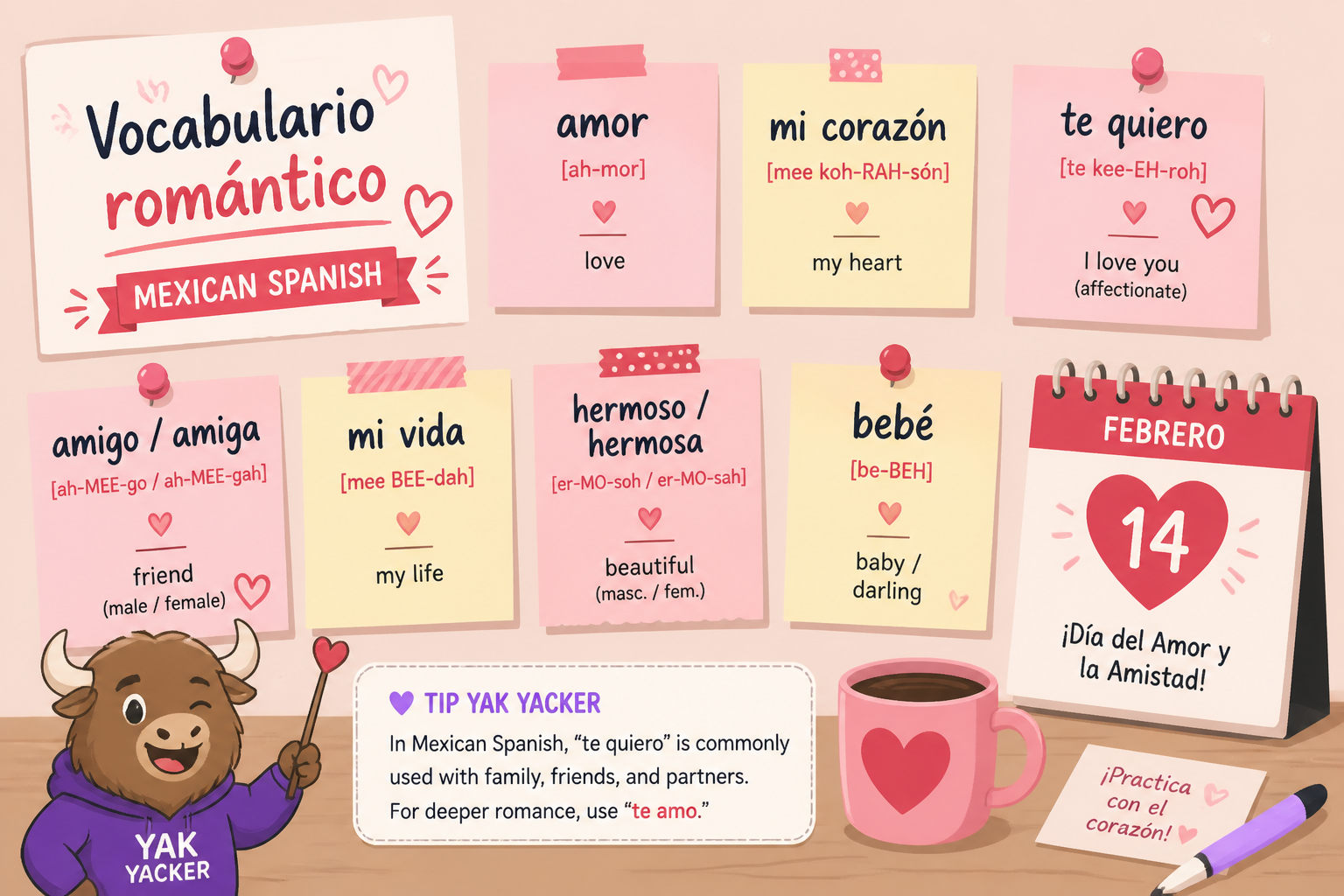
In Mexico, Valentine’s Day is usually called el Día del Amor y la Amistad, which literally means “Day of Love and Friendship.” That’s important, because it is not only for couples. Friends, classmates, and coworkers may exchange small gifts or sweet messages too. Romance gets the spotlight, sure, but friendship is invited to the party.
| Spanish | Pronunciation | Meaning | Example Sentence | Translation | Learner Note |
|---|---|---|---|---|---|
| el Día del Amor y la Amistad | day-ah del ah-MOR ee lah ah-mees-TAD | Valentine’s Day in Mexico | El Día del Amor y la Amistad es muy popular en México. | Valentine’s Day is very popular in Mexico. | Very common in Mexico; not just for couples. |
| San Valentín | sahn bah-len-TEEN | Valentine’s Day / Saint Valentine | Vamos a cenar por San Valentín. | We’re going out to dinner for Valentine’s Day. | Used across Latin America and Spain. |
| el 14 de febrero | el KAH-tohr-seh de feh-breh-ROH | February 14 | El 14 de febrero hay muchos regalos. | On February 14, there are lots of gifts. | Useful for dates, plans, and texting. |
| una tarjeta | OO-nah tar-HEH-tah | a card | Le compré una tarjeta con un mensaje bonito. | I bought her a card with a nice message. | Gender: tarjeta is feminine. |
| un regalo | oon reh-GAH-loh | a gift | Te traje un regalo pequeño. | I brought you a small gift. | Good all-purpose Valentine’s noun. |
Little pronunciation note: in Mexican Spanish, the “ll” in Amistad and many other words is not the English “l.” Also, Spanish vowels are clean and crisp. No dramatic vowel gymnastics required. Thank goodness.
Sweet Words For A Partner
These are the sweet, affectionate words people use for a boyfriend, girlfriend, spouse, or someone they are dating. Some are romantic, some are playful, and some are so common that you may hear them in a café, a text, or a slightly dramatic telenovela scene.
| Spanish | Pronunciation | Meaning | Example Sentence | Translation | Learner Note |
|---|---|---|---|---|---|
| mi amor | mee ah-MOR | my love | Mi amor, ¿quieres salir conmigo? | My love, do you want to go out with me? | Very common, warm, and not overly formal. |
| mi vida | mee VEE-dah | my life | Gracias, mi vida, por ayudarme. | Thank you, my love, for helping me. | Common affectionate nickname in Mexico. |
| mi cielo | mee SYEH-loh | my heaven / darling | Buenos días, mi cielo. | Good morning, darling. | Sweet and affectionate; not literal. |
| corazón | koh-rah-SON | heart / sweetheart | ¿Cómo estás, corazón? | How are you, sweetheart? | Very common as a term of endearment. |
| cariño | kah-REE-nyoh | darling / affection | Cariño, te preparé café. | Darling, I made you coffee. | Soft, affectionate, and useful in many contexts. |
| amorcito | ah-mor-SEE-toh | little love / sweetheart | Amorcito, ven acá. | Sweetheart, come here. | Diminutive makes it sweeter. Sometimes very cute, sometimes very extra. |
| precioso / preciosa | preh-SYOH-soh / preh-SYOH-sah | beautiful, lovely | Te ves preciosa hoy. | You look beautiful today. | Agreement matters: precioso for masculine, preciosa for feminine. |
| bonito / bonita | boh-NEE-toh / boh-NEE-tah | pretty, nice, cute | Qué bonito detalle. | What a nice detail. | Gentler than “beautiful”; useful for casual sweetness. |
| lindo / linda | LEEN-doh / LEEN-dah | lovely, cute | Tu mensaje estuvo muy lindo. | Your message was very sweet. | Very common in Latin America; a little less common in Spain. |
| hermoso / hermosa | ehr-MOH-soh / ehr-MOH-sah | gorgeous, beautiful | Tu sonrisa es hermosa. | Your smile is beautiful. | Stronger and more poetic than bonito. |
| tesoro | teh-SOH-roh | treasure | Eres un tesoro para mí. | You’re a treasure to me. | Sweet and common, especially in affectionate speech. |
| chiquito / chiquita | chee-KEE-toh / chee-KEE-tah | little one, cutie | Hola, chiquita, ¿cómo va tu día? | Hi, cutie, how’s your day going? | Can sound playful. Use only if the relationship is clearly warm. |
In Mexico, affectionate nicknames are everywhere, but the tone matters. Mi amor can be tender and normal, while amorcito is more sugary. If you say it too early, it may sound like you swallowed a heart-shaped candy whole.
Romantic Phrases You Can Actually Use
These phrases are great for texts, cards, messages, and real conversations. Most are sweet without sounding stiff. A few are slightly bold, so use them only if the vibe is already there.
| Spanish | Pronunciation | Meaning | Example Sentence | Translation | Learner Note |
|---|---|---|---|---|---|
| te quiero | teh KYEH-roh | I love you / I care about you | Te quiero mucho. | I care about you a lot. | Less intense than te amo; very common. |
| te amo | teh AH-moh | I love you deeply | Te amo con todo mi corazón. | I love you with all my heart. | Stronger, more serious, and usually for close relationships. |
| me encantas | meh en-KAHN-tahs | I really like you / I adore you | Me encantas tal como eres. | I adore you just the way you are. | Very useful and common in dating language. |
| me gustas mucho | meh GOOS-tahs MOO-choh | I really like you | Me gustas mucho desde la primera vez. | I’ve liked you a lot since the first time. | Good for early romance; simpler than saying te amo. |
| me haces feliz | meh AH-sehs feh-LEES | you make me happy | Tú me haces feliz todos los días. | You make me happy every day. | Easy, clear, and sweet. |
| eres lo mejor que me ha pasado | EH-rehs lo meh-HOR keh meh ah pah-SAH-doh | you are the best thing that has happened to me | Eres lo mejor que me ha pasado. | You’re the best thing that has happened to me. | Big romantic energy. Use with sincerity, not as a joke. |
| me haces sonreír | meh AH-sehs son-reh-EER | you make me smile | Tu mensaje me hizo sonreír. | Your message made me smile. | A nice soft compliment for texting. |
| pienso en ti | pyehn-soh en tee | I think about you | Pienso en ti todo el día. | I think about you all day. | Very useful in cards and messages. |
| eres muy especial para mí | EH-rehs nwee ehs-peh-syahl pah-rah mee | you are very special to me | Eres muy especial para mí. | You are very special to me. | Safe, sweet, and not too intense. |
| me haces falta | meh AH-sehs FAHL-tah | I miss you | Me haces falta cuando no estás. | I miss you when you’re not here. | Literally “you make me lack”; very common Spanish wording. |
| quiero verte | KYEH-roh BEHR-teh | I want to see you | Quiero verte este fin de semana. | I want to see you this weekend. | Natural and simple for plans. |
| ¿quieres ser mi San Valentín? | KYEH-rehs sehr mee sahn bah-len-TEEN | Will you be my Valentine? | ¿Quieres ser mi San Valentín? | Will you be my Valentine? | Cute and direct. Works best in a playful tone. |
| me robaste el corazón | meh roh-BAHS-teh el koh-rah-SON | you stole my heart | Me robaste el corazón desde el primer día. | You stole my heart from day one. | A classic expression. Very natural. |
| estoy enamorado / enamorada | ehs-TOY eh-nah-moh-RAH-doh / eh-nah-moh-RAH-dah | I’m in love | Estoy enamorado de ti. | I’m in love with you. | Gender changes with the speaker: enamorado or enamorada. |
| me tienes loco / loca | meh TYEH-nehs LOH-koh / LOH-kah | you drive me crazy | Me tienes loco con tu sonrisa. | You drive me crazy with your smile. | Flirty, playful, and a little dramatic. Very Spanish-language, frankly. |
Useful nuance: te quiero is often safer than te amo for newer relationships. In many Latin American contexts, te quiero is the everyday affectionate one, while te amo is deeper and more intense. If you mix them up, nobody will arrest you. But the emotional temperature changes a lot.
Flirty Text Messages And Cute Replies
These are perfect when you want to sound sweet in texts, cards, or notes. They’re short, natural, and not full of glitter-covered nonsense.
| Spanish | Pronunciation | Meaning | Example Sentence | Translation | Learner Note |
|---|---|---|---|---|---|
| te extraño | teh ehs-TRYAH-nyoh | I miss you | Te extraño mucho hoy. | I miss you a lot today. | Very common in Latin America. |
| ¿qué haces? | keh AH-sehs | what are you doing? | Hola, ¿qué haces esta noche? | Hi, what are you doing tonight? | Very useful in casual texting. |
| estoy pensando en ti | ehs-TOY pehn-SAN-doh en tee | I’m thinking about you | Estoy pensando en ti todo el día. | I’m thinking about you all day. | Soft and romantic without sounding too heavy. |
| me alegraste el día | meh ah-leh-GRAHS-teh el DEE-ah | you made my day | Tu mensaje me alegró el día. | Your message made my day. | Great for replying to a sweet text. |
| qué lindo mensaje | keh LEEN-doh mehn-SAH-heh | what a sweet message | Qué lindo mensaje me mandaste. | What a sweet message you sent me. | Lindo is especially common in Latin America. |
| eres un amor | EH-rehs oon ah-MOR | you are so sweet | Gracias, eres un amor. | Thanks, you’re so sweet. | Nice for thanking someone kindly. |
| me haces sonreír como tonto / tonta | meh AH-sehs son-reh-EER KOH-moh TON-toh / TON-tah | you make me smile like a fool | Me haces sonreír como tonta. | You make me smile like a fool. | Playful, but only if the relationship is warm. |
| qué detalle tan bonito | keh deh-TAH-yeh tahn boh-NEE-toh | what a nice detail / gesture | Qué detalle tan bonito tuviste. | What a nice gesture you made. | Very useful for thanking someone for a gift or note. |
| me derrites | meh deh-RREE-tehs | you melt me | Con esa sonrisa me derrites. | With that smile, you melt me. | Flirty and dramatic. A little goes a long way. |
| me encantaría verte | meh en-kahn-tah-REE-ah BEHR-teh | I’d love to see you | Me encantaría verte hoy. | I’d love to see you today. | Polite and romantic at the same time. |
Kind Words For Friends Too
Remember, Valentine’s Day in Mexico also celebrates friendship. So if you want to message a friend, you don’t need to sound like you’re proposing under a rose arch. You can keep it warm and friendly.
| Spanish | Pronunciation | Meaning | Example Sentence | Translation | Learner Note |
|---|---|---|---|---|---|
| amigo / amiga | ah-MEE-goh / ah-MEE-gah | friend | Feliz Día del Amor y la Amistad, amiga. | Happy Valentine’s Day, friend. | Works in friendly messages and cards. |
| compa | KOM-pah | buddy, pal | <More Spanish to explore |