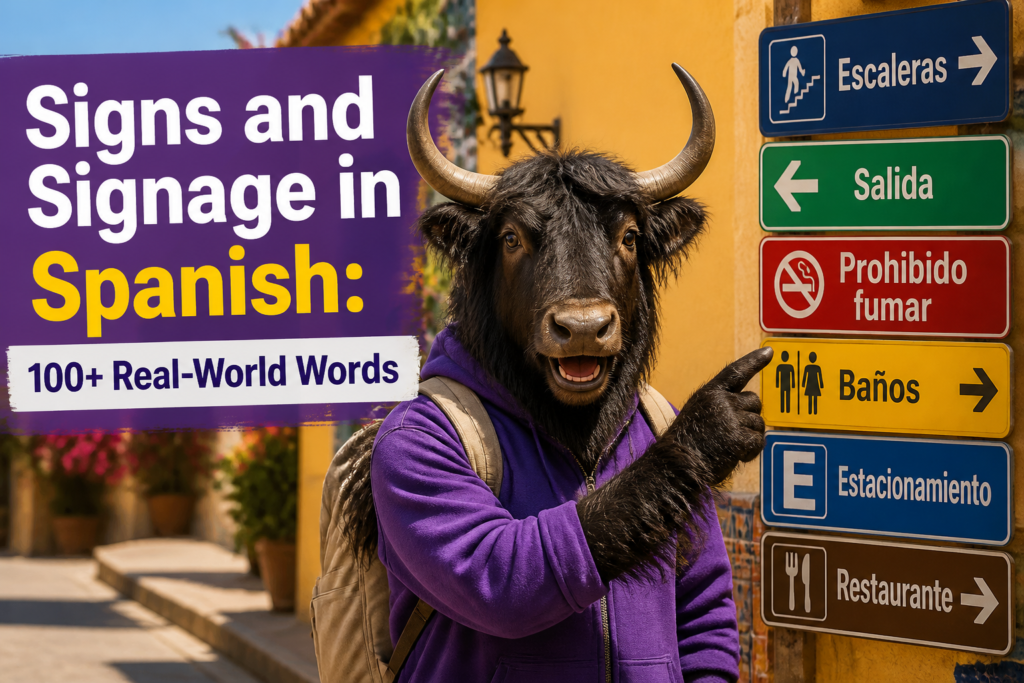
If you can read signs in Spanish, you can survive a lot more than you think. Airports, metro stations, pharmacies, road trips, hotel lobbies, random tiny stores with suspiciously loud music — signs are basically the adult version of “follow the arrows and pretend you know what you’re doing.”
For the broader learning path, visit our parent guide.
This guide gives you practical Spanish vocabulary and phrases for signs, notices, labels, warnings, directions, and everyday public information. You’ll learn the words that actually show up in real life, not the weird dictionary leftovers nobody has used since 1987.
For a useful language note on contrast and clarity, it helps to remember that some sign vocabulary overlaps with other everyday words. If you want a broader starter list too, see 100 Essential Spanish Words & Phrases.
Quick Sign Reading Tips
Spanish signs often use short, blunt wording. That is normal. A sign is not here to make friends; it is here to tell you where the bathroom is and what not to touch.
Also, punctuation matters. If you have ever mixed up sí and si, or qué and que, signs will happily punish you for it. For date-related signs like schedules, opening hours, and appointments, this can be extra useful: Write the Date in Spanish.
Core Words You’ll See Everywhere
| Spanish | Pronunciation | Meaning | Example Sentence | Translation | Learner Note |
|---|---|---|---|---|---|
| señal | seh-NYAHL | sign; signal | La señal de alto está más adelante. | The stop sign is ahead. | ñ sounds like the “ny” in “canyon.” |
| letrero | leh-TREH-roh | sign; signboard | El letrero dice “Entrada”. | The sign says “Entrance.” | Very common for store and street signs. |
| cartel | kar-TEHL | poster; sign; notice | Hay un cartel en la puerta. | There is a sign on the door. | Can mean “poster” too. |
| aviso | ah-BEE-soh | notice; warning | El aviso está en la recepción. | The notice is at reception. | Useful for announcements and notices. |
| anuncio | ah-NOON-syoh | announcement; ad | Vi un anuncio en la estación. | I saw an announcement at the station. | Also means “advertisement.” |
| letrero luminoso | leh-TREH-roh loo-mee-NOH-soh | illuminated sign | El letrero luminoso está encendido. | The illuminated sign is on. | Common in shops and restaurants. |
| rótulo | ROH-too-loh | label; sign; heading | El rótulo del edificio es pequeño. | The building sign is small. | More formal; common on buildings and documents. |
| escrito | eh-SKREE-toh | written | Está escrito en inglés y español. | It is written in English and Spanish. | Useful in sign descriptions. |
| texto | TEHK-stoh | text | El texto del aviso es claro. | The text of the notice is clear. | Simple but useful on forms and signs. |
| símbolo | SEEM-boh-loh | symbol | El símbolo del baño es fácil de entender. | The bathroom symbol is easy to understand. | Great when words are not used. |
Direction And Location Words
| Spanish | Pronunciation | Meaning | Example Sentence | Translation | Learner Note |
|---|---|---|---|---|---|
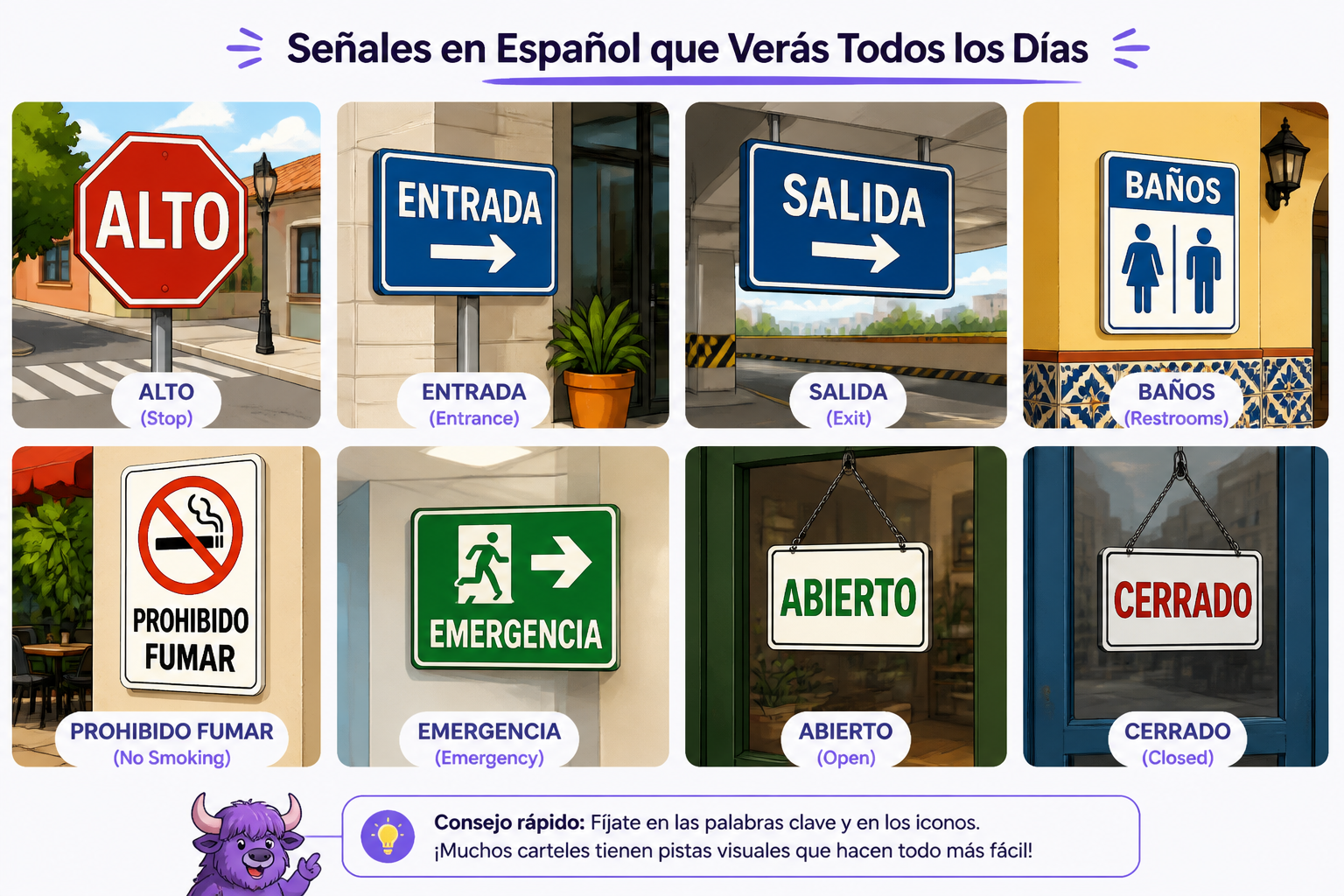
| entrada | en-TRAH-dah | entrance | La entrada está por ahí. | The entrance is over there. | Opposite of salida. |
| salida | sah-LEE-dah | exit; way out | La salida está a la derecha. | The exit is on the right. | Very common in buildings and stations. |
| arriba | ah-REE-bah | up; above | La farmacia está arriba. | The pharmacy is upstairs. | Can mean “upstairs” in signs. |
| abajo | ah-BAH-hoh | down; below | Los baños están abajo. | The bathrooms are downstairs. | Very common in malls and offices. |
| derecha | deh-REH-chah | right | Gire a la derecha. | Turn right. | Often used in directions. |
| izquierda | ees-kyair-DAH | left | La oficina queda a la izquierda. | The office is on the left. | The qu keeps the “k” sound. |
| recto | REHK-toh | straight ahead | Siga recto hasta el semáforo. | Go straight ahead until the traffic light. | Very practical for directions. |
| al frente | ahl FREHN-teh | in front; straight ahead | La parada está al frente. | The stop is straight ahead. | Common in Latin America. |
| al lado de | ahl LAH-doh deh | next to | El banco está al lado de la farmacia. | The bank is next to the pharmacy. | Useful for location signs. |
| cerca de | SEHR-kah deh | near | Hay un hotel cerca de la estación. | There is a hotel near the station. | Very common on maps and signs. |
| lejos de | LEH-hos deh | far from | El centro queda lejos de aquí. | The center is far from here. | Useful when reading city directions. |
Public Notices And Warning Signs
| Spanish | Pronunciation | Meaning | Example Sentence | Translation | Learner Note |
|---|---|---|---|---|---|
| prohibido | proh-EE-BEE-doh | forbidden | Está prohibido fumar aquí. | Smoking is forbidden here. | Very common on signs. |
| no fumar | noh foo-MAHR | no smoking | No fumar en el edificio. | No smoking in the building. | Short, direct, and everywhere. |
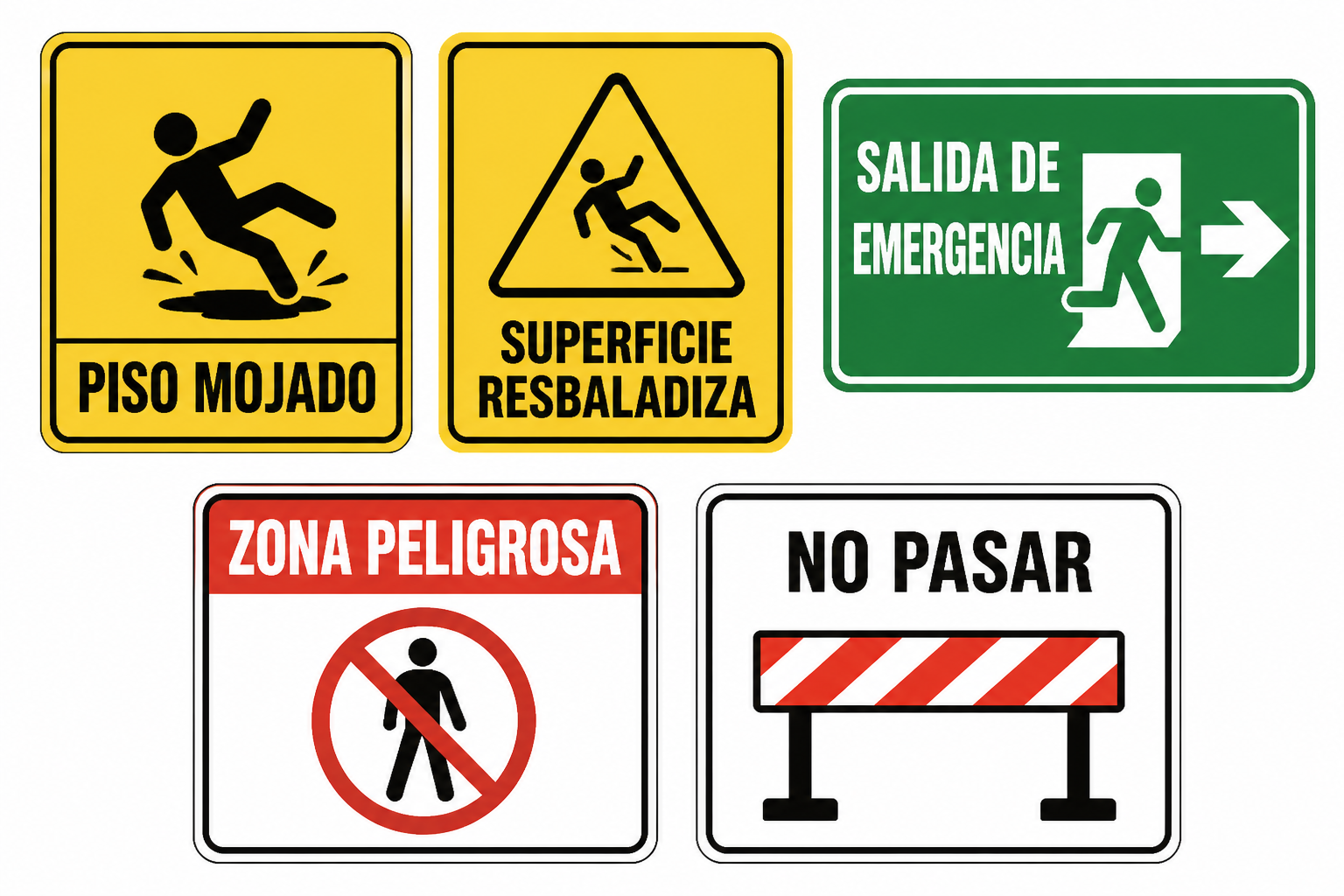
| no pasar | noh pah-SAHR | do not enter; do not pass | No pasar por esta puerta. | Do not go through this door. | Often seen on restricted areas. |
| peligro | peh-LEE-groh | danger | Peligro: piso mojado. | Danger: wet floor. | The classic sign everyone ignores until they slip. |
| cuidado | kwee-DAH-doh | care; caution | Cuidado con el escalón. | Watch out for the step. | Very common warning word. |
| atención | ah-ten-SYOHN | attention; warning | Atención: puerta automática. | Attention: automatic door. | Often used in formal notices. |
| precaución | preh-kow-SYOHN | caution | Precaución: niños jugando. | Caution: children playing. | Neutral and formal. |
| riesgo | REES-goh | risk | Hay riesgo de caída. | There is a risk of falling. | Common in safety notices. |
| zona peligrosa | SOH-nah peh-lee-GROH-sah | danger zone | Zona peligrosa: entrada restringida. | Danger zone: restricted entry. | Very explicit signage. |
| superficie resbaladiza | soo-pehr-FEE-thee ehz-bah-lah-DEE-thah | slippery surface | La superficie está resbaladiza. | The surface is slippery. | Long, but extremely useful on caution signs. |
| piso mojado | PEE-so moh-HAH-doh | wet floor | Hay un letrero de piso mojado. | There is a wet floor sign. | Common in shops and hotels. |
| salida de emergencia | sah-LEE-dah deh eh-mehr-HEN-syah | emergency exit | La salida de emergencia está al fondo. | The emergency exit is at the back. | One of the most useful safety phrases. |
Transport And Street Signs
| Spanish | Pronunciation | Meaning | Example Sentence | Translation | Learner Note |
|---|---|---|---|---|---|
| parada | pah-RAH-dah | stop; bus stop | La parada del autobús está cerca. | The bus stop is nearby. | Very common in cities. |
| estación | eh-stah-SYOHN | station | La estación está cerrada hoy. | The station is closed today. | Can be train, bus, or metro station. |
| metro | MEH-troh | subway; metro | El metro está lleno. | The subway is full. | Common in many countries. |
| autobús | ow-toh-BOOS | bus | El autobús pasa cada diez minutos. | The bus passes every ten minutes. | In some countries, bus is also used. |
| calle | KAH-yeh | street | La calle está cortada. | The street is closed off. | Very common in addresses and signs. |
| avenida | ah-veh-NEE-dah | avenue | La avenida principal está aquí. | The main avenue is here. | Common in city maps. |
| camino | kah-MEE-noh | road; path | Este camino no tiene salida. | This road has no exit. | Useful on rural or small-road signs. |
| desvío | dehs-VEE-oh | detour | Hay un desvío por obras. | There is a detour because of roadworks. | Very common on driving signs. |
| obra | OH-brah | construction; works | Hay obras en la avenida. | There is construction on the avenue. | Common on road signs. Also means “work” in art/literature, because Spanish enjoys ambiguity. |
| peaje | peh-AH-heh | toll | La carretera tiene peaje. | The highway has a toll. | Important on road trips. |
| semáforo | seh-MAH-foh-roh | traffic light | Gire en el semáforo. | Turn at the traffic light. | Accent on the second syllable. |
| paso peatonal | PAH-soh peh-ah-toh-NAHL | crosswalk | Cruce por el paso peatonal. | Cross at the crosswalk. | Formal and very common on street signs. |
Store, Restaurant, And Building Signs
| Spanish | Pronunciation | Meaning | Example Sentence | Translation | Learner Note |
|---|---|---|---|---|---|
| abierto | ah-BYEHR-toh | open | La tienda está abierta. | The store is open. | Adjective changes for gender: abierto/abierta. |
| cerrado | seh-RAH-doh | closed | Está cerrado por vacaciones. | It is closed for vacation. | Common on doors and schedules. |
| horario | oh-RAH-ryoh | hours; schedule | El horario está en la entrada. | The hours are at the entrance. | Very common for shops and offices. |
| abierto al público | ah-BYEHR-toh ahl POO-blee-koh | open to the public | El museo está abierto al público. | The museum is open to the public. | Formal, useful in museums and offices. |
| recepción | reh-sep-SYOHN | reception; front desk | Pregunte en recepción. | Ask at reception. | Common in hotels and offices. |
| mostrador | mos-trah-DOHR | counter | El pedido está en el mostrador. | The order is at the counter. | Useful in cafés and stores. |
| caja | KAH-hah | cash register; checkout | Pague en caja, por favor. | Pay at the checkout, please. | Can also mean “box,” naturally. |
| baño | BAH-nyoh | bathroom | ¿Dónde está el baño? | Where is the bathroom? | Very important. Possibly the most important. |
| servicio | sehr-VEE-syoh | service; restroom | Los servicios están al fondo. | The restrooms are at the back. | Common on signs, especially formal ones. |
| entrada gratuita | en-TRAH-dah groo-TOO-ee-tah | free entry | La entrada es gratuita hoy. | Entry is free today. | Gratuita is feminine because entrada is feminine. |
| reservado | reh-sehr-VAH-doh | reserved | Esta mesa está reservada. | This table is reserved. | Common in restaurants and parking signs. |
| para llevar | PAH-rah yeh-VAHR | to go; takeaway | ¿Es para llevar? | Is it to go? | Latin America and Spain both use this. |
In many places, servicios is the polite, sign-friendly way to say bathrooms. It sounds a little more formal than baño, but less dramatic than the human panic that usually comes with needing one.
Signs About Rules, Access, And Services
| Spanish | Pronunciation | Meaning | Example Sentence | Translation | Learner Note |
|---|---|---|---|---|---|
| entrada libre | en-TRAH-dah LEE-breh | free entry; open access | Hay entrada libre los domingos. | There is free entry on Sundays. | Often used for museums and events. |
| acceso | ak-SEH-soh | access | No hay acceso por esta puerta. | There is no access through this door. | Formal and common. |
| prohibido el paso | proh-EE-BEE-doh ehl PAH-soh | no entry; passage forbidden | Prohibido el paso en esta zona. | No entry in this area. | Strong warning sign. |
| uso exclusivo | OO-so ehk-skloo-SEE-boh | for exclusive use | Baño de uso exclusivo para clientes. | Bathroom for customers’ exclusive use. | Common in businesses. |
| solo personal autorizado | SOH-loh pehr-soh-NAHL ow-toh-ree-SAH-doh | authorized personnel only | Solo personal autorizado puede entrar. | Only authorized staff may enter. | Very common in workplaces. |
| privado | pree-VAH-doh | private | Área privada, por favor no pasar. | Private area, please do not enter. | Useful on door signs and notices. |
| público | POO-blee-koh | public | El parque es público. | The park is public.More Spanish to explore |