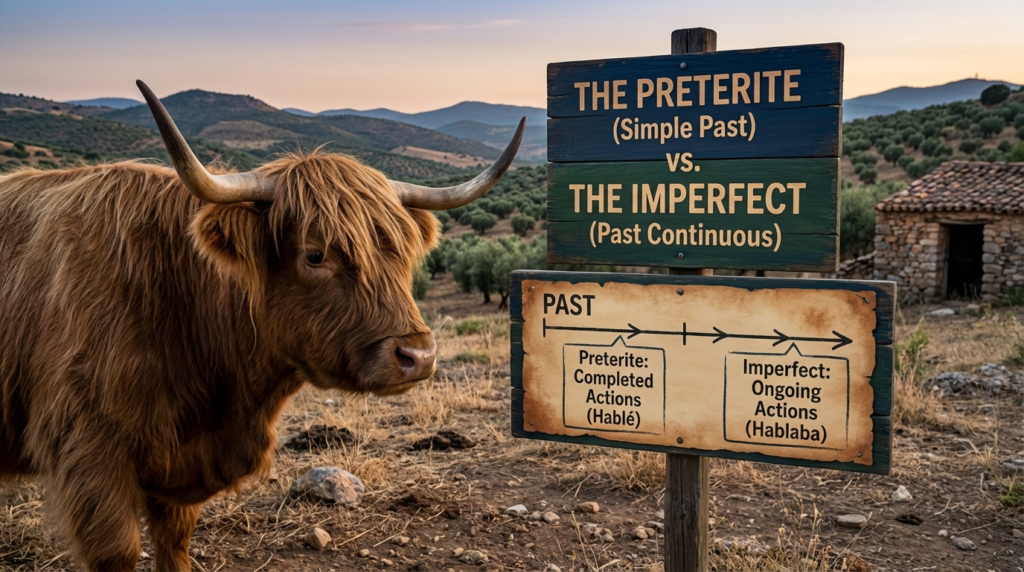
Two past tenses. One goal: tell the past without sounding like you’re throwing darts at a verb chart.
Win you get today: you’ll know which past tense to pick in real-life situations (stories, habits, descriptions, interruptions).
Yak Box (Remember This): Preterite = finished events (the “plot”). Imperfect = background, habits, descriptions, and “was/were ___-ing” vibes (the “scene”). Mix them and your Spanish suddenly sounds… suspiciously fluent.
The Big Idea (Plot vs. Scene)
Preterite = The Plot
Use it when an action is completed or you’re listing what happened (one thing after another).
Fui al mercado, compré pan y regresé a casa.
I went to the market, bought bread, and returned home.
Imperfect = The Scene
Use it for ongoing past, habits, descriptions, and what was happening when something interrupted.
Vivía en Guadalajara y trabajaba de noche.
I used to live in Guadalajara and used to work at night.
When To Use The Preterite
- Single, completed actions: it happened and it’s done.
- Actions in a sequence: first this, then that.
- Beginning/ending of something: the moment it started or stopped.
- Sudden changes: emotions, decisions, surprises.
- Specific time frames: yesterday, last week, in 2019, etc.
Rule → Example
Completed action: Terminé la tarea. I finished the homework.
Sequence: Me levanté, me bañé y salí. I got up, showered, and left.
Sudden change: De repente, me enojé. Suddenly, I got angry.
When To Use The Imperfect
- Habitual actions: what you used to do.
- Background descriptions: weather, time, setting, people’s states.
- Ongoing action: what was happening (especially when interrupted).
- Age and time: “I was 10,” “It was 3:00,” “It was Tuesday.”
- Mental/emotional states: what you felt/thought in the background.
Rule → Example
Habit: Cuando era niño, jugaba en la calle. When I was a kid, I used to play in the street.
Description: Hacía calor y la calle estaba vacía. It was hot and the street was empty.
Ongoing + interruption: Estudiaba cuando sonó el teléfono. I was studying when the phone rang.
How They Work Together (The Classic Combo)
Here’s the super common pattern in Spanish storytelling:
| What You’re Doing | Usually Use | Spanish Example | English Meaning |
|---|---|---|---|
| Set the scene (background) | Imperfect | Era tarde y llovía. | It was late and it was raining. |
| Move the plot (main event) | Preterite | De repente, llegó Ana. | Suddenly, Ana arrived. |
| Interrupt an ongoing action | Imperfect + Preterite | Caminaba cuando me caí. | I was walking when I fell. |
Quick sanity check: If you can answer “How many times?” or “When exactly?” easily, preterite is often your friend. If it’s “It depends / it was ongoing / it used to happen,” imperfect usually wins.
Signal Words That Nudge Each Tense
These words don’t force a tense, but they strongly hint at one. And yes, you should memorize a few—your future self will be grateful.
Preterite “Plot” Signals
| Spanish | English Meaning | Example Sentence |
|---|---|---|
| ayer | yesterday | Ayer vi a mi primo. |
| anoche | last night | Anoche cené temprano. |
| la semana pasada | last week | La semana pasada trabajé mucho. |
| hace dos días | two days ago | Hace dos días llamé a mi mamá. |
| una vez | one time / once | Una vez me perdí en el centro. |
| de repente | suddenly | De repente se apagó la luz. |
| entonces | then | Entonces decidí irme. |
| por fin | finally | Por fin encontré mis llaves. |
Imperfect “Scene” Signals
| Spanish | English Meaning | Example Sentence |
|---|---|---|
| siempre | always | Siempre tomaba café por la mañana. |
| a menudo | often | A menudo iba al parque. |
| normalmente | normally | Normalmente salía a correr. |
| todos los días | every day | Todos los días estudiaba un poco. |
| mientras | while | Mientras cocinaba, escuchaba música. |
| cuando era niño/a | when I was a kid | Cuando era niño, vivía cerca de aquí. |
| en esa época | back then / at that time | En esa época no tenía carro. |
| todavía | still | Todavía pensaba en eso. |
Past Continuous: Two Common Options
If you mean “was/were doing,” Spanish often uses the imperfect by itself… or it can get extra specific with estar in the imperfect + gerund (-ando/-iendo).
| Pattern | English Meaning | Spanish Example | English Translation |
|---|---|---|---|
| Imperfect (simple) | was/were doing (general) | Leía cuando llegaste. | I was reading when you arrived. |
| Estaba/estabas… + gerund | was/were in the middle of (more vivid) | Estaba leyendo cuando llegaste. | I was (in the middle of) reading when you arrived. |
In everyday Mexican Spanish, both are common. The “estaba + gerund” version feels more “camera zoomed in” on the action.
High-Impact Pairs That Confuse Everyone
Same verb, different tense, different meaning. This is where you level up fast.
Ser: Era vs Fue
Era = it was (description/background).
La fiesta era tranquila. The party was calm.
Fue = it was (completed/“that’s what it ended up being”).
La fiesta fue un desastre. The party was a disaster.
Tener: Tenía vs Tuve
Tenía = I had (ongoing/background).
Tenía sueño. I was sleepy.
Tuve = I had (a specific event/experience).
Tuve un problema. I had a problem.
Conocer: Conocía vs Conocí
Conocía = I knew (ongoing familiarity).
Conocía ese lugar. I knew that place.
Conocí = I met (a completed moment).
Conocí a tu hermano ayer. I met your brother yesterday.
Poder / Querer (Meaning Shifts)
Podía = I was able to / I could (ability/possibility in the background).
No podía dormir. I couldn’t sleep.
Pude = I managed to (result happened).
Por fin pude hablar con el doctor. I finally managed to speak with the doctor.
Quería = I wanted (background desire).
Quería comprar un café. I wanted to buy a coffee.
Quise = I tried / decided (often a sudden decision).
Quise ayudar, pero no pude. I tried to help, but I couldn’t.
Quick Endings (So You Can Recognize Them Fast)
This is not a full conjugation course. This is “spot it in the wild” support.
| Preterite Endings | -AR | -ER/-IR |
|---|---|---|
| yo | é | í |
| tú | aste | iste |
| él/ella/usted | ó | ió |
| nosotros | amos | imos |
| ellos/ustedes | aron | ieron |
| Imperfect Endings | -AR | -ER/-IR |
|---|---|---|
| yo | aba | ía |
| tú | abas | ías |
| él/ella/usted | aba | ía |
| nosotros | ábamos | íamos |
| ellos/ustedes | aban | ían |
Bonus: imperfect has very few irregulars (mostly ir → iba, ser → era, ver → veía). Preterite has… more drama. Lots more.
Practice Time (Choose The Right Past)
Pick preterite or imperfect for each blank. Don’t overthink it. (Okay, maybe a little.)
- 1) Ayer yo _____ (ir) al doctor.
- 2) Cuando era niño, _____ (vivir) en México.
- 3) _____ (hacer) frío y _____ (llover) toda la tarde.
- 4) Yo _____ (estudiar) cuando mi amigo _____ (llegar).
- 5) La semana pasada _____ (tener) una entrevista de trabajo.
- 6) Siempre _____ (pedir) tacos los viernes.
- 7) De repente, _____ (escuchar) un ruido raro.
- 8) Mientras ella _____ (cocinar), yo _____ (poner) la mesa.
- 9) Nosotros _____ (ser) muy tímidos en esa época.
- 10) El concierto _____ (ser) increíble.
Show Answers
- 1) fui
- 2) vivía
- 3) hacía, llovía
- 4) estudiaba, llegó
- 5) tuve
- 6) pedía
- 7) escuché
- 8) cocinaba, puse
- 9) éramos
- 10) fue
Common Mistakes And Quick Fixes
Mistake: Using Preterite For Background
Wrong-ish vibe: Fue tarde y llovió (sounds like you’re listing events).
Better scene: Era tarde y llovía. It was late and it was raining.
Mistake: Using Imperfect For A Finished Event
Too blurry: Ayer iba al doctor (sounds like “I used to go” or “I was going”).
Clear: Ayer fui al doctor. Yesterday I went to the doctor.
Mistake: Forgetting The “Interruption” Pattern
Use this: imperfect (ongoing) + preterite (interrupt).
Hablaba con mi jefe cuando se fue el internet. I was talking to my boss when the internet went out.
Mistake: Treating Imperfect As Only “Past Continuous”
Imperfect is also used to and background.
Antes trabajaba aquí. I used to work here.
Quick Reference Cheat Sheet
| If You Mean… | Use | Spanish Example | English Meaning |
|---|---|---|---|
| One finished event | Preterite | Compré un café. | I bought a coffee. |
| Habit / “used to” | Imperfect | Compraba café todos los días. | I used to buy coffee every day. |
| Background description | Imperfect | El lugar era tranquilo. | The place was calm. |
| Sudden change | Preterite | Me asusté. | I got scared. |
| Ongoing action interrupted | Imperfect + Preterite | Manejaba cuando me llamaste. | I was driving when you called me. |
| Time/age in the past | Imperfect | Eran las tres. / Tenía diez años. | It was 3:00. / I was 10. |
Mini FAQ (Fast Answers)
Is “imperfect” always the same as “past continuous”?
Nope. It can mean “was/were doing,” but it also covers habits (“used to”) and background descriptions. If you want extra “in the middle of” emphasis, use estaba + gerund.
Why does “fue” sometimes sound harsh?
Fue can feel more final/judgment-like (“it ended up being”). Era feels descriptive/background. Compare: Fue terrible (verdict) vs Era terrible (description at the time).
Can the same sentence work with both tenses?
Sometimes yes—because you’re changing the meaning. Sabía la respuesta (I knew it) vs Supe la respuesta (I found out / I learned it).
Final Yak
If you remember only one thing: imperfect paints the background, preterite moves the story. When you’re unsure, ask yourself: “Am I describing the scene… or reporting what happened?” Your verbs will behave.