


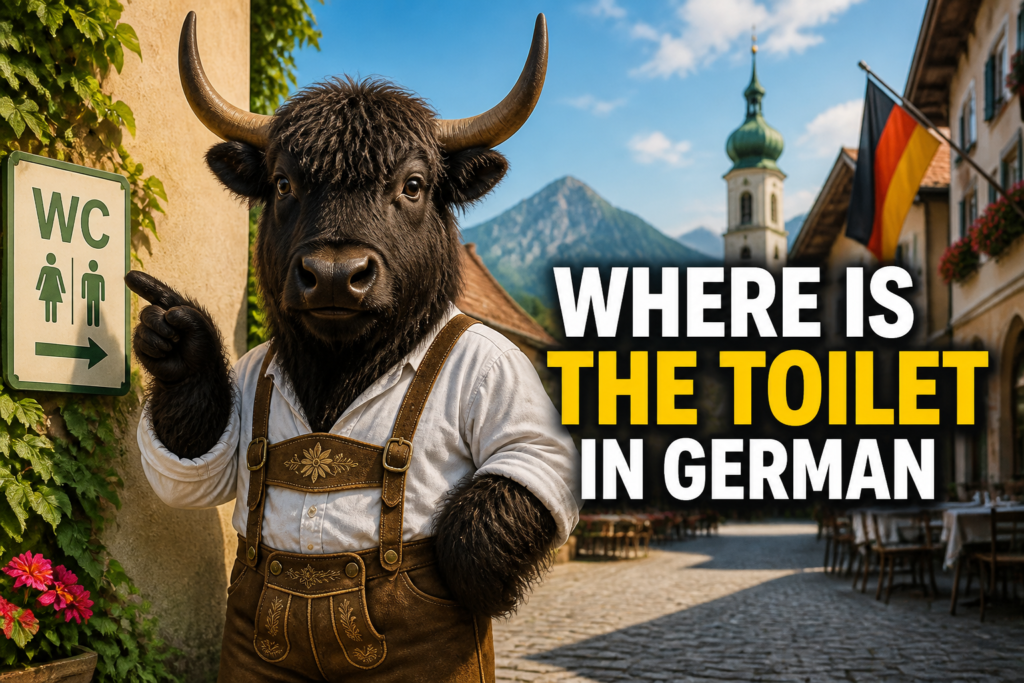
If you ever need to ask for the toilet in Germany, Austria, or Switzerland, good news: you do not need a dramatic vocabulary monologue. A short, polite question is usually enough. The trick is knowing which phrase sounds natural, which one sounds a bit old-school, and which one is best when you are trying not to panic in public.
This guide gives you the practical German you actually need in real life: the common questions, polite versions, casual versions, region notes, and a few useful follow-up phrases. Because yes, language learning should be about useful things too. Nature calls. Grammar can wait a second.
If you also want a broader set of friendly everyday expressions, the useful German greetings guide is a nice companion piece. For a wider learning path, the main hub is here: learn German.
The Most Useful Way To Ask
The safest and most common question is:
| German | Pronunciation | Meaning | Example Sentence | Translation | Learner Note |
|---|---|---|---|---|---|
| Wo ist die Toilette? | voh ist dee toy-LET-teh | Where is the toilet? | Entschuldigung, wo ist die Toilette? | Excuse me, where is the toilet? | Very common and polite. In Germany this is perfectly normal in cafés, restaurants, stations, and shops. |
| Wo sind die Toiletten? | voh zind dee toy-LET-ten | Where are the toilets? | Wo sind die Toiletten bitte? | Where are the toilets, please? | Use the plural if you are asking generally, or if a place has multiple toilets. |
That word Toilette is the standard everyday word in German for a toilet or restroom. It is not rude. It is not weird. It is just normal. English speakers sometimes expect another word, but German is happy to be direct here.
Pronunciation tip: Toilette starts with “toy,” then a short “LET,” then a soft “teh.” Do not stress the first syllable too hard. German is not asking for a performance.
Other Very Common Ways To Ask
Here are the phrases you will actually hear in the wild. Some are more polite, some are more casual, and some are region-specific. That is German for you: practical, but with opinions.
| German | Pronunciation | Meaning | Example Sentence | Translation | Learner Note |
|---|---|---|---|---|---|
| Wo ist die Toilette, bitte? | voh ist dee toy-LET-teh BIT-teh | Where is the toilet, please? | Wo ist die Toilette, bitte? | Where is the toilet, please? | The polite bitte makes the question softer. Use it often. |
| Wo kann ich zur Toilette gehen? | voh kann ikh tsoor toy-LET-teh GAY-en | Where can I go to the toilet? | Entschuldigung, wo kann ich zur Toilette gehen? | Excuse me, where can I go to the toilet? | Very polite and slightly softer. Good in formal situations. |
| Wo ist das WC? | voh ist das vay-tseh | Where is the WC? | Entschuldigung, wo ist das WC? | Excuse me, where is the WC? | WC is very common, especially on signs. Safe and understood everywhere. |
| Haben Sie hier eine Toilette? | HAH-ben zee heer EYE-neh toy-LET-teh | Do you have a toilet here? | Haben Sie hier eine Toilette? | Do you have a toilet here? | Use Sie for formal “you.” Very useful in hotels, restaurants, and shops. |
| Wo ist die nächste Toilette? | voh ist dee NEX-teh toy-LET-teh | Where is the nearest toilet? | Wo ist die nächste Toilette? | Where is the nearest toilet? | Handy if you are in a station, museum, or big public place. |
| Entschuldigung, ich suche die Toilette. | ent-SHOOL-di-goong ikh ZOO-kheh dee toy-LET-teh | Excuse me, I’m looking for the toilet. | Entschuldigung, ich suche die Toilette. | Excuse me, I’m looking for the toilet. | Useful if you are lost and want to ask for directions. |
| Wo ist die Herrentoilette? | voh ist dee HAIR-ren-toy-LET-teh | Where is the men’s toilet? | Wo ist die Herrentoilette? | Where is the men’s toilet? | Herrentoilette is formal and clear. Same for Damentoilette. |
| Wo ist die Damentoilette? | voh ist dee DAH-men-toy-LET-teh | Where is the women’s toilet? | Wo ist die Damentoilette? | Where is the women’s toilet? | Very common on signs and in public buildings. |
| Ist hier ein WC? | ist heer ayn vay-tseh | Is there a WC here? | Entschuldigung, ist hier ein WC? | Excuse me, is there a WC here? | A simple yes/no question. Good when you want to be brief. |
| Ich muss zur Toilette. | ikh moos tsoor toy-LET-teh | I need to go to the toilet. | Entschuldigung, ich muss zur Toilette. | Excuse me, I need to go to the toilet. | Very natural. If you need to explain yourself quickly, this works well. |
| Wo kann ich mich frisch machen? | voh kann ikh mikh frish MAH-khen | Where can I freshen up? | Wo kann ich mich frisch machen? | Where can I freshen up? | More indirect and polite. Common if you want to sound less blunt. |
Useful Toilet Vocabulary
These words help you understand signs, ask follow-up questions, and avoid the classic “I can say the sentence, but I cannot understand the reply” situation. Very on-brand for language learning.
| German | Pronunciation | Meaning | Example Sentence | Translation | Learner Note |
|---|---|---|---|---|---|
| die Toilette | dee toy-LET-teh | the toilet | Die Toilette ist dort drüben. | The toilet is over there. | Feminine noun: die Toilette. |
| das WC | das vay-tseh | the toilet / WC | Das WC ist links. | The toilet is on the left. | Very common on signs. WC is neutral: das WC. |
| die Rezeption | dee reh-tsep-TSEE-on | reception desk | Fragen Sie bitte an der Rezeption. | Please ask at reception. | Useful in hotels and hostels. |
| die Toilette benutzen | dee toy-LET-teh beh-NOOT-tsen | to use the toilet | Darf ich Ihre Toilette benutzen? | May I use your toilet? | Good in homes or small shops. Very polite. |
| die Tür | dee toor | the door | Die Tür ist am Ende des Flurs. | The door is at the end of the hallway. | Handy if someone gives directions. |
| der Flur | der floor | hallway | Die Toilette ist am Ende des Flurs. | The toilet is at the end of the hallway. | Common in buildings, hotels, offices. |
| links | links | left | Gehen Sie links. | Go left. | Important for directions. |
| rechts | rekhts | right | Die Toilette ist rechts. | The toilet is on the right. | Another direction word worth memorizing immediately. |
| geradeaus | guh-RAH-deh-ows | straight ahead | Gehen Sie geradeaus. | Go straight ahead. | Often used in directions. |
| oben | OH-ben | upstairs / above | Die Toilette ist oben. | The toilet is upstairs. | Useful in restaurants, trains, and houses. |
| unten | OON-ten | downstairs / below | Unten gibt es auch eine Toilette. | There is also a toilet downstairs. | Helpful when there are multiple floors. |
| die Etage | dee eh-TAH-zheh | floor, storey | Die Toilette ist auf dieser Etage. | The toilet is on this floor. | Common in hotels and office buildings. |
Polite German For Real-Life Situations
If you are asking a stranger, a waiter, a receptionist, or a shop employee, it helps to be polite. German does not need complicated politeness magic, just a simple Entschuldigung and a calm tone.
| German | Pronunciation | Meaning | Example Sentence | Translation | Learner Note |
|---|---|---|---|---|---|
| Entschuldigung | ent-SHOOL-di-goong | Excuse me / Sorry | Entschuldigung, wo ist die Toilette? | Excuse me, where is the toilet? | One of the most useful words in German. Say it a lot. |
| Bitte | BIT-teh | Please | Wo ist die Toilette, bitte? | Where is the toilet, please? | Very common and friendly. |
| Könnten Sie mir helfen? | KURN-ten zee meer HEL-fen | Could you help me? | Entschuldigung, könnten Sie mir helfen? | Excuse me, could you help me? | Useful if you need directions, especially in formal settings. |
| Ich hätte gern die Rechnung. | ikh HET-teh gern dee REKH-noong | I’d like the bill. | Und ich hätte gern die Rechnung, bitte. | And I’d like the bill, please. | Not toilet-related, but useful in the same café or restaurant situation. |
| Ist sie frei? | ist zee fry | Is it free / available? | Ist die Toilette frei? | Is the toilet free? | Good if you want to know whether it is occupied. |
| Besetzt | beh-ZETST | occupied | Die Toilette ist besetzt. | The toilet is occupied. | Very common on doors or signs. |
| Frei | fry | free / available | Die Toilette ist frei. | The toilet is free. | Useful on signs or when asking if you can go in. |
| Wo finde ich …? | voh FIN-deh ikh | Where do I find …? | Wo finde ich die Toilette? | Where do I find the toilet? | Natural and friendly. Good if you forget the exact sign wording. |
Germany, Austria, And Switzerland: Small Differences
Standard German is understood everywhere, but some labels and everyday habits vary a little by region. Good news: the toilet does not require a regional identity crisis.
| Region | Common Word | Notes | Example | Translation |
|---|---|---|---|---|
| Germany | die Toilette, das WC, sometimes das Klo | Toilette and WC are the safest choices. Klo is casual. | Wo ist die Toilette? | Where is the toilet? |
| Austria | das Klo, WC, Toilette | Klo is very common in Austria and perfectly normal in casual speech. | Wo ist das Klo? | Where is the toilet? |
| Switzerland | WC, Toilette | WC is especially common in signs and everyday use. | Wo ist das WC? | Where is the toilet? |
Learner note: if you want one phrase that works almost everywhere, use Wo ist die Toilette? or Wo ist das WC?. If you are in Austria and hear Klo, that is just the local everyday word, not a rude surprise.
Casual Versus Polite: Which One Should You Use?
The choice depends on where you are and who you are speaking to. In a café with staff, use polite language. With friends, casual is fine. With a stranger on the street, polite is still the safe bet. Revolutionary, I know.
| Style | German | When To Use It | Translation | Learner Note |
|---|---|---|---|---|
| Polite | Entschuldigung, wo ist die Toilette? | Restaurants, shops, hotels, museums | Excuse me, where is the toilet? | Safe default for most situations. |
| Polite | Wo ist das WC, bitte? | Public places, signs, asking staff | Where is the WC, please? | Short and neat. |
| Casual | Wo ist das Klo? | With friends, informal settings | Where is the toilet? | Casual and more colloquial. Best not to lead with this to a stranger. |
| Very indirect | Wo kann ich mal hin? | Very casual, often spoken | Where can I go for a second? | Soft, indirect, and very colloquial. Not ideal for beginners. |
When in doubt, be polite. A simple Entschuldigung plus Wo ist die Toilette? is almost always enough.
Grammar You Actually Need
You do not need a full grammar dungeon to ask for the toilet. Still, a few patterns help a lot, especially the word order and the small but important preposition zu in phrases like zur Toilette.
| Pattern | Meaning | German Example | English Translation | Learner Note |
|---|---|---|---|---|
| Wo ist …? | Where is …? | Wo ist die Toilette? | Where is the toilet? | Simple question word + verb + subject/object. Very common. |
| Wo kann ich …? | Where can I …? | Wo kann ich zur Toilette gehen? | Where can I go to the toilet? | The verb comes in second position in a normal question. |
| zur + feminine noun | to the | zur Toilette | to the toilet | zur = zu der. It shrinks in real German, because German enjoys compression. |
| Ich muss … | I have to / I need to | Ich muss zur Toilette. | I need to go to the toilet. | Very natural and useful. |
| Haben Sie …? | Do you have …? | Haben Sie hier eine Toilette? | Do you have a toilet here? | Formal polite question using Sie. |
| Wo befindet sich …? | Where is … located? | Wo befindet sich die Toilette? | Where is the toilet located? | More formal and a bit stiff. Understand it, but do not overuse it. |
One very useful little thing: zur is a contraction of zu der. Since Toilette is feminine, it becomes zur Toilette. This comes up in lots of similar phrases, not just bathroom emergencies. Language learning, always so glamorous.
Pronunciation Tips That Matter
You do not need perfect accent control to be understood. But a few sound tips make these phrases much easier to say naturally.
| German Sound / Word | How To Say It | Common Mistake | Example | Learner Note |
|---|---|---|---|---|
| Toilette | toy-LET-teh | Stressing the first syllable too much | Wo ist die Toilette? | Keep the stress on the middle syllable: -LET-. |
| Entschuldigung | ent-SHOOL-di-goong | Trying to say every letter too sharply | Entschuldigung, wo ist die Toilette? | Fast and smooth is more natural than dramatic and careful. |
| ch in ich | soft throat sound | Using a hard English “k” or “sh” | Ich muss zur Toilette. | The ch in ich is a soft sound, not a hard k. |
| r in zur | light, not overdone | Over-rolling the r in every word | zur Toilette | Keep it relaxed. German r is often softer than learners expect. |
| WC | vay-tseh | Saying the English letters | Wo ist das WC? | Say the German letter names: V as “vay,” C as “tseh.” |
| wo | voh | Saying “who” | Wo ist …? | It sounds like “voh,” not English “who.” |
| bitte | BIT-teh | Rushing it | Wo ist die Toilette, bitte? | It is short and polite. Easy win. |
For a deeper dictionary-style check of the main word, the boring-but-helpful Duden entry for Toilette is a solid reference. Boring sources are often the best sources. Tragic, but true.
Mini Dialogues You Can Actually Use
Short exchanges are easier to remember than isolated words. Here are a few realistic ones.
| German | Pronunciation | Meaning | Translation | Learner Note |
|---|---|---|---|---|
| Entschuldigung, wo ist die Toilette? Geradeaus und dann rechts. | ent-SHOOL-di-goong, voh ist dee toy-LET-teh? guh-RAH-deh-ows oont dahn rekhts | Excuse me, where is the toilet? Straight ahead and then right. | Excuse me, where is the toilet? Straight ahead and then right. | This is a very typical question-and-answer pattern. |
| Wo ist das WC? Im Erdgeschoss. | voh ist das vay-tseh? im AIRD-guh-shoss | Where is the WC? On the ground floor. | Where is the WC? On the ground floor. | Erdgeschoss means ground floor in Germany. |
| Haben Sie hier eine Toilette? Ja, hinten links. | HAH-ben zee heer EYE-neh toy-LET-teh? yah, HIN-ten links | Do you have a toilet here? Yes, back left. | Do you have a toilet here? Yes, back left. | Very useful in cafés and restaurants. |
| Ich muss zur Toilette. Natürlich, dort drüben. | ikh moos tsoor toy-LET-teh. na-TYOOR-likh, dort DRUE-ben | I need to go to the toilet. Of course, over there. | I need to go to the toilet. Of course, over there. | Dort drüben means over there. |
Notice how short German replies often are. That is normal. People may simply say links, rechts, oben, or hinten. If you catch one word, you are already doing well.
Common Signs And Words To Recognize
In public places, you may not need to ask at all if you can read the sign. Helpful, right? German labels are usually direct and practical.
| Sign / Word | Meaning | Example | Translation | Learner Note |
|---|---|---|---|---|
| WC | toilet | WC | toilet / restroom | Often the most visible sign in public spaces. |
| Toilette | toilet | Toilette | toilet | Common in Germany and easy to understand. |
| Damen | women | Damen | women’s | Usually part of a ladies’ toilet sign. |
| Herren | men | Herren | men’s | Usually part of a men’s toilet sign. |
| Behindertentoilette | accessible toilet | Behindertentoilette | accessible toilet | Long word, very German. The compound tells you exactly what it is. |
| frei | free / available | frei | available | On doors: it means nobody is inside. |
| besetzt | occupied | besetzt | occupied | On doors: someone is inside. Wait your turn. |
Quick Practice
Try these quick drills. Say them out loud if you can. Your future self in a train station will appreciate the effort.
- Translate into German: “Excuse me, where is the toilet?” → Entschuldigung, wo ist die Toilette?
- Translate into German: “Where is the WC?” → Wo ist das WC?
- Translate into German: “I need to go to the toilet.” → Ich muss zur Toilette.
- Translate into German: “Is the toilet free?” → Ist die Toilette frei?
- Translate into German: “Where can I go to the toilet?” → Wo kann ich zur Toilette gehen?
- Translate into German: “It is occupied.” → Es ist besetzt.
- Translate into German: “The toilet is on the left.” → Die Toilette ist links.
- Translate into German: “Do you have a toilet here?” → Haben Sie hier eine Toilette?
Now try the opposite direction. That is often the real test.
- Wo ist die Toilette? → Where is the toilet?
- Wo ist das WC? → Where is the WC?
- Entschuldigung, ich suche die Toilette. → Excuse me, I’m looking for the toilet.
- Wo kann ich zur Toilette gehen? → Where can I go to the toilet?
- Die Toilette ist hinten links. → The toilet is back left.
Common Mistakes And Easy Fixes
These are the mistakes English-speaking learners make all the time. Nothing fatal. Just mildly embarrassing if left unchecked.
| Wrong / Awkward | Better | Why | Example | English Translation |
|---|---|---|---|---|
| Wo ist das Toilette? | Wo ist die Toilette? | Toilette is feminine, so use die, not das. | Wo ist die Toilette? | Where is the toilet? |
| Wo Toilette? | Wo ist die Toilette? | You need the verb ist for a full question. | Wo ist die Toilette? | Where is the toilet? |
| Where is the toilette? | Wo ist die Toilette? | German spelling uses Toilette, not the English spelling. | Die Toilette ist dort. | The toilet is over there. |
| Wo kann ich die Toilette gehen? | Wo kann ich zur Toilette gehen? | German uses zur, not die, after gehen in this phrase. | Wo kann ich zur Toilette gehen? | Where can I go to the toilet? |
| Entschuldigung, wo ist das WC? | Entschuldigung, wo ist das WC? | This one is actually fine. Keep it. Your instincts are working. | Wo ist das WC? | Where is the WC? |
| Wo ist das Klo? in a formal setting | Wo ist die Toilette? or Wo ist das WC? | Klo is casual. Fine with friends, not ideal with hotel staff. | Wo ist das Klo? | Where is the toilet? |
Small grammar note: German asks for the question word first, then the verb. So Wo ist …? or Wo kann ich …? feels natural. English speakers often want to translate word-for-word and accidentally create a tiny sentence pretzel. German is not impressed.
Extra Useful Phrases For Getting There
Once someone answers, you may still need to understand directions. These little phrases are worth learning now, before you are standing in a hallway pretending to understand everything.
| German | Pronunciation | Meaning | Example Sentence | Translation | Learner Note |
|---|---|---|---|---|---|
| links | links | left | Gehen Sie links. | Go left. | One of the first direction words to learn. |
| rechts | rekhts | right | Die Toilette ist rechts. | The toilet is on the right. | Often heard in directions. |
| geradeaus | guh-RAH-deh-ows | straight ahead | Gehen Sie geradeaus. | Go straight ahead. | Very handy in public buildings. |
| hinten | HIN-ten | at the back | Die Toilette ist hinten. | The toilet is at the back. | Very common in cafés and restaurants. |
| oben | OH-ben | upstairs | Die Toilette ist oben. | The toilet is upstairs. | Use it if the toilet is on another floor. |
| unten | OON-ten | downstairs | Unten ist die Toilette. | The toilet is downstairs. | Often used in buildings and hotels. |
| am Ende des Flurs | am EN-deh des floors | at the end of the hallway | Die Toilette ist am Ende des Flurs. | The toilet is at the end of the hallway. | Very common, very useful. |
| neben der Treppe | NAY-ben der TREP-peh | next to the stairs | Die Toilette ist neben der Treppe. | The toilet is next to the stairs. | Good for hotels, stations, and large buildings. |
Quick Reference Summary
Keep these on your mental emergency list:
- Wo ist die Toilette? = Where is the toilet?
- Wo ist das WC? = Where is the WC?
- Wo kann ich zur Toilette gehen? = Where can I go to the toilet?
- Entschuldigung = Excuse me / Sorry
- bitte = please
- frei = free / available
- besetzt = occupied
- links = left
- rechts = right
- geradeaus = straight ahead
Remember the safest all-purpose version: Entschuldigung, wo ist die Toilette? It is polite, clear, and widely understood. That is the kind of German that saves lives, or at least saves awkward wandering around a café.
Yak takeaway: when you need the toilet in German, keep it simple, polite, and short. Wo ist die Toilette? will do the heavy lifting, and WC is your backup hero. Tiny phrase, big payoff.