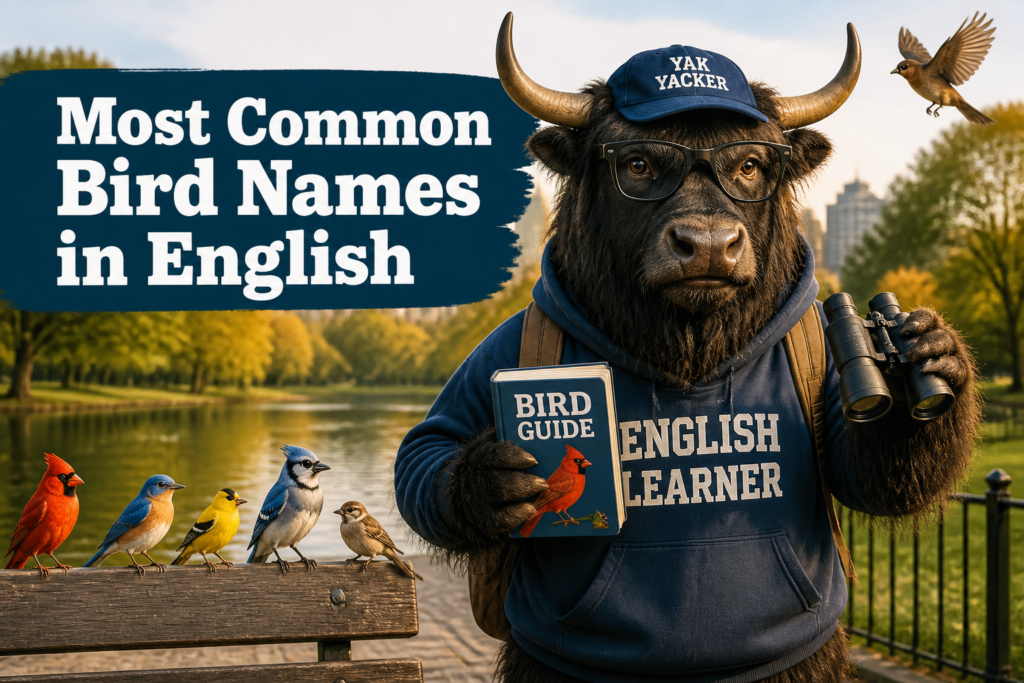
Bird names are one of those everyday English topics that look easy until someone says, “Look, a robin!” and half the room quietly imagines a completely different bird. English bird names can be simple, practical, and a little weird in the best way.
For the broader learning path, visit our parent guide.
In this guide, you’ll learn the most common bird names in English, plus simple pronunciation help, example sentences, and useful learner notes. By the end, you should be able to talk about common birds in parks, gardens, cities, farms, and nature trips without sounding like you just escaped from a wildlife documentary.
For a reliable dictionary check, you can also look up bird words in the Cambridge Dictionary.
Quick Bird Vocabulary Table
| English | Pronunciation | Meaning | Example Sentence | Learner Note |
|---|---|---|---|---|
| bird | burd | a feathered animal that usually flies | I saw a small bird on the fence. | Very general word. Use it when you do not know the exact bird name. |
| sparrow | SPAIR-oh | a small brown bird often seen near houses | A sparrow was hopping under the table at the café. | Common in cities and parks. |
| robin | ROB-in | a small bird with a red breast; in North America, a larger bird with an orange-red chest | I heard a robin singing in the morning. | Meaning can differ in the US and UK. More on that later. |
| crow | KROH | a large black bird | A crow sat on the roof and watched us. | Often used in stories and everyday speech. |
| raven | RAY-vən | a very large black bird like a crow | We saw a raven near the mountain trail. | Usually larger than a crow. |
| pigeon | PIJ-ən | a common gray city bird | Pigeons were eating crumbs in the square. | Very common in towns and cities. |
| dove | duhv | a bird related to pigeons; often used for a white, peaceful-looking bird | A white dove appeared in the garden. | “Dove” can sound more poetic than “pigeon.” |
| duck | duhk | a water bird with a broad bill | The duck swam across the pond. | Common near lakes, rivers, and parks. |
| goose | gooss | a large water bird; plural is geese | A goose was walking across the grass. | Plural spelling is irregular: goose → geese. |
| swan | swon | a large white water bird with a long neck | Two swans floated on the lake. | Often described as graceful or elegant. |
Most Common Bird Names You’ll Hear Often
These are the bird names English learners are most likely to meet in daily life, nature walks, school books, travel conversations, and simple reading passages. Some are very common in cities. Some show up in gardens, fields, or near water. Nature is generous like that.
| English | Pronunciation | Meaning | Example Sentence | Learner Note |
|---|---|---|---|---|
| bird | burd | any bird | There was a bird singing outside my window. | Useful when you do not know the exact species. |
| sparrow | SPAIR-oh | a small brown bird | We saw sparrows near the subway entrance. | Very common in urban areas. |
| robin | ROB-in | a small bird with a red or orange breast | A robin built a nest in the tree. | British and American meanings are different. |
| crow | KROH | a large black bird | Crows are very smart birds. | Also appears in idioms and folklore. |
| raven | RAY-vən | a large black bird | A raven flew over the cliff. | Often bigger and heavier than a crow. |
| pigeon | PIJ-ən | a common city bird | The pigeons gathered around the fountain. | Very common in cities worldwide. |
| dove | duhv | a bird related to pigeons; often white | A dove landed on the rooftop. | Often linked with peace or love. |
| duck | duhk | a water bird | Children fed the ducks in the park. | Plural is regular: ducks. |
| goose | gooss | a large water bird | Geese are louder than ducks. | Plural changes to geese. |
| swan | swon | a large elegant water bird | The swan moved quietly across the lake. | Common in stories and descriptions of lakes. |
| owl | owl | a bird that hunts at night | An owl hooted in the dark. | Very common in stories and nighttime scenes. |
| eagle | EE-gəl | a large powerful bird of prey | We saw an eagle flying high above the valley. | Often a symbol of strength. |
| hawk | hawk | a bird of prey that hunts smaller animals | A hawk circled above the field. | Common in nature articles and wildlife talks. |
| falcon | FAL-kən | a fast bird of prey | The falcon dived quickly toward its target. | Used in wildlife and sports team names too. |
| woodpecker | WOOD-pek-er | a bird that pecks wood with its beak | I heard a woodpecker tapping on the tree. | Easy to remember: it “pecks wood.” |
| crow | KROH | a black bird with a loud call | The crow cawed from the tree. | “Caw” is the sound a crow makes. |
Useful Bird Names In Real-Life English
Here are more bird names that can show up in everyday conversations, nature lessons, travel guides, and casual reading. Some are common in North America, while others appear more in British English or in general global English.
| English | Pronunciation | Meaning | Example Sentence | Learner Note |
|---|---|---|---|---|
| seagull | SEE-guhl | a bird often found near the sea | Seagulls were crying over the beach. | Common at beaches and harbors. |
| heron | HAIR-ən | a long-legged water bird | A heron stood very still by the river. | Often seen near lakes and wetlands. |
| pelican | PEL-i-kən | a large water bird with a big bill | We saw a pelican on the dock. | Easy to spot because of the large beak. |
| flamingo | fluh-MING-goh | a pink bird with long legs | Flamingos stood in the shallow water. | Often used in zoo and travel vocabulary. |
| parrot | PAIR-it | a colorful bird that can mimic sounds | The parrot repeated a few words. | Popular in pet and animal vocabulary. |
| canary | kuh-NAIR-ee | a small yellow bird | A canary sang in the cage. | Often seen in older texts and pet stories. |
| finch | finch | a small bird with a short beak | A finch landed on the feeder. | Common in birdwatching talk. |
| swallow | SWOL-oh | a small bird that flies quickly and often in groups | Swallows flew low over the field. | Do not confuse with the verb “swallow.” |
| starling | STAR-ling | a medium-sized bird, often dark and shiny | Starlings gathered on the wires. | Often seen in big groups. |
| magpie | MAG-pye | a black and white bird known for shiny objects | A magpie stole a shiny wrapper. | Common in British English and some other varieties. |
| blue jay | BLOO jay | a blue bird common in North America | A blue jay called loudly from the tree. | Very common in North American bird vocabulary. |
| cardinal | KAR-din-uhl | a bright red bird common in North America | A cardinal sat on the snowy branch. | Often mentioned in winter descriptions. |
| turkey | TUR-kee | a large bird often raised for food | Turkeys walked across the farm road. | Also a food word, so context matters. |
| chicken | CHIK-in | a common farm bird; also used for meat | The chickens were scratching in the dirt. | Can mean the bird or the food. |
| hen | hen | a female chicken | The hen laid an egg. | Useful on farms and in animal stories. |
| rooster | ROOS-ter | a male chicken | The rooster crowed before sunrise. | American English. British English often says cock in this sense, though that word can be awkward in some situations. |
Bird Names That Often Cause Confusion
Some bird words are simple on paper but tricky in real life. English likes to make learners do a little extra work for fun. Charming, really.
| Word | Simple Help | Common Confusion | Example |
|---|---|---|---|
| robin | ROB-in | In the UK, a robin is a small red-breasted bird. In the US, a robin is a larger bird with an orange-red chest. | I saw a robin in the garden. |
| pigeon | PIJ-ən | Often used for city birds. Some learners say “dove” when they mean “pigeon,” but they are not always the same. | Pigeons were walking across the street. |
| owl | owl | Pronunciation is simple, but some learners miss the silent-style glide in the sound. | An owl hooted at night. |
| goose / geese | gooss / geese | Plural changes completely. | One goose, two geese. |
| duck | duhk | Also a verb meaning “to lower your head quickly.” | Duck under the branch. |
| swallow | SWOL-oh | Can be a bird or a verb meaning “to eat/drink something by moving it down your throat.” | A swallow flew past the window. |
| chicken | CHIK-in | Can mean the bird, the meat, or a person who is afraid in informal English. | That chicken is hiding in the barn. |
For a more general English level check, you can also compare your vocabulary range with the English Placement Test CEFR and practice more words with the English Vocabulary Test.
Common Phrases With Bird Names
These phrases help you talk about birds naturally. They are useful for travel, nature, hobbies, and simple conversation. Not every phrase needs to be dramatic. Sometimes you just need to say, “Oh look, a bird.”
| Phrase | Pronunciation | Meaning | Example Sentence | Learner Note |
|---|---|---|---|---|
| a bird | uh burd | any bird | I can hear a bird outside. | Use when the exact species is unknown. |
| a flock of birds | uh flok ov burdz | a group of birds | A flock of birds flew south. | “Flock” is the common group word for birds. |
| a bird feeder | uh burd FEE-der | a container that holds bird food | We filled the bird feeder this morning. | Very common in garden English. |
| birdwatching | BURD-wotch-ing | the hobby of watching and identifying birds | Birdwatching is popular in many parks. | Also written as bird-watching. |
| birdsong | BURD-sawng | the sound birds make when they sing | The birdsong was loud at sunrise. | Often used in peaceful, descriptive writing. |
| bird’s nest | burdz nest | a place where a bird lays eggs and raises babies | We found a bird’s nest in the tree. | Apostrophe shows possession: the nest belongs to the bird. |
| bird flu | burd floo | a disease that affects birds | Farmers were worried about bird flu. | Used in health and news vocabulary. |
| fly like a bird | fly lyk uh burd | move through the air freely, like a bird | The kite seemed to fly like a bird. | More figurative than literal. |
| free as a bird | free az uh burd | completely free | After the exam, I felt free as a bird. | Common idiom. Not about actual birds being on vacation. |
| kill two birds with one stone | kil too burdz with wuhn stohn | do two things with one action | I walked to the store and visited my friend, so I killed two birds with one stone. | Very common idiom, but some learners prefer softer alternatives like “solve two problems at once.” |
British And American English Differences
Bird names are usually the same in British and American English, but a few differences matter.
| Bird Name | American English | British English | Example Note |
|---|---|---|---|
| robin | small bird with a red/orange chest | small bird with a red breast | The bird called a robin is not the same in the US and the UK. |
| rooster | rooster | often cock | Use rooster in American English for a male chicken. |
| seagull | seagull | seagull | No big difference here, just plenty of noisy birds by the water. |
| magpie | used, but less central in some regions | very common in everyday speech | Magpies appear more often in British descriptions. |
Pronunciation Tips For Bird Names
A few bird names are easy to pronounce, but some are worth checking once so you do not accidentally sound like you are naming a sandwich.
- sparrow = “SPAIR-oh”
- robin = “ROB-in”
- pigeon = “PIJ-ən”
- pelican = “PEL-i-kən”
- flamingo = “fluh-MING-goh”
- woodpecker = “WOOD-pek-er”
- seagull = “SEE-guhl”
- eagle = “EE-gəl”
- cardinal = “KAR-din-uhl”
- swallow = “SWOL-oh”
Yak wisdom: If you know bird, duck, crow, and pigeon, you can already understand a lot of everyday bird talk. Small vocabulary, big payoff. Very sneaky.
Practice: Match The Bird To The Clue
Try this quick practice. Read the clue and choose the bird name that fits best.
- 1. A common gray city bird: pigeon
- 2. A bird that hunts at night: owl
- 3. A large black bird: crow or raven
- 4. A bird with a long neck and graceful look: swan
- 5. A bird that makes a tapping sound on trees: woodpecker
- 6. A colorful bird that can copy sounds: parrot
- 7. A bird often seen near water and beaches: seagull
- 8. A female chicken: hen
- 9. A male chicken: rooster in American English
- 10. A small bird often seen near houses: sparrow
Quick Fill-In-The-Blank Practice
Choose the bird word that makes sense.
- 1. I saw a ______ on the lake. Answer: swan
- 2. The ______ was flying over the city. Answer: pigeon
- 3. A ______ sang outside my window this morning. Answer: robin / bird / sparrow
- 4. We heard an ______ at night. Answer: owl
- 5. The ______ pecked the tree trunk. Answer: woodpecker
- 6. The ______ stole the fries from the bench. Answer: seagull
- 7. The ______ crowed before sunrise. Answer: rooster
- 8. Two ______ were swimming near the shore. Answer: ducks
Common Mistakes With Bird Names
| Common Mistake | Better English | Why |
|---|---|---|
| “I saw a geese.” | I saw a goose. | Geese is plural. Use goose for one bird. |
| “There are two goose.” | There are two geese. | Plural form changes irregularly. |
| “A bird flyed away.” | A bird flew away. | The past tense of fly is flew, not flyed. |
| “A parrots is loud.” | Parrots are loud. | Plural nouns need plural verbs. |
| “The duck is in the water, and the duck is a verb.” | Duck can be a noun or a verb. | Context tells you the meaning. |
| “Robins is red.” | Robins are red. | Plural subject needs are. |
Mini Summary
Here are the most useful bird names to remember first:
- sparrow = small brown bird
- robin = small red-breasted bird
- crow = large black bird
- raven = very large black bird
- pigeon = common city bird
- duck = water bird
- goose = large water bird; plural geese
- swan = large graceful water bird
- owl = night bird
- eagle = large powerful bird of prey
- woodpecker = bird that taps wood
- parrot = colorful bird that can copy sounds
If you can use those words in a sentence, you already have a strong basic bird vocabulary. Not glamorous, maybe, but useful. And useful English beats fancy English that falls over in real life.
Yak takeaway: Start with the birds you actually see and hear: bird, sparrow, pigeon, crow, duck, goose, owl, and swan. Learn the pronunciation, notice the plurals, and English bird talk gets much friendlier very fast.