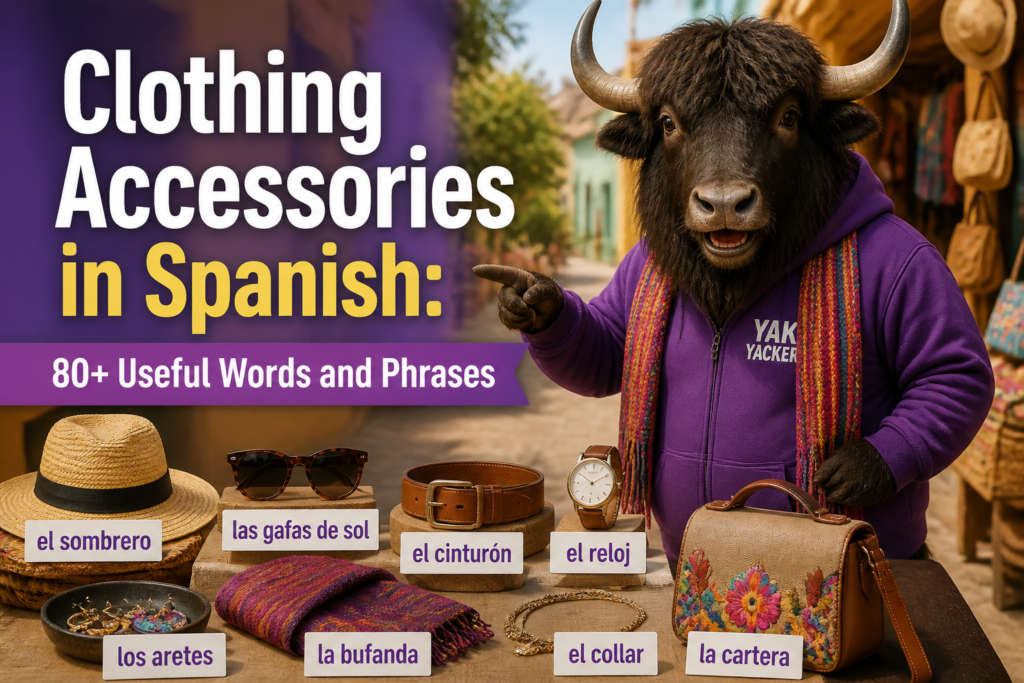
If you can talk about a scarf, a belt, or a pair of earrings in Spanish, you are already way more useful at a store, market, or fashion conversation than most people who only know hola and gracias. Tiny accessories, big survival value. Funny how that works.
For the broader learning path, visit our parent guide.
This guide gives you practical Spanish for clothing accessories: the words people actually use, the phrases you need when shopping, and the little grammar bits that stop you from sounding like you got dressed in a dictionary. The default here is standard Latin American Spanish, with notes when Spain Spanish differs.
By the end, you’ll be able to ask for accessories, describe them, and understand basic store conversations without staring at the cashier like a confused mannequin.
For a related vocabulary boost, you may also want colors in Spanish, because accessories love being red, black, gold, or suspiciously neon.
Useful Clothing Accessories Words In Spanish
Here are the most useful accessory words first. A few are everyday essentials, and a few are the things you only suddenly need when you are standing in a store with no clue what the salesperson just said.
| Spanish | Pronunciation | Meaning | Example Sentence | Translation | Learner Note |
|---|---|---|---|---|---|
| el accesorio | ahk-seh-SOH-ryoh | accessory | Este accesorio combina con tu bolso. | This accessory matches your bag. | General word for accessory. Plural: los accesorios. |
| la bufanda | boo-FAHN-dah | scarf | Me puse una bufanda porque hace frío. | I put on a scarf because it’s cold. | Very common in Latin America and Spain. |
| el cinturón | seen-too-RON | belt | Necesito un cinturón negro para estos pantalones. | I need a black belt for these pants. | Accent mark matters: cinturón. |
| los guantes | GWAHN-tes | gloves | Mis guantes están en la mochila. | My gloves are in the backpack. | Plural-only in everyday use. |
| el gorro | GO-rro | hat / beanie / cap | Voy a ponerme el gorro. | I’m going to put on my hat/beanie. | Meaning changes by country. In some places, it means a knit cap. |
| la gorra | GO-rrah | cap | Compré una gorra para el sol. | I bought a cap for the sun. | Very common for baseball-style cap. |
| los lentes de sol | LEN-tes de sol | sunglasses | Mis lentes de sol están en el carro. | My sunglasses are in the car. | Latin America often says lentes de sol. Spain often says gafas de sol. |
| las gafas de sol | GAH-fahs de sol | sunglasses | ¿Dónde dejaste las gafas de sol? | Where did you leave the sunglasses? | More common in Spain. |
| el anillo | ah-NEE-yoh | ring | Ese anillo es muy bonito. | That ring is very pretty. | Double ll is usually a soft y sound. |
| los aretes | ah-REH-tes | earrings | Me gustan mucho tus aretes. | I really like your earrings. | Common in Latin America. |
| los pendientes | pen-DYEN-tes | earrings | Compré unos pendientes pequeños. | I bought some small earrings. | More common in Spain. |
| el collar | koh-YAR | necklace | Lleva un collar de plata. | She is wearing a silver necklace. | ll is not a hard English L sound. |
| el brazalete | brah-sah-LEH-teh | bracelet | Este brazalete es de cuero. | This bracelet is made of leather. | Also la pulsera is very common. |
| la pulsera | pool-SEH-rah | bracelet / wristband | Me regalaron una pulsera azul. | They gave me a blue bracelet. | Very common in everyday Spanish. |
| el reloj | reh-LOKH | wristwatch / clock | ¿A qué hora es? Mira tu reloj. | What time is it? Check your watch. | The j is a strong throat sound. |
| la cartera | kar-TEH-rah | wallet / purse | Se me olvidó la cartera en casa. | I forgot my wallet at home. | Can mean wallet or handbag depending on country. |
| la billetera | bee-yeh-TEH-rah | wallet | Lleva la billetera en el bolsillo. | He keeps his wallet in his pocket. | Very common in parts of Latin America. |
| el bolso | BOHL-soh | bag / handbag | Dejé el bolso en la silla. | I left the bag on the chair. | Often a handbag or medium bag. |
| la mochila | moh-CHEE-lah | backpack | La mochila pesa mucho hoy. | The backpack is heavy today. | Very common and practical. |
| la corbata | kor-BAH-tah | tie | Necesito una corbata para la entrevista. | I need a tie for the interview. | Business word, not just for formal events. |
| la pajarita | pah-hah-REE-tah | bow tie | Lleva una pajarita roja. | He is wearing a red bow tie. | Common in Spain and some Latin American contexts. |
| la billetera | bee-yeh-TEH-rah | wallet | ¿Trajiste la billetera? | Did you bring your wallet? | Useful in shopping and travel situations. |
Small pronunciation tip: Spanish vowels stay clean and clear. Bufanda is not “boo-FAN-dah” with mushy vowels; every vowel gets its own job and no one is allowed to freeload.
More Accessories You’ll See All The Time
Here’s the next batch. These are common in stores, outfit descriptions, and everyday conversation.
| Spanish | Pronunciation | Meaning | Example Sentence | Translation | Learner Note |
|---|---|---|---|---|---|
| el sombrero | sohm-BREH-roh | hat | El sombrero me protege del sol. | The hat protects me from the sun. | Broader than gorra; can be casual or fancy. |
| la visera | bee-SEH-rah | visor / cap brim | La visera de la gorra es muy grande. | The brim of the cap is very big. | Useful for describing hats. |
| los calcetines | kahl-seh-TEE-nes | socks | Me faltan calcetines limpios. | I’m missing clean socks. | In Spain, calcetines is common; in parts of Latin America, people may say medias. |
| las medias | MEH-dee-as | stockings / socks | Necesito medias negras para el uniforme. | I need black stockings/socks for the uniform. | Meaning changes by region. |
| la bufanda de lana | boo-FAHN-dah deh LAH-nah | wool scarf | Compré una bufanda de lana muy suave. | I bought a very soft wool scarf. | Great for describing material. |
| los tirantes | tee-RAHN-tes | suspenders / braces | Mis tirantes son negros. | My suspenders are black. | Common in formal or vintage style. |
| el broche | BROH-cheh | brooch / clasp / fastener | Ese broche sostiene la bufanda. | That clasp holds the scarf. | Can mean a decorative pin or fastening piece. |
| el alfiler | al-fee-LAIR | pin / safety pin | Necesito un alfiler para arreglar esto. | I need a pin to fix this. | Useful for quick repairs. |
| la hebilla | eh-BEE-yah | buckle | La hebilla del cinturón es plateada. | The belt buckle is silver. | Silent h; the ll sounds like a soft y. |
| las gafas | GAH-fahs | glasses | Necesito mis gafas para leer. | I need my glasses to read. | More common in Spain. Latin America often says anteojos or lentes. |
| los anteojos | ahn-teh-OH-hos | glasses | Mis anteojos están rotos. | My glasses are broken. | Very common in Latin America. |
| la cadena | kah-DEH-nah | chain / necklace chain | La cadena es de oro. | The chain is gold. | Can refer to jewelry or a chain in general. |
| la joya | HOY-yah | jewel / piece of jewelry | Es una joya elegante. | It’s an elegant piece of jewelry. | Useful umbrella word for jewelry items. |
| la joyería | hoh-yeh-REE-ah | jewelry | Compré la pulsera en una joyería. | I bought the bracelet at a jewelry store. | Also means jewelry store in many places. |
| el pendiente | pen-DYEN-teh | earring | Perdí un pendiente. | I lost one earring. | Singular version; Spain often prefers this word. |
| la mochila pequeña | moh-CHEE-lah peh-KEH-nyah | small backpack | Solo necesito una mochila pequeña. | I only need a small backpack. | Adjective follows the noun: mochila pequeña. |
| el paraguas | pah-RAH-gwas | umbrella | Llueve, así que lleva tu paraguas. | It’s raining, so bring your umbrella. | Technically not clothing, but absolutely accessory-adjacent and useful. |
| la liga para el cabello | LEE-gah pah-rah ehl kah-BEH-yoh | hair tie | ¿Tienes una liga para el cabello? | Do you have a hair tie? | Great practical phrase for everyday life. |
| la pinza para el cabello | PEEN-sah pah-rah ehl kah-BEH-yoh | hair clip | Se me perdió la pinza para el cabello. | I lost my hair clip. | Very common in casual conversation. |
| el collar | koh-YAR | necklace | El collar es sencillo pero bonito. | The necklace is simple but pretty. | Good word to know when shopping for gifts. |
Want the boring-but-useful official version of some of these terms? Real Academia Española is there for exactly that kind of thing: serious dictionary energy, zero sparkle, maximum reliability.
Useful Phrases For Shopping And Describing Accessories
Now let’s make the words do real work. These are the phrases you’ll actually say in a store, at a market, or while complimenting someone’s outfit without sounding like a robot wearing flip-flops.
| Spanish | Pronunciation | Meaning | Example Sentence | Translation | Learner Note |
|---|---|---|---|---|---|
| ¿Tienes esto en otro color? | TYEH-nes EHS-toh en OH-troh koh-LOR | Do you have this in another color? | ¿Tienes esto en otro color, como negro? | Do you have this in another color, like black? | Very useful while shopping. Review colors in Spanish colors. |
| Me lo pruebo | meh loh proo-EH-boh | I’ll try it on | Me lo pruebo en el probador. | I’ll try it on in the fitting room. | Probarse is reflexive here. |
| ¿Me queda bien? | meh KEH-dah byen | Does it fit me well? | ¿Me queda bien esta gorra? | Does this cap fit me well? | Very natural and common phrase. |
| Me queda grande | meh KEH-dah GRAHN-deh | It’s too big for me | Ese sombrero me queda grande. | That hat is too big for me. | Also: me queda pequeño = too small. |
| Me queda perfecto | meh KEH-dah pehr-FEK-toh | It fits perfectly | La bufanda me queda perfecta. | The scarf fits me perfectly. | Adjective changes with gender: perfecto/perfecta. |
| ¿Cuánto cuesta? | KWAN-toh KWEHS-tah | How much does it cost? | ¿Cuánto cuesta este cinturón? | How much does this belt cost? | Shopping essential, obviously. |
| Busco un(a) … | BOOS-koh oon/ah | I’m looking for a … | Busco una bufanda de lana. | I’m looking for a wool scarf. | Add un or una depending on the noun. |
| ¿Lo tiene en talla grande? | loh TYEH-neh en TAH-yah GRAHN-deh | Do you have it in a large size? | ¿Lo tiene en talla grande? | Do you have it in a large size? | Talla = size. Works for hats, clothes, and some accessories. |
| ¿Puedo verlo? | PWEH-doh VER-loh | Can I see it? | ¿Puedo verlo antes de comprarlo? | Can I see it before buying it? | Polite and natural. |
| ¿Tiene algo más sencillo? | TYEH-neh AHL-goh mahs sen-SYEE-yoh | Do you have something simpler? | ¿Tiene algo más sencillo para diario? | Do you have something simpler for everyday wear? | Good for polite shopping. |
| Me gusta cómo te queda | meh GOOS-tah KOH-moh teh KEH-dah | I like how it looks on you | Me gusta cómo te queda el collar. | I like how the necklace looks on you. | Great compliment phrase. Compare with compliments in Spanish. |
| Va con todo | bah kohn TOH-doh | It goes with everything | Esta bufanda va con todo. | This scarf goes with everything. | Very handy phrase for style talk. |
| Se ve elegante | seh beh eh-leh-GAHN-teh | It looks elegant | Ese reloj se ve elegante. | That watch looks elegant. | Se ve = it looks/seems. |
Pronunciation note: in Spanish, h is silent, so hebilla sounds like eh-BEE-yah. No dramatic English “h” puff required. Save the drama for the fashion show.
How To Describe Accessories In Spanish
Once you know the nouns, you’ll want to describe them. Spanish adjectives usually go after the noun, and they must agree in gender and number. Yes, the language makes you earn your adjectives.
| Pattern | Meaning | Spanish Example | English Translation | Learner Note |
|---|